
Verwandte Artikel zu Trance
Inhaltsangabe
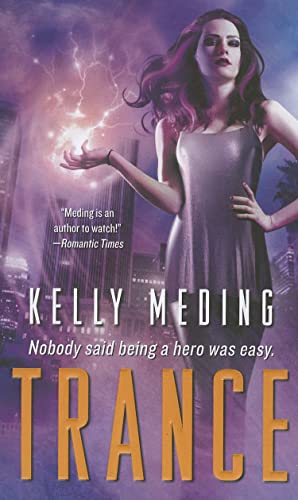
The first novel in Kelly Meding’s thrilling urban fantasy series, where war-ravaged Los Angeles becomes the battleground for an epic Meta human showdown filled with danger, passion, and high-octane action.
Fifteen years ago, Teresa “Trance” West was a talented telepath and proud member of the elite Ranger Corps—heroes who protected the world during the devastating Meta War. But when the Rangers inexplicably lost their powers at the war’s climax, Trance was left powerless, drifting from one dead-end job to another.
Now, her abilities have returned without warning—stronger and stranger than ever—and they’re threatening to destroy her. Determined to understand what happened, Trance heads to Los Angeles to find the surviving Rangers and uncover the truth behind their mysterious resurgence.
But someone in the shadows is hunting them, determined to eliminate the team before they can reunite. As the attacks escalate, Trance and her fellow Rangers must face a sinister enemy who knows their powers better than they do—and who plans to use those powers as his ultimate weapon.
Fast-paced, sexy, and packed with explosive twists, Trance is perfect for fans of superhero fantasy, fierce heroines, and action-driven romance.
Die Inhaltsangabe kann sich auf eine andere Ausgabe dieses Titels beziehen.
Über die Autorin bzw. den Autor
A native of the Delaware seashore, Kelly Meding lives in Maryland, with a neurotic cat that occasionally meows at ghosts. After discovering Freddy Krueger at a very young age, Kelly began a lifelong obsession with horror, science fiction, and fantasy, on which she blames her interest in vampires, psychic powers, superheroes, and all things paranormal. When not writing, she can be found crafting jewelry, enjoying a good cup of coffee, or scouring the Internet for gossip on her favorite television shows.
Auszug. © Genehmigter Nachdruck. Alle Rechte vorbehalten.
Trance
One
Central Park
The bronze man’s head was melting. It oozed fat splats of liquid metal and swirled down the front of his old-fashioned suit jacket to puddle at his feet. Some of it hit the bronze duck below him, adding layers of new metal that mutated it into a nightmarish goose. The molten metal cooled and hardened as it hit the sidewalk. Mayhem’s heat blasts were concentrated above the statue, and metal needs a constant heat source to stay liquid. I learned that in class.
Gage had told me the statue was of a once-famous man who wrote stories for kids. I don’t know for sure, but if Gage says so, it must be true. He’s in charge while the adults are fighting for all of our lives, and he kept us quiet and hidden. For a while.
Until Mayhem found our hiding place.
“We have to run for it,” Gage said.
I didn’t want to run. We’d been running for hours, from the southernmost point of Central Park to where we were now. I don’t know how many blocks, but a lot, and it was raining, too—light, chilly rain and heavy, splattering rain. Sometimes it stopped and just blew cold wind; then Ethan would use his Tempest powers to try to redirect it so we didn’t freeze.
Hours of it, and I was exhausted. We all were. Each time the Banes gained ground and pushed the last of the grown-up Rangers north, we kids ran ahead and took cover. We were there to fight if we had to, but the grown-ups didn’t want us to—not until absolutely necessary. At fifteen, Gage was the oldest; I’m the youngest at ten-almost-eleven. He says we’re the last line of defense for the city of New York.
We’re the last line of defense for the rest of the country.
And we’re just a bunch of kids.
Mayhem kept blasting.
Ethan stepped out from the shelter of the stone wall, all wiry and red-haired and cocky thirteen. He raised his hands to the sky. A blast of wind shot away from him and swirled toward Mayhem. She was a good hundred yards away, across a cement hole that had once been a lake or something, near a statue of a bronze girl on a mushroom. The statue was losing shape, turning into goo from her being so close to it.
Ethan’s air blast slammed Mayhem’s heat back at her. She was wearing street clothes, just jeans and a black shirt, and they were nothing like our special uniforms. No armor to protect Mayhem from her own powers or ours, so she flew backward with a piercing shriek. Her braided black hair flipped around like snakes, and she landed out of sight on the other side of the mushroom.
“Go!” Gage shouted.
Mellie ran first, as fast as she could across the cement ground, toward the nearest clutch of unburned trees. Renee went next, a streak of blue skin and honey-blond hair, with William behind her. He carried Janel, who was unconscious from power overload; William had superstrength so he could run and carry her at the same time, while I could barely run and carry myself.
I followed the big kids, including Marco, who was still in panther form, and fifteen of us streaked across the way, rounding the edge of the cement pit, seeking our next place to hide. Just like we’d done all day. My lungs were burning, aching with smoke and cold and overuse and unshed tears. I just wanted to curl up in a ball and cry myself to sleep. I was sick of being cold. I didn’t want to be afraid anymore. I didn’t want to have to think about tomorrow—if we had a tomorrow.
I was only ten. Almost eleven. I wasn’t ready to die.
None of us was.
Mellie sure wasn’t when one of Mayhem’s heat blasts caught her full in the face and melted her skin down to her bones. Mellie didn’t even get to scream. I screamed plenty. So did Renee and Nate and William. Only panther-Marco paused long enough to sniff her, then loped past.
Ethan cried out, and then he wasn’t running with the group anymore. I didn’t stop to see what happened, but a few seconds later, Mayhem shouted again. This time, the roar of wind was louder. I hoped he tossed her into a tree or something.
We left poor Mellie on the ground and kept going, like we’d left three others behind already. My jelly legs didn’t want to keep running, and one by one the older kids moved ahead of me. Toward the trees and the promise of safety somewhere else. I’d get left behind and it wouldn’t matter. My powers were stupid; I couldn’t help in a fight. My ability to hypnotize people and alter their thoughts worked only if I looked them in the eye. That was hard to do in the middle of a war zone. I hadn’t done anything today but cry and scream and get in the way.
Not like my dad, Hinder, one of the greatest heroes in the Ranger Corps. He was fighting south of us with the last half dozen grown-up Rangers, keeping the horde of Banes (sixty-something of them, Gage had said) from overrunning us. We were kids training to be heroes. If our parents and mentors died, how did anyone expect us to stop them?
We could barely save ourselves from one Bane with a superheat blast. Once the line fell and the Banes got through, sixty-something of them would crush us in seconds.
No, the line couldn’t fall. Not with my dad in charge. He’d save us.
A hand grabbed my arm and yanked me forward. I nearly tripped. Gage didn’t let go as we ran; he was practically pulling me along. It was as close as we’d ever come—or ever would—to holding hands. I’m still a baby and he’s a teenager. He’s just helping me because he’s in charge. He can’t let me lag behind.
We found a wide path. It took us under a stone archway and we emerged onto an open lawn. If it was ever green, it was now brown and rutted and overrun here and there with clumps of dried weeds. A lot of Central Park looked like that now. After New York City’s first major battle in the War, most of the city had been evacuated and a lot of the buildings destroyed. I’d seen it from the helicopter that brought us here this morning—burning, crumbling skyscrapers, gutted old theaters, debris in the empty streets. William had pointed at a tall, skinny building called the Empire or something, and said it used to be twice as tall. I didn’t believe him.
Manhattan was a good place to fight, we were told. Early evacuation meant fewer civilian injuries. One of the major rules of the Ranger Corps code is protect civilians at all costs. Even the dumb ones who stand there and scream, instead of getting out of the way.
I once overheard Gage’s mentor, Delphi, say that any civilian who didn’t get out of the way of battling Metas was too stupid to save. It had made the other adults laugh. I didn’t know why it was funny, and I couldn’t ask her to explain it. I shouldn’t have been listening in the first place. But Delphi was smart, so it had to be important. She’d mentored a lot of kids who didn’t have anyone to teach them about their powers and how to be a Ranger. If I’d been an orphan like Gage, I’d have liked Delphi to be my mentor, too.
No one else attacked us on the lawn, but it was too open. Gage changed our direction, sideways instead of across the lawn. It felt like forever before we hit the cover of trees again. In the distance, peeking through the crisping, late summer leaves, was...
„Über diesen Titel“ kann sich auf eine andere Ausgabe dieses Titels beziehen.
Suchergebnisse für Trance

Beispielbild für diese ISBN
Trance
Verlag:
Pocket Books (edition 0), 2011
ISBN 10: 1451620926
ISBN 13: 9781451620924
Gebraucht
Mass Market Paperback
Anbieter: BooksRun, Philadelphia, PA, USA
Verkäuferbewertung 5 von 5 Sternen

Mass Market Paperback. Zustand: Very Good. 0. It's a well-cared-for item that has seen limited use. The item may show minor signs of wear. All the text is legible, with all pages included. It may have slight markings and/or highlighting. Artikel-Nr. 1451620926-11-1
Gebraucht kaufen
EUR 4,87
Versand gratis
Versand innerhalb von USA
Versand innerhalb von USA
Anzahl: 1 verfügbar
Beispielbild für diese ISBN
Trance
Verlag:
Pocket Books, 2011
ISBN 10: 1451620926
ISBN 13: 9781451620924
Gebraucht
Mass Market Paperback
Anbieter: ThriftBooks-Atlanta, AUSTELL, GA, USA
Verkäuferbewertung 5 von 5 Sternen
Mass Market Paperback. Zustand: Good. No Jacket. Former library book; Pages can have notes/highlighting. Spine may show signs of wear. ~ ThriftBooks: Read More, Spend Less. Artikel-Nr. G1451620926I3N10
Gebraucht kaufen
EUR 6,22
Versand gratis
Versand innerhalb von USA
Versand innerhalb von USA
Anzahl: 1 verfügbar
Beispielbild für diese ISBN
Trance
Anbieter: Wonder Book, Frederick, MD, USA
Verkäuferbewertung 5 von 5 Sternen
Zustand: Very Good. Very Good condition. A copy that may have a few cosmetic defects. May also contain light spine creasing or a few markings such as an owner's name, short gifter's inscription or light stamp. Artikel-Nr. F16B-02680
Gebraucht kaufen
EUR 6,36
Versand gratis
Versand innerhalb von USA
Versand innerhalb von USA
Anzahl: 1 verfügbar
Beispielbild für diese ISBN
Trance
Anbieter: Better World Books: West, Reno, NV, USA
Verkäuferbewertung 5 von 5 Sternen
Zustand: Good. 0th Edition. Former library copy. Pages intact with minimal writing/highlighting. The binding may be loose and creased. Dust jackets/supplements are not included. Includes library markings. Stock photo provided. Product includes identifying sticker. Better World Books: Buy Books. Do Good. Artikel-Nr. GRP97710552
Gebraucht kaufen
EUR 8,25
Versand gratis
Versand innerhalb von USA
Versand innerhalb von USA
Anzahl: 1 verfügbar
Beispielbild für diese ISBN
Trance
Verlag:
Pocket Books, 2011
ISBN 10: 1451620926
ISBN 13: 9781451620924
Gebraucht
Mass Market Paperback
Anbieter: Robinson Street Books, IOBA, Binghamton, NY, USA
Verkäuferbewertung 4 von 5 Sternen

Mass Market Paperback. Zustand: Very Good. Prompt Shipment, shipped in Boxes, Tracking PROVIDEDVery good used mass market paperback. Some creasing. Artikel-Nr. above83mm068
Gebraucht kaufen
EUR 12,28
EUR 8,39 Versand
Versand innerhalb von USA
Versand innerhalb von USA
Anzahl: 1 verfügbar