
Verwandte Artikel zu Great Projects: The Epic Story of the Building of America,...
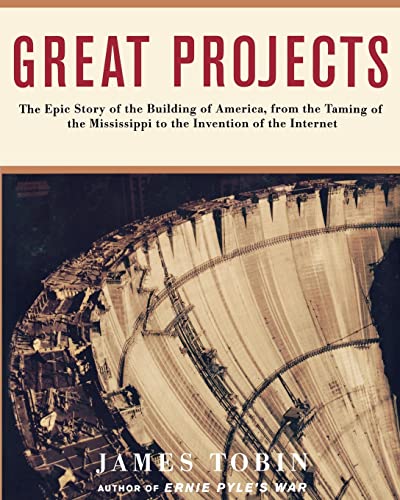
Great Projects: The Epic Story of the Building of America, from the Taming of the Mississippi to the Invention of the Internet - Softcover
Inhaltsangabe
Since the earliest days of the republic, great engineering projects have shaped American landscapes and expressed American dreams. The ambition to build lies as close to the nation's heart as the belief in liberty. We live in a built civilization, connected one to another in an enormous web of technology. Yet we have all too often overlooked the role of engineers and builders in American history. With glorious photographs and epic narrative sweep, Great Projects at last gives their story the prominence it deserves. Each of the eight projects featured in this masterful narrative was a milestone in its own right: the flood-control works of the lower Mississippi, Hoover Dam, Edison's lighting system, the spread of electricity across the nation, the great Croton Aqueduct, the bridges of New York City, Boston's revamped street system, known as the Big Dig, and the ever-evolving communications network called the Internet. Each project arose from a heroic vision. Each encountered obstacles. Each reveals a tale of genius and perseverance. James Tobin, winner of a National Book Critics Circle Award, explains the four essential tasks of the engineer: to protect people from the destructive force of water while harnessing it for the enormous good it can do; to provide people with electricity, the motive force of modern life; to make great cities habitable and vital; and to create the pathways that connect place to place and person to person. Tobin focuses on the individuals behind our greatest structures of earth and concrete and steel: James Buchanan Eads, who walked on the floor of the Mississippi to learn the river's secrets; Arthur Powell Davis and Frank Crowe, who imagined a dam that could transform the West; Thomas Edison, who envisioned a new way to light the world; Samuel Insull, the organizational mastermind of the electrical revolution; the long-forgotten John Bloomfield Jervis, who assured New York's future
Die Inhaltsangabe kann sich auf eine andere Ausgabe dieses Titels beziehen.
Über die Autorin bzw. den Autor
James Tobin won the National Book Critics Circle Award for his first book, Ernie Pyle's War, and the J. Anthony Lukas Work-in-Progress Award for his forthcoming biography of the Wright Brothers. He lives in Ann Arbor, Michigan.
Auszug. © Genehmigter Nachdruck. Alle Rechte vorbehalten.
Chapter One: The Lower Mississippi
...[T]en thousand River Commissions...cannot tame that lawless stream...cannot say to it, "Go here," or "Go there," and make it obey.
- Mark Twain
...[E]very atom that moves onward in the river...is controlled by laws as fixed and certain as those which direct the majestic march of the heavenly spheres....The engineer needs only to be assured that he does not ignore the existence of any of these laws, to feel positively certain of the result he aims at.
- James Buchanan Eads
The river man watched as thunderheads blew in from the west, throwing the valley of the Ohio in purple shade. Soon rain fell. Now after months of drought the river would rise, and Henry Shreve could go down the great Ohio to the greater river in the West, and begin the job no one thought he could do.
He was forty-four in the summer of 1829, thick in the shoulders and upper arms from his early years of excruciating labor, but thickening at the belt now, too. His brown hair was wavy, his eyes gray. He was given to long contemplative silences interspersed with bursts of creative energy. Shreve had first seen the Mississippi as a boy, in 1799. By that year Americans west of the Alleghenies were already sending prodigious amounts of farm produce, whiskey, and furs down the river to New Orleans by raft, barge, and keelboat. Gravity supplied all the power needed for the downstream trip. But to go upstream, crews had no choice but to pull and push the boats themselves. Tapping the potential of the inner continent demanded that someone figure a way to drive boats up the river as well as down.
Then in 1816 Henry Shreve designed a river-worthy steamboat and proved it could beat the current. That craft, with its shallow draft and high-built decks, revolutionized western transportation and made Shreve's name famous. He married happily, built and ran more steamboats, made money.
Yet for nearly ten years he devoted much of his time and considerable mental powers to an engineering problem that nearly all the river men of his generation believed insoluble. Why would he undertake this new errand in the wilderness -- a fool's errand, nearly everyone said, even for a man of Shreve's achievements?
Shreve left no record of his deepest motives. But surely he was driven by the same westward imperative that had driven his father, a veteran of Valley Forge, to carve a wilderness farm from the Allegheny forest, and his older half-brother to seek his fortune on the western rivers. The revolutionary generation had made the new land their own. Now Shreve's generation would pry the land open to extract the prizes that lay within, and they quickly learned that the richest prizes lay in the valley of the Mississippi River. There they found agricultural land as fine as any in the world and a waterway that connected the nation's midsection with the ocean trade routes. But using the river for transport would not be easy. And the job of claiming and safeguarding the land -- and the works of civilization they built on it -- would be harder still. For of all the natural adversaries greeting Americans on the new continent, the lower Mississippi River was the most dangerous and the least tractable.
"TEETH OF THE RIVER"
Long before Henry Shreve first boarded a flatboat, his countrymen realized the Mississippi and its tributaries comprised one of the world's great systems of navigable water. The main stream is really two rivers -- the upper Mississippi, which flows from snow-choked headwaters near Canada to the center of the continent; and the broader, more baffling lower Mississippi, which carries the waters of the upper river, the Missouri, and the Ohio to the sultry salt marshes of the Gulf of Mexico. Together, the Mississippi and all its tributaries form a fifteen-thousand-mile web of waterways stretching from present-day New York to Montana, through nearly half the lands of the continental forty-eight states. Its shallow valley is so broad, a traveler once said, that "a native tribe from its eastern rim of the Alleghenies might spend a generation migrating through it before sighting the Rockies that walled it on the west."
The river came to be called "Father of Waters," but in geological age it was barely a toddler, and a defiant one at that.
It sprang into being as the glaciers of the last Ice Age lumbered northward, trailing swampy streams that became the Ohio, the Missouri, and a hundred others. Where these streams joined and ran south to the ocean, they dug a groove through the soft slab of clay and sand that became the American South. Every year, every droplet of spring rain that fell upon much of the continent ran downhill in the direction of that groove -- the Mississippi's riverbed -- each rill carrying a microscopic load of organic material and sand. Coursing southward, the water scoured more soft earth from the banks and bottom and whisked it along. Below the points where the Missouri and Ohio joined the master stream, uncounted tons of dirt swirled in the water like muddy clouds. (Farmers would say it was too thick to drink and too thin to farm.) The water and its burden of sediment determined the river's ever-shifting geography, and the geography challenged the ingenuity of the Americans who settled on the banks.
They soon learned that the river, like a creature of myth, possessed the power to change its shape, and did so again and again. Wherever the current slows, especially on the inside curve of a bend, sediment falls to the bottom. There a sandbar forms. The bar nudges the oncoming current toward the opposite bank. That bank crumbles under the current's pressure, sending more sediment downstream, where it collects elsewhere as a new sandbar. Mile after mile, century after century, the river undulates in a crazy squiggle of curves and horseshoes.
This process of geological transformation handed Henry Shreve his great challenge. In his era the trees of the original North American forest still stood guard up and down the Mississippi. Wherever the current assaulted the banks, these old giants lost their footing, slid into the river, and floated downstream as dangerous snags. Some blundered into sandbars or islands, catching other snags and blocking the watercourse. Some wandered free, their bobbing limbs beckoning to rivermen in slow, sinister gestures of invitation. (These were called "sawyers," for the way they appeared to saw the surface.) The deadliest snags were called planters -- trees whose roots caught in the silt floor and stuck fast. More silt would pile against the roots, embedding the tree, its shaft pointing to the surface like a battering ram. When a steamboat struck a planter, the murderous effects were instantaneous -- "a sudden wrench, the rush of sucking water, a clanging of bells, terrified screams, and the current would sweep over another tragedy."
The snags had been falling into the Mississippi since the Mississippi began. The early French settlers at New Orleans had called them chicots -- "teeth of the river." By the 1820s, American surveyors counted 50,000 of them. And those were only the ones they could see. As steam traffic mounted, so did the damage and loss of life. Fear of snags slowed commerce. Military men, including Generals Andrew Jackson and William Henry Harrison, said snags impeded their mobility in the War of 1812 and the Indian campaigns. Pleas for federal action rose. In the summer of 1818, the influential Niles' Register reported: "Three steam boats have been lost in five months...in consequence of running foul of great trunks of trees....Will not the increased navigation of this mighty stream soon justify an attempt to clear it of such serious incumbrances -- or is it practicable to do it?"
That was the question: Did any effort to clear the...
„Über diesen Titel“ kann sich auf eine andere Ausgabe dieses Titels beziehen.
Suchergebnisse für Great Projects: The Epic Story of the Building of America,...

Beispielbild für diese ISBN
Great Projects: The Epic Story of the Building of America, from th
Anbieter: California Books, Miami, FL, USA
Verkäuferbewertung 5 von 5 Sternen

Zustand: New. Artikel-Nr. I-9781451613018
Neu kaufen
EUR 28,66
EUR 2,69 Versand
Versand innerhalb von USA
Versand innerhalb von USA
Anzahl: Mehr als 20 verfügbar
Foto des Verkäufers
Great Projects : The Epic Story of the Building of America, from the Taming of the Mississippi to the Invention of the Internet
Anbieter: GreatBookPricesUK, Woodford Green, Vereinigtes Königreich
Verkäuferbewertung 5 von 5 Sternen
Zustand: As New. Unread book in perfect condition. Artikel-Nr. 9945995
Gebraucht kaufen
EUR 34,47
EUR 17,98 Versand
Versand von Vereinigtes Königreich nach USA
Versand von Vereinigtes Königreich nach USA
Anzahl: Mehr als 20 verfügbar
Beispielbild für diese ISBN
Great Projects: The Epic Story of the Building of America, from the Taming of the Mississippi to the Invention of the Internet
Anbieter: Revaluation Books, Exeter, Vereinigtes Königreich
Verkäuferbewertung 5 von 5 Sternen
Paperback. Zustand: Brand New. reprint edition. 322 pages. 10.00x8.00x1.00 inches. In Stock. Artikel-Nr. x-1451613016
Neu kaufen
EUR 39,29
EUR 14,98 Versand
Versand von Vereinigtes Königreich nach USA
Versand von Vereinigtes Königreich nach USA
Anzahl: 2 verfügbar
Foto des Verkäufers
Great Projects : The Epic Story of the Building of America, from the Taming of the Mississippi to the Invention of the Internet
Anbieter: GreatBookPricesUK, Woodford Green, Vereinigtes Königreich
Verkäuferbewertung 5 von 5 Sternen
Zustand: New. Artikel-Nr. 9945995-n
Neu kaufen
EUR 38,83
EUR 17,98 Versand
Versand von Vereinigtes Königreich nach USA
Versand von Vereinigtes Königreich nach USA
Anzahl: Mehr als 20 verfügbar