
Verwandte Artikel zu Badge of the Assassin
Inhaltsangabe
A blood-chilling true-crime account from former district attorney and New York Times bestselling author Robert K. Tanenbaum
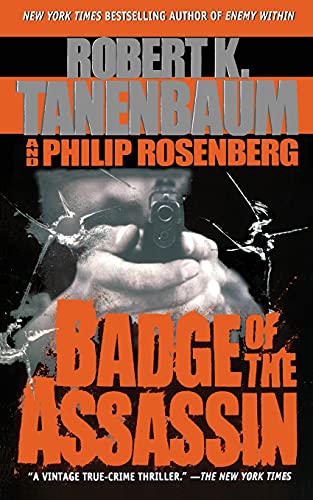
BADGE OF THE ASSASSIN
They were just doing their jobs -- serving and protecting -- when the unimaginable happened: Officers Waverly Jones and Joseph Piagentini became moving targets, ambushed from behind at a Manhattan housing project. Jones lay dead in a pool of his own blood, and Piagentini lived long enough to beg for his life -- before he was riddled with twenty-two bullet holes by members of a deadly hit squad hell-bent on taking out the men and women of law enforcement.
Masterfully building suspense on every page, Robert K. Tanenbaum reconstructs the vicious murders of Jones and Piagentini and the manhunt for the suspects, and brings to life his courtroom prosecution of the killers -- revealing the triumphs and failures of America's legal system.
Die Inhaltsangabe kann sich auf eine andere Ausgabe dieses Titels beziehen.
Über die Autorin bzw. den Autor
Robert K. Tanenbaum is the author of over thirty books and os one of the most successful prosecuting attorneys, having never lost a felony trial and convicting hundreds of violent criminals. He was a special prosecution consultant on the Hillside strangler case in Los Angeles and defended Amy Grossberg in her sensationalized baby death case. He was Assistant District Attorney in New York County in the office of legendary District Attorney Frank Hogan, where he ran the Homicide Bureau, served as Chief of the Criminal Courts, and was in charge of the DA’s legal staff training program. He served as Deputy Chief counsel for the Congressional Committee investigation into the assassinations of President John F. Kennedy and the Rev. Dr. Martin Luther King, Jr. He also served two terms as mayor of Beverly Hills and taught Advanced Criminal Procedure for four years at Boalt Hall School of Law, University of California, Berkeley, and has conducted continuing legal education (CLE) seminars for practicing lawyers in California, New York, and Pennsylvania. Born in Brooklyn, New York, Tanenbaum attended the University of California at Berkeley on a basketball scholarship, where he earned a BA. He received his law degree (JD) from Boalt Hall School of Law at the University of California, Berkeley. Visit RobertKTanenbaumBooks.com.
Auszug. © Genehmigter Nachdruck. Alle Rechte vorbehalten.
Chapter One
North of the Triborough Bridge, the Harlem River slices sharply to the northwest, narrowing Manhattan Island down to a tadpole tail of land. At 142nd Street, Fifth Avenue, the dividing line between the East Side and the West Side, runs up against the river and comes to a stop. Lenox Avenue, which is Harlem's name for Sixth, extends northward as far as 147th, and then it, too, runs out of land. Seventh lasts all the way to 154th, just one block short of the Macombs Dam Bridge, which leads across the river to the Bronx and Yankee Stadium.
From the air, the triangle of land bordered on the south by 155th Street, on the west by the sheer cliff known as Coogan's Bluff, and on the east by the Harlem River doesn't look like it belongs to New York. Beyond it, to the south and west, one can see the huddled tenements of Harlem pressed to each other like subway riders in the morning. But in the triangle itself, known generally as the Colonial Park district, the tenements have long since been leveled, to be replaced by two distinct sets of ungainly X-shaped apartment towers.
The southernmost set of towers consists of four thirty-story apartments that from above look like mammoth jacks left lying on the ground by the children of giants. And well they might, for the land they stand on was once the home of Giants. The Polo Grounds used to be here, and now someone's living room covers the spot where Eddie Stanky rode from third to home on Leo Durocher's back after Bobby Thomson's home run in the '51 playoff.
Just north of the Polo Grounds Project stand seven identical twelve-story towers and a larger eighth one that is really just two of the smaller buildings run together. Although the grounds have been attractively landscaped with hedges, grass, trees, and wide walkways, nothing can disguise the fact that the Colonial Park Houses, as these eight towers are collectively called, are low-income housing. In an effort to pass them off as something else, the architects hoped to create a parklike atmosphere by facing the main entrances of all the buildings inward, so that the project is self-contained, its back turned on Harlem. But Harlem cannot be so easily thrust aside. Like an unpleasant thought the mind tries to reject, it has a way of reasserting itself. Psychoanalysts call this phenomenon the return of the repressed, but the cops in the Thirty-second Precinct had a simpler way of putting it. In Colonial Park, they said, you watched your ass.
Richard Hill had fought in Vietnam and should have known the sound of gunfire when he heard it. But on a spring night twelve thousand miles from where he had done his fighting, the sudden noise caught him off guard and he assumed the explosions were firecrackers. It took a moment for him to realize he was once again on a battlefield. When he did, he reacted like a soldier.
As he passed between buildings 159-14 and 159-20, he glanced to his left, the direction from which the sound of the firecrackers had come. But there were no children playing in the area, no signs of life at all. There was just, on the sidewalk near the bushes, sixty to seventy feet in front of him, a clump of discarded clothes.
Then the clothing moved, shifting on the ground as though there were something alive in it. He watched for a few seconds, until he was certain he had seen it move, then walked toward it, quickening his pace as he drew closer. When he had cut the distance in half he began to hear a terrible moaning, like an animal in pain, like the wind keening through high trees. By this time he was running.
The thought flashed through his mind that there were snipers on one of the roofs. An instinct bred in distant jungles took over and he darted for cover, then raised his head and scanned the rooftops. He saw nothing. In an infantryman's crawl, he inched toward the fallen man, alert for any glint from above that would be the only warning he would get of the sniper's presence.
As he rounded the corner of the walkway, he saw a second body, actually closer to him than the one he had seen before. He crawled to it, saw it was a cop and that the back of his head was missing. He looked for the cop's gun but it wasn't there. He knew he was safe, for a sniper couldn't have taken the gun, so he ran toward the other cop. The walkie-talkie one of them had been carrying lay on the ground between them. Hill grabbed for it, punched at the button that would make it work, and shouted an alarm. "May Day! May Day! Two cops shot!" he called. Then he dropped the box and ran to the second patrolman, the one whose cries he had been hearing all along.
Joseph Piagentini was still moving, still trying to crawl to the clump of bushes at the edge of the sidewalk. He didn't know the shooting had stopped.
Hector Grace, a beer-bellied, forty-five-year-old gypsy-cab driver, had taken his wife out for dinner before going on the night shift. He dropped her off in the back of the project and waited in the cab for a light to go on in the apartment window, their signal that she was safely inside.
He heard shots and saw, not far from where his wife had just walked, the flashes of gunshots, a quick bright series of flares in the near darkness. He saw two cops go down, then two men running along the sidewalk toward him, pistols in their hands.
He didn't follow them with his eyes once they were beyond his cab, didn't even wait for the light to come on in his living-room window. He gunned the engine and raced from the project, squealing the tires in a hard right onto Eighth Avenue. He was looking for a cop, heading south toward the precinct house but praying he would find a patrol car sooner than later.
He was in luck. At 145th and Eighth he spotted a green-and-white cruiser, pulled up beside it, and told the officer what he had seen and heard. The siren flashed on even as the cruiser was screeching into the U-turn that would take it back uptown to Colonial Park.
Mike Warnecke reached for the radio to report the call. "Jesus, that's our sector," his partner Bob Alvino muttered under his breath, in the back of his mind the realization already taking shape that but for a chance call that had drawn them from their sector only minutes before, it would have been he and Mike lying in their own blood on the sidewalk.
"They was sitting on that car," someone shouted from the crowd of thirty or forty curious and angry blacks clustered behind the barricade of sawhorses and ropes that had been set up to quarantine the crime scene.
Bill Butler, the blond, thick-bodied thirty-one-year-old detective who had just caught what was going to be the longest and most difficult case of his career, scanned the crowd, knowing that somewhere in it was a witness. For an instant he thought of holding them all, questioning them until they produced the man who called out that he had seen the killers sitting on the white Mustang. But Butler had been in the Thirty-second Precinct long enough to know it wouldn't work. Pressure from the police would only deepen the silence. So he turned his back on the crowd, ordered a nearby patrolman to secure the Mustang, then stood at parade rest, waiting. Behind him, voices in the crowd whispered hoarsely but offered him nothing more.
f0 An Emergency Services crew arrived with its generator truck and began stringing the high-powered lights that would illuminate the parking area like a fairground. While fifteen or twenty detectives circulated through the crowd, prowling the lawns, shrubs, and walkways in search of evidence, at least as many uniformed men began canvassing the project for potential witnesses. Kneeling on the ground, a detective from Forensic was tracing outlines on the sidewalk where the bodies had been found. He drew a circle for Waverly Jones' head, a long ellipse for his body, then wrote the name jones in large square...
„Über diesen Titel“ kann sich auf eine andere Ausgabe dieses Titels beziehen.
Suchergebnisse für Badge of the Assassin

Beispielbild für diese ISBN
Badge of the Assassin
Anbieter: World of Books (was SecondSale), Montgomery, IL, USA
Verkäuferbewertung 5 von 5 Sternen

Zustand: Good. Item in good condition. Textbooks may not include supplemental items i.e. CDs, access codes etc. Artikel-Nr. 00091883189
Gebraucht kaufen
EUR 3,96
Versand gratis
Versand innerhalb von USA
Versand innerhalb von USA
Anzahl: 1 verfügbar
Beispielbild für diese ISBN
Badge of the Assassin
Anbieter: Better World Books, Mishawaka, IN, USA
Verkäuferbewertung 5 von 5 Sternen
Zustand: Very Good. Former library copy. Pages intact with possible writing/highlighting. Binding strong with minor wear. Dust jackets/supplements may not be included. Includes library markings. Stock photo provided. Product includes identifying sticker. Better World Books: Buy Books. Do Good. Artikel-Nr. 49823066-6
Gebraucht kaufen
EUR 6,04
Versand gratis
Versand innerhalb von USA
Versand innerhalb von USA
Anzahl: 1 verfügbar
Beispielbild für diese ISBN
Badge of the Assassin
Anbieter: Revaluation Books, Exeter, Vereinigtes Königreich
Verkäuferbewertung 5 von 5 Sternen
Paperback. Zustand: Brand New. reprint edition. 464 pages. 8.00x5.00x1.50 inches. In Stock. Artikel-Nr. x-1451607466
Neu kaufen
EUR 32,07
EUR 14,58 Versand
Versand von Vereinigtes Königreich nach USA
Versand von Vereinigtes Königreich nach USA
Anzahl: 2 verfügbar
Foto des Verkäufers
Badge of the Assassin
Anbieter: AHA-BUCH GmbH, Einbeck, Deutschland
Verkäuferbewertung 5 von 5 Sternen
Taschenbuch. Zustand: Neu. Neuware - They were just doing their jobs -- serving and protecting -- when the unimaginable happened: Officers Waverly Jones and Joseph Piagentini became moving targets, ambushed from behind at a Manhattan housing project. Jones lay dead in a pool of his own blood, and Piagentini lived long enough to beg for his life -- before he was riddled with twenty-two bullet holes by members of a deadly hit squad hell-bent on taking out the men and women of law enforcement.Masterfully building suspense on every page, Robert K. Tanenbaum reconstructs the vicious murders of Jones and Piagentini and the manhunt for the suspects, and brings to life his courtroom prosecution of the killers -- revealing the triumphs and failures of America's legal system. Artikel-Nr. 9781451607468
Neu kaufen
EUR 42,91
EUR 30,50 Versand
Versand von Deutschland nach USA
Versand von Deutschland nach USA
Anzahl: 2 verfügbar
Foto des Verkäufers
Badge of the Assassin
Anbieter: moluna, Greven, Deutschland
Verkäuferbewertung 5 von 5 Sternen
Zustand: New. Über den AutorRobert K. Tanenbaum is the author of thirty-two books&mdashtwenty-nine novels and three nonfiction books: Badge of the Assassin, the true account of his investigation and trials of self-proclaimed members of th. Artikel-Nr. 4187319
Neu kaufen
EUR 33,40
EUR 48,99 Versand
Versand von Deutschland nach USA
Versand von Deutschland nach USA
Anzahl: Mehr als 20 verfügbar