
Verwandte Artikel zu Emotional Equations: Simple Steps for Creating Happiness...
Inhaltsangabe
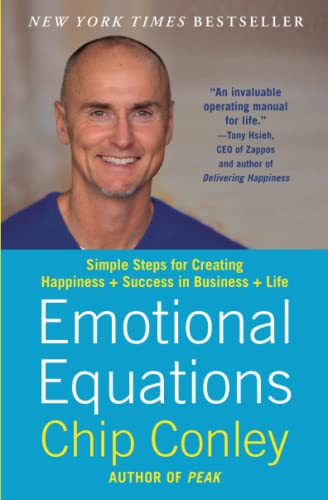
“An invaluable operating manual,” says Tony Hsieh, Zappos CEO and author of Delivering Happiness. Using brilliantly simple logic that illuminates the universal truths in common emotional challenges, popular motivational speaker and bestselling author Chip Conley has written “a fresh, original guide to an authentic and fulfilling life.”*
With a foreword by Tony Hsieh, CEO of Zappos and author of Delivering Happiness
When Chip Conley, dynamic author of the bestselling Peak, suffered a series of devastating personal and professional setbacks, he began using what he came to call “Emotional Equations” (such as Joy = Love - Fear) to help him focus on the variables in life that he could handle, rather than dwelling on the parts he couldn’t, such as the bad economy, death, and taxes.
Using brilliantly simple logic that illuminates the universal truths in common emotional challenges, Emotional Equations offers a way to identify the elements in our lives that we can change, those we can’t, and how to better understand our emotions so they can help us . . . rather than hurt us. Equations like “Despair = Suffering - Meaning” and “Happiness = Wanting What You Have ÷ Having What You Want” have been reviewed for mathematical and psychological accuracy by experts. Now Conley tells his own comeback story and those of other resilient people and inspiring role models who have worked through emotional equations in their own lives. Emotional Equations arms you with practical strategies for turbulent times.
Die Inhaltsangabe kann sich auf eine andere Ausgabe dieses Titels beziehen.
Über die Autorin bzw. den Autor
Veteran CEO Chip Conley has created more boutique hotels than anyone in the world. Founder of Joie de Vivre Hospitality, which he grew into America’s second largest boutique hotel company, he speaks around the world on how to find meaning at the intersection of business and psychology. The author of several books, including Peak: How Great Companies Get Their Mojo from Maslow, he was named the Most Innovative CEO in the San Francisco Bay Area, which he calls home. For more information, visit EmotionalEquations.com and ChipConley.com.
Auszug. © Genehmigter Nachdruck. Alle Rechte vorbehalten.
Emotional Equations
1
![image]()
On August 19, 2008, my heart stopped. Just minutes after my business presentation on stage, I passed out. Flatline. My memories of that day are opaque, but I can still see the image that was swirling around my brain as I came to in the emergency room: thick, sweet, fragrant oil slowly dripping down a set of dark wooden stairs. My version of “seeing the light,” this was the ultimate wake-up call for me. The doctors could find no medical explanation for my heart failure.
Over the preceding few years, a series of wake-up waves culminating in my heart failure had hit me like an emotional tsunami and tested my sense of who I thought I was: a business I had built was sinking; a family member had been wrongly convicted of a crime and sentenced to San Quentin State Prison; a long-term relationship had ended painfully; and I had lost five friends and colleagues to suicide.
I know I’m not alone in experiencing these tragedies and setbacks. Many people have felt either out of control or stuck in an emotional logjam. At times, our emotions are crystal clear; we know what we’re feeling and how to respond. At other times, we need guidance. And my heart failure, besides being a medical emergency, was also an emotional emergency. I felt as if I were treading water, gasping for air, my emotions acting like enemies instead of intuitive allies.
I had tried my best to put on a good “game face,” because we CEOs like to portray a strong, steady image to everyone and a lot of people were relying on me. After all, my company is called Joie de Vivre (French for “joy of life”), so dour didn’t really fit the profile. I’d started the company in 1987 and grown it to more than three thousand employees, the largest group of independent boutique hotels in the state of California, and had been adept at creating healthy “psycho-hygiene” at the company. I’d also written Peak: How Great Companies Get Their Mojo from Maslow about adapting for the workplace the theory of motivation created by the psychologist Abraham Maslow.
During the momentous days of the decade’s first economic downturn, this mixing of psychology and business had let Joie de Vivre defy the general trend and nearly triple in size. It had also led me to lecture all over the world on how to become self-actualized—to become everything we’re capable of becoming at work.
When the second economic downturn hit in 2008, however, I retreated to my home—once my sanctuary but now a place filled with beautiful things and ugly thoughts. I would take off my game face and wallow in an emotional darkroom where all my negatives were developing. I had a certain emotional awareness about what was going on inside me but little means to make sense of it, let alone find meaning in it. I felt almost paralyzed by a psychological fog.
As I was waiting for some revelation, one of my good friends, Chip Hankins, took his own life. He was my best “Chip” friend in the world and my insurance broker for more than a decade—a force of nature whom I deeply admired and, at times, emulated. We had more in common than just our names: we were both publicly extroverted but had an introverted, melancholy side as well; we both went for long periods of sobriety, even though we both owned bars. And we were both spiritual seekers who enjoyed throwing a frivolous party; we’d been planning to throw a “Chip” party someday to which we’d invite Chips from around the world to share stories of “The World According to Chip.”
Instead, there I was at Chip’s memorial service, where I listened to person after person get up and tell “Chip stories.” It was surreal. The truth is, up to this moment, my mind had occasionally veered toward images of my own demise—by car crash or cancer—something dramatic that might help me escape from the mess of emotions my life had become. Clearly, I needed to push the reset button on my mind, and my life, and make some fundamental changes. The terror and despair I felt over this profound loss gradually gave way to a renewed sense that I could remake my experience here on Earth and a budding gratitude that I would have that opportunity even though others would not.
During that time, as four other friends also chose death over life, I learned more about the nature of emotional depression and suicide. Nearly a million people try to commit suicide annually in America; about 5 percent of them “succeed.” Men are four times as likely to commit suicide as women, and suicide attempts by middle-aged people have spiked during the economic downturn (all five of my friends were men in their forties).
Shining the light on these sobering statistics gave me the incentive to look for a healthy way to make sense of my emotions.
SEARCHING FOR AN EMOTIONAL ANSWER
I was compelled to revisit a book I’d read years before, the psychologist Viktor Frankl’s landmark memoir Man’s Search for Meaning. Dr. Frankl’s book was a spiritual salve for me. I figured that if this man could withstand the agony of a Nazi concentration camp, I could probably deal with the challenges in my own life. I was acutely aware that my company needed a new solution to its problems, but I was more focused on turning around my own life. Maybe if I could do that, a company turnaround would follow.
I would recount the story of Man’s Search for Meaning to friends and colleagues, yet most couldn’t understand why I was so fascinated with it. In spite of their blank stares, I kept reading Frankl’s book and began to distill its wisdom down to one simple equation:
In other words, despair is what results when suffering has no meaning. In a recession (or, in Frankl’s case, in prison), suffering is virtually a constant, so it’s best to place your attention on growing your sense of meaning in order to decrease your feeling of despair.
This little mental rule of thumb or mantra became my lighthouse. Throughout the day, especially when I was feeling particularly tested, I would quietly recite this equation to myself as a reminder not to get caught up in the suffering and instead to place my attention on what I was supposed to learn. Because the worldwide hospitality industry was hit particularly hard by the Great Recession, the leaders of Joie de Vivre (JdV) were living lives of “quiet desperation”—in some cases, not so quiet. One day, as I facilitated a leadership series for senior managers, knowing that they were suffering, I decided to discuss my own vulnerability and worries and introduced my “Meaning” equation to the group. The managers really responded to it—they started texting and tweeting it to their staff, and, next thing I knew, they’d asked me to teach a whole class on Emotional Equations. To this day, I teach employees at JdV how to use Emotional Equations to create insight and perspective as well as happiness and success. Here are a few of the most popular:
Though most people today aren’t locked in a concentration camp or acting as CEOs of companies in distress, many people are prisoners of their own minds. So in this book I ask you, “What’s your prison?” and I offer you some keys to unlock the door. Frankl’s...
„Über diesen Titel“ kann sich auf eine andere Ausgabe dieses Titels beziehen.
Suchergebnisse für Emotional Equations: Simple Steps for Creating Happiness...

Beispielbild für diese ISBN
Emotional Equations: Simple Steps for Creating Happiness + Success in Business + Life
Anbieter: World of Books (was SecondSale), Montgomery, IL, USA
Verkäuferbewertung 5 von 5 Sternen

Paperback. Zustand: Very Good. An invaluable operating manual, says Tony Hsieh, Zappos CEO and author of Delivering Happiness. Using brilliantly simple logic that illuminates the universal truths in common emotional challenges, popular motivational speaker and bestselling author Chip Conley has written a fresh, original guide to an authentic and fulfilling life.* With a foreword by Tony Hsieh, CEO of Zappos and author of Delivering Happiness When Chip Conley, dynamic author of the bestselling Peak, suffered a series of devastating personal and professional setbacks, he began using what he came to call Emotional Equations (such as Joy = Love - Fear) to help him focus on the variables in life that he could handle, rather than dwelling on the parts he couldn't, such as the bad economy, death, and taxes. Using brilliantly simple logic that illuminates the universal truths in common emotional challenges, Emotional Equations offers a way to identify the elements in our lives that we can change, those we can't, and how to better understand our emotions so they can help us . . . rather than hurt us. Equations like Despair = Suffering - Meaning and Happiness = Wanting What You Have Having What You Want have been reviewed for mathematical and psychological accuracy by experts. Now Conley tells his own comeback story and those of other resilient people and inspiring role models who have worked through emotional equations in their own lives. Emotional Equations arms you with practical strategies for turbulent times. Artikel-Nr. 00108773904
Gebraucht kaufen
EUR 3,99
Versand gratis
Versand innerhalb von USA
Versand innerhalb von USA
Anzahl: 1 verfügbar
Beispielbild für diese ISBN
Emotional Equations: Simple Steps for Creating Happiness + Success in Business + Life
Anbieter: World of Books (was SecondSale), Montgomery, IL, USA
Verkäuferbewertung 5 von 5 Sternen
Paperback. Zustand: Good. An invaluable operating manual, says Tony Hsieh, Zappos CEO and author of Delivering Happiness. Using brilliantly simple logic that illuminates the universal truths in common emotional challenges, popular motivational speaker and bestselling author Chip Conley has written a fresh, original guide to an authentic and fulfilling life.* With a foreword by Tony Hsieh, CEO of Zappos and author of Delivering Happiness When Chip Conley, dynamic author of the bestselling Peak, suffered a series of devastating personal and professional setbacks, he began using what he came to call Emotional Equations (such as Joy = Love - Fear) to help him focus on the variables in life that he could handle, rather than dwelling on the parts he couldn't, such as the bad economy, death, and taxes. Using brilliantly simple logic that illuminates the universal truths in common emotional challenges, Emotional Equations offers a way to identify the elements in our lives that we can change, those we can't, and how to better understand our emotions so they can help us . . . rather than hurt us. Equations like Despair = Suffering - Meaning and Happiness = Wanting What You Have Having What You Want have been reviewed for mathematical and psychological accuracy by experts. Now Conley tells his own comeback story and those of other resilient people and inspiring role models who have worked through emotional equations in their own lives. Emotional Equations arms you with practical strategies for turbulent times. Artikel-Nr. 00093460136
Gebraucht kaufen
EUR 3,99
Versand gratis
Versand innerhalb von USA
Versand innerhalb von USA
Anzahl: 5 verfügbar
Beispielbild für diese ISBN
Emotional Equations : Simple Steps for Creating Happiness + Success in Business + Life
Anbieter: Better World Books, Mishawaka, IN, USA
Verkäuferbewertung 5 von 5 Sternen
Zustand: Very Good. Pages intact with possible writing/highlighting. Binding strong with minor wear. Dust jackets/supplements may not be included. Stock photo provided. Product includes identifying sticker. Better World Books: Buy Books. Do Good. Artikel-Nr. 5258764-6
Gebraucht kaufen
EUR 6,09
Versand gratis
Versand innerhalb von USA
Versand innerhalb von USA
Anzahl: 1 verfügbar
Beispielbild für diese ISBN
Emotional Equations : Simple Steps for Creating Happiness + Success in Business + Life
Anbieter: Better World Books, Mishawaka, IN, USA
Verkäuferbewertung 5 von 5 Sternen
Zustand: Good. Pages intact with minimal writing/highlighting. The binding may be loose and creased. Dust jackets/supplements are not included. Stock photo provided. Product includes identifying sticker. Better World Books: Buy Books. Do Good. Artikel-Nr. 5689713-6
Gebraucht kaufen
EUR 6,09
Versand gratis
Versand innerhalb von USA
Versand innerhalb von USA
Anzahl: 1 verfügbar
Beispielbild für diese ISBN
Emotional Equations: Simple Steps for Creating Happiness + Success in Business + Life
Anbieter: Wonder Book, Frederick, MD, USA
Verkäuferbewertung 5 von 5 Sternen
Zustand: Very Good. Very Good condition. A copy that may have a few cosmetic defects. May also contain light spine creasing or a few markings such as an owner's name, short gifter's inscription or light stamp. Artikel-Nr. L14S-01375
Gebraucht kaufen
EUR 6,33
Versand gratis
Versand innerhalb von USA
Versand innerhalb von USA
Anzahl: 1 verfügbar
Beispielbild für diese ISBN
Emotional Equations: Simple Steps for Creating Happiness + Success in Business + Life
Anbieter: ThriftBooks-Atlanta, AUSTELL, GA, USA
Verkäuferbewertung 5 von 5 Sternen
Paperback. Zustand: Good. No Jacket. Pages can have notes/highlighting. Spine may show signs of wear. ~ ThriftBooks: Read More, Spend Less. Artikel-Nr. G1451607261I3N00
Gebraucht kaufen
EUR 6,66
Versand gratis
Versand innerhalb von USA
Versand innerhalb von USA
Anzahl: 1 verfügbar
Beispielbild für diese ISBN
Emotional Equations: Simple Steps for Creating Happiness + Success in Business + Life
Anbieter: ThriftBooks-Atlanta, AUSTELL, GA, USA
Verkäuferbewertung 5 von 5 Sternen
Paperback. Zustand: Fair. No Jacket. Readable copy. Pages may have considerable notes/highlighting. ~ ThriftBooks: Read More, Spend Less. Artikel-Nr. G1451607261I5N00
Gebraucht kaufen
EUR 6,66
Versand gratis
Versand innerhalb von USA
Versand innerhalb von USA
Anzahl: 1 verfügbar
Beispielbild für diese ISBN
Emotional Equations: Simple Steps for Creating Happiness + Success in Business + Life
Anbieter: ThriftBooks-Atlanta, AUSTELL, GA, USA
Verkäuferbewertung 5 von 5 Sternen
Paperback. Zustand: Very Good. No Jacket. May have limited writing in cover pages. Pages are unmarked. ~ ThriftBooks: Read More, Spend Less. Artikel-Nr. G1451607261I4N00
Gebraucht kaufen
EUR 6,66
Versand gratis
Versand innerhalb von USA
Versand innerhalb von USA
Anzahl: 1 verfügbar
Beispielbild für diese ISBN
Emotional Equations: Simple Steps for Creating Happiness + Success in Business + Life
Anbieter: medimops, Berlin, Deutschland
Verkäuferbewertung 5 von 5 Sternen
Zustand: very good. Gut/Very good: Buch bzw. Schutzumschlag mit wenigen Gebrauchsspuren an Einband, Schutzumschlag oder Seiten. / Describes a book or dust jacket that does show some signs of wear on either the binding, dust jacket or pages. Artikel-Nr. M01451607261-V
Gebraucht kaufen
EUR 16,39
EUR 10,00 Versand
Versand von Deutschland nach USA
Versand von Deutschland nach USA
Anzahl: 1 verfügbar
Beispielbild für diese ISBN
Emotional Equations: Simple Steps for Creating Happiness + Success in Business + Life
Anbieter: Revaluation Books, Exeter, Vereinigtes Königreich
Verkäuferbewertung 5 von 5 Sternen
Paperback. Zustand: Brand New. reprint edition. 279 pages. 8.50x5.50x0.75 inches. In Stock. Artikel-Nr. xr1451607261
Neu kaufen
EUR 19,27
EUR 11,66 Versand
Versand von Vereinigtes Königreich nach USA
Versand von Vereinigtes Königreich nach USA
Anzahl: 1 verfügbar