
Verwandte Artikel zu In-between Days
Inhaltsangabe
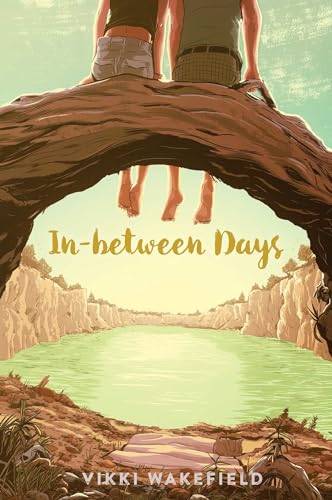
Seventeen-year-old Jacklin maneuvers her way through a summer of family drama and first—and second—loves in this gorgeous, lyrical novel from the author of Friday Never Leaving.
Sixteen-year-old Jacklin Bates (aka “Jack”) believes the only way to soar beyond her life is to drop out of school and move in with her free-spirited sister, Trudy. But Jack quickly discovers her sister isn’t the same person she used to be. And when Jack loses her job and the boy she loves breaks her heart, she becomes desperate for distractions.
She strikes up an unlikely friendship with Pope, a lost soul camping in the forest behind her house. And then there’s Jeremiah, the boy next door with a kind, listening ear and plenty of troubles of his own. Together, over an endless summer, Jack and Jeremiah fix up the abandoned drive-in theater at the edge of town. But even as a fragile romance builds between them, Jack knows deep down that she can’t stay in limbo forever.
When Jack faces losing Jeremiah, she searches for a way to repair their relationship—beginning with the other broken pieces in her life. Only, sometimes the hardest part of starting over isn’t choosing a path…it’s figuring out how to take that first step forward.
Die Inhaltsangabe kann sich auf eine andere Ausgabe dieses Titels beziehen.
Über die Autorin bzw. den Autor
Vikki Wakefield is the author of three award-winning novels: In-between Days, Friday Never Leaving, and All I Ever Wanted. She lives in Adelaide, Australia. Visit her at VikkiWakefield.com.
Auszug. © Genehmigter Nachdruck. Alle Rechte vorbehalten.
In-between Days
1
The worst part was the waiting. I swear I spent half my life with my chin on my hands, looking out the bedroom window. The summer I turned seventeen we were all waiting—our town was waiting for death to bring it back to life; my sister Trudy was waiting for me to grow up so the rest of her life could happen; Ma was waiting for Trudy and me to disappear.
I waited for Sundays. Every other day was just an empty square on the calendar that I couldn’t wait to put a line through.
Friday night: a pale crescent moon, no breeze. The air was so humid it was hard to breathe, and my pajamas clung to my skin. Even though it meant the world could see in, I switched on a light in every room. The sky was split open, and the stars were a blizzard; in the trees, the high-pitched buzz of the insects was like an electrical pulse. My blood kept time. Sunday was still too far away.
Just before eleven, a car had driven up the dirt road behind our house to the hanging forest. Now it was after midnight, and it hadn’t come back down.
I was good at being alone. I listened to the radio, played who’ll blink first with the possum in the gum tree, or wrote notes to Luke Cavanaugh that I’d never send. I had our old boxer Gypsy for company. She was twelve, arthritic, and half-blind, but her instincts were sharp. Her underbite was so bad we had to wipe her chin after she’d eaten.
Gypsy was lying in her corner of my room, blowing air and twitching in her sleep. I wondered if she was young in her dreams. Could she run again? Could she see?
I picked up my pen and opened my notebook. I wrote: I love you. Next to that I doodled his name over and over, in loops, in capitals, in daggers: LukeLukeLukeLukeLuke. Trudy always said you should never be the first to declare love, but by her reasoning it would never be declared at all. I crossed it out. I’d wait for Sunday and show him instead.
I slid open the window and plugged the hole in the screen with my finger. The air outside was still, but the ground moved—bugs, millions of them, drunk on light. A big Christmas beetle hit the window and landed on the sill, spinning on its back. A smaller beetle, maybe a male, clung to the mesh. I pressed my knuckles into the hole, working my fist until my arm went through, then flipped the big beetle over, unhooked the smaller one, and turned them to face each other.
“Here he is. Look.” I nudged the big beetle with my finger. “He’s right in front of you.” The female turned a slow circle, shuddered her wings, and took off, lured back to the light.
How on earth did they find each other, fumbling around in the dark, half-stunned and blinking?
I saw headlights, but coming from the main road. Gypsy’s reaction was lazy and late, so it had to be Trudy. I was relieved, but the other kind of relief would have been better. A minute later, Trudy’s wheezy Mazda pulled into the driveway.
I closed the window. When she walked in the front door, I was waiting.
“You’re late.”
“Are you my mother?” She smirked.
“A car drove up.”
Trudy’s irises turned flat and black. She shrugged. “I’m exhausted. I’m going to bed. Max kept the bar open way past closing.” She stretched, faked a yawn, and untied herself: hair, shoes, apron. She took too much care undressing, folding, and stacking her clothes on the arm of the couch. When she was down to her underwear, she frowned at the neat pile she’d made. “Were you waiting up for me?” Her tone was breezy, but a mad pulse in her throat gave her away.
“There was only one person in the car.” It was a lie. I was half asleep when I heard it, and by the time I got to my window, the taillights were all I could see.
“You’re obsessed,” she said.
“We can’t sit here and do nothing.”
“That’s what the ranger’s for. Anyway, cars go up all the time.”
“Not this late. I know. I listen.”
I knew I wouldn’t be able to sleep. I wanted Trudy to stay up. She would never come to look for the car with me, so the best I could do was wait out the dark. Morning arrived late to our town and night came early; it was ten by the time the sun made it over Pryor Ridge and around four when it ducked behind Mount Moon. Everything in Mobius stretched to reach the light: We built our houses on stilts; our trees grew tall and spindly; our shadows were long.
Trudy roughed up the pile of clothes, and they fell to the floor. She went to her bedroom, switching off lights along the way, and came back wrapped in her robe. She poured herself a glass of wine, and I knew she’d stay.
“Just one,” she said. “Do you want to watch a movie?” She climbed onto the U-shaped couch we called the banana lounge and curled her legs under her.
“You pick,” I said.
She chose The Man from Snowy River, like I knew she would. Trudy liked films. I preferred documentaries. It was our version of conversation, and letting the other choose was as close to kindness as we got.
I watched her watching the film. She always mouthed her favorite lines. Maybe she thought I didn’t notice—more likely she didn’t care.
Male company will be a pleasant relief in this hothouse of female emotions.
Trudy snorted. Wine spilled onto her lap.
I didn’t think it was that funny.
It wasn’t often we laughed at the same things, and, considering the man ban Trudy had imposed on our house, it was kind of tragic. Under her rule it was okay for me to come home raccoon-eyed and bowlegged, but I had to come home alone.
Something inhuman screamed out in the forest.
“Have you been feeding that damned cat?” Trudy snapped.
I shook my head.
She poured another glass of wine but fell asleep before the movie finished, still holding the full glass.
I prized it from her fingers and set it on the table.
When she was drunk or asleep, the lines around my sister’s mouth disappeared. She unclenched her fists and smiled in her sleep. All of her spikes were laid flat. This was the Trudy I’d remembered and missed.
I lifted a stray rope of hair and placed it with the rest.
When the credits rolled, I turned the volume down and started the movie over. I draped a blanket over her.
Gypsy came out of my room. She shuffled to her spot by the back door and flopped down like someone had let go of her strings. Her eyes rolled back. I peeked through the curtains, but the moon had disappeared behind a cloud. The road stayed dark.
Mobius called itself a town, but it was really a populated dead end, a wrong turn, a sleepy hollow. Other towns had histories, natural wonders, monuments, and attractions, but Mobius was only famous for one thing: fifty-three people who had left their possessions in neat piles, gone deep into the forest, and never come out.
Ma used to say that it wasn’t healthy for the moods and fortunes of a whole town to be dependent on that dirt road and what lay beyond it, but the forest didn’t scare me. It was just a bunch of trees as old as time, and if there were ghosts, I’d never seen them.
People scared me.
• • •
Only Trudy could make coffee smell bad. My stomach lurched.
I pushed open the sliding door,...
„Über diesen Titel“ kann sich auf eine andere Ausgabe dieses Titels beziehen.
Suchergebnisse für In-between Days

Beispielbild für diese ISBN
In-between Days
Verlag:
Simon & Schuster Books For Young Readers, 2016
ISBN 10: 1442486562
ISBN 13: 9781442486560
Gebraucht
Hardcover
Anbieter: Better World Books: West, Reno, NV, USA
Verkäuferbewertung 5 von 5 Sternen

Zustand: Good. Pages intact with minimal writing/highlighting. The binding may be loose and creased. Dust jackets/supplements are not included. Stock photo provided. Product includes identifying sticker. Better World Books: Buy Books. Do Good. Artikel-Nr. 10023378-75
Gebraucht kaufen
EUR 7,59
Versand gratis
Versand innerhalb von USA
Versand innerhalb von USA
Anzahl: 1 verfügbar
Beispielbild für diese ISBN
In-between Days
Verlag:
Simon & Schuster Books For Young Readers, 2016
ISBN 10: 1442486562
ISBN 13: 9781442486560
Gebraucht
Hardcover
Anbieter: Better World Books, Mishawaka, IN, USA
Verkäuferbewertung 5 von 5 Sternen
Zustand: Good. Former library copy. Pages intact with minimal writing/highlighting. The binding may be loose and creased. Dust jackets/supplements are not included. Includes library markings. Stock photo provided. Product includes identifying sticker. Better World Books: Buy Books. Do Good. Artikel-Nr. 45708030-6
Gebraucht kaufen
EUR 7,59
Versand gratis
Versand innerhalb von USA
Versand innerhalb von USA
Anzahl: 1 verfügbar
Beispielbild für diese ISBN
In-Between Days
Verlag:
Simon & Schuster Books for Young Readers, 2016
ISBN 10: 1442486562
ISBN 13: 9781442486560
Gebraucht
Hardcover
Anbieter: ThriftBooks-Atlanta, AUSTELL, GA, USA
Verkäuferbewertung 5 von 5 Sternen
Hardcover. Zustand: Very Good. No Jacket. Former library book; May have limited writing in cover pages. Pages are unmarked. ~ ThriftBooks: Read More, Spend Less. Artikel-Nr. G1442486562I4N10
Gebraucht kaufen
EUR 8,71
Versand gratis
Versand innerhalb von USA
Versand innerhalb von USA
Anzahl: 1 verfügbar
Beispielbild für diese ISBN
In-between Days
Verlag:
Simon & Schuster Books for Young Readers, 2016
ISBN 10: 1442486562
ISBN 13: 9781442486560
Neu
Hardcover
Anbieter: Majestic Books, Hounslow, Vereinigtes Königreich
Verkäuferbewertung 4 von 5 Sternen

Zustand: New. Artikel-Nr. 371471792
Neu kaufen
EUR 30,29
EUR 7,67 Versand
Versand von Vereinigtes Königreich nach USA
Versand von Vereinigtes Königreich nach USA
Anzahl: 1 verfügbar