
Verwandte Artikel zu Sons from Afar (Volume 6) (The Tillerman Cycle)
Inhaltsangabe
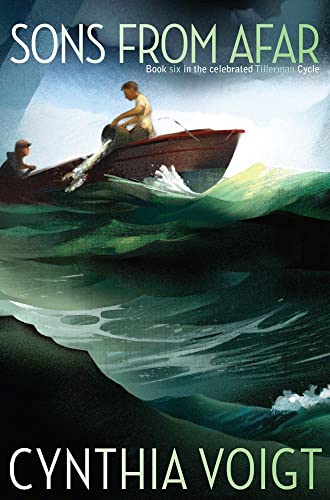
Will a common cause unite two brothers—or drive them further apart? Find out in the sixth installment of Cynthia Voigt’s Tillerman cycle.
If James and Sammy Tillerman agree on anything, it’s that they have nothing in common. Sammy is a tough jock, while James is an intellectual who has begun to question his identity. Then James enlists his brother’s help to find Francis Verricker, who may be the father who deserted them long ago. Through this quest, the brothers learn more about themselves than they thought possible.
Cynthia Voigt writes realistically of human failure—and triumph—in this poignant novel from her acclaimed Tillerman cycle.
Die Inhaltsangabe kann sich auf eine andere Ausgabe dieses Titels beziehen.
Über die Autorin bzw. den Autor
Cynthia Voigt won the Newbery Medal for Dicey’s Song, the Newbery Honor Award for A Solitary Blue, and the National Book Award Honor for Homecoming, all part of the beloved Tillerman Cycle. She is also the author of many other celebrated books for middle grade and teen readers, including Izzy, Willy-Nilly, and Jackaroo. She was awarded the Margaret A. Edwards Award in 1995 for her work in literature, and the Katahdin Award in 2004. She lives in Maine.
Auszug. © Genehmigter Nachdruck. Alle Rechte vorbehalten.
Sons from Afar
CHAPTER 1
James Tillerman watched his brother, Sammy, who was bailing two inches of rain water from their boat. It had rained all the previous night—a cold slanting March rain—and most of the morning, too. Then, Marchlike, the wind had shifted in the afternoon to the southwest, blowing the heavy clouds away, blowing warm. In the twilight, the boys had come down to bail the boat.
Sammy sat on the narrow gunwales, using his weight to tilt the boat and bring the water within it into easy reach. He bent and straightened, rhythmically, bailing the boat. The bailer was an empty bleach jug with the top cut off; it poured water into the bay with a wet, rushing sound. Sammy, whatever he did, moved as if he would never get tired. James, sitting cross-legged on the dock, his arms resting on his thighs, his fingers laced together, watched his brother.
“Do you ever wonder—?” James started.
“No.” Sammy bent, straightened, poured water out into water.
Irritated, James looked at his own hands, jealous, too. He moved the fourth finger of his right hand beneath the fingers of his left hand, then moved over the little finger to conceal the gap. In the growing darkness, you could fool someone, they might not notice that one finger was apparently missing. Things were so simple for Sammy, clear and simple. But he had wanted to ask Sammy. He didn’t like being just cut off like that, didn’t like it one bit.
Sammy broke the rhythm of bailing to look at his brother, sitting there on the dock above, just sitting there looking at his own hands. He could have asked James to help out. If he asked James, James would probably get down into the boat and help. But it seemed to Sammy that James shouldn’t be waiting around to be asked, shouldn’t just sit there, a pale blob in the dim air. There was another bailer. The job wouldn’t take so long if James helped, and Sammy wouldn’t have minded getting his hands into the cold water only half as many times. The air was warm enough, but the water held a winter chill longer than the air, long into spring, just the way it held summer’s warmth long into fall.
Sammy bent to work again, enjoying it actually. It was good to feel the muscles along his back and shoulders, the way they worked. It was good to feel the balance of his body, the way his legs kept his own weight and the water’s weight and the boat’s buoyant weight all in the right balance. His body knew how to do that, without any thinking. James would have to think it out, and he’d probably have gotten both of them wet before he figured out how to sit right. James was always thinking about something, wondering about something; it was almost as if he was always trying to make Sammy feel stupid, showing off a busier, smarter brain. Sammy smiled to himself, remembering how long it had taken him to figure out that there was no way he’d ever catch up the three years between him and James. But he was catching up in height—at five five he was only an inch shorter, and he weighed more, too, because of his muscular build. Sammy looked, he knew, older than twelve, while James looked younger than fifteen-almost-sixteen. Sammy didn’t mind that, not one bit.
“Seriously,” James said. “Wonder about our father. Do you ever?”
“Cripes, no.” When Sammy emptied the bailer, the water splashed up from the dark bay. “Why would I wonder about him? He never even saw me.”
“I do.”
“Not even once.”
“He did me, I guess. I don’t remember. Dicey remembers—but even Dicey was just a little kid the last time she probably saw him. I might as well never have had a father.”
“Considering that he blew the scene before I was born, I’d say I didn’t have one. So, why worry about him?”
“Haven’t you ever heard of genes and chromosomes? Heredity?”
“Don’t talk to me like I’m stupid.”
“Look,” James began, leaning forward.
“I can’t look. I’m working,” Sammy pointed out. “It’s too dark to see anyway.”
“We all have the same eyes,” James went on, ignoring what Sammy said, because it wasn’t to the point. The point was heredity. “The particular tones and colors vary, but they’re all hazel, because of dominant genes. We’ve got Tillerman eyes, that’s the way genetics work. Have you heard of Mendel’s laws of heredity?”
James didn’t think Sammy would have, but he waited a minute, anyway, before going on, in case his brother had anything to say.
“Mendel discovered genetics. He worked with beans. To discover what laws inherited characteristics are governed by.”
“What kind of beans? Green beans or pole beans? Lima beans?”
“Don’t be ridiculous. What does it matter what kind of beans?”
“I don’t know what any of it matters.”
“Because of the law of dominance,” James explained patiently. “Because you get one gene—for eye color, for example—from each one of your parents. So there are two genes for eye color. If they’re different, one of them will be dominant, and that’s the color eyes you’ll have.”
“Very educational.” Sammy shifted his position, sliding into the boat and hunkering down low next to the backseat, careful to not clunk his shoulder on the motor. The bottom of the bailer scraped along the wooden floor of the boat. Sammy was almost done, which was lucky because it was almost full dark. James continued explaining genetics to his brother.
“So all of our physical characteristics are inherited, according to Mendel’s laws. But it’s not just physical characteristics. Maybe. That’s one thing I’m wondering about. It’s like—mental characteristics, too. You know, intelligence, right or left brain dominance, maybe even aptitudes.”
Sammy was looking at him, but he wasn’t really listening.
“Integrity, aggression, whether you’re an extrovert or an introvert, whether you’re psychologically stable or have a tendency to mental disease, like schizophrenia, maybe that kind of thing too,” James went on. “Nobody knows for sure just how much is encoded in DNA, they keep finding out more about it, so it could be that character traits as well are inherited.”
“So what?” Sammy stood up. He dropped the bailer into the bottom of the boat. Reaching up, because the boat sat low on a low tide, he hauled himself onto the dock.
James gave up trying to explain to Sammy, who didn’t care about anything that wasn’t right under his nose. Intellectual curiosity, that was what Sammy didn’t have.
“Thanks for all the help,” Sammy said, sarcastic. He stood next to James, but looking out to where the dark bay moved under the dark sky.
James kept his mind on the important thing. “I mean, we don’t even know what color his eyes were. Or are.”
“Whose?”
“Our father’s.”
“What does the color of his eyes matter?”
“We don’t know anything. We might even be orphans.”
“Come on, James,” Sammy turned to him. “How can we be orphans? We had Momma....
„Über diesen Titel“ kann sich auf eine andere Ausgabe dieses Titels beziehen.
Suchergebnisse für Sons from Afar (Volume 6) (The Tillerman Cycle)

Beispielbild für diese ISBN
Sons from Afar (6) (The Tillerman Cycle)
Verlag:
Atheneum Books for Young Readers (edition Reissue), 2012
ISBN 10: 1442450657
ISBN 13: 9781442450653
Gebraucht
Hardcover
Anbieter: BooksRun, Philadelphia, PA, USA
Verkäuferbewertung 5 von 5 Sternen

Hardcover. Zustand: Good. Reissue. With dust jacket. It's a preowned item in good condition and includes all the pages. It may have some general signs of wear and tear, such as markings, highlighting, slight damage to the cover, minimal wear to the binding, etc., but they will not affect the overall reading experience. Ex-Library. Artikel-Nr. 1442450657-11-1-12_29
Gebraucht kaufen
EUR 5,48
Versand gratis
Versand innerhalb von USA
Versand innerhalb von USA
Anzahl: 1 verfügbar
Beispielbild für diese ISBN
Sons from Afar
Verlag:
Simon & Schuster Children's Publishing, 2012
ISBN 10: 1442450657
ISBN 13: 9781442450653
Gebraucht
Hardcover
Anbieter: Better World Books: West, Reno, NV, USA
Verkäuferbewertung 5 von 5 Sternen
Zustand: Very Good. Former library copy. Pages intact with possible writing/highlighting. Binding strong with minor wear. Dust jackets/supplements may not be included. Includes library markings. Stock photo provided. Product includes identifying sticker. Better World Books: Buy Books. Do Good. Artikel-Nr. 1367761-6
Gebraucht kaufen
EUR 6,60
Versand gratis
Versand innerhalb von USA
Versand innerhalb von USA
Anzahl: 1 verfügbar
Beispielbild für diese ISBN
Sons from Afar
Verlag:
Simon & Schuster Children's Publishing, 2012
ISBN 10: 1442450657
ISBN 13: 9781442450653
Gebraucht
Hardcover
Anbieter: Better World Books, Mishawaka, IN, USA
Verkäuferbewertung 5 von 5 Sternen
Zustand: Very Good. Pages intact with possible writing/highlighting. Binding strong with minor wear. Dust jackets/supplements may not be included. Stock photo provided. Product includes identifying sticker. Better World Books: Buy Books. Do Good. Artikel-Nr. 55052865-6
Gebraucht kaufen
EUR 6,60
Versand gratis
Versand innerhalb von USA
Versand innerhalb von USA
Anzahl: 1 verfügbar
Beispielbild für diese ISBN
Sons from Afar, 6
Verlag:
Atheneum Books for Young Readers, 2012
ISBN 10: 1442450657
ISBN 13: 9781442450653
Gebraucht
Hardcover
Anbieter: ThriftBooks-Atlanta, AUSTELL, GA, USA
Verkäuferbewertung 5 von 5 Sternen
Hardcover. Zustand: Very Good. No Jacket. May have limited writing in cover pages. Pages are unmarked. ~ ThriftBooks: Read More, Spend Less. Artikel-Nr. G1442450657I4N00
Gebraucht kaufen
EUR 6,63
Versand gratis
Versand innerhalb von USA
Versand innerhalb von USA
Anzahl: 1 verfügbar
Beispielbild für diese ISBN
Sons from Afar, 6
Verlag:
Atheneum Books for Young Readers, 2012
ISBN 10: 1442450657
ISBN 13: 9781442450653
Gebraucht
Hardcover
Anbieter: ThriftBooks-Atlanta, AUSTELL, GA, USA
Verkäuferbewertung 5 von 5 Sternen
Hardcover. Zustand: Good. No Jacket. Pages can have notes/highlighting. Spine may show signs of wear. ~ ThriftBooks: Read More, Spend Less. Artikel-Nr. G1442450657I3N00
Gebraucht kaufen
EUR 6,63
Versand gratis
Versand innerhalb von USA
Versand innerhalb von USA
Anzahl: 1 verfügbar
Beispielbild für diese ISBN
Sons from Afar
Verlag:
Simon & Schuster Children's Publishing, 2012
ISBN 10: 1442450657
ISBN 13: 9781442450653
Gebraucht
Hardcover
Anbieter: Better World Books Ltd, Dunfermline, Vereinigtes Königreich
Verkäuferbewertung 5 von 5 Sternen
Zustand: Very Good. Former library copy. Pages intact with possible writing/highlighting. Binding strong with minor wear. Dust jackets/supplements may not be included. Includes library markings. Stock photo provided. Product includes identifying sticker. Better World Books: Buy Books. Do Good. Artikel-Nr. 1367761-6
Gebraucht kaufen
EUR 8,60
EUR 6,00 Versand
Versand von Vereinigtes Königreich nach USA
Versand von Vereinigtes Königreich nach USA
Anzahl: 1 verfügbar