
Verwandte Artikel zu Quantum Plasmadynamics: Unmagnetized Plasmas (Lecture...
Inhaltsangabe
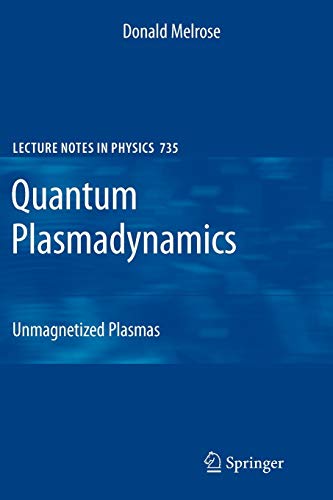
The idea of synthesizing quantum electrodynamics (QED) and the kinetic theory of plasmas ?rst occurred to me in the early 1970s [1, 2]. The project to do so has been carried out bit by bit over the subsequent years. The name “quantum plasmadynamics” (QPD) is my own jargon [3] for the synthesized theory. Both QED and the kinetic theory of plasmas areconcerned with the int- action between charged particles and the electromagnetic ?eld, but they are radically di?erent in the way the interaction is described. The kinetic theory of plasmas is a collective-medium theory: a plasma is not a collection of - dependent particles in a given electromagnetic ?eld, but a medium in which the particles collectively modify the ?eld, and the ?eld modi?es the par- cles. The charge and current densities associated with the particles are part of a self-consistent ?eld. Conventionally, the kinetic theory of plasmas is a classical theory: the motions of particles are treated using classical dynamics.
Die Inhaltsangabe kann sich auf eine andere Ausgabe dieses Titels beziehen.
Über die Autorin bzw. den Autor
Following completion of his doctoral thesis, in theoretical particle physics at Oxford University in 1965, Don Melrose changed his research interests to plasma astrophysics. After post-doctoral appointments in the UK and the USA he returned to Australia in 1969, to the Australian National University until he took up his current appointment as Professor of Physics (Theoretical) at the University of Sydney in 1979. He made important contributions to the theory of coherent emission processes in astrophysics: plasma emission in solar radio bursts, electron cyclotron maser emission and pulsar radio emission. His current interests include pulsars, quantum plasmas and solar flares.
Von der hinteren Coverseite
The field of quantum plasmas has a long and diverse tradition and is becoming of increasing current interest, motivated by applications to micro-electronics and to focused high-power lasers. In this book, plasma kinetic theory is developed in a covariant (4-tensor) notation, which facilitates generalizations to include all relativistic and electromagnetic effects. Relativistic quantum effects are included by using quantum electrodynamics (QED) to calculate the plasma response 4-tenors. The effects of the plasma are included in QED by replacing the photon propagator in vacuo by that in the medium, such that the poles of this propagator correspond to the natural wave modes of the medium.
„Über diesen Titel“ kann sich auf eine andere Ausgabe dieses Titels beziehen.
Suchergebnisse für Quantum Plasmadynamics: Unmagnetized Plasmas (Lecture...

Beispielbild für diese ISBN
Quantum Plasmadynamics: Unmagnetized Plasmas (Lecture Notes in Physics, 735)
Anbieter: Ria Christie Collections, Uxbridge, Vereinigtes Königreich
Verkäuferbewertung 5 von 5 Sternen

Zustand: New. In. Artikel-Nr. ria9781441925381_new
Neu kaufen
EUR 110,47
EUR 14,00 Versand
Versand von Vereinigtes Königreich nach USA
Versand von Vereinigtes Königreich nach USA
Anzahl: Mehr als 20 verfügbar
Beispielbild für diese ISBN
Quantum Plasmadynamics: Unmagnetized Plasmas
Anbieter: Revaluation Books, Exeter, Vereinigtes Königreich
Verkäuferbewertung 5 von 5 Sternen
Paperback. Zustand: Brand New. 466 pages. 9.00x6.00x1.10 inches. In Stock. Artikel-Nr. x-1441925384
Neu kaufen
EUR 181,37
EUR 14,61 Versand
Versand von Vereinigtes Königreich nach USA
Versand von Vereinigtes Königreich nach USA
Anzahl: 2 verfügbar
Foto des Verkäufers
Quantum Plasmadynamics : Unmagnetized Plasmas
Verlag:
Springer New York, Springer New York, 2010
ISBN 10: 1441925384
ISBN 13: 9781441925381
Neu
Taschenbuch
Anbieter: AHA-BUCH GmbH, Einbeck, Deutschland
Verkäuferbewertung 5 von 5 Sternen
Taschenbuch. Zustand: Neu. Druck auf Anfrage Neuware - Printed after ordering - The idea of synthesizing quantum electrodynamics (QED) and the kinetic theory of plasmas rst occurred to me in the early 1970s [1, 2]. The project to do so has been carried out bit by bit over the subsequent years. The name 'quantum plasmadynamics' (QPD) is my own jargon [3] for the synthesized theory. Both QED and the kinetic theory of plasmas areconcerned with the int- action between charged particles and the electromagnetic eld, but they are radically di erent in the way the interaction is described. The kinetic theory of plasmas is a collective-medium theory: a plasma is not a collection of - dependent particles in a given electromagnetic eld, but a medium in which the particles collectively modify the eld, and the eld modi es the par- cles. The charge and current densities associated with the particles are part of a self-consistent eld. Conventionally, the kinetic theory of plasmas is a classical theory: the motions of particles are treated using classical dynamics. Artikel-Nr. 9781441925381
Neu kaufen
EUR 136,10
EUR 63,67 Versand
Versand von Deutschland nach USA
Versand von Deutschland nach USA
Anzahl: 1 verfügbar