
Verwandte Artikel zu A Life Well Built: The Authorized Biography of Brigadier...
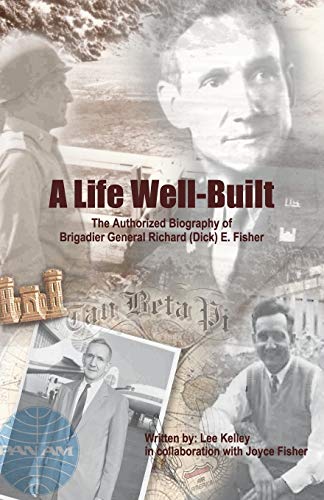
A Life Well Built: The Authorized Biography of Brigadier General Richard (Dick) E. Fisher - Softcover
Inhaltsangabe
From the tapestry of human history and experience, some individuals rise above the fabric's common braid and seem destined for great achievements. Richard Fisher was one of these souls. In A Life Well Built, author Lee Kelley tells the story of this natural-born leader who was an extraordinary soldier, father, husband, pilot, engineer, and friend. Raised in Ohio, Richard "Dick" Fisher showed natural signs of leadership at a young age. This biography spans his lifetime-through ninety years and twenty-six countries-and touches on his widespread successes. It follows him from the Ohio State University School of Engineering, to the Pennsylvania Railroad, to his work as an engineer in Ohio, and to building airports for the Army during World War II. A lifelong pilot, he flew airplanes and managed operations for Air America. He co-piloted the last aircraft to escape Saigon when the Vietnam War began and retired from the Army as a brigadier general. A Life Well Built shows the depth of this man who accomplished feats that most people could only dream of. This biography demonstrates that Fisher's life was a solid, inspired piece of engineering; he created a personal masterpiece in the art of living.
Die Inhaltsangabe kann sich auf eine andere Ausgabe dieses Titels beziehen.
Über die Autorin bzw. den Autor
Lee Kelley is a published author and creative writer. He also operates his own professional writing company called Desert Sun Writing, LLC.
Auszug. © Genehmigter Nachdruck. Alle Rechte vorbehalten.
A Life Well-Built
The Authorized Biography of Brigadier General Richard (Dick) E. FisherBy Lee Kelley Joyce Perry FisheriUniverse, Inc.
Copyright © 2010 Lee KelleyAll right reserved.
ISBN: 978-1-4401-9720-8
Contents
Preface by Lee Kelley.....................................1Acknowledgments by Joyce Perry Fisher.....................3Introduction by Joyce Perry Fisher........................7Chapter 1.................................................11Chapter 2.................................................29Chapter 3.................................................73Chapter 4.................................................89Chapter 5.................................................117Time Line.................................................131
Chapter One
From the tapestry of human history and experience, there sometimes come forth individuals who rise above the fabric's common braid and seem destined for great things. Richard Fisher was one of these souls.It was a seemingly random moment in America, but World War I was about to begin in earnest. Airplanes flew in countless air corridors. Soldiers shot their weapons and trained for war. Human endeavor was growing in leaps and bounds, and military conflict for the United States of America looked unavoidable.
In Alice, Ohio, Perry and Vergie Fisher were caught up in their own moment. She was giving birth to their first child, and Perry looked on, holding her hand. It was a warm morning on July 7, 1914, and on the second floor of a modest house on his grandfather's farm, Richard Evan Fisher came into this world.
Time did not stop. The wind didn't gust, nor could any haunting distant church bells be heard. But that morning, a very special individual joined the human race-one who would care honestly about the people he encountered, would love and learn deeply, and would truly be a natural-born leader. This baby would grow up to be an extraordinary soldier, father, husband, pilot, engineer, and friend. He would go on to a life of distinguished leadership, but no one knew any of that yet; right then, he was a helpless, crying infant in charge of nothing.
Baby "Richie" began crawling all over the house at a very young age. His father had a creamery business and collected milk from all the surrounding farms to test it for butterfat content. They used sulfuric acid to separate the butterfat from the milk. The acid was stored in large glass bottles called carboys, which were kept in the kitchen on a table covered with a white cloth.
When Richie was very young, he crawled over and pulled on the tablecloth. The carboy fell onto the floor and smashed, spilling sulfuric acid everywhere. The adults cleaned Richie up as much as they could with water, but the sulfuric acid left scars on his arms and one leg and a small cleft in his nose, which he would have for the rest of his life.
Early on, Richie's father had visions of his son becoming a military man. When Richie was three, his father had a World War I-style uniform fitted for him.
In addition to the creamery business, Perry Fisher also owned a restaurant, which was operated by Vergie Fisher, as well as a machine shop with five or six mechanics who worked on Maxwell automobiles. Maxwell was famous as one of the first cars that sold really well.
Richie spent countless hours in his baby carriage with his mother, either in the restaurant or in the machine shop which were located right next door to each other. There was a family joke about Richie's first words. They were not "Dada" or "Mama," but "Dod dammit!" He couldn't pronounce the word correctly, but when the mechanics hit their fingers or hurt themselves at work and said, "Goddammit!" little Richie was listening. He was a perceptive child to say the least.
TP1[Grade School Days]TP1
Although Welsh and Gaelic are related Celtic languages, according to Dick's parents, Gaelic was the common tongue in the Fisher home. The nurses, his mother, and everybody else spoke Gaelic around the home. At the age of five, Richie began to learn English because that was the language used in his formal school.
Richie attended Ligett Grade School in Akron, Ohio, which was only a one-room building for many years. He excelled in all of his studies. The only problem the teachers noticed was his swearing. He had naturally and innocently absorbed some bad language during the large amount of time he spent around the mechanics. Richie spent more than a little bit of time on a stool wearing a dunce hat as a result.
When he reached the upper grades in grade school, he had a teacher with a strong interest in grammar, and Richie followed suit. He really enjoyed the rules of the English language, while most of the other kids in his class struggled with them. They couldn't figure out, for example, why they needed so many inflections of the same verb. Until the end of his days, he kept his fascination with grammar. He could spot a misspelled word on a storefront or in any written correspondence within seconds. He also remembered being motivated by the same teacher to continue his formal education in college.
Summers on the Farm
Richie was the oldest of five children. His Aunt Ibbie and cousin Virgil were about his age. The children were very close, but when Richie was left in charge at the age of nine, he took the responsibility quite seriously. He told the other children not to go upstairs and mess things up. He had zero tolerance. Once the children broke the rule, he sternly assigned them to the couch and proceeded to stand guard over them for hours. The other children couldn't believe that Richie actually followed through and that they actually had to sit on the couch until their parents returned. The other children didn't understand his diligence.
Richie would spend the summers working on his grandfather's farm into his teenage years. His parents sent him partly to get him out of the house for a while, but mostly to keep him productive. The same day each school year ended, Richie went to the farm and stayed there until school started again in the fall.
Richie's grandfather had twelve to fifteen horses and over thirty cows. Every spring, there were two thousand chickens. His grandfather had incubated the eggs and raised the birds from chicks. Richie hated chickens because he found them so dirty, walking around in their own droppings. He disliked eating chicken throughout his life, and even in the later years, he would say, "I just hated those chickens." Luckily, his main work was hauling water from a nearby creek and filling the chickens' pans.
When Richie turned fifteen in 1929, his family had no mechanical technology whatsoever, and all plow work on the farm was done by a team of horses. The first machine they had was a steam engine that powered a tractor, which was the only mechanical power they had. They'd use that tractor as a thresher because it had a great big wheel that could be connected with a belt to the separator, which shook out all the seeds when harvesting wheat and oats. The thresher was a machine first invented by Scottish mechanical engineer Andrew Meikle for use in agriculture. It was invented around 1784 for the separation of grain from stalks and husks. For thousands of years, grain was separated by hand with flails. It was very laborious and time consuming. Mechanization of this process took much of the drudgery out of farm labor.
Those were hard days for a kid, because on a farm, wakeup time was usually 3:00 am. Richie's first job was to go out into the field and bring...
„Über diesen Titel“ kann sich auf eine andere Ausgabe dieses Titels beziehen.
Suchergebnisse für A Life Well Built: The Authorized Biography of Brigadier...

Beispielbild für diese ISBN
A Life Well Built: The Authorized Biography of Brigadier General Richard (Dick) E. Fisher
Anbieter: BooksRun, Philadelphia, PA, USA
Verkäuferbewertung 5 von 5 Sternen

Paperback. Zustand: Very Good. It's a well-cared-for item that has seen limited use. The item may show minor signs of wear. All the text is legible, with all pages included. It may have slight markings and/or highlighting. Artikel-Nr. 1440197202-11-1
Gebraucht kaufen
EUR 7,23
Versand gratis
Versand innerhalb von USA
Versand innerhalb von USA
Anzahl: 1 verfügbar
Beispielbild für diese ISBN
A Life Well Built: The Authorized Biography of Brigadier General Richard (Dick) E. Fisher
Anbieter: Redux Books, Grand Rapids, MI, USA
Verkäuferbewertung 5 von 5 Sternen
Paperback. Zustand: As New. APPEARS UNREAD. Paperback. Covers show minimal shelving wear, otherwise an UNBLEMISHED copy.; 100% Satisfaction Guaranteed! Ships same or next business day! Artikel-Nr. 142501140013
Gebraucht kaufen
EUR 8,74
Versand gratis
Versand innerhalb von USA
Versand innerhalb von USA
Anzahl: 1 verfügbar
Beispielbild für diese ISBN
A Life Well Built: The Authorized Biography of Brigadier General Richard (Dick) E. Fisher
Anbieter: ThriftBooks-Atlanta, AUSTELL, GA, USA
Verkäuferbewertung 5 von 5 Sternen
Paperback. Zustand: Fair. No Jacket. Readable copy. Pages may have considerable notes/highlighting. ~ ThriftBooks: Read More, Spend Less. Artikel-Nr. G1440197202I5N00
Gebraucht kaufen
EUR 9,18
Versand gratis
Versand innerhalb von USA
Versand innerhalb von USA
Anzahl: 1 verfügbar
Beispielbild für diese ISBN
A Life Well Built: The Authorized Biography of Brigadier General Richard (Dick) E. Fisher
Anbieter: Ria Christie Collections, Uxbridge, Vereinigtes Königreich
Verkäuferbewertung 5 von 5 Sternen
Zustand: New. In English. Artikel-Nr. ria9781440197208_new
Neu kaufen
EUR 13,48
EUR 11,11 Versand
Versand von Vereinigtes Königreich nach USA
Versand von Vereinigtes Königreich nach USA
Anzahl: Mehr als 20 verfügbar