
Verwandte Artikel zu Miles to Go: The Second Journal of the Walk Series
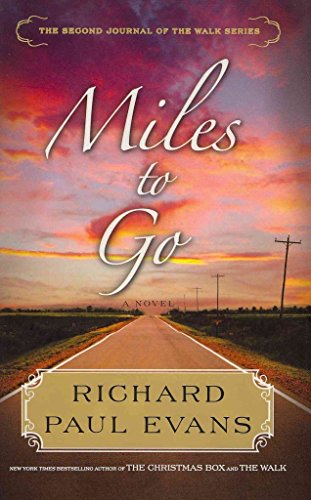
Inhaltsangabe
Alan Christoffersen, a once-successful advertising executive, wakes one morning to find himself injured, alone, and confined to a hospital bed in Spokane, Washington. Sixteen days earlier, reeling from the sudden loss of his wife, his home, and his business, Alan left everything he knew behind and set off on an extraordinary cross-country journey. Carrying only a backpack, he planned to walk to Key West, the farthest destination on his map. But a vicious roadside stabbing has interrupted Alan’s trek and robbed him of his one source of solace: the ability to walk.
Homeless and facing months of difficult recovery, Alan has nowhere to turn—until a mysterious woman enters his life and invites him into her home. Generous and kind, Angel seems almost too good to be true, but all is not as it appears. Alan soon realizes that before he can return to his own journey, he must first help Angel with hers.
From one of America’s most beloved and bestselling storytellers comes an astonishing tale of life and death, love and second chances, and why sometimes the best way to heal your own suffering is by helping to heal someone else’s.
Inspiring, moving, and full of wisdom, Miles to Go picks up where the bestseller The Walk left off, continuing the unforgettable series about one man’s unrelenting search for hope.
Die Inhaltsangabe kann sich auf eine andere Ausgabe dieses Titels beziehen.
Über die Autorin bzw. den Autor
Richard Paul Evans is the #1 bestselling author of The Christmas Box. Each of his more than thirty-five novels has been a New York Times bestseller. There are more than thirty-five million copies of his books in print worldwide, translated into more than twenty-four languages. He is the recipient of numerous awards, including the American Mothers Book Award, the Romantic Times Best Women’s Novel of the Year Award, the German Audience Gold Award for Romance, five Religion Communicators Council Wilbur Awards, the Washington Times Humanitarian of the Century Award and the Volunteers of America National Empathy Award. He lives in Salt Lake City, Utah, with his wife, Keri, and their five children. You can learn more about Richard on Facebook at Facebook.com/RPEFans, or visit his website RichardPaulEvans.com.
Auszug. © Genehmigter Nachdruck. Alle Rechte vorbehalten.
Miles to Go
PROLOGUE
The sun will rise again. The only uncertainty is whether or not we will rise to greet it.
Alan Christoffersen’s diary
Several months after I was mugged, stabbed, and left unconscious along the shoulder of Washington’s Highway 2, a friend asked me what being stabbed felt like. I told her it hurt.
Really, how do you describe pain? Sometimes doctors ask us to rate our pain on a scale from one to ten, as if that number had some reliable meaning. In my opinion there needs to be a more objective rating system, something comparative; like, would you trade what you’re feeling for a root canal or maybe half a childbirth?
And with what would we compare emotional pain—physical pain? Arguably, emotional pain is the greater of the two evils. Sometimes people will inflict physical pain on themselves to dull their emotional anguish. I understand. If I had the choice between being stabbed or losing my wife, McKale, again, the knife has the advantage—because if the knife kills me, I stop hurting. If it doesn’t kill me, the wound will heal. Either way the pain stops. But no matter what I do, my McKale is never coming back. And I can’t imagine that the pain in my heart will ever go away.
Still, there is hope—not to forget McKale, nor even to understand why I had to lose her—but to accept that I did and somehow go on. As a friend recently said to me, no matter what I do, McKale will always be a part of me. The question is, what part—a spring of gratitude, or a fountain of bitterness? Someday I’ll have to decide. Someday the sun will rise again. The only uncertainty is whether or not I will rise to greet it.
In the meantime, what I hope for most is hope. Walking helps. I wish I were walking again right now. I think I’d rather be anywhere right now than where I am.|Miles to Go
CHAPTER
Three
Somewhere between being stabbed and waking in the hospital, I had an experience that’s difficult to describe. Call it a dream or a vision, but McKale came to me. She told me that it wasn’t my time to die—that there were still people I was meant to meet. When I asked her who, she replied, “Angel.” Who is this woman?
Alan Christoffersen’s diary
The first time I woke in the hospital, there was a strange woman sitting in a chair next to my hospital bed. She was about my age and dressed casually, wearing a fitted T-shirt and jeans. When I could speak, I asked her who she was. She told me that we had met a few days earlier just outside the small town of Waterville. Her car had been stopped at the side of the road with a flat tire.
I recalled the encounter. She had tried to change the tire herself but had spilled the wheel’s lug nuts down the side of the incline into a deep gorge, leaving her stranded. I had taken a nut from each of the other tires and attached her spare.
She had offered me a ride to Spokane that I turned down. Just before she drove off, she gave me her business card, which (since I’d thrown my cell phone away on the first day of my walk) was the only contact information the police found on me. They called her and, inexplicably, she came. Her name was Annie, but she told me to call her Angel. “That’s what my friends call me,” she said.
She was with me when the doctor told me that I would need several weeks of convalescence at home.
“I’m homeless,” I said.
There was an awkward silence. Then Angel said, “He can come home with me.”
Since then she had come every day to see me, staying for about an hour each night, our conversation as stilted as two teenagers on a blind date. I wasn’t bothered that she came—I was lonely and appreciated the company—I just didn’t know why she came.
Tonight’s visit (angelic visitations, she called them) was later than usual. When I woke, she was looking down, reading a paperback Amish love story. As I looked at her, a song started playing in my head.
I’m on top of the world looking down on creation…
The tune, ironically cheerful, kept on playing, as annoyingly insistent as a scratched vinyl record. The melody was from a seventies song—something from my childhood. The Carpenters. My mother loved the Carpenters. She’d talk about Richard and Karen Carpenter like they were relatives.
Even as she was dying of cancer, she’d play their records. Especially when she was dying. She said their music kept her spirits up. As a kid, I knew the words to all their songs by heart. I still did. “Close to You,” “Rainy Days and Mondays,” “Hurting Each Other”; I remember tracing the Carpenters’ signature logo on typing paper, then trying to improve it, which was probably my first commercial graphic attempt.
My mother would play their albums on our walnutveneered, Zenith console stereo (a Plymouth-sized appliance which nearly took up the entire east wall of our living room), and their music would fill our home, which always made me feel peaceful because I knew it made my mother happy.
Angel was still engrossed in her book when I realized why the tune had come to mind. She looked like Karen Carpenter. Not exactly. She was blond and probably a little prettier, but close enough to warrant a second glance. I wondered if she could sing. As I was musing over the similarities, Angel suddenly looked up. She smiled when she saw me looking at her. “Hi.”
My mouth was parched and I ran my tongue over my lips before speaking. “Hi.”
“How are you feeling?”
“A little better than yesterday. How long have you been here?”
“About an hour.” Silence. Then she said, “You were talking in your sleep.”
“Did I say anything profound?”
“I think you were calling for someone … McKay or McKale?”
I winced but offered no explanation.
“I talked to your nurse. She said that if your scan turns out well, you could leave in a few days. Maybe even Monday.” Her mouth twisted a little. “Halloween. Scary.”
“That would be nice,” I said.
After a moment she said, “My offer’s still open. You’re welcome to stay with me. I’ve already moved some things around in my apartment …” then she added cautiously, “just in case.”
“That’s kind of you,” I said without commitment.
She looked at me apprehensively. Nearly a minute had passed when she asked, “What do you think?”
What did I think? I had spent the last few days considering the few options I had. After the destruction of my life, the only friend I had left was Falene, my former assistant, back in Seattle. In spite of our friendship, I couldn’t go back there.
My only other option was my father in Los Angeles. If I went to California, I knew I’d never come back. And I needed to come back. I needed to finish my walk.
For the first time since I’d left my home, I realized that my trek was more than just a physical commitment; it was a spiritual one—like the walkabouts of the Australian aborigines or the spirit walk of the Native Americans. Something I didn’t completely understand compelled me onward.
And, for whatever reason, this woman was part of my journey. There was some reason...
„Über diesen Titel“ kann sich auf eine andere Ausgabe dieses Titels beziehen.
Suchergebnisse für Miles to Go: The Second Journal of the Walk Series

Beispielbild für diese ISBN
Miles to Go: The Second Journal of the Walk
Anbieter: World of Books (was SecondSale), Montgomery, IL, USA
Verkäuferbewertung 5 von 5 Sternen

Hardback. Zustand: Good. From the author of The Walk and The Christmas Box, the inspiring New York Times bestseller about the journey of a heartbroken man who embarks on a walk across America. Alan Christoffersen, a once-successful advertising executive, wakes one morning to find himself injured, alone, and confined to a hospital bed in Spokane, Washington. Sixteen days earlier, reeling from the sudden loss of his wife, his home, and his business, Alan left everything he knew behind and set off on the cross-country journey of a lifetime. But a vicious roadside stabbing has interrupted Alan's trek and robbed him of his one source of solace: the ability to walk. Homeless and facing months of difficult recovery, Alan has nowhere to turn--until a mysterious woman enters his life and invites him into her home. An astonishing tale of life and death, suffering and healing, love and second chances, Miles to Go picks up the story of The Walk, continuing this unforgettable bestselling series about one man's unrelenting search for hope. Artikel-Nr. 00100223844
Gebraucht kaufen
EUR 4,05
Versand gratis
Versand innerhalb von USA
Versand innerhalb von USA
Anzahl: Mehr als 20 verfügbar
Beispielbild für diese ISBN
Miles to Go: The Second Journal of the Walk Series (2)
Verlag:
Simon & Schuster (edition First Edition), 2011
ISBN 10: 1439191379
ISBN 13: 9781439191378
Gebraucht
Hardcover
Erstausgabe
Anbieter: BooksRun, Philadelphia, PA, USA
Verkäuferbewertung 5 von 5 Sternen
Hardcover. Zustand: Very Good. First Edition. With dust jacket. It's a well-cared-for item that has seen limited use. The item may show minor signs of wear. All the text is legible, with all pages included. It may have slight markings and/or highlighting. Artikel-Nr. 1439191379-11-6-29
Gebraucht kaufen
EUR 4,82
Versand gratis
Versand innerhalb von USA
Versand innerhalb von USA
Anzahl: 1 verfügbar
Beispielbild für diese ISBN
Miles to Go: The Second Journal of the Walk Series (2)
Verlag:
Simon & Schuster (edition First Edition), 2011
ISBN 10: 1439191379
ISBN 13: 9781439191378
Gebraucht
Hardcover
Erstausgabe
Anbieter: BooksRun, Philadelphia, PA, USA
Verkäuferbewertung 5 von 5 Sternen
Hardcover. Zustand: Very Good. First Edition. With dust jacket. It's a well-cared-for item that has seen limited use. The item may show minor signs of wear. All the text is legible, with all pages included. It may have slight markings and/or highlighting. Artikel-Nr. 1439191379-11-1-29
Gebraucht kaufen
EUR 5,62
Versand gratis
Versand innerhalb von USA
Versand innerhalb von USA
Anzahl: 1 verfügbar
Beispielbild für diese ISBN
Miles to Go: The Second Journal of the Walk Series (2)
Anbieter: ThriftBooks-Reno, Reno, NV, USA
Verkäuferbewertung 5 von 5 Sternen
Hardcover. Zustand: Very Good. No Jacket. Former library book; May have limited writing in cover pages. Pages are unmarked. ~ ThriftBooks: Read More, Spend Less. Artikel-Nr. G1439191379I4N10
Gebraucht kaufen
EUR 5,96
Versand gratis
Versand innerhalb von USA
Versand innerhalb von USA
Anzahl: 1 verfügbar
Beispielbild für diese ISBN
Miles to Go: The Second Journal of the Walk Series (2)
Anbieter: ThriftBooks-Phoenix, Phoenix, AZ, USA
Verkäuferbewertung 5 von 5 Sternen
Hardcover. Zustand: Good. No Jacket. Pages can have notes/highlighting. Spine may show signs of wear. ~ ThriftBooks: Read More, Spend Less. Artikel-Nr. G1439191379I3N00
Gebraucht kaufen
EUR 5,96
Versand gratis
Versand innerhalb von USA
Versand innerhalb von USA
Anzahl: 15 verfügbar
Beispielbild für diese ISBN
Miles to Go: The Second Journal of the Walk Series (2)
Anbieter: ThriftBooks-Atlanta, AUSTELL, GA, USA
Verkäuferbewertung 5 von 5 Sternen
Hardcover. Zustand: Very Good. No Jacket. Missing dust jacket; May have limited writing in cover pages. Pages are unmarked. ~ ThriftBooks: Read More, Spend Less. Artikel-Nr. G1439191379I4N01
Gebraucht kaufen
EUR 5,96
Versand gratis
Versand innerhalb von USA
Versand innerhalb von USA
Anzahl: 1 verfügbar
Beispielbild für diese ISBN
Miles to Go: The Second Journal of the Walk Series (2)
Anbieter: ThriftBooks-Dallas, Dallas, TX, USA
Verkäuferbewertung 5 von 5 Sternen
Hardcover. Zustand: Good. No Jacket. Former library book; Pages can have notes/highlighting. Spine may show signs of wear. ~ ThriftBooks: Read More, Spend Less. Artikel-Nr. G1439191379I3N10
Gebraucht kaufen
EUR 5,96
Versand gratis
Versand innerhalb von USA
Versand innerhalb von USA
Anzahl: 2 verfügbar
Beispielbild für diese ISBN
Miles to Go: The Second Journal of the Walk Series (2)
Anbieter: ThriftBooks-Reno, Reno, NV, USA
Verkäuferbewertung 5 von 5 Sternen
Hardcover. Zustand: Good. No Jacket. Missing dust jacket; Pages can have notes/highlighting. Spine may show signs of wear. ~ ThriftBooks: Read More, Spend Less. Artikel-Nr. G1439191379I3N01
Gebraucht kaufen
EUR 5,96
Versand gratis
Versand innerhalb von USA
Versand innerhalb von USA
Anzahl: 2 verfügbar
Beispielbild für diese ISBN
Miles to Go: The Second Journal of the Walk Series (2)
Anbieter: ThriftBooks-Phoenix, Phoenix, AZ, USA
Verkäuferbewertung 5 von 5 Sternen
Hardcover. Zustand: Good. No Jacket. Former library book; Pages can have notes/highlighting. Spine may show signs of wear. ~ ThriftBooks: Read More, Spend Less. Artikel-Nr. G1439191379I3N10
Gebraucht kaufen
EUR 5,96
Versand gratis
Versand innerhalb von USA
Versand innerhalb von USA
Anzahl: 2 verfügbar
Beispielbild für diese ISBN
Miles to Go: The Second Journal of the Walk Series (2)
Anbieter: ThriftBooks-Reno, Reno, NV, USA
Verkäuferbewertung 5 von 5 Sternen
Hardcover. Zustand: Good. No Jacket. Former library book; Pages can have notes/highlighting. Spine may show signs of wear. ~ ThriftBooks: Read More, Spend Less. Artikel-Nr. G1439191379I3N10
Gebraucht kaufen
EUR 5,96
Versand gratis
Versand innerhalb von USA
Versand innerhalb von USA
Anzahl: 2 verfügbar