
Verwandte Artikel zu Who Is Jesus?: Linking the Historical Jesus with the...
Inhaltsangabe
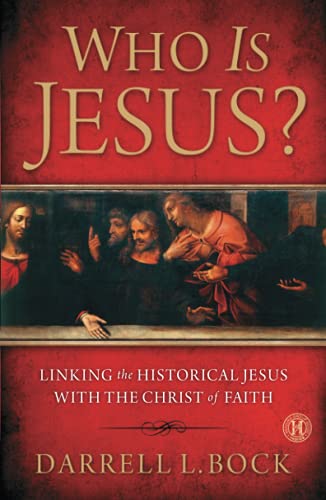
From the author of Discovering the Da Vinci Code, this new book is the result of a ten-year study that offers concrete evidence to reconcile the Jesus of history with the Christ of faith.
IS JESUS WHO HE SAID HE WAS? Some say he was just a man; others claim he was the Son of God. Historian Darrell Bock tests the authenticity of Jesus’ claims against the rules of history to find out if he truly is the Christ of Faith.
This reader-friendly book examines twelve events, sayings, and teachings of Jesus, using ten well-accepted historical rules. Pull up a chair, engage in the conversation, and discover how fascinating the discussion of the historical Jesus can be.
Die Inhaltsangabe kann sich auf eine andere Ausgabe dieses Titels beziehen.
Über die Autorin bzw. den Autor
Darrell L. Bock is Research Professor of New Testament Studies at Dallas Theological Seminary in Dallas, Texas. He also serves as Professor for Spiritual Development and Culture for the Seminary’s Center for Christian Leadership. He is the New York Times bestselling author of Breaking the Da Vinci Code. His special fields include the historical Jesus, gospel studies, and the integration of theology and culture. He is a graduate of the University of Texas (BA), Dallas Theological Seminary (ThM), and the University of Aberdeen (PhD).
Auszug. © Genehmigter Nachdruck. Alle Rechte vorbehalten.
Who Is Jesus? 1
The Rules:
Getting Ready to Play
RULES MAKE a difference. They determine what can and cannot work in a game. Just take soccer and football. In one of the great ironies in American sports, soccer (appropriately called football in most of the world) allows use of the feet but not the hands; while American football hardly uses the feet at all in relation to possession of the ball. The difference involves the rules of the two games.
So also in Jesus studies, there are rules that apply in order to make a corroborative case for the historicity of the accounts and, as a result, to understand what Jesus said and did. These rules are technically called the “criteria for authenticity.”1 They test whether we can show a text to have its roots authentically in the actual events in Jesus’ life. Where the church allows the gospel texts to stand as witnesses for Jesus without such corroboration (because these texts are included in the canon that makes up Scripture), in historical Jesus studies, we have to make a historical case for any event or saying that is tied to Jesus. Like soccer and football, different rules make for a different game: the church uses faith, and historical Jesus studies use corroboration.
THEOLOGICAL VS. HISTORICAL
One of the earliest rules involved setting aside claims or qualifying claims of divine activity for what was called a more rational approach to Jesus. Rather than working from heaven or through a claim about divine revelation to get the story, one worked from the earth. This was done in three ways.
First, some said we cannot speak of God at all as a historical matter, but that speaking of him is a theological matter—and theology is different from history. Since divine activity cannot be validated, it must be left off the table of history. The most skeptical form of this view argues that God is a human construct or that history and God have nothing to do with each other. In this most radical form, little conversation is possible. Wherever God is said to act, something else is going on, not divine activity.
A second approach argues that history and theology are distinct, but both address distinct realities within events. Historians address only what humans do and can show only what humans did. If God is to be included, it has to be understood as a matter of faith and is theology, not history. This second view contends that history has limitations and that God is real; so whenever God is addressed, we have moved from discussing history to treating theology. Think of this view as erecting a kind of secular wall in the discussion of history. Those who hold to it argue that history is not equipped to make theological judgments.
However, there is a third view that contends that a person must still be open to God and the possibility of his working in history. You may not be able to prove absolutely that God acted, but the historical work shows that the most likely explanation for an event is that God acted as claimed by some involved in the event. Even if absolute proof of divine activity cannot be established, a case can be made for the likelihood of events rooted in divine activity.
In the origins of the historical approach to Jesus, rationalism becomes the key over any form of theism. Our mind and its judgment become the key arbiters in the game. This is where understanding the rules and the nature of the game is important. The church in general does not handle this topic as historical Jesus scholars do. In the church, faith relies on God’s guidance and inspiration when it comes to the gospels, both the writing and canonization. But in this particular kind of historical discussion, claims of divine activity are ruled out, or bracketed off to the side. A case has to be constructed for the claim of divine activity, so we have to rely on the historian’s toolbox, that is, corroboration.
CORROBORATIVE SUPPORT REQUIRED
Historical Jesus study requires corroborative support and validation for claims. This means that singularly attested materials are largely set aside (even though they might contain real information about Jesus). “Singularly attested material” means accounts that are told from only a single source, even if others used that source. There are complicated ways singularly attested material can be brought in at a later stage of study, but for the most part, much of what is uniquely attested is set aside for lack of corroboration. Lack of corroboration simply means that there is no confirmation that what these single sources attest is true or not. This is a key limitation of the corroborative process because it can well be the case that a singularly attested event took place. One just cannot corroborate that it did.
This chapter seeks to explain the rules that we shall be applying to the twelve key events we study in subsequent chapters. These are the rules most historical Jesus scholars use.
RULE 1: MULTIPLE ATTESTATION OF SOURCES
At the core of technical gospels study are the sources that one argues stand behind the gospels. Luke 1:1–2 tells us about traditions, oral and written, that he was aware of as he wrote his gospel. Verse 1 speaks of written materials, while verse 2 describes those who as eyewitnesses and ministers of the Word verbally passed on material about Jesus. Scholars refer to these kinds of sources in doing their work. There are written sources and oral traditional materials. These traditions are said to come from eyewitnesses. That is important, but in historical Jesus discussion, the credibility of that source, even if it is early, has to be established. The claim alone is not enough.
The First Source—Mark
Although scholars debate the exact order of the writing of the gospels (as is the case with many matters in scholarly discussion), most Jesus scholars see Mark as the first one written. They name his work as one of the sources, if not the key source, for understanding the historical Jesus. Almost all of Mark is also found in Matthew or Luke. More than that, the other gospels follow an outline of events very parallel to Mark. These facts point to Mark’s importance. So Mark is our first key source.
The Second Source—Q
The second source commonly appealed to is called Q. This single letter stands for the term source, because the German word for “source,” Quelle, begins with the letter Q. This source is hypothesized (posited as likely) because some 220 verses of Jesus’ teaching are shared between Matthew and Luke—almost 20 percent of each of these gospels. Most scholars believe that Matthew and Luke did not use each other in writing their gospels. For example, the accounts of Jesus’ birth are quite different in the two gospels. Matthew’s Sermon on the Mount (Matthew 5–7) differs significantly from Luke’s Sermon on the Plain (Luke 6:20–49). Matthew has five key discourse units, but Luke lacks some of these.
The accounts about Jesus’ appearance after the resurrection differ in their locale, with Luke highlighting Jerusalem and Matthew, Galilee. So the theory goes, if Luke did not use Matthew and vice versa, where did those 220 verses come from? The argument is they shared a circulating traditional source of some type, which has never been found, that had similar teaching in it. The idea is that something has to explain the size of this agreement and overlap, even if we have never found such a written source.
In calling Q a source, we are not committing to the idea that Q is only a written source, a source reflective of oral tradition, or a mixture of the two. Variations on all of these positions exist when it comes to Q. The point is only that Matthew and Luke share a strand of tradition that circulated in the church...
„Über diesen Titel“ kann sich auf eine andere Ausgabe dieses Titels beziehen.
Suchergebnisse für Who Is Jesus?: Linking the Historical Jesus with the...

Beispielbild für diese ISBN
Who Is Jesus?
Anbieter: ThriftBooks-Reno, Reno, NV, USA
Verkäuferbewertung 5 von 5 Sternen

Paperback. Zustand: Good. No Jacket. Pages can have notes/highlighting. Spine may show signs of wear. ~ ThriftBooks: Read More, Spend Less. Artikel-Nr. G1439190682I3N00
Gebraucht kaufen
EUR 6,34
Versand gratis
Versand innerhalb von USA
Versand innerhalb von USA
Anzahl: 1 verfügbar
Beispielbild für diese ISBN
Who Is Jesus?
Anbieter: ThriftBooks-Phoenix, Phoenix, AZ, USA
Verkäuferbewertung 5 von 5 Sternen
Paperback. Zustand: Good. No Jacket. Pages can have notes/highlighting. Spine may show signs of wear. ~ ThriftBooks: Read More, Spend Less. Artikel-Nr. G1439190682I3N00
Gebraucht kaufen
EUR 6,34
Versand gratis
Versand innerhalb von USA
Versand innerhalb von USA
Anzahl: 1 verfügbar
Beispielbild für diese ISBN
Who Is Jesus?
Anbieter: World of Books (was SecondSale), Montgomery, IL, USA
Verkäuferbewertung 5 von 5 Sternen
Paperback. Zustand: Good. From the author of Discovering the Da Vinci Code, this book is the result of a ten-year study that offers concrete evidence to reconcile the Jesus of history with the Christ of faith. Is Jesus who he said he was? Some say he was just a man; others claim he was the Son of God. Historian Darrell Bock tests the authenticity of Jesus' claims against the rules of history to find out if he truly is the Christ of Faith. This reader-friendly book examines twelve events, sayings, and teachings of Jesus, using ten well-accepted historical rules. Pull up a chair, engage in the conversation, and discover how fascinating the discussion of the historical Jesus can be. Artikel-Nr. 00109224409
Gebraucht kaufen
EUR 6,35
Versand gratis
Versand innerhalb von USA
Versand innerhalb von USA
Anzahl: 2 verfügbar
Beispielbild für diese ISBN
Who Is Jesus?
Anbieter: World of Books (was SecondSale), Montgomery, IL, USA
Verkäuferbewertung 5 von 5 Sternen
Paperback. Zustand: Fair. From the author of Discovering the Da Vinci Code, this book is the result of a ten-year study that offers concrete evidence to reconcile the Jesus of history with the Christ of faith. Is Jesus who he said he was? Some say he was just a man; others claim he was the Son of God. Historian Darrell Bock tests the authenticity of Jesus' claims against the rules of history to find out if he truly is the Christ of Faith. This reader-friendly book examines twelve events, sayings, and teachings of Jesus, using ten well-accepted historical rules. Pull up a chair, engage in the conversation, and discover how fascinating the discussion of the historical Jesus can be. Artikel-Nr. 00105014695
Gebraucht kaufen
EUR 6,35
Versand gratis
Versand innerhalb von USA
Versand innerhalb von USA
Anzahl: 1 verfügbar
Beispielbild für diese ISBN
Who Is Jesus?
Anbieter: World of Books (was SecondSale), Montgomery, IL, USA
Verkäuferbewertung 5 von 5 Sternen
Paperback. Zustand: Very Good. From the author of Discovering the Da Vinci Code, this book is the result of a ten-year study that offers concrete evidence to reconcile the Jesus of history with the Christ of faith. Is Jesus who he said he was? Some say he was just a man; others claim he was the Son of God. Historian Darrell Bock tests the authenticity of Jesus' claims against the rules of history to find out if he truly is the Christ of Faith. This reader-friendly book examines twelve events, sayings, and teachings of Jesus, using ten well-accepted historical rules. Pull up a chair, engage in the conversation, and discover how fascinating the discussion of the historical Jesus can be. Artikel-Nr. CIN1439190682VG
Gebraucht kaufen
EUR 6,35
Versand gratis
Versand innerhalb von USA
Versand innerhalb von USA
Anzahl: 1 verfügbar
Beispielbild für diese ISBN
Who Is Jesus?
Anbieter: ThriftBooks-Dallas, Dallas, TX, USA
Verkäuferbewertung 5 von 5 Sternen
Paperback. Zustand: Good. No Jacket. Former library book; Pages can have notes/highlighting. Spine may show signs of wear. ~ ThriftBooks: Read More, Spend Less. Artikel-Nr. G1439190682I3N10
Gebraucht kaufen
EUR 6,36
Versand gratis
Versand innerhalb von USA
Versand innerhalb von USA
Anzahl: 1 verfügbar
Beispielbild für diese ISBN
Who Is Jesus?
Anbieter: ThriftBooks-Atlanta, AUSTELL, GA, USA
Verkäuferbewertung 5 von 5 Sternen
Paperback. Zustand: Fair. No Jacket. Readable copy. Pages may have considerable notes/highlighting. ~ ThriftBooks: Read More, Spend Less. Artikel-Nr. G1439190682I5N00
Gebraucht kaufen
EUR 6,36
Versand gratis
Versand innerhalb von USA
Versand innerhalb von USA
Anzahl: 1 verfügbar
Beispielbild für diese ISBN
Who Is Jesus?
Anbieter: ThriftBooks-Atlanta, AUSTELL, GA, USA
Verkäuferbewertung 5 von 5 Sternen
Paperback. Zustand: Very Good. No Jacket. May have limited writing in cover pages. Pages are unmarked. ~ ThriftBooks: Read More, Spend Less. Artikel-Nr. G1439190682I4N00
Gebraucht kaufen
EUR 6,36
Versand gratis
Versand innerhalb von USA
Versand innerhalb von USA
Anzahl: 1 verfügbar
Beispielbild für diese ISBN
Who Is Jesus?
Anbieter: ThriftBooks-Atlanta, AUSTELL, GA, USA
Verkäuferbewertung 5 von 5 Sternen
Paperback. Zustand: Good. No Jacket. Former library book; Pages can have notes/highlighting. Spine may show signs of wear. ~ ThriftBooks: Read More, Spend Less. Artikel-Nr. G1439190682I3N10
Gebraucht kaufen
EUR 6,36
Versand gratis
Versand innerhalb von USA
Versand innerhalb von USA
Anzahl: 1 verfügbar
Beispielbild für diese ISBN
Who Is Jesus?
Anbieter: ThriftBooks-Dallas, Dallas, TX, USA
Verkäuferbewertung 5 von 5 Sternen
Paperback. Zustand: Very Good. No Jacket. May have limited writing in cover pages. Pages are unmarked. ~ ThriftBooks: Read More, Spend Less. Artikel-Nr. G1439190682I4N00
Gebraucht kaufen
EUR 6,36
Versand gratis
Versand innerhalb von USA
Versand innerhalb von USA
Anzahl: 1 verfügbar