
Verwandte Artikel zu The Journal of Best Practices: A Memoir of Marriage,...
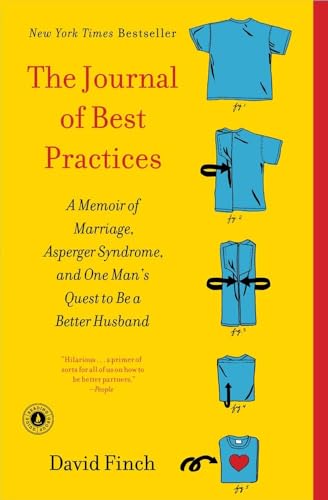
The Journal of Best Practices: A Memoir of Marriage, Asperger Syndrome, and One Man's Quest to Be a Better Husband - Softcover
Inhaltsangabe
*A New York Times Bestseller*
A warm and hilarious memoir by a man diagnosed with Asperger syndrome who sets out to save his relationship.
Five years after David Finch married Kristen, the love of his life, they learned that he has Asperger syndrome. The diagnosis explained David’s ever-growing list of quirks and compulsions, but it didn’t make him any easier to live with.
Determined to change, David set out to understand Asperger syndrome and learn to be a better husband with an endearing zeal. His methods for improving his marriage involve excessive note-taking, performance reviews, and most of all, the Journal of Best Practices: a collection of hundreds of maxims and hard-won epiphanies, including “Don’t change the radio station when she’s singing along” and “Apologies do not count when you shout them.” David transforms himself from the world’s most trying husband to the husband who tries the hardest. He becomes the husband he’d always meant to be.
Filled with humor and wisdom, The Journal of Best Practices is a candid story of ruthless self-improvement, a unique window into living with an autism spectrum condition, and proof that a true heart is the key to happy marriage.
Die Inhaltsangabe kann sich auf eine andere Ausgabe dieses Titels beziehen.
Über die Autorin bzw. den Autor
David Finch grew up on a farm in northern Illinois and attended the University of Miami, where he studied Music Engineering Technology. In 2008 he was diagnosed with Asperger’s syndrome. His essay, “Somewhere Inside, a Path to Empathy” appeared in The New York Times and became the basis for this book. David lives in northern Illinois with his wife Kristen and two children and is still a total nerd.
Von der hinteren Coverseite
The warm and hilarious "New York Times"-bestselling memoir by a man diagnosedwith Asperger's syndrome who sets out to save his marriage.
Auszug. © Genehmigter Nachdruck. Alle Rechte vorbehalten.
Introduction
Do all that you can to be worthy of her love.
I was thirty years old and had been married five years when I learned that I have Asperger syndrome, a relatively mild form of autism. My wife, Kristen, a speech therapist and autism expert, brought it to my attention one evening after harboring suspicions for years.
Receiving such a diagnosis as an adult might seem shocking and unsettling. It wasn’t. Eye-opening, yes. Life-changing, yes. But not distressing in the least. Strangely, it was rather empowering to discover that I had this particular condition. In fact, the diagnosis ultimately changed my life for the better.
I received the news the day before my niece was born. I remember this not because I’m a wonderful uncle but because she was born on March 14, 2008, which is well-known among my fellow nerds in the math and science communities as “Pi Day” because pi, the ratio of a circle’s circumference to its diameter, is equal to 3.14. Also 3 + 14 + 2 + 0 + 8 totals 27, which is divisible by 3, and I love numbers that are divisible by 3, particularly numbers whose digits sum to 27, of which 3 is the cube root. (Are you starting to see why Kristen had her suspicions?)
The day had been chaotic but really nothing out of the ordinary for two young working parents. Kristen was in the kitchen, trying to put it back in some kind of order, and I was upstairs saying good night to our kids. After walking with our ten-month-old son, Parker, in little circles around his dark room and whispering the lyrics of an Eric Clapton song until he fell asleep, I cuddled with our daughter, Emily, until her restless two-year-old squirming subsided and her breathing slowed and deepened. I crept out, whispering “I love you,” the words all but dissolving into the whir of her electric fan.
As I descended into the warm amber glow that bathed the first floor of our house, I could hear the hum of the dishwasher in the kitchen and the soft clunk of toys being put away in the playroom. Something was up; the house was never so tranquil right after the kids went to bed. Usually, the television was on, the kitchen was a disaster, and books and toys were scattered everywhere. I expected to find Kristen in her usual spot: sitting on the couch among stacks of paper and thick binders, her laptop resting on her legs as she feverishly prepared for the next day’s work. But everything was different that night.
In the kitchen, my dinner was cooling on the clean counter, and I felt an unusual sense of peace as I prepared for my evening routine. At eight thirty each night, after the kids have been put to bed, I circle the first floor, counterclockwise, starting in the kitchen, where I check to see if the patio door is locked. Then it’s back to the kitchen, where I usually wander around in circles until Kristen asks me what I’m doing.
But that night, before I began, Kristen approached me by the refrigerator in her pajamas and wrapped me in a tight hug.
“Oh,” I said, surprised. “Hello there.” I couldn’t remember the last time she had given me a hug for no particular reason. I hesitated for a moment, trying to play it cool, then squeezed her close.
“Hi,” she said into my chest. Her blond hair darkened to a shade of honey and shimmered lightly in the dimness. “Do you want some pizza?” she asked.
“Yeah, thanks for making it.”
“Sure,” she said. “When you’re ready, why don’t you bring it down to the basement?” Without letting go, she looked up at me and smiled. “There’s something I want to show you.”
“Okay, I’ll be right down.”
Understanding the importance of my routines, she playfully patted my butt and headed down to her office in the basement. Stunned by this rare and remarkable display of affection, I completed my rounds. I proceeded through the dining room and living room, then it was on to the foyer, where I always take a few moments to stare out the front window, visually lining up the neighbors’ rooftops (the alignment is the same every time, which is so gratifying it makes my shoulders relax, and for a moment my head is clear, my thoughts organized). As usual, I took note of which lights were on. I don’t normally shut them off, I just like to check in and see how they’re doing. Dining room light on, piano lamp not on, foyer not on, hallway on, kitchen off (that’s kind of rare . . . how ’bout it, kitchen?), oven hood on. I grabbed my pizza from the counter, swiped a Pepsi from the fridge, and made my way down the loud, clunky steps to Kristen’s office in our basement, where she was sitting in front of her computer. She turned and beamed at me.
“Sit here,” she said, pointing to the empty chair beside her. I had no idea what was going on, but there was pizza involved, and for the first time in weeks, I’d made her smile. Whatever it is, I’m in.
“Ready to get down to business?” she asked in a tone that seemed to suggest that I was.
I laughed. “Wet’s get down to bwass tacks!”
“Huh?” She looked thoroughly confused.
“It’s from Blazing Saddles. I’m ready.”
Embarrassed and disappointed that my movie reference tanked, I shoved my hands under my legs and swiveled back and forth in my chair.
“All right,” she said. “I’m going to ask you a list of questions, and you just have to answer honestly.” She must have realized that she was setting herself up by telling me to answer honestly. I tend to be verbose when people ask me to talk about myself; some would even say exhausting. I have no filter to limit my discourse to relevant things, and that puts people off. When I am invited to speak about myself, often what comes forth is the verbal equivalent of a volcanic eruption, spewing molten mind magma in every direction.
“I mean, you don’t have to deliberate each question,” she said, backpedaling. “I don’t need big, long answers, just honest ones.”
“Got it.”
She began: “Do you tend to get so absorbed by your special interests that you forget or ignore everything else? Just answer yes, no, or sometimes.”
“Special interests?”
“You know,” she said, “things like practicing your saxophone for four hours a day, or when you wrote scenes at the Second City and I hardly ever saw you . . .”
“Oh, well, sure,” I said. We both laughed. “I mean, doesn’t everybody get into stuff?”
“No,” she replied, marking down my answer. “Many people can do something they enjoy and not let it consume their whole life so they forget to pay bills, or put on shoes, or check in on their family from time to time.”
“Well. That’s their problem if they don’t have the intellectual capacity to engage constructively with an activity.”
“Next one: Is your sense of humor different from the mainstream or considered odd?”
I reflected back on the moment thirty seconds earlier, when I had cracked myself up by throwing my head back and bellowing what would be for most people a forgettable line from a Mel Brooks movie. Then I recalled going to a Victoria’s Secret store fifteen years earlier with my friend Greg and convincing the salesclerk that my girlfriend was shaped exactly like me, just so that I could quickly try on some lingerie against store policy (apparently) and give Greg a good laugh. That joke had been a success. But then I...
„Über diesen Titel“ kann sich auf eine andere Ausgabe dieses Titels beziehen.
Suchergebnisse für The Journal of Best Practices: A Memoir of Marriage,...

Beispielbild für diese ISBN
The Journal of Best Practices
Anbieter: World of Books (was SecondSale), Montgomery, IL, USA
Verkäuferbewertung 5 von 5 Sternen

Zustand: Good. Item in good condition. Textbooks may not include supplemental items i.e. CDs, access codes etc. Artikel-Nr. 00099525790
Gebraucht kaufen
EUR 5,90
Versand gratis
Versand innerhalb von USA
Versand innerhalb von USA
Anzahl: Mehr als 20 verfügbar
Beispielbild für diese ISBN
The Journal of Best Practices
Anbieter: World of Books (was SecondSale), Montgomery, IL, USA
Verkäuferbewertung 5 von 5 Sternen
Zustand: Acceptable. Item in acceptable condition! Textbooks may not include supplemental items i.e. CDs, access codes etc. Artikel-Nr. 00108009930
Gebraucht kaufen
EUR 5,90
Versand gratis
Versand innerhalb von USA
Versand innerhalb von USA
Anzahl: 1 verfügbar
Beispielbild für diese ISBN
The Journal of Best Practices: A Memoir of Marriage, Asperger Syndrome, and One Man's Quest to Be a Better Husband
Anbieter: ThriftBooks-Reno, Reno, NV, USA
Verkäuferbewertung 5 von 5 Sternen
Paperback. Zustand: Good. No Jacket. Pages can have notes/highlighting. Spine may show signs of wear. ~ ThriftBooks: Read More, Spend Less. Artikel-Nr. G1439189749I3N00
Gebraucht kaufen
EUR 5,91
Versand gratis
Versand innerhalb von USA
Versand innerhalb von USA
Anzahl: 3 verfügbar
Beispielbild für diese ISBN
The Journal of Best Practices: A Memoir of Marriage, Asperger Syndrome, and One Man's Quest to Be a Better Husband
Anbieter: ThriftBooks-Atlanta, AUSTELL, GA, USA
Verkäuferbewertung 5 von 5 Sternen
Paperback. Zustand: Good. No Jacket. Pages can have notes/highlighting. Spine may show signs of wear. ~ ThriftBooks: Read More, Spend Less. Artikel-Nr. G1439189749I3N00
Gebraucht kaufen
EUR 5,91
Versand gratis
Versand innerhalb von USA
Versand innerhalb von USA
Anzahl: 4 verfügbar
Beispielbild für diese ISBN
The Journal of Best Practices: A Memoir of Marriage, Asperger Syndrome, and One Man's Quest to Be a Better Husband
Anbieter: ThriftBooks-Dallas, Dallas, TX, USA
Verkäuferbewertung 5 von 5 Sternen
Paperback. Zustand: Fair. No Jacket. Readable copy. Pages may have considerable notes/highlighting. ~ ThriftBooks: Read More, Spend Less. Artikel-Nr. G1439189749I5N00
Gebraucht kaufen
EUR 5,91
Versand gratis
Versand innerhalb von USA
Versand innerhalb von USA
Anzahl: 1 verfügbar
Beispielbild für diese ISBN
The Journal of Best Practices: A Memoir of Marriage, Asperger Syndrome, and One Man's Quest to Be a Better Husband
Anbieter: ThriftBooks-Dallas, Dallas, TX, USA
Verkäuferbewertung 5 von 5 Sternen
Paperback. Zustand: Good. No Jacket. Pages can have notes/highlighting. Spine may show signs of wear. ~ ThriftBooks: Read More, Spend Less. Artikel-Nr. G1439189749I3N00
Gebraucht kaufen
EUR 5,91
Versand gratis
Versand innerhalb von USA
Versand innerhalb von USA
Anzahl: 3 verfügbar
Beispielbild für diese ISBN
The Journal of Best Practices: A Memoir of Marriage, Asperger Syndrome, and One Man's Quest to Be a Better Husband
Anbieter: ThriftBooks-Reno, Reno, NV, USA
Verkäuferbewertung 5 von 5 Sternen
Paperback. Zustand: Good. No Jacket. Former library book; Pages can have notes/highlighting. Spine may show signs of wear. ~ ThriftBooks: Read More, Spend Less. Artikel-Nr. G1439189749I3N10
Gebraucht kaufen
EUR 5,91
Versand gratis
Versand innerhalb von USA
Versand innerhalb von USA
Anzahl: 1 verfügbar
Beispielbild für diese ISBN
The Journal of Best Practices: A Memoir of Marriage, Asperger Syndrome, and One Man's Quest to Be a Better Husband
Anbieter: ThriftBooks-Phoenix, Phoenix, AZ, USA
Verkäuferbewertung 5 von 5 Sternen
Paperback. Zustand: Fair. No Jacket. Readable copy. Pages may have considerable notes/highlighting. ~ ThriftBooks: Read More, Spend Less. Artikel-Nr. G1439189749I5N00
Gebraucht kaufen
EUR 5,91
Versand gratis
Versand innerhalb von USA
Versand innerhalb von USA
Anzahl: 1 verfügbar
Beispielbild für diese ISBN
The Journal of Best Practices: A Memoir of Marriage, Asperger Syndrome, and One Man's Quest to Be a Better Husband
Anbieter: ThriftBooks-Phoenix, Phoenix, AZ, USA
Verkäuferbewertung 5 von 5 Sternen
Paperback. Zustand: Good. No Jacket. Former library book; Pages can have notes/highlighting. Spine may show signs of wear. ~ ThriftBooks: Read More, Spend Less. Artikel-Nr. G1439189749I3N10
Gebraucht kaufen
EUR 5,91
Versand gratis
Versand innerhalb von USA
Versand innerhalb von USA
Anzahl: 1 verfügbar
Beispielbild für diese ISBN
The Journal of Best Practices: A Memoir of Marriage, Asperger Syndrome, and One Man's Quest to Be a Better Husband
Anbieter: ThriftBooks-Phoenix, Phoenix, AZ, USA
Verkäuferbewertung 5 von 5 Sternen
Paperback. Zustand: Good. No Jacket. Pages can have notes/highlighting. Spine may show signs of wear. ~ ThriftBooks: Read More, Spend Less. Artikel-Nr. G1439189749I3N00
Gebraucht kaufen
EUR 5,91
Versand gratis
Versand innerhalb von USA
Versand innerhalb von USA
Anzahl: 3 verfügbar