
Verwandte Artikel zu I Remember You
Inhaltsangabe
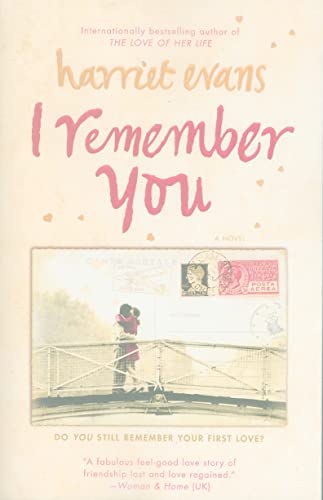
Internationally bestselling author Harriet Evans gives readers "the perfect girly read" (Cosmopolitan, UK) in this fun, bittersweet, and irresistibly surprising journey of fresh starts and first loves.
Twelve years in bustling London have left Tess Tennant dumped by her boyfriend, out of work, and miserable. Still, maybe taking a new job as a classics professor at the tiny college in her picture-perfect hometown in the English countryside was a bit drastic. Langford’s stone cottages, quaint shops, and lifelong locals feel even smaller than she remembered, but at least Tess has Adam, her best and oldest friend. On a spontaneous birthday adventure back to the city, though, their painful and heartbreaking past forces them into an angry confrontation.
Tess escapes to Rome on a class trip and falls unexpectedly into the arms of Peter, a charming American journalist . . . until a tragedy cuts her vacation short. Back home and alone, Tess must slowly unravel her feelings about her secretive best friend, the romantic new lover she barely knows, and the independent woman she really wants to be.
Die Inhaltsangabe kann sich auf eine andere Ausgabe dieses Titels beziehen.
Über die Autorin bzw. den Autor
Harriet Evans is the internationally bestselling author of Going Home, A Hopeless Romantic, The Love of Her Life, I Remember You, Love Always, Happily Ever After, Not Without You, A Place for Us, The Butterfly Summer, The Wildflowers. She lives in London. Visit her website at Harriet-Evans.com.
Auszug. © Genehmigter Nachdruck. Alle Rechte vorbehalten.
One
The old woman sat at her window, her usual position, and watched, waiting. It was noon in Langford, and if there was to be any activity on the high street (described as “one of the most beautiful streets in England” by DK Eyewitness, “picture-postcard perfect” in the Rough Guide, and “chintzy” in Lonely Planet), it would be at this time.
There might be a couple of ladies walking to lunch at the tea shop. Or some weekenders emerging from Knick-Knacks, one of the many gift shops that sold Medici Society note cards, chintz cushions, and “vintage” mirrors. Or perhaps a group of American tourists, rarer at this time of year, distressingly loud, having visited the house where Jane Austen spent several months staying with an old friend. (The house, formerly known as 12 St. Catherine’s Street, was now the Jane Austen Centre, a museum which contained a glove of the great author’s, a letter from her describing Langford as “neither incommodious nor invidious, yet I cannot like it,” and a first edition of Emma, inscribed, “To Lord Mortmain, in respect of his great knowledge, this little offering.” But since the author was anonymous until she died, it was generally agreed it wasn’t her inscription, anyway.)
Perhaps she might spot a bus trip taking people to Langford Regis, the famous Roman villa nearby (home to some of the best mosaics of Roman Britain and a new heritage trail promising a fun day out for all the family). Perhaps even a film crew: they were increasingly common in Langford these days. But whatever it was, Leonora Mortmain would have seen it before, in some form or another. For, as she was fond of telling her housekeeper, Jean, she had seen most things in the town. And nothing surprised her anymore.
She watched them walk past with a weary disdain: the tourists, lured from London or Bath for the day, even on this cold January morning, clutching their guidebooks, reading aloud to each other. And there was her old adversary, Mick Hopkins, the publican at the Feathers. He was putting a sign out on the road. Leonora couldn’t make out the bright chalk lettering, and her glasses were on the other side of the room, in the bureau. Something annoying, no doubt; some quiz night that would mean everyone became disgracefully inebriated and staggered out onto the street, calling names and making noise, waking her all too easily from a restless sleep. Leonora Mortmain sighed, and her long fingers briefly clutched her skirt. Sometimes she wondered, quite literally, what the world was coming to. The town she had known all her life was changing. And she didn’t like it.
There was a picture in the town hall (renamed the Civic Centre in the eighties, now mercifully re-renamed). Leonora had a copy too. It showed the Langford Parish Council on Easter Day 1904, outside St. Mary’s Church, behind the high street. Men in morning suits, top hats, and gloves, with walking sticks, their sepia faces serious and respectable, their wives demurely on their arms, expressionless and slim in pintucked, ruffled Edwardian dresses. Everything correct, respectful. The church noticeboard in the background was freshly painted. Even the urchin playing in the street in the foreground, unseen by the subjects of the photograph—even he was clean and presentable! The previous day, Leonora had watched in amazement and horror as a mother—she presumed she was the mother—pushed her child along the high street in a baby carriage with one hand. The woman was fat, red-faced, and sweating, holding a cigarette with the hand that steered the carriage and eating a meat pie of some description in the other. She was dressed in pink jogging bottoms; the child was filthy. And she was shouting at it as she went. “Shut the **** up, Tiffany!” she’d screamed, as the child screamed back. And then later that same day, as evening came, a troop of girls, no more than teen-agers, walking along toward the bus stop, wearing jeans and sneakers and tops that displayed more than enough of their cleavages, smoking and drinking out of cans. One of them—no more than fourteen, Leonora estimated—stopped and kissed, in a most unseemly way, a youth of the same age, whose hands had roved over her body like—like oil in a pan. And under her clothes! Leonora had watched it all from the window.
Extraordinary! Incredible! That the town had come to this, and Leonora increasingly had no remedy for it. O tempora, O mores, her father had been wont to say (although he disapproved of Cicero in many ways). Well, what Sir Charles Mortmain would have made of his beloved town now, she shuddered to think. She simply could not imagine. Leonora Mortmain shifted uneasily in her seat, and her hand restlessly stroked the bell that lay near her at all times.
Her father was a man who cast a long shadow: a passionate classicist, author of Roman Society (Heinemann, 1933), which expounded the virtues of Imperial Rome (its organization, its rules, its ruthlessness), omitting many of its more interesting vices (vomitoriums, poisonings, slave boys). Young Leonora (many doubted such a beast had ever existed, but it had) had lived in fear of him, desperate for his approval. He had died in 1952. She wondered, often, what he would have made of things now.
The fact that his own daughter had been eventually forced, because of inheritance taxes, to sell Langford Hall in 1960, the Victorian Gothic manor house at the edge of the town, was something that still, nearly forty years on, gave her pause. Langford Hall was now Langford College, a private institution that at least taught respectable things, like history of art, French, the classics, of course, and so on. But no matter how respectable it was, she knew Father wouldn’t have liked it.
Leonora Mortmain took a deep breath. Thinking about her father brought back painful memories. She had been feeling older lately, and these days she kept thinking about the past. More and more. She had a final plan afoot—one that she knew was right, but which sometimes made even her quail at the thought of what she was doing . . .
Something caught her eye, and Leonora sat back in her chair. A tall, darkish blond boy—well, she supposed he was a man now. He appeared outside the pub and started chatting to Mick Hopkins. He clapped the older man on the back as they laughed about something, his wide, easy smile infectious.
Leonora knew them both. Mick Hopkins had been at the Feathers for more than thirty years now. They said he was a good landlord; Leonora had never been inside the pub, though she had lived opposite it for forty years. She supposed he was an inoffensive man in his way, compared to some of the people she was forced to watch on a regular basis, but she didn’t care for him. He was responsible for so much of the bad behavior she saw outside her window, and whenever she complained, he brushed her aside, politely, but she could tell he was laughing at her. She hated that, hated it.
Her eyes fell, almost greedily, on the man he was with. It was Adam Smith, Philippa Smith’s son. Leonora watched him carefully, knowing she was spying, but just for once letting her curiosity get the better of her.
When he was eleven, Adam had won the top prize at Langford Primary, for outstanding achievement. Leonora had offered to pay his school fees. It was the right thing to do. He was an extremely intelligent boy, he had been offered a part scholarship, as a weekly boarder, to —— School, and his mother couldn’t afford for him to take it up. Leonora had stepped in, enjoying the slightly surprised murmurs of approval that greeted the announcement that she was paying for his education....
„Über diesen Titel“ kann sich auf eine andere Ausgabe dieses Titels beziehen.
Suchergebnisse für I Remember You

Beispielbild für diese ISBN
I Remember You
Anbieter: World of Books (was SecondSale), Montgomery, IL, USA
Verkäuferbewertung 5 von 5 Sternen

Paperback. Zustand: Very Good. Internationally bestselling author Harriet Evans gives readers the perfect girly read (Cosmopolitan, UK) in this fun, bittersweet, and irresistibly surprising journey of fresh starts and first loves. Twelve years in bustling London have left Tess Tennant dumped by her boyfriend, out of work, and miserable. Still, maybe taking a new job as a classics professor at the tiny college in her picture-perfect hometown in the English countryside was a bit drastic. Langford's stone cottages, quaint shops, and lifelong locals feel even smaller than she remembered, but at least Tess has Adam, her best and oldest friend. On a spontaneous birthday adventure back to the city, though, their painful and heartbreaking past forces them into an angry confrontation. Tess escapes to Rome on a class trip and falls unexpectedly into the arms of Peter, a charming American journalist . . . until a tragedy cuts her vacation short. Back home and alone, Tess must slowly unravel her feelings about her secretive best friend, the romantic new lover she barely knows, and the independent woman she really wants to be. Artikel-Nr. 00077475171
Gebraucht kaufen
EUR 5,52
Versand gratis
Versand innerhalb von USA
Versand innerhalb von USA
Anzahl: 4 verfügbar
Beispielbild für diese ISBN
I Remember You
Anbieter: World of Books (was SecondSale), Montgomery, IL, USA
Verkäuferbewertung 5 von 5 Sternen
Paperback. Zustand: Good. Internationally bestselling author Harriet Evans gives readers the perfect girly read (Cosmopolitan, UK) in this fun, bittersweet, and irresistibly surprising journey of fresh starts and first loves. Twelve years in bustling London have left Tess Tennant dumped by her boyfriend, out of work, and miserable. Still, maybe taking a new job as a classics professor at the tiny college in her picture-perfect hometown in the English countryside was a bit drastic. Langford's stone cottages, quaint shops, and lifelong locals feel even smaller than she remembered, but at least Tess has Adam, her best and oldest friend. On a spontaneous birthday adventure back to the city, though, their painful and heartbreaking past forces them into an angry confrontation. Tess escapes to Rome on a class trip and falls unexpectedly into the arms of Peter, a charming American journalist . . . until a tragedy cuts her vacation short. Back home and alone, Tess must slowly unravel her feelings about her secretive best friend, the romantic new lover she barely knows, and the independent woman she really wants to be. Artikel-Nr. 00075334211
Gebraucht kaufen
EUR 5,52
Versand gratis
Versand innerhalb von USA
Versand innerhalb von USA
Anzahl: 4 verfügbar
Beispielbild für diese ISBN
I Remember You
Anbieter: ThriftBooks-Reno, Reno, NV, USA
Verkäuferbewertung 5 von 5 Sternen
Paperback. Zustand: Very Good. No Jacket. May have limited writing in cover pages. Pages are unmarked. ~ ThriftBooks: Read More, Spend Less. Artikel-Nr. G1439182000I4N00
Gebraucht kaufen
EUR 6,22
Versand gratis
Versand innerhalb von USA
Versand innerhalb von USA
Anzahl: 1 verfügbar
Beispielbild für diese ISBN
I Remember You
Anbieter: ThriftBooks-Atlanta, AUSTELL, GA, USA
Verkäuferbewertung 5 von 5 Sternen
Paperback. Zustand: Very Good. No Jacket. May have limited writing in cover pages. Pages are unmarked. ~ ThriftBooks: Read More, Spend Less. Artikel-Nr. G1439182000I4N00
Gebraucht kaufen
EUR 6,22
Versand gratis
Versand innerhalb von USA
Versand innerhalb von USA
Anzahl: 1 verfügbar
Beispielbild für diese ISBN
I Remember You
Anbieter: Wonder Book, Frederick, MD, USA
Verkäuferbewertung 5 von 5 Sternen
Zustand: Good. Good condition. A copy that has been read but remains intact. May contain markings such as bookplates, stamps, limited notes and highlighting, or a few light stains. Artikel-Nr. F29A-03202
Gebraucht kaufen
EUR 6,42
Versand gratis
Versand innerhalb von USA
Versand innerhalb von USA
Anzahl: 2 verfügbar
Beispielbild für diese ISBN
I Remember You
Anbieter: Wonder Book, Frederick, MD, USA
Verkäuferbewertung 5 von 5 Sternen
Zustand: Very Good. Very Good condition. A copy that may have a few cosmetic defects. May also contain light spine creasing or a few markings such as an owner's name, short gifter's inscription or light stamp. Artikel-Nr. V09M-00460
Gebraucht kaufen
EUR 6,42
Versand gratis
Versand innerhalb von USA
Versand innerhalb von USA
Anzahl: 1 verfügbar
Beispielbild für diese ISBN
I Remember You
Anbieter: Better World Books, Mishawaka, IN, USA
Verkäuferbewertung 5 von 5 Sternen
Zustand: Good. 0th Edition. Pages intact with minimal writing/highlighting. The binding may be loose and creased. Dust jackets/supplements are not included. Stock photo provided. Product includes identifying sticker. Better World Books: Buy Books. Do Good. Artikel-Nr. GRP102271871
Gebraucht kaufen
EUR 6,56
Versand gratis
Versand innerhalb von USA
Versand innerhalb von USA
Anzahl: 2 verfügbar
Beispielbild für diese ISBN
I Remember You
Anbieter: Better World Books Ltd, Dunfermline, Vereinigtes Königreich
Verkäuferbewertung 5 von 5 Sternen
Zustand: Good. 0th Edition. Former library copy. Pages intact with minimal writing/highlighting. The binding may be loose and creased. Dust jackets/supplements are not included. Includes library markings. Stock photo provided. Product includes identifying sticker. Better World Books: Buy Books. Do Good. Artikel-Nr. GRP88907209
Gebraucht kaufen
EUR 5,72
EUR 5,93 Versand
Versand von Vereinigtes Königreich nach USA
Versand von Vereinigtes Königreich nach USA
Anzahl: 1 verfügbar
Beispielbild für diese ISBN
I Remember You
Anbieter: medimops, Berlin, Deutschland
Verkäuferbewertung 5 von 5 Sternen
Zustand: good. Befriedigend/Good: Durchschnittlich erhaltenes Buch bzw. Schutzumschlag mit Gebrauchsspuren, aber vollständigen Seiten. / Describes the average WORN book or dust jacket that has all the pages present. Artikel-Nr. M01439182000-G
Gebraucht kaufen
EUR 4,37
EUR 10,00 Versand
Versand von Deutschland nach USA
Versand von Deutschland nach USA
Anzahl: 1 verfügbar