
Verwandte Artikel zu About Time: Cosmology and Culture at the Twilight of...
Inhaltsangabe
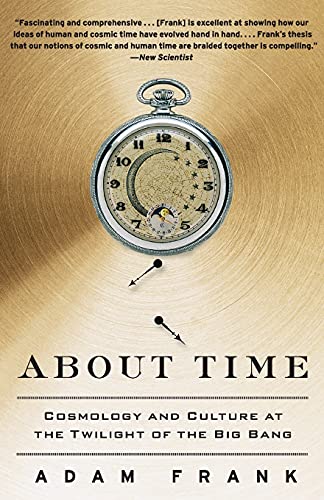
Now in paperback, “a phenomenal blend of science and cultural history” (Kirkus Reviews, starred review), About Time gives readers a peek into the cutting edge of cosmology, showing how it is intimately wedded to the texture of our daily lives.
Our universe’s “beginning” is at an end. What does this have to do with us, here on Earth? Everything. Our lives are about to be dramatically shaken—as altered as they were by the invention of the clock, the steam engine, the railroad, the radio and the Internet.
In About Time, astrophysicist Adam Frank allows us a peek into the cutting edge of cosmology, explaining how the texture of our lives changes along with our understanding of the universe’s origin. Since we awoke to self-consciousness fifty thousand years ago, our lived experience of time, from hunting and gathering to the invention of cell phones and electronic calendars, has been transformed and rebuilt many times. But the latest theories in cosmology—time with no beginning, parallel universes, eternal inflation—are about to send us in a new direction.
Time is both our grandest and most intimate conception of the universe. Frank tells the story of humanity’s deepest question—when and how did everything begin?—alongside the story of how human beings have experienced time, looking at the way our engagement with the world has allowed us to discover the nature of the universe and how those discoveries inform our daily experience. This astounding book will change the way we think about time and how it affects our lives.
Die Inhaltsangabe kann sich auf eine andere Ausgabe dieses Titels beziehen.
Über die Autorin bzw. den Autor
Adam Frank is Professor of Astrophysics at the University of Rochester and a regular contributor to Discover and Astronomy magazines. He has also written for Scientific American and many other publications and is the co-founder of NPR's 13:7 Cosmos & Culture blog. He was a Hubble Fellow and is the recipient of an American Astronomical Society Prize for his scientific writing.
Auszug. © Genehmigter Nachdruck. Alle Rechte vorbehalten.
About Time
Chapter 1
TALKING SKY, WORKING STONE AND LIVING FIELD
From Prehistory to the Agricultural Revolution
ABRI BLANCHARD: THE DORDOGNE, FRANCE • 20,000 BCE
The shaman stands before the opening of the cave and waits. Night is falling now and the piercing cold of autumn easily penetrates her animal-hide cloak. Outside, beyond the sheltering U-shaped bay of low cliff walls, the wind has picked up. These winds originated hundreds of miles to the north at the blue-white wall of glaciers that cover much of northern Europe.1
Winter is coming and the shaman’s people will have to move soon. The hides and supplies will be gathered and they will begin the trek toward the low-hanging sun and the warmer camps. But tonight the shaman’s mind is fixed on the present and she waits. It is her job to read the signs the living world provides. It is her job to know the turnings of Earth, animal and sky. The shaman’s people depend on this wisdom and so she waits to complete the task her mother suggested before she died. She waits, massaging the reindeer bone fragment in one hand and the pointed shard of flint in the other.
Now she sees it, the glow over the eastern horizon. The great mother rises. The shaman waits to see the moon’s face—pale, full of power. There, see! She is complete again.
From the crescent horns of many days ago, she has now returned, completed, to life. The full circle of the moon’s face, promising rebirth and renewal, has returned. The shaman holds the bone fragment before her in the gray light. With her index finger she traces out the long serpentine trail of her previous engravings on the bone. Then at the end of the trail she makes tonight’s mark with the flint-knife, carving the shape of tonight’s full moon into the hard bone.
Two rounds of the moon’s dying and rebirth have now been traced out. The shaman’s work is complete. The round of life and death in the sky, like the rounds of women’s bleeding, have been given form, remembered, noted and honored. She returns the bone to its place beneath the rocks where she keeps the other shamanic tools her mother gave her so long ago. Now she has added to the store, a marking of passages, that she will use and pass on to her own children.2
WANDERING TIME: THE PALEOLITHIC WORLD
The origins of human culture are saturated with time but we have only recently learned to see this truth. The evidence of the age when we grew into an awareness of ourselves, the cosmos and time itself had always been just out of reach. For most of our remembered history, the clues to the birth of culture and cultural time lay forgotten, buried a few feet below the ground. Then, in the late 1870s, the discoveries began and we started to remember.
We first encountered the great awakening of our consciousness in 1879 in Spain when the nine-year-old daughter of amateur archeologist Marcelino Sanz de Sautuola led him to a cave at Altamira. Venturing inside, he found its walls covered in vivid paintings now known to be twenty thousand years old. As archeologists began systematic explorations, new caves were discovered, many of them also covered in paintings. The caves are a bestiary: bear, bison and mastodon appear on the walls along with other species. Sometimes these animals appear alone. Other times they are in herds. Sometimes we appear too—human figures set against the herd, spear at the ready.
FIGURE 1.1. The Recognition of Time. The Abri Blanchard bone fragment (dating back between 12,000 to 20,000 BCE). Archeologist Alexander Marshack proposed that the distinct pattern of engravings was an early record of lunar cycles.
These paintings gave voice to a heretofore silent past, showing that early humans were anything but “savages” incapable of representation, abstraction or response. This vivid prehistory, the time before written records, was set into a temporal sequence through painstaking work across the twentieth century. Radiocarbon dating allowed scientists to see when each cave was inhabited and when the paintings were laid down. As the sequence became complete, scientists came to understand how rapidly our ancestors had reimagined what it meant to be human. With that recognition, conceptions of evolution and the origins of the human mind were thrown open. Scientists began searching for some purchase on a new theory that could explain how the mind rapidly woke to itself and to time.
Buried next to the painted walls, archeologists discovered artifacts worked by human hands. There were statues of women with wide hips, pendulous breasts and finely articulated vulvas, seeming to focus on the mysteries of fertility. Spear points, needles, flint daggers and hammers spoke of cultures skilled in the creation of a diverse set of tools for diverse needs. And on the floor of a cave at Abri Blanchard, a rock shelter in the Dordogne region of central France,3 archeologists found a “small flat ovoid piece of bone pockmarked with stokes and notches . . . just the right size to be held in the palm of the hand.”4
The Abri Blanchard artifact would sit in a French museum for decades until amateur archeologist Alexander Marshack chanced upon it. Marshack was a journalist hired by NASA in 1962 to recount the long human journey leading up to the Apollo moon landing program. In his efforts for NASA, Marshack dug so deeply into the history of astronomy, he found himself at the very dawn of human time. He first became obsessed with the Abri Blanchard bone when he encountered it, as part of his NASA project, in grainy illustrations of forgotten archeology tracts. Eventually traveling to the imposing Musée des Antiquités Nationales near Paris, he found the small artifact all but ignored in a “musty . . . stone chamber” among “accumulations of Upper Paleolithic materials, crowded under glass with their aged yellowing labels.”5
Marshack dedicated years of intense study to the Abri Blanchard bone fragment, rejecting the accepted wisdom that the notched carvings were nothing more than early artistic doodling. He traced over the curved trail of finely etched crescents and circles again and again. Finally he discovered a pattern echoing his own interests and his ongoing studies of the moon’s impact on human life, time and culture. In 1970 he published a closely reasoned and convincing argument that the etchings on the bone fragment were one of the earliest tallies of time’s passage, a two-month record of passing lunar phases.6 Rather than random doodles, the creator of the Abri Blanchard fragment had been marking time in a systematic way, for perhaps the first time ever.
In caves at other sites across the world, fragments of humanity’s first encounters with time were also found. Sticks with sequential notches, flat stones engraved with periodic engravings—each artifact gave testimony to an increasingly sophisticated temporal awareness.7 It was in those caves, tens of thousands of years ago, that the dawn of time broke in the human mind.8
Scientists call this era the Paleolithic—meaning “old stone age.” The origins of human culture (and human time) occurred during the so-called Upper Paleolithic, from roughly 43,000 to 10,000 BCE.9 All human beings during this period lived as hunter-gatherers and left us no written records of their thoughts (writing would have to wait until around 4000 BCE). Through painstaking analysis and considerable imagination, however, scientists have pieced together the outlines of the Paleolithic human universe. Using the artifacts found at sites around the world and the narratives of contemporary hunter-gatherers, scientists have gained some understanding of these first modern humans.
...
„Über diesen Titel“ kann sich auf eine andere Ausgabe dieses Titels beziehen.
Suchergebnisse für About Time: Cosmology and Culture at the Twilight of...

Beispielbild für diese ISBN
About Time
Anbieter: ThriftBooks-Dallas, Dallas, TX, USA
Verkäuferbewertung 5 von 5 Sternen

Paperback. Zustand: Very Good. No Jacket. May have limited writing in cover pages. Pages are unmarked. ~ ThriftBooks: Read More, Spend Less. Artikel-Nr. G1439169608I4N00
Gebraucht kaufen
EUR 5,96
Versand gratis
Versand innerhalb von USA
Versand innerhalb von USA
Anzahl: 1 verfügbar
Beispielbild für diese ISBN
About Time
Anbieter: ThriftBooks-Atlanta, AUSTELL, GA, USA
Verkäuferbewertung 5 von 5 Sternen
Paperback. Zustand: As New. No Jacket. Pages are clean and are not marred by notes or folds of any kind. ~ ThriftBooks: Read More, Spend Less. Artikel-Nr. G1439169608I2N00
Gebraucht kaufen
EUR 5,96
Versand gratis
Versand innerhalb von USA
Versand innerhalb von USA
Anzahl: 1 verfügbar
Beispielbild für diese ISBN
About Time
Anbieter: ThriftBooks-Reno, Reno, NV, USA
Verkäuferbewertung 5 von 5 Sternen
Paperback. Zustand: Very Good. No Jacket. May have limited writing in cover pages. Pages are unmarked. ~ ThriftBooks: Read More, Spend Less. Artikel-Nr. G1439169608I4N00
Gebraucht kaufen
EUR 5,96
Versand gratis
Versand innerhalb von USA
Versand innerhalb von USA
Anzahl: 1 verfügbar
Beispielbild für diese ISBN
About Time: Cosmology and Culture at the Twilight of the Big Bang
Anbieter: WorldofBooks, Goring-By-Sea, WS, Vereinigtes Königreich
Verkäuferbewertung 5 von 5 Sternen
Paperback. Zustand: Very Good. The book has been read, but is in excellent condition. Pages are intact and not marred by notes or highlighting. The spine remains undamaged. Artikel-Nr. GOR009671649
Gebraucht kaufen
EUR 20,87
EUR 6,63 Versand
Versand von Vereinigtes Königreich nach USA
Versand von Vereinigtes Königreich nach USA
Anzahl: 1 verfügbar
Beispielbild für diese ISBN
About Time: Cosmology and Culture at the Twilight of the Big Bang
Anbieter: Revaluation Books, Exeter, Vereinigtes Königreich
Verkäuferbewertung 5 von 5 Sternen
Paperback. Zustand: Brand New. reprint edition. 406 pages. 9.00x5.75x1.25 inches. In Stock. Artikel-Nr. x-1439169608
Neu kaufen
EUR 30,00
EUR 11,84 Versand
Versand von Vereinigtes Königreich nach USA
Versand von Vereinigtes Königreich nach USA
Anzahl: 2 verfügbar