
Verwandte Artikel zu Counterstrike: The Last World War, Book 2
Inhaltsangabe
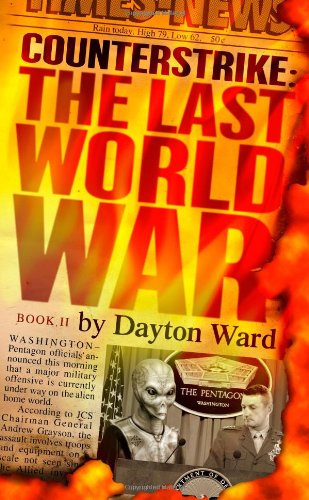
COUNTERSTRIKE
When the alien war engulfing a distant planet spilled to Earth through a network of hidden portals, humankind was plunged into an apocalyptic, generations-old conflict between the Plysserians and the Chodrecai. Now, months after Earth’s most powerful military forces formed a tenuous alliance with the Plysserians and countered a devastating, three-pronged Chodrecai offensive, alien survivors continue to wreak havoc on a shell-shocked Earth. Martial law and civil unrest run rampant. Resistance cells and pockets of Chodrecai sympathizers are gathering strength. And two U.S. Marines—Sergeant Major Simon DiCarlo and Sergeant Belinda Russell— remain trapped on the alien planet of Jontashreena.
Now, as human and Plysserian scientists and engineers race to unlock the intergalactic portals and harvest alien technology, Earth prepares for the most explosive battle for its existence. Joining the war effort are recruits like young Colin Laney, who will advance from Marine boot camp to the forefront of a massive invasion on alien terrain—with the fate of two worlds hanging in the balance.
Die Inhaltsangabe kann sich auf eine andere Ausgabe dieses Titels beziehen.
Über die Autorin bzw. den Autor
Dayton Ward is the New York Times bestselling author or co-author of nearly forty novels and novellas, often working with his best friend, Kevin Dilmore. His short fiction has appeared in more than twenty anthologies, and he’s written for magazines such as NCO Journal, Kansas City Voices, Famous Monsters of Filmland, Star Trek, and Star Trek Communicator, as well as the websites Tor.com, StarTrek.com, and Syfy.com. A native of Tampa, Florida, he currently lives in Kansas City, Missouri with his wife and two daughters. Visit him on the web at DaytonWard.com.
Auszug. © Genehmigter Nachdruck. Alle Rechte vorbehalten.
1
Corporal Bradley Gardner did not see the lone Chodrecai soldier, at least not until the damned thing was ready to frag his ass.
“Gardner! On your nine!”
Reacting to the warning from somewhere behind him, Gardner spun to his left in time to see the wounded alien warrior rising from beneath smoldering wreckage, bringing up the pulse rifle it carried in its bulky, muscled arms. Its pale gray skin was darkened with ash and soot. Shreds of burned skin and muscle hung from its left arm, injuries no doubt resulting from the fuel-air bombs that had blanketed the area less than thirty minutes earlier. It appeared to Gardner that the alien’s molded body armor had melted in places, perhaps even fusing to the Chodrecai’s exposed, scorched skin. How the thing managed to stay on its feet was beyond him.
Then none of that mattered as the gaping muzzle of the soldier’s pulse rifle rose to point in his direction.
Gardner fired without really aiming, the oversized Plysserian weapon bucking in his hands as it belched energy. The air whined in his ears and a bolt of displaced air crossed the space separating him from the Chodrecai, striking the wounded alien in its broad chest and sending it staggering backward. It tripped over a piece of flame-riddled debris and fell, toppling to the blackened ground.
“Get down!” another voice shouted, this time from somewhere to Gardner’s right, and the corporal dropped instinctively to one knee as figures rushed past him. Leveling his pulse rifle at the fallen Chodrecai, he watched as fellow Marines closed on its position, training their own weapons on it. Someone yelled at the soldier in its native language, ordering the alien to remain still and offer no resistance.
“Nice shot, Gardner,” a gravelly voice said from behind him, and Gardner looked up to see Gunnery Sergeant Kelley Owens, his platoon leader. The imposing African-American man’s eyes bored into him from beneath the brim of his floppy green camouflage boonie hat. “Almost makes up for you sleepwalking through the area. You looking to get your ticket punched, or what?”
Rising to his feet, Gardner felt his face flush in embarrassment as he watched fellow Marines take the wounded Chodrecai soldier into custody. “Sorry, Gunny. I was too busy looking for anything we might salvage. I screwed up.” It had been a boot mistake, the kind of error Gardner might have made what seemed like a lifetime ago, when he was nothing more than a full-time hospital payroll administrator back in Kansas City and a part-time Marine reservist.
A lifetime ago, before the war had come.
From somewhere off to his right, Gardner heard more weapons fire and turned to see other Marines—some wielding pulse rifles like his own while others carried M4A1 carbines—converging on another Chodrecai warrior, this one appearing uninjured as it lunged from behind the burnt-out shell of a collapsible shelter. The alien was firing on the run, lumbering toward the protective cover of the forest surrounding the glade where the Chodrecai had made their encampment. Gardner flinched as one Marine caught the full brunt of the alien’s weapon, everything above his waist disintegrating in a cloud of blood, skin, bone, and clothing fragments. What remained of the man fell to the ground as his companions pressed forward, catching the Chodrecai in a cross fire until the alien soldier collapsed in the onslaught.
“Damn it,” Owens said, shaking his head as he and Gardner made their way over to the fallen Marine. Gardner’s stomach lurched at the sight, one he had already seen far too many times in the months that had passed since the arrival of the Plysserians and their enemies, the Chodrecai. Using the muzzle of his pulse rifle to turn the dead Marine’s largely uninjured lower body onto its front, Owens reached down and moved aside a piece of shredded camouflage uniform to read the name tape stitched above one back pocket. “Meade,” he read. “Shit.” Looking to Gardner, he asked, “Did you know him?”
Gardner replied, “Not well. We played poker a few times.” It was a reality of the life he now lived that he did not form close friendships with most of the people with whom he came in contact. That was a consequence of his frequent transfers from unit to unit around the country, as well as occasional trips abroad, thanks to the rather specialized knowledge he mostly by accident had come to possess.
Yeah. Lucky me.
Owens was walking across the scorched ground looking around the glade and the burnt remains of what had been the Chodrecai encampment. Wreckage still smoldered here and there, but some of the Marines already were seeing to the small fires, some kicking dirt on the flames while others used entrenching tools—military folding shovels—to take care of the larger fires. “Doesn’t look like the Air Force left much of anything,” the gunny said.
“Probably not,” Gardner conceded, reaching up to wipe sweat from his forehead. The pair of B-2 stealth bombers dispatched to sanitize this target had done so with their usual effectiveness, all but obliterating the encampment with surgical precision.
“Recognize anything that might be a portal generator?” Owens asked.
Gardner shook his head. Very little of whatever equipment and materiel staged at this location had survived the B-2 bombardment. He pointed toward a larger, curved structure, similar in design to the old Quonset huts he remembered from boot camp at the recruit training base in San Diego. Only a portion of one curved wall still stood, the rest of the structure having been consumed by fire. “That looks like it was the only thing large enough to house it,” Gardner said, “but it got hammered pretty good. I’ll be surprised if there’s anything salvageable in there.”
The camp’s location had been pinpointed less than a day earlier, deep in an expansive, largely uninhabited area of Pacific Northwest forest in Oregon. Orbiting satellites had detected the energy output of what was believed to be the power source for yet another in a series of portals that had been opened between Earth and Jontashreena.
“According to the satellite imagery they gave us,” Owens said, “whatever generator they had here could only have been operational for thirteen or fourteen hours. Still plenty of time to move troops and equipment through.” Giving the area another look, he added, “And I have to say, I don’t see that much stuff lying around here.”
“If they stuck to usual Gray tactics, they’ve scattered,” Gardner replied, using the nickname bestowed upon the Chodrecai during his first encounter in southwestern Missouri with members of the alien race, in response to their pallid skin pigmentation. He waved his left hand to indicate the surrounding Oregonian forest. “They could be anywhere out there. Besides us and maybe Bigfoot, there’s nobody for miles.”
From behind him, a deep voice said, “We must also remember that the Chodrecai who built the generator here had to have arrived via another portal.”
Gardner and Owens turned to see the towering figure of Makoquolax, a Plysserian soldier. He was dressed in a formfitting dark uniform, over which he wore a vest comprised of interconnected armor plates, along with an equipment harness. Large, oval-shaped black eyes peered out from beneath a protruding brow, and small holes occupied the locations where ears or a nose would be on a human head. The pale gray skin of his exposed arms and bald head were...
„Über diesen Titel“ kann sich auf eine andere Ausgabe dieses Titels beziehen.
Suchergebnisse für Counterstrike: The Last World War, Book 2

Beispielbild für diese ISBN
Counterstrike: The Last World War, Book 2
Anbieter: World of Books (was SecondSale), Montgomery, IL, USA
Verkäuferbewertung 5 von 5 Sternen

Zustand: Good. Synopsis coming soon. Artikel-Nr. 00101055725
Gebraucht kaufen
EUR 7,32
Versand gratis
Versand innerhalb von USA
Versand innerhalb von USA
Anzahl: 1 verfügbar
Beispielbild für diese ISBN
Counterstrike: The Last World War, Book 2
Anbieter: ThriftBooks-Dallas, Dallas, TX, USA
Verkäuferbewertung 5 von 5 Sternen
Unknown. Zustand: Fair. No Jacket. Readable copy. Pages may have considerable notes/highlighting. ~ ThriftBooks: Read More, Spend Less. Artikel-Nr. G1439167745I5N00
Gebraucht kaufen
EUR 7,55
Versand gratis
Versand innerhalb von USA
Versand innerhalb von USA
Anzahl: 1 verfügbar
Beispielbild für diese ISBN
Counterstrike: The Last World War, Book 2
Anbieter: ThriftBooks-Reno, Reno, NV, USA
Verkäuferbewertung 5 von 5 Sternen
Unknown. Zustand: Fair. No Jacket. Readable copy. Pages may have considerable notes/highlighting. ~ ThriftBooks: Read More, Spend Less. Artikel-Nr. G1439167745I5N00
Gebraucht kaufen
EUR 7,55
Versand gratis
Versand innerhalb von USA
Versand innerhalb von USA
Anzahl: 1 verfügbar
Beispielbild für diese ISBN
Counterstrike: The Last World War, Book 2
Anbieter: ThriftBooks-Phoenix, Phoenix, AZ, USA
Verkäuferbewertung 5 von 5 Sternen
Unknown. Zustand: Fair. No Jacket. Readable copy. Pages may have considerable notes/highlighting. ~ ThriftBooks: Read More, Spend Less. Artikel-Nr. G1439167745I5N00
Gebraucht kaufen
EUR 7,55
Versand gratis
Versand innerhalb von USA
Versand innerhalb von USA
Anzahl: 1 verfügbar
Beispielbild für diese ISBN
Counterstrike: The Last World War, Book 2
Anbieter: ThriftBooks-Dallas, Dallas, TX, USA
Verkäuferbewertung 5 von 5 Sternen
Unknown. Zustand: Good. No Jacket. Pages can have notes/highlighting. Spine may show signs of wear. ~ ThriftBooks: Read More, Spend Less. Artikel-Nr. G1439167745I3N00
Gebraucht kaufen
EUR 7,55
Versand gratis
Versand innerhalb von USA
Versand innerhalb von USA
Anzahl: 1 verfügbar
Beispielbild für diese ISBN
Counterstrike: The Last World War, Book 2
Anbieter: ThriftBooks-Atlanta, AUSTELL, GA, USA
Verkäuferbewertung 5 von 5 Sternen
Unknown. Zustand: Fair. No Jacket. Readable copy. Pages may have considerable notes/highlighting. ~ ThriftBooks: Read More, Spend Less. Artikel-Nr. G1439167745I5N00
Gebraucht kaufen
EUR 7,55
Versand gratis
Versand innerhalb von USA
Versand innerhalb von USA
Anzahl: 1 verfügbar
Beispielbild für diese ISBN
Counterstrike: the Last World War, Book 2
Anbieter: Better World Books, Mishawaka, IN, USA
Verkäuferbewertung 5 von 5 Sternen
Zustand: Good. 0th Edition. Pages intact with minimal writing/highlighting. The binding may be loose and creased. Dust jackets/supplements are not included. Stock photo provided. Product includes identifying sticker. Better World Books: Buy Books. Do Good. Artikel-Nr. 11437366-75
Gebraucht kaufen
EUR 10,07
Versand gratis
Versand innerhalb von USA
Versand innerhalb von USA
Anzahl: 1 verfügbar
Beispielbild für diese ISBN
Counterstrike: The Last World War, Book 2
Anbieter: Wonder Book, Frederick, MD, USA
Verkäuferbewertung 5 von 5 Sternen
Zustand: As New. Like New condition. Volume 2 A near perfect copy that may have very minor cosmetic defects. Artikel-Nr. I05L-01743
Gebraucht kaufen
EUR 131,61
Versand gratis
Versand innerhalb von USA
Versand innerhalb von USA
Anzahl: 1 verfügbar
Beispielbild für diese ISBN
Counterstrike
Anbieter: Revaluation Books, Exeter, Vereinigtes Königreich
Verkäuferbewertung 5 von 5 Sternen
Mass Market Paperback. Zustand: Brand New. original edition. 512 pages. 6.75x4.25x1.25 inches. In Stock. Artikel-Nr. 1439167745
Neu kaufen
EUR 418,95
EUR 11,73 Versand
Versand von Vereinigtes Königreich nach USA
Versand von Vereinigtes Königreich nach USA
Anzahl: 1 verfügbar