
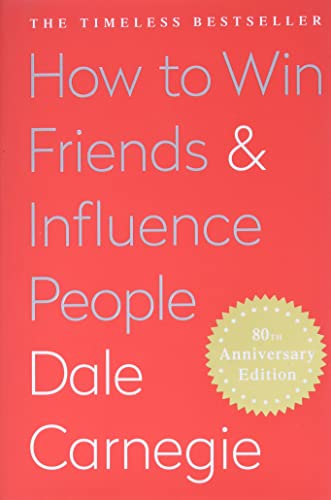
Verwandte Artikel zu How to Win Friends AND Influence People by Dale Carnegie
Inhaltsangabe
• One of the best known motivational books in history: Since it was released in 1936, How to Win Friends and Influence People has sold more than 15 million copies. Carnegie’s first book is timeless and appeals equally to business audiences, self-help audiences, and general readers alike.. • Proven advice for success in life: Carnegie believed that most successes come from an ability to communicate effectively rather than from brilliant insights. His book teaches these skills by showing readers how to value others and make them feel appreciated rather than manipulated. . • As relevant as ever before: In the age of Steven Covey and Tony Robbins, Dale Carnegie’s principles endure. The original edition was published in response to the Great Depression, and this fresh hardcover edition will appeal now more than ever to readers wanting tried and true advice on how to deal with a depressed economy. Readers can learn how to get the job they want, improve the job they have, and make the best of any situation. . Editorial Reviews Amazon.com Review This grandfather of all people-skills books was first published in 1937. It was an overnight hit, eventually selling 15 million copies. How to Win Friends and Influence People is just as useful today as it was when it was first published, because Dale Carnegie had an understanding of human nature that will never be outdated. Financial success, Carnegie believed, is due 15 percent to professional knowledge and 85 percent to "the ability to express ideas, to assume leadership, and to arouse enthusiasm among people." He teaches these skills through underlying principles of dealing with people so that they feel important and appreciated. He also emphasizes fundamental techniques for handling people without making them feel manipulated. Carnegie says you can make someone want to do what you want them to by seeing the situation from the other person's point of view and "arousing in the other person an eager want." You learn how to make people like you, win people over to your way of thinking, and change people without causing offense or arousing resentment. For instance, "let the other person feel that the idea is his or hers," and "talk about your own mistakes before criticizing the other person." Carnegie illustrates his points with anecdotes of historical figures, leaders of the business world, and everyday folks. --Joan Price --This text refers to the Mass Market Paperback edition. Review "it changed my life" Warren Buffet "The most successful self-help book of all time... Carnegie has never seemed more relevant" The Times "It's helped me immeasurably in life. I think everyone should read it" Jenny Colgan, Independent on Sunday 20090607 "a no-nonsense guide to being a better person...an easy-to-read, practical guide" Spirit and Destiny.
Die Inhaltsangabe kann sich auf eine andere Ausgabe dieses Titels beziehen.
Über die Autorin bzw. den Autor
Dale Carnegie (1888–1955) described himself as a “simple country boy” from Missouri but was also a pioneer of the self-improvement genre. Since the 1936 publication of his first book, How to Win Friends and Influence People, he has touched millions of readers and his classic works continue to impact lives to this day. Visit DaleCarnegie.com for more information.
Auszug. © Genehmigter Nachdruck. Alle Rechte vorbehalten.
Chapter 1
"If You Want to Gather Honey, Don't Kick Over the Beehive"
On May 7, 1931, the most sensational manhunt New York City had ever known had come to its climax. After weeks of search, "Two Gun" Crowley -- the killer, the gunman who didn't smoke or drink -- was at bay, trapped in his sweetheart's apartment on West End Avenue.
One hundred and fifty policemen and detectives laid siege to his top-floor hideaway. They chopped holes in the roof; they tried to smoke out Crowley, the "cop killer," with tear gas. Then they mounted their machine guns on surrounding buildings, and for more than an hour one of New York's fine residential areas reverberated with the crack of pistol fire and therat-tat-tat of machine guns. Crowley, crouching behind an overstuffed chair, fired incessantly at the police. Ten thousand excited people watched the battle. Nothing like it had ever been seen before on the sidewalks of New York.
When Crowley was captured, Police Commissioner E. P. Mulrooney declared that the two-gun desperado was one of the most dangerous criminals ever encountered in the history of New York. "He will kill," said the Commissioner, "at the drop of a feather."
But how did "Two Gun" Crowley regard himself? We know, because while the police were firing into his apartment, he wrote a letter addressed "To whom it may concern." And, as he wrote, the blood flowing from his wounds left a crimson trail on the paper. In his letter Crowley said: "Under my coat is a weary heart, but a kind one -- one that would do nobody any harm."
A short time before this, Crowley had been having a necking party with his girl friend on a country road out on Long Island. Suddenly a policeman walked up to the car and said: "Let me see your license."
Without saying a word, Crowley drew his gun and cut the policeman down with a shower of lead. As the dying officer fell, Crowley leaped out of the car, grabbed the officer's revolver, and fired another bullet into the prostrate body. And that was the killer who said: "Under my coat is a weary heart, but a kind one -- one that would do nobody any harm."
Crowley was sentenced to the electric chair. When he arrived at the death house in Sing Sing, did he say, "This is what I get for killing people"? No, he said: "This is what I get for defending myself."
The point of the story is this: "Two Gun" Crowley didn't blame himself for anything.
Is that an unusual attitude among criminals? If you think so, listen to this:
"I have spent the best years of my life giving people the lighter pleasures, helping them have a good time, and all I get is abuse, the existence of a hunted man."
That's Al Capone speaking. Yes, America's most notorious Public Enemy -- the most sinister gang leader who ever shot up Chicago. Capone didn't condemn himself. He actually regarded himself as a public benefactor -- an unappreciated and misunderstood public benefactor.
And so did Dutch Schultz before he crumpled up under gangster bullets in Newark. Dutch Schultz, one of New York's most notorious rats, said in a newspaper interview that he was a public benefactor. And he believed it.
I have had some interesting correspondence with Lewis Lawes, who was warden of New York's infamous Sing Sing prison for many years, on this subject, and he declared that "few of the criminals in Sing Sing regard themselves as bad men. They are just as human as you and I. So they rationalize, they explain. They can tell you why they had to crack a safe or be quick on the trigger finger. Most of them attempt by a form of reasoning, fallacious or logical, to justify their antisocial acts even to themselves, consequently stoutly maintaining that they should never have been imprisoned at all."
If Al Capone, "Two Gun" Crowley, Dutch Schultz, and the desperate men and women behind prison walls don't blame themselves for anything -- what about the people with whom you and I come in contact?
John Wanamaker, founder of the stores that bear his name, once confessed: "I learned thirty years ago that it is foolish to scold. I have enough trouble overcoming my own limitations without fretting over the fact that God has not seen fit to distribute evenly the gift of intelligence."
Wanamaker learned this lesson early, but I personally had to blunder through this old world for a third of a century before it even began to dawn upon me that ninety-nine times out of a hundred, people don't criticize themselves for anything, no matter how wrong it may be.
Criticism is futile because it puts a person on the defensive and usually makes him strive to justify himself. Criticism is dangerous, because it wounds a person's precious pride, hurts his sense of importance, and arouses resentment.
B. F. Skinner, the world-famous psychologist, proved through his experiments that an animal rewarded for good behavior will learn much more rapidly and retain what it learns far more effectively than an animal punished for bad behavior. Later studies have shown that the same applies to humans. By criticizing, we do not make lasting changes and often incur resentment.
Hans Selye, another great psychologist, said, "As much as we thirst for approval, we dread condemnation."
The resentment that criticism engenders can demoralize employees, family members and friends, and still not correct the situation that has been condemned.
George B. Johnston of Enid, Oklahoma, is the safety coordinator for an engineering company. One of his responsibilities is to see that employees wear their hard hats whenever they are on the job in the field. He reported that whenever he came across workers who were not wearing hard hats, he would tell them with a lot of authority of the regulation and that they must comply. As a result he would get sullen acceptance, and often after he left, the workers would remove the hats.
He decided to try a different approach. The next time he found some of the workers not wearing their hard hat, he asked if the hats were uncomfortable or did not fit properly. Then he reminded the men in a pleasant tone of voice that the hat was designed to protect them from injury and suggested that it always be worn on the job. The result was increased compliance with the regulation with no resentment or emotional upset.
You will find examples of the futility of criticism bristling on a thousand pages of history. Take, for example, the famous quarrel between Theodore Roosevelt and President Taft -- a quarrel that split the Republican party, put Woodrow Wilson in the White House, and wrote bold, luminous lines across the First World War and altered the flow of history. Let's review the facts quickly. When Theodore Roosevelt stepped out of the White House in 1908, he supported Taft, who was elected President. Then Theodore Roosevelt went off to Africa to shoot lions. When he returned, he exploded. He denounced Taft for his conservatism, tried to secure the nomination for a third term himself, formed the Bull Moose party, and all but demolished the G.O.P. In the election that followed, William Howard Taft and the Republican party carried only two states -- Vermont and Utah. The most disastrous defeat the party had ever known.
Theodore Roosevelt blamed Taft, but did President Taft blame himself? Of course not. With tears in his eyes, Taft said: "I don't see how I could have done any differently from what I have."
Who was to blame? Roosevelt or Taft? Frankly, I don't know, and I don't care. The point I am trying to make is that all of Theodore Roosevelt's criticism didn't persuade Taft that he was wrong. It merely made Taft strive to justify himself and...
„Über diesen Titel“ kann sich auf eine andere Ausgabe dieses Titels beziehen.
Suchergebnisse für How to Win Friends AND Influence People by Dale Carnegie

Foto des Verkäufers
How to Win Friends AND Influence People by Dale Carnegie
Anbieter: Dream Books Co., Denver, CO, USA
Verkäuferbewertung 5 von 5 Sternen

Zustand: acceptable. This copy has clearly been enjoyedâ"expect noticeable shelf wear and some minor creases to the cover. Binding is strong, and all pages are legible. May contain previous library markings or stamps. Artikel-Nr. 4EKGY3007RD5_ns
Gebraucht kaufen
EUR 4,25
Versand gratis
Versand innerhalb von USA
Versand innerhalb von USA
Anzahl: 2 verfügbar
Foto des Verkäufers
How to Win Friends AND Influence People by Dale Carnegie
Anbieter: Dream Books Co., Denver, CO, USA
Verkäuferbewertung 5 von 5 Sternen
Zustand: very_good. Pages are clean with no markings. May show minor signs of wear or cosmetic defects marks, cuts, bends, or scuffs on the cover, spine, pages, or dust jacket. May have remainder marks on edges. Artikel-Nr. DBV.1439167346.VG
Gebraucht kaufen
EUR 4,53
Versand gratis
Versand innerhalb von USA
Versand innerhalb von USA
Anzahl: 1 verfügbar
Foto des Verkäufers
How to Win Friends AND Influence People by Dale Carnegie
Anbieter: Dream Books Co., Denver, CO, USA
Verkäuferbewertung 5 von 5 Sternen
Zustand: good. Gently used with minimal wear on the corners and cover. A few pages may contain light highlighting or writing, but the text remains fully legible. Dust jacket may be missing, and supplemental materials like CDs or codes may not be included. May be ex-library with library markings. Ships promptly! Artikel-Nr. DBV.1439167346.G
Gebraucht kaufen
EUR 5,90
Versand gratis
Versand innerhalb von USA
Versand innerhalb von USA
Anzahl: 4 verfügbar
Beispielbild für diese ISBN
How to Win Friends and Influence People
Anbieter: ThriftBooks-Reno, Reno, NV, USA
Verkäuferbewertung 5 von 5 Sternen
Hardcover. Zustand: Good. No Jacket. Pages can have notes/highlighting. Spine may show signs of wear. ~ ThriftBooks: Read More, Spend Less. Artikel-Nr. G1439167346I3N00
Gebraucht kaufen
EUR 5,95
Versand gratis
Versand innerhalb von USA
Versand innerhalb von USA
Anzahl: 16 verfügbar
Beispielbild für diese ISBN
How to Win Friends and Influence People
Anbieter: ThriftBooks-Dallas, Dallas, TX, USA
Verkäuferbewertung 5 von 5 Sternen
Hardcover. Zustand: Very Good. No Jacket. Missing dust jacket; May have limited writing in cover pages. Pages are unmarked. ~ ThriftBooks: Read More, Spend Less. Artikel-Nr. G1439167346I4N01
Gebraucht kaufen
EUR 5,95
Versand gratis
Versand innerhalb von USA
Versand innerhalb von USA
Anzahl: 4 verfügbar
Beispielbild für diese ISBN
How to Win Friends and Influence People
Anbieter: ThriftBooks-Atlanta, AUSTELL, GA, USA
Verkäuferbewertung 5 von 5 Sternen
Hardcover. Zustand: Good. No Jacket. Former library book; Pages can have notes/highlighting. Spine may show signs of wear. ~ ThriftBooks: Read More, Spend Less. Artikel-Nr. G1439167346I3N10
Gebraucht kaufen
EUR 5,95
Versand gratis
Versand innerhalb von USA
Versand innerhalb von USA
Anzahl: 4 verfügbar
Beispielbild für diese ISBN
How to Win Friends and Influence People
Anbieter: ThriftBooks-Phoenix, Phoenix, AZ, USA
Verkäuferbewertung 5 von 5 Sternen
Hardcover. Zustand: Good. No Jacket. Missing dust jacket; Pages can have notes/highlighting. Spine may show signs of wear. ~ ThriftBooks: Read More, Spend Less. Artikel-Nr. G1439167346I3N01
Gebraucht kaufen
EUR 5,95
Versand gratis
Versand innerhalb von USA
Versand innerhalb von USA
Anzahl: 4 verfügbar
Beispielbild für diese ISBN
How to Win Friends and Influence People
Anbieter: ThriftBooks-Atlanta, AUSTELL, GA, USA
Verkäuferbewertung 5 von 5 Sternen
Hardcover. Zustand: Fair. No Jacket. Missing dust jacket; Readable copy. Pages may have considerable notes/highlighting. ~ ThriftBooks: Read More, Spend Less. Artikel-Nr. G1439167346I5N01
Gebraucht kaufen
EUR 5,95
Versand gratis
Versand innerhalb von USA
Versand innerhalb von USA
Anzahl: 2 verfügbar
Beispielbild für diese ISBN
How to Win Friends and Influence People
Anbieter: ThriftBooks-Reno, Reno, NV, USA
Verkäuferbewertung 5 von 5 Sternen
Hardcover. Zustand: Very Good. No Jacket. May have limited writing in cover pages. Pages are unmarked. ~ ThriftBooks: Read More, Spend Less. Artikel-Nr. G1439167346I4N00
Gebraucht kaufen
EUR 5,95
Versand gratis
Versand innerhalb von USA
Versand innerhalb von USA
Anzahl: Mehr als 20 verfügbar
Beispielbild für diese ISBN
How to Win Friends and Influence People
Anbieter: ThriftBooks-Phoenix, Phoenix, AZ, USA
Verkäuferbewertung 5 von 5 Sternen
Hardcover. Zustand: Fair. No Jacket. Readable copy. Pages may have considerable notes/highlighting. ~ ThriftBooks: Read More, Spend Less. Artikel-Nr. G1439167346I5N00
Gebraucht kaufen
EUR 5,95
Versand gratis
Versand innerhalb von USA
Versand innerhalb von USA
Anzahl: 3 verfügbar