
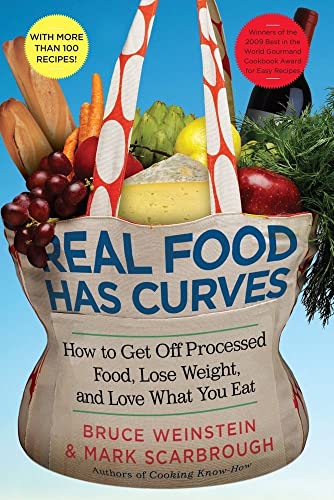
Verwandte Artikel zu Real Food Has Curves: How to Get Off Processed Food,...
Inhaltsangabe
CURVE YOUR APPETITE.
Dumping the fake stuff and relishing real food will make you feel better, help you drop pounds, and most importantly, take all the fear out of what you eat. Does that sound too good to be true? It isn’t—despite the fact that lately we’ve given up ripe vegetables for the canned stuff; tossed out sweet, tart orange juice for pasteurized concentrate; traded fresh fish for boil-in-a-bag dinners; and replaced real desserts with supersweet snacks that make us feel ridiculously overfed but definitely disappointed. The result? Most of us are overweight or obese—or heading that way; more and more of us suffer from diabetes, clogged arteries, and even bad knees. We eat too much of the fake stuff, yet we’re still hungry. And not satisfied.
Who hasn’t tried to change all that? Who hasn’t walked into a supermarket and thought, I’m going to eat better from now on? So you load your cart with whole-grain crackers, fish fillets, and asparagus. Sure, you have a few barely satisfying meals before you think, Hey, life’s too short for this! And soon enough, you’re back to square one. For real change, you need a real plan. It’s in your hands.
Real Food Has Curves is a fun and ultimately rewarding seven-step journey to rediscover the basic pleasure of fresh, well-prepared natural ingredients: curvy, voluptuous, juicy, sweet, savory. And yes, scrumptious, too. In these simple steps—each with its own easy, delicious recipes—you’ll learn to become a better shopper, savor your meals, and eat your way to a better you. Yes, you’ll drop pounds. But you won’t be counting calories. Instead, you’ll learn to celebrate the abundance all around. It’s time to realize that food is not the enemy but a life-sustaining gift. It’s time to get off the processed and packaged merry-go-round. It’s time to be satisfied, nourished, thinner, and above all, happier. It’s time for real food.
Shape your waist, rediscover real food, and find new pleasure in every meal as Bruce Weinstein and Mark Scarbrough teach you how to:
• Eat to be satisfied
• Recognize the fake and kick it to the curb
• Learn to relish the big flavors you’d forgotten
• Get healthier and thinner
• Save money and time in your food budget
• Decode the lies of deprivation diets
• Relish every minute, every bite, and all of life
REAL FOOD. REAL CHANGE. REAL EASY.
Die Inhaltsangabe kann sich auf eine andere Ausgabe dieses Titels beziehen.
Über die Autorinnen und Autoren
BRUCE WEINSTEIN and MARK SCARBROUGH are the authors of nineteen books about food, including Real Food Has Curves; the bestselling, multi-volume Ultimate Cook Book series; Ham: An Obsession with the Hindquarter; Goat: Meat, Milk, Cheese; and Cooking Know-How, winner of a 2009 Gourmand World Award. They are online columnists for Weight Watchers ("A Cut Above"), have been spokespeople for the U. S. Potato Board and the California Milk Advisory Board, and regularly contribute to Fine Cooking, Cooking Light, Eating Well, Relish, and The Washington Post. They live in Litchfield County, Connecticut.
BRUCE WEINSTEIN and MARK SCARBROUGH are the authors of nineteen books about food, including Real Food Has Curves; the bestselling, multi-volume Ultimate Cook Book series; Ham: An Obsession with the Hindquarter; Goat: Meat, Milk, Cheese; and Cooking Know-How, winner of a 2009 Gourmand World Award. They are online columnists for Weight Watchers ("A Cut Above"), have been spokespeople for the U. S. Potato Board and the California Milk Advisory Board, and regularly contribute to Fine Cooking, Cooking Light, Eating Well, Relish, and The Washington Post. They live in Litchfield County, Connecticut.
Auszug. © Genehmigter Nachdruck. Alle Rechte vorbehalten.
Real Food Has Curves
STEP
1
Learn the Secrets to Satisfaction
WHAT WILL YOU DO?
Bite into a tasty peach
Connect memory to taste
Eat with several senses at once
Relish chewing
WHAT WILL YOU DISCOVER?
The complexity of our sense of taste
Flavor overtones
The necessity—and the trap—of a bolus
The basic textures of food
Eat a Peach
A ripe, irresistible peach is one of nature’s better pleasures. Our first step is to celebrate it.
How do you find a great peach? Begin with your nose. If a peach doesn’t smell like anything, it won’t taste like anything. Search for that tantalizing fragrance. The best peach might not be the first one that comes to hand. Dig in the bin; smell the peaches one by one, particularly at the ends where their stems once were.
Got one with an unbelievable perfume? Look at it for a second. See that rosy blush over the dappled yellow? That’s a sign you’ve chosen well.
Now gently squeeze the fruit. Although it’s heavy to the hand, there’s a delicate give beneath the skin—nothing squishy, just a little fragile, stocked with juice.
Once you’ve chosen (and paid for!) that peach, take a bite. Don’t be shy. The juice bursts from the pulp, pooling in the corners of your mouth.
Chew a few times, then gently push what’s in your mouth up against your hard palate, the roof of your mouth right behind your front teeth. Take a slow breath to draw in that sweet fragrance.
Swallow and take another bite. Because the miracle wasn’t really that peach. It’s what happened to you. You just took a step away from all that is processed, packaged, low nutrition, and poor quality. You just started down the road to enjoying food more, weighing less, and being more content with your life.
All that from tasting a peach? Absolutely.
Taste: A Seriously Underrated Sense
When we taste something wonderful, we experience some familiar physical reactions: the saliva in our mouths and a gurgle in our stomachs. But other, less familiar reactions are even more important: released chemicals in our brains set us up for both anticipation and its coming fulfillment in the neurons all along our digestive tracks, from our mouths to our stomachs and beyond.1 If we take into account the run of chemical changes among those receptors, as well as the targeted preparations from our brains to our pancreases, taste’s only rival may well be sexual arousal.
We don’t even need a peach. If we imagine it, our brains instantly release those chemicals that drive us to find one and relish it. MRI scans prove that when we think of a specific food, our brains light up the same way they do when we’re eating it.2
As you were reading about our perfect peach, you probably started salivating. Your brain was just doing its job: priming you for a peach although there were none in sight, not the slightest whiff of the fruit, just some words on a page.
Go Get Some Peaches
Put down this book and fulfill that desire. But don’t just get one. Get a bunch. After you’ve tasted that peach to find the ways it connects to deeper pleasures in your mind, try one or both of these recipes.
Don’t worry about changing any other food choices in your life. Keep doing what you’re doing. Just focus on that peach—as well as these ways to upgrade its flavors. You’ll notice that the recipes at the start of our journey are simple. We want to focus on tasting elemental flavors.
And one more thing: since you’re going to be doing some cooking on your journey to real food, Bruce and I should offer you a few tips for kitchen success:
1. Before you begin a recipe, read it through, headnotes and all.
2. In general, Bruce’s recipes call for ingredients the way you find them at your supermarket (for example, 2 celery stalks). However, when less than a whole is called for, the ingredient is measured out (like ¼ cup diced red onion).
3. Before you put a pot over the fire, gather your ingredients and put them out on the counter.
4. Make sure you’ve prepared the ingredients themselves. If the recipe says 1 medium yellow onion, chopped, it’s telling you that chopping will not be a part of the recipe itself. In other words, chop before you cook. By the way, chopped, diced, and minced are not clichés but real directions:
• Roughly chopped yields uneven pieces up to 1 inch wide;
• chopped, slightly smaller but also more uniform pieces, about ¾ inch on each side;
• cubed, small, ½-inch cubes;
• finely chopped, smaller still but less precise, about ¼-inch pieces;
• diced, ¼-inch cubes; and
• minced, the smallest of all, less than 1/8 inch, usually made by rocking a knife through an ingredient.
5. It’s better to make substitutions and changes the second time you make a recipe.
FRESH PEACH SALSA
There are no tomatoes here, just sweet peaches. Tomatoes are firmer and almost meatier; by contrast, peaches offer a luxurious richness. That said, if you can’t find a good peach, go for plums, apricots, or nectarines. Try this easy salsa on top of a baked potato with a dollop of sour cream or alongside some rotisseried chicken picked up at the market. Keep connecting the taste of those peaches to pleasure in your brain.
1½ pounds ripe medium peaches, pitted and diced (about 4 or 5 peaches)
Up to 1 medium fresh jalapeño chile, seeded and minced
½ cup red bell pepper, seeded and diced (see Note)
½ cup red onion, diced
3 tablespoons minced cilantro leaves, 2½ tablespoons stemmed thyme leaves, or 2 tablespoons minced mint leaves
2 tablespoons lime juice
½ teaspoon ground cumin
½ teaspoon salt
Stir everything together in a serving bowl. If you want to make the salsa ahead of time, omit the salt and store the mixture, covered, in the fridge for up to 2 days. Salt will leach liquid from the mixture, turning it watery during storage—so stir in the salt at the last minute.
Note: To seed and core a bell pepper, stand it up on your cutting board with the stem end facing up. Holding the stem, use a large knife to slice one side off the pepper, leaving the seeds attached to the core. Continue making more slices around the pepper, always leaving the seeds and core intact. Once all the wedges have been removed around the pepper, slice off any white membranes on their insides, discard the core, and prepare the pepper as directed in the recipe.
MAKES 8 SERVINGS
POACHED PEACHES
A minimal amount of cooking highlights the fruit’s natural sugars by concentrating the flavors. Try these poached peaches for a midafternoon snack, a dessert at night, or even breakfast in the mornings. (Store them in the fridge for up to three days.) Serve them warm (either fresh off the stove or reheated in the microwave) with some of the poaching liquid and a little plain yogurt on...
„Über diesen Titel“ kann sich auf eine andere Ausgabe dieses Titels beziehen.
Suchergebnisse für Real Food Has Curves: How to Get Off Processed Food,...

Beispielbild für diese ISBN
Real Food Has Curves: How to Get Off Processed Food, Lose Weight, and Love What You Eat
Anbieter: World of Books (was SecondSale), Montgomery, IL, USA
Verkäuferbewertung 5 von 5 Sternen

Zustand: Very Good. Item in very good condition! Textbooks may not include supplemental items i.e. CDs, access codes etc. Artikel-Nr. 00105136912
Gebraucht kaufen
EUR 5,71
Versand gratis
Versand innerhalb von USA
Versand innerhalb von USA
Anzahl: 1 verfügbar
Beispielbild für diese ISBN
Real Food Has Curves: How to Get Off Processed Food, Lose Weight, and Love What You Eat
Anbieter: World of Books (was SecondSale), Montgomery, IL, USA
Verkäuferbewertung 5 von 5 Sternen
Zustand: Good. Item in good condition. Textbooks may not include supplemental items i.e. CDs, access codes etc. Artikel-Nr. 00105799974
Gebraucht kaufen
EUR 5,71
Versand gratis
Versand innerhalb von USA
Versand innerhalb von USA
Anzahl: 2 verfügbar
Beispielbild für diese ISBN
Real Food Has Curves: How to Get Off Processed Food, Lose Weight, and Love What You Eat
Anbieter: ThriftBooks-Dallas, Dallas, TX, USA
Verkäuferbewertung 5 von 5 Sternen
Hardcover. Zustand: Very Good. No Jacket. May have limited writing in cover pages. Pages are unmarked. ~ ThriftBooks: Read More, Spend Less. Artikel-Nr. G1439160384I4N00
Gebraucht kaufen
EUR 5,76
Versand gratis
Versand innerhalb von USA
Versand innerhalb von USA
Anzahl: 1 verfügbar
Beispielbild für diese ISBN
Real Food Has Curves: How to Get Off Processed Food, Lose Weight, and Love What You Eat
Anbieter: ThriftBooks-Dallas, Dallas, TX, USA
Verkäuferbewertung 5 von 5 Sternen
Hardcover. Zustand: As New. No Jacket. Pages are clean and are not marred by notes or folds of any kind. ~ ThriftBooks: Read More, Spend Less. Artikel-Nr. G1439160384I2N00
Gebraucht kaufen
EUR 5,76
Versand gratis
Versand innerhalb von USA
Versand innerhalb von USA
Anzahl: 1 verfügbar
Beispielbild für diese ISBN
Real Food Has Curves: How to Get Off Processed Food, Lose Weight, and Love What You Eat
Anbieter: ThriftBooks-Atlanta, AUSTELL, GA, USA
Verkäuferbewertung 5 von 5 Sternen
Hardcover. Zustand: Very Good. No Jacket. May have limited writing in cover pages. Pages are unmarked. ~ ThriftBooks: Read More, Spend Less. Artikel-Nr. G1439160384I4N00
Gebraucht kaufen
EUR 5,76
Versand gratis
Versand innerhalb von USA
Versand innerhalb von USA
Anzahl: 1 verfügbar
Beispielbild für diese ISBN
Real Food Has Curves: How to Get Off Processed Food, Lose Weight, and Love What You Eat
Anbieter: ThriftBooks-Dallas, Dallas, TX, USA
Verkäuferbewertung 5 von 5 Sternen
Hardcover. Zustand: Good. No Jacket. Pages can have notes/highlighting. Spine may show signs of wear. ~ ThriftBooks: Read More, Spend Less. Artikel-Nr. G1439160384I3N00
Gebraucht kaufen
EUR 5,76
Versand gratis
Versand innerhalb von USA
Versand innerhalb von USA
Anzahl: 1 verfügbar
Beispielbild für diese ISBN
Real Food Has Curves: How to Get Off Processed Food, Lose Weight, and Love What You Eat
Anbieter: ThriftBooks-Reno, Reno, NV, USA
Verkäuferbewertung 5 von 5 Sternen
Hardcover. Zustand: Very Good. No Jacket. May have limited writing in cover pages. Pages are unmarked. ~ ThriftBooks: Read More, Spend Less. Artikel-Nr. G1439160384I4N00
Gebraucht kaufen
EUR 5,76
Versand gratis
Versand innerhalb von USA
Versand innerhalb von USA
Anzahl: 1 verfügbar
Beispielbild für diese ISBN
Real Food Has Curves : How to Get off Processed Food, Lose Weight, and Love What You Eat
Anbieter: Better World Books, Mishawaka, IN, USA
Verkäuferbewertung 5 von 5 Sternen
Zustand: Good. Former library copy. Pages intact with minimal writing/highlighting. The binding may be loose and creased. Dust jackets/supplements are not included. Includes library markings. Stock photo provided. Product includes identifying sticker. Better World Books: Buy Books. Do Good. Artikel-Nr. 3937793-75
Gebraucht kaufen
EUR 6,14
Versand gratis
Versand innerhalb von USA
Versand innerhalb von USA
Anzahl: 1 verfügbar
Beispielbild für diese ISBN
Real Food Has Curves: How to Get Off Processed Food, Lose Weight, and Love What You Eat
Anbieter: Wonder Book, Frederick, MD, USA
Verkäuferbewertung 5 von 5 Sternen
Zustand: Very Good. Very Good condition. Very Good dust jacket. A copy that may have a few cosmetic defects. May also contain light spine creasing or a few markings such as an owner's name, short gifter's inscription or light stamp. Artikel-Nr. E02O-01596
Gebraucht kaufen
EUR 6,21
Versand gratis
Versand innerhalb von USA
Versand innerhalb von USA
Anzahl: 1 verfügbar
Beispielbild für diese ISBN
Real Food Has Curves: How to Get Off Processed Food, Lose Weight, and Love What You Eat
Anbieter: WorldofBooks, Goring-By-Sea, WS, Vereinigtes Königreich
Verkäuferbewertung 5 von 5 Sternen
Paperback. Zustand: Very Good. The book has been read, but is in excellent condition. Pages are intact and not marred by notes or highlighting. The spine remains undamaged. Artikel-Nr. GOR006828290
Gebraucht kaufen
EUR 5,67
EUR 6,53 Versand
Versand von Vereinigtes Königreich nach USA
Versand von Vereinigtes Königreich nach USA
Anzahl: 1 verfügbar