
Verwandte Artikel zu First Contact: Scientific Breakthroughs in the Hunt...
Inhaltsangabe
Are we alone in the universe? Almost certainly not.
In First Contact, Marc Kaufman provides a gripping tour of the magnificent new science of astrobiology that is closing in on the discovery of extraterrestrial life. In recent decades, scientists generally held that the genesis of life was unique to Earth: It was too delicate a process, and the conditions needed to support it too fragile, for it to exist anywhere else. But we are now on the verge of the biggest discovery since Copernicus and Galileo told us that Earth is not at the center of the universe. New scientific breakthroughs have revolutionized our assumptions about the building blocks of life and where it may be found. Scientists have hunted down and identified exoplanets, those mysterious balls in the universe that orbit distant suns not too different from our own. They have discovered extremophiles, the extraordinary microbes that thrive in environments of intense heat or cold that may mimic the inhospitable conditions of other planets. They have landed rovers on Mars and detected its methane, a possible signature of past life. And they have created sophisticated equipment to sweep the sky for distant radio signals and to explore the deep icebound lakes of Antarctica. Each of these developments has brought forth a new generation of out-of-the-box researchers, adventurers, and thinkers who are each part Carl Sagan, part Indiana Jones, part Watson and Crick—and part forensic specialists on CSI: Mars.
In this masterful book, Kaufman takes us to the frontiers of astrobiology’s quest for extraterrestrial life and shows how this quest is inextricably linked with the quest to understand life on Earth. He takes us deep under the glaciers of Antarctica, into the mouth of an Alaskan volcano, and beneath the Earth into the unbearable heat of a South African mine, and leads us to the world’s driest desert. For thousands of years, humans have wondered about who and what might be living beyond the confines of our planet. First Contact transports us into the cosmos to bring those musings back to Earth and recast our humanity.
Die Inhaltsangabe kann sich auf eine andere Ausgabe dieses Titels beziehen.
Über die Autorin bzw. den Autor
Marc Kaufman is a science writer and national editor for The Washington Post. He lives outside of Washington, D.C.
Auszug. © Genehmigter Nachdruck. Alle Rechte vorbehalten.
1 THE BIGGEST DISCOVERY OF THEM ALL
If it’s just us in this universe, what a terrible waste of space.
But it’s not. Before the end of this century, and perhaps much sooner than that, scientists will determine that life exists elsewhere in the universe. This book is about how they’re going to get there. And when they do, that discovery will rival the immensity of those that launched our previous scientific revolutions and, in the process, defined our humanity. Copernicus and Galileo told us we were not, after all, at the center of the universe, and their ideas fathered a scientific astronomy that, four hundred years later, is allowing us to be a space-faring planet. Charles Darwin gave us our evolutionary roots, which, a century later, propelled Louis and Mary Leakey on a thirty-year search culminating in the recovery of fossil hominid remains almost two million years old in Tanzania’s Olduvai Gorge—proof that humankind began in Africa. So here we are now, the descendants of the skilled toolmakers and explorers who left the continent some sixty to seventy thousand years ago. We’ve populated the globe and sent astronauts to the moon. Next up: Life beyond Earth.
For thousands of years, humans have wondered about who and what might be living beyond the confines of our planet: gods, beneficent or angry, a heaven full of sinners long forgiven, creatures as large and strange as our imagination. Scientists now are on the cusp of bringing those musings back to Earth and recasting our humanity yet again. “Astrobiology” is the name of their young but fast-growing field, which immodestly seeks to identify life throughout the universe, partly by determining how it began on our planet. The men and women of astrobiology—an iconoclastic lot, quite unlike the caricatures of geeks in white lab coats or UFO-crazed conspiracy theorists—are driven by a confidence that extraterrestrial creatures are there to be found, if only we learn how to find them. Most hold the conviction that if a form of independently evolved life, even the tiniest microbe, is detected below the surface of Mars or Europa, or other moons of Jupiter or Saturn, then the odds that life does exist elsewhere in our galaxy and potentially in billions of others shoot up dramatically. A solar system that produces one genesis—ours—might be an anomaly. A single solar system that produces two or more geneses tells us that life can begin and evolve whenever and wherever conditions allow, and that extraterrestrial life may well be an intergalactic commonplace.
With goals so enormous and compelling, astrobiology has brought forth a new generation of outside-the-box researchers, field scientists, adventurers, and thinkers—part Carl Sagan, part Indiana Jones, part Watson and Crick, part CSI: Mars. They are men and women who drop deep below the surface of the Earth or tunnel into Antarctic glaciers in search of life in the most extreme places, who probe volcanoes for clues into how Earthly life began, who propel life-detecting robots and ultimately themselves into space. They come up with ever more ingenious methods for detecting planets that circle distant suns; they scour our planet for Mars- or Europa-like habitats they can minutely study for the life-supporting conditions they might encounter when our spaceships arrive there. They probe the cosmos as far as 13 billion light-years away for signs of the earliest stirrings of the order and chemistry that created life on Earth. Some are even working to define and understand “life” by creating it in the lab. They’ve harnessed that childhood excitement so many of us felt when, on hot, hard-to-sleep summer nights, we tried to imagine what it would be like to visit Mars (very dry), or travel to the end of the universe (very confusing), be around when life first began (very lonely), or come across extraterrestrial life (very exciting). The world has changed enough that today, a large and growing number of scientists are earning their livelihoods turning their imaginings into hypotheses and putting them to tests inconceivable even a decade ago.
Why now? Why does the promise of cracking the extraterrestrial barrier seem close enough that so many prominent scientists from NASA to the Massachusetts Institute of Technology, from the Carnegie Institution of Washington to Princeton and Cambridge universities, have decided to ignore the giggle factor associated with UFOs and ET and join the quest? The answer, put broadly, is that the field is getting results.
In the past ten years we have found that hundreds of planets orbit distant suns not too different from our own and can reasonably infer that billions more exist. Many are bound to be rocky planets in eminently habitable zones the right distance from stable suns to give life a chance. More than five hundred of these exoplanets (“exo” because they orbit suns other than our own) have already been identified and even more new ones are being discovered every week. In the past two decades, we have also explored a vast world of microbial “extremophiles” that live in Earthly environments once assumed to be incapable of supporting life—findings that make it easier to hypothesize that life survives in “uninhabitable” conditions on other planets and moons, too.
Extremophile research started with microbes living in hot springs like Yellowstone and near deep underseas “black smoker” thermal vents that are even hotter. Each year scientists reach further and almost always get results—finding life miles underground, encased in ice, or bathed in acid. A very different group of researchers is also getting closer to synthesizing something akin to life in the lab, research that sets the stage for an understanding of how life might have started on Earth and elsewhere. One of those labs will soon have produced self-replicating genetic material out of nonliving component parts—in other words, created something very life-like from synthesized genetic material. And planetary scientists are finding ever more reason to conclude that Mars in particular—written off as lifeless thirty years ago, after NASA’s Viking missions—has, or had in the past, most everything necessary to support life: liquid water, carbon compounds, nutrients, and a minimally protective atmosphere. In 2009, the life-on-Mars theory got a major boost with the confirmed discovery of methane gas in its atmosphere. On Earth, 90 percent of methane is produced through biology.
The field of astrobiology in its modern form came into existence in the late 1990s, following an announcement by NASA that its researchers had found likely signatures of life in an ancient Martian meteorite that landed in Antarctica. The proof supporting that conclusion was contested by many scientists, but the study of meteorites from Mars and elsewhere has blossomed anyway. Since then, increasingly sophisticated instruments have allowed researchers to tease more widely accepted secrets from the rocks. All these very concrete discoveries—and the fact that interstellar space is full of potentially life-supporting, carbon-based compounds that constantly rain down on us and on other celestial bodies—have convinced scientists around the world that it’s highly unlikely that Earth is the only place in the universe where life arose.
This is heady stuff, and it has scientists moving in all directions. If primitive life forms can exist miles below the Earth’s surface in the mines of South Africa without contact with the sun or its products, why couldn’t the same be true on Mars, or on the moons of Jupiter and Saturn, or on the untold number of rocky planets we now know exist across the universe? The same logic applies to...
„Über diesen Titel“ kann sich auf eine andere Ausgabe dieses Titels beziehen.
Suchergebnisse für First Contact: Scientific Breakthroughs in the Hunt...

Beispielbild für diese ISBN
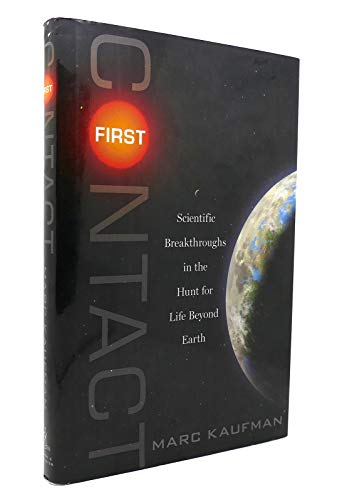
First Contact: Scientific Breakthroughs in the Hunt for Life Beyond Earth
Verlag:
Simon & Schuster (edition ), 2011
ISBN 10: 1439109001
ISBN 13: 9781439109007
Gebraucht
Hardcover
Anbieter: BooksRun, Philadelphia, PA, USA
Verkäuferbewertung 5 von 5 Sternen

Hardcover. Zustand: Very Good. With dust jacket. It's a well-cared-for item that has seen limited use. The item may show minor signs of wear. All the text is legible, with all pages included. It may have slight markings and/or highlighting. Artikel-Nr. 1439109001-11-1-29
Gebraucht kaufen
EUR 4,97
Versand gratis
Versand innerhalb von USA
Versand innerhalb von USA
Anzahl: 1 verfügbar
Beispielbild für diese ISBN
First Contact: Scientific Breakthroughs in the Hunt for Life Beyond Earth
Anbieter: Wonder Book, Frederick, MD, USA
Verkäuferbewertung 5 von 5 Sternen
Zustand: Very Good. . Good dust jacket. Artikel-Nr. G05A-01330
Gebraucht kaufen
EUR 6,39
Versand gratis
Versand innerhalb von USA
Versand innerhalb von USA
Anzahl: 1 verfügbar
Beispielbild für diese ISBN
First Contact: Scientific Breakthroughs in the Hunt for Life Beyond Earth
Anbieter: Wonder Book, Frederick, MD, USA
Verkäuferbewertung 5 von 5 Sternen
Zustand: Good. Good condition. Very Good dust jacket. A copy that has been read but remains intact. May contain markings such as bookplates, stamps, limited notes and highlighting, or a few light stains. Artikel-Nr. F09B-02928
Gebraucht kaufen
EUR 6,40
Versand gratis
Versand innerhalb von USA
Versand innerhalb von USA
Anzahl: 1 verfügbar
Beispielbild für diese ISBN
First Contact : Scientific Breakthroughs in the Hunt for Life Beyond Earth
Verlag:
Simon & Schuster, 2011
ISBN 10: 1439109001
ISBN 13: 9781439109007
Gebraucht
Hardcover
Erstausgabe
Anbieter: Better World Books: West, Reno, NV, USA
Verkäuferbewertung 5 von 5 Sternen
Zustand: Good. First Edition. Former library copy. Pages intact with minimal writing/highlighting. The binding may be loose and creased. Dust jackets/supplements are not included. Includes library markings. Stock photo provided. Product includes identifying sticker. Better World Books: Buy Books. Do Good. Artikel-Nr. GRP61962502
Gebraucht kaufen
EUR 6,54
Versand gratis
Versand innerhalb von USA
Versand innerhalb von USA
Anzahl: 1 verfügbar
Beispielbild für diese ISBN
First Contact : Scientific Breakthroughs in the Hunt for Life Beyond Earth
Verlag:
Simon & Schuster, 2011
ISBN 10: 1439109001
ISBN 13: 9781439109007
Gebraucht
Hardcover
Erstausgabe
Anbieter: Better World Books, Mishawaka, IN, USA
Verkäuferbewertung 5 von 5 Sternen
Zustand: Very Good. First Edition. Former library copy. Pages intact with possible writing/highlighting. Binding strong with minor wear. Dust jackets/supplements may not be included. Includes library markings. Stock photo provided. Product includes identifying sticker. Better World Books: Buy Books. Do Good. Artikel-Nr. GRP102395751
Gebraucht kaufen
EUR 6,54
Versand gratis
Versand innerhalb von USA
Versand innerhalb von USA
Anzahl: 1 verfügbar
Beispielbild für diese ISBN
First Contact: Scientific Breakthroughs in the Hunt for Life Beyond Earth
Anbieter: Visible Voice Books, Cleveland, OH, USA
Verkäuferbewertung 5 von 5 Sternen
hardcover. Zustand: Good. Simon & Schuster April 2011 8vo. 213 pages. ex-library copy. text block crisp. G+. Artikel-Nr. 179958
Gebraucht kaufen
EUR 6,12
EUR 4,00 Versand
Versand innerhalb von USA
Versand innerhalb von USA
Anzahl: 1 verfügbar
Beispielbild für diese ISBN
First Contact: Scientific Breakthroughs in the Hunt for Life Beyond Earth
Verlag:
Simon & Schuster, New York, 2011
ISBN 10: 1439109001
ISBN 13: 9781439109007
Gebraucht
Hardcover
Anbieter: Abacus Bookshop, Pittsford, NY, USA
Verkäuferbewertung 5 von 5 Sternen
hardcover. Zustand: Fine copy in fine dust jacket. Illus. with photos (illustrator). 2nd prt. 8vo, 213 pp. Artikel-Nr. 083954
Gebraucht kaufen
EUR 6,87
EUR 3,55 Versand
Versand innerhalb von USA
Versand innerhalb von USA
Anzahl: 1 verfügbar
Beispielbild für diese ISBN
First Contact: Scientific Breakthroughs in the Hunt for Life Beyond Earth
Anbieter: AwesomeBooks, Wallingford, Vereinigtes Königreich
Verkäuferbewertung 5 von 5 Sternen
Hardcover. Zustand: Very Good. First Contact: Scientific Breakthroughs in the Hunt for Life Beyond Earth This book is in very good condition and will be shipped within 24 hours of ordering. The cover may have some limited signs of wear but the pages are clean, intact and the spine remains undamaged. This book has clearly been well maintained and looked after thus far. Money back guarantee if you are not satisfied. See all our books here, order more than 1 book and get discounted shipping. . Artikel-Nr. 7719-9781439109007
Gebraucht kaufen
EUR 7,82
EUR 4,85 Versand
Versand von Vereinigtes Königreich nach USA
Versand von Vereinigtes Königreich nach USA
Anzahl: 1 verfügbar
Beispielbild für diese ISBN
First Contact: Scientific Breakthroughs in the Hunt for Life Beyond Earth
Verlag:
Simon & Schuster 05/04/2011, 2011
ISBN 10: 1439109001
ISBN 13: 9781439109007
Gebraucht
Hardcover
Anbieter: Bahamut Media, Reading, Vereinigtes Königreich
Verkäuferbewertung 4 von 5 Sternen

Hardcover. Zustand: Very Good. Shipped within 24 hours from our UK warehouse. Clean, undamaged book with no damage to pages and minimal wear to the cover. Spine still tight, in very good condition. Remember if you are not happy, you are covered by our 100% money back guarantee. Artikel-Nr. 6545-9781439109007
Gebraucht kaufen
EUR 7,82
EUR 8,21 Versand
Versand von Vereinigtes Königreich nach USA
Versand von Vereinigtes Königreich nach USA
Anzahl: 1 verfügbar
Foto des Verkäufers
First Contact: Scientific Breakthroughs in the Hunt for Life Beyond Earth
Anbieter: Maynard & Bradley, Leicester, Vereinigtes Königreich
Verkäuferbewertung 5 von 5 Sternen
Hardcover. Zustand: As New. Zustand des Schutzumschlags: As New. 2011. An excellent copy, clean and unmarked throughout with no notable creases or signs of wear beyond some mild bumps around outer edges from ordinary handling and shelving. Why on Amazon do most sellers not describe their actual book? Buy with confidence and support a genuine Independent Bricks & Mortar Real Bookshop. We are Maynard & Bradley CAMBO & PBFA(now lapsed) members here in Leicester City Centre. Size: 170 x 250 mm. 214 pages. Item Type: Book. Quantity Available: 1. Shipped Weight: Under 1 kilogram. Category: Science & Technology; Britain/UK; Modern; ISBN: 1439109001. ISBN/EAN: 9781439109007. Pictures of this item not already displayed here available upon request. Inventory No: 30401. Artikel-Nr. 30401
Gebraucht kaufen
EUR 6,00
EUR 25,83 Versand
Versand von Vereinigtes Königreich nach USA
Versand von Vereinigtes Königreich nach USA
Anzahl: 1 verfügbar