
Verwandte Artikel zu The Rainbow Trail: Sequel to Riders of the Purple Sage...
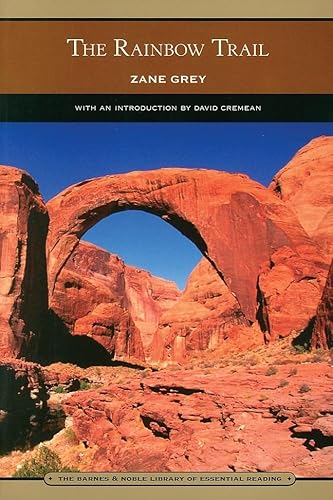
The Rainbow Trail: Sequel to Riders of the Purple Sage (Barnes & Noble Library of Essential Reading) - Softcover
Inhaltsangabe
When John Shefford sees a rainbow full of promises, he journeys toward a wild canyon full of secrets. On his way, he must enter a Mormon village, where intruders face certain death. The sequel to Riders of the Purple Sage, this western tells the story of the new generations of Mormons who will no longer condone polygamy.
Die Inhaltsangabe kann sich auf eine andere Ausgabe dieses Titels beziehen.
Über die Autorin bzw. den Autor
Born in 1875, Pearl Zane Grey was raised in Zanesville, Ohio, a town founded by his mother’s family, and graduated from the University of Pennsylvania in 1896. His passion for the American West was aroused in 1907 when Grey had an opportunity to tour the West with Buffalo Jones, a longtime hunter and adventurer. He published a total of eighty-five books before dying on October 23, 1939, at his home in Altadena, California.
Auszug. © Genehmigter Nachdruck. Alle Rechte vorbehalten.
To ride through a classic Zane Grey Western like The Rainbow Trail rarely allows readers the luxury of walking or trotting, loping or pacing; rather, it almost always demands galloping, or at least cantering. Grey ranks among the most intense writers in any literature. Unlike many of his kin, such as Edgar Allan Poe and H. Rider Haggard, whose intensity rises primarily out of the psychological focus of their works, Grey’s own literary power rises primarily from a physical focus, including but not limited to action. Exclamation marks thunder through his Westerns; passions pulse through his heroes; landscapes are vast, ineffably beautiful; adventure, danger, violence, and love can loom immediately around any bend of canyon; life itself is mystical in essence, God to be experienced rather than known. Each of these Grey trademarks is present in The Rainbow Trail, a book that ranks high among the best Westerns ever written.
Grey’s parents, Dr. Lewis M. Gray, a dentist, and the former Josephine Zane, named him Pearl Zane Gray upon his birth in Zanesville, Ohio, on January 31, 1872. Grey’s father changed the spelling of the family’s last name when they moved to Columbus, apparently because of some financial difficulties he had created for himself. Later, for fairly obvious reasons, Pearl dropped his first name in favor of his middle one. However, despite being an almost humorless writer, another of his finest books, Wanderer of the Wasteland, includes the following inside joke in a description of a landscape: “so beautifully pearl gray in tint” (emphases mine).1
Whatever negatives the feminine original first name engendered—or perhaps in part because of them—Grey became an outdoorsman as a youth and was a good enough athlete to play college baseball at the University of Pennsylvania. Like George Armstrong Custer and many other vitally active men, Grey was at best an indifferent student. His father pushed Grey to follow him into dentistry, an occupation Grey loathed but nevertheless practiced for a few years in New York City. During a trip to Pennsylvania in 1900, Grey met his future wife, Lina Elise Roth, better known as Dolly. They married five years later, beginning a thirty-four-year marriage that survived Zane’s multiple and often strange affairs with other women, as documented by Thomas H. Pauly’s definitive biography, Zane Grey: His Life, His Adventures, His Women. In fact, Zane and Dolly Grey’s marriage created one of the most intriguing literary partnerships of the twentieth century. In numerous ways, Dolly was both inspiration and stabilizer, and in more practical matters, from typing, editing, and rewriting to managing her husband’s career and various facets of the cottage industry that sprung up around it, she helped forge his huge success—as, apparently, did some of Grey’s other women.
Zane Grey was almost certainly manic depressive (bipolar), his moods ranging and raging from incredible highs to tumbling depressions. Yet like many such individuals then and now, he possessed extreme gifts. He basically self-medicated, though not with the usual alcohol or other substances, but via other addictions: writing, women, fishing, hunting, living a vigorous life outdoors. In a writing career of almost forty years, he has been credited with writing roughly ninety books (many published posthumously, many of those in truth written by “hired ghostwriters”).2 Well over fifty of these books are Westerns, and Grey additionally published a large number of articles. He also played a strong hand in the young film industry and its reliance on the Western. In addition to his writing, which more than one hundred films have been based upon, he formed Zane Grey Productions and produced several films of his own. He died on October 23, 1939, appropriately enough for an outdoorsman and romantic, of a heart attack, his second in two years, each suffered while he engaged in physical activity.
Running hard, both in date of publication and as sequel, on the rear hooves of Grey’s first full-bore success and best-known title, Riders of the Purple Sage (1912), The Rainbow Trail (1915) features a frequent Grey brand of hero, the lost but searching “pilgrim,” as a John Wayne character likely would term tenderfoot John Shefford. From the Midwest like many Grey characters, Shefford grows into a true Westerner. Indeed, the novel is set in the sweeping country that director John Ford, along with Wayne and others, would make famous in numerous films beginning, ironically enough, in the very year Grey died, 1939, with the release of Stagecoach: the northeastern Arizona–southeastern Utah region in and around Monument Valley and the Painted Desert. But if Ford turned this region into a national icon, Grey blazed the trail.
One key to categorizing Rainbow Trail in terms of literature is that like so many of Grey’s books, it is a romance, which is the very term Grey uses to identify it in the foreword, as well as the term he uses for all of his books in his long-unpublished essay, “My Answer to the Critics.” If readers remain unaware of or misunderstand this intention and what it actually means, it will prove difficult or even impossible for them to understand or appreciate it, as, strangely enough, numerous critics who should have known better nonetheless have managed to do. Romances, in fact, provided the seedbed for the novel’s future growth and evolution as a literary form. As major critic of the Western John G. Cawelti notes, adding his own voice to that of twentieth-century literary critic Northrop Frye, in The Six-Gun Mystique Sequel, “The Western is clearly an example of . . . romance.” Cawelti, in a statement that fits The Rainbow Trail’s main hero, Jim Shefford, promptly adds that romance incorporates “the movement of the hero from alienation to commitment.”3 Additionally, romance focuses on adventure and a quest, the idealization of characters, places, occurrences, and even ideas, on mysterious forces and even the supernatural. In essence, a romance allows an author to go beyond realism even while employing vast amounts of it. Moreover, it connects strongly to myth-making and demands heightened emotions, two features of The Rainbow Trail and Grey’s writing as a whole, whether fiction or nonfiction. As such, romance demands what the great British Romantic Thomas Coleridge famously termed “willful suspension of disbelief.”
One result of Grey’s repeatedly writing romances is that, strangely enough, it helps qualify the commonplace claim that he penned mere formula fiction; while Grey most certainly employs abundant formulaic elements, on the whole, his romances fit more as literary equivalents to music’s variations on a theme. Granted, Grey’s variations may not ascend to a sublimity analogous to classical music, but they do register somewhere comparable to the more complex songs of rock and roll, like Bruce Springsteen’s “Backstreets.” The Rainbow Trail, in fact, creates one of these variations. John Shefford’s quest proves at least three-pronged. Yes, love also being central to romance, he improbably seeks out Fay Larkin, an exotic young woman he has only heard about through hearsay from two friends, Bern and Elizabeth Venters. Ancillary to that, Shefford hopes to account for the legendary gunman Jim Lassiter and his female companion, Jane...
„Über diesen Titel“ kann sich auf eine andere Ausgabe dieses Titels beziehen.
Suchergebnisse für The Rainbow Trail: Sequel to Riders of the Purple Sage...

Beispielbild für diese ISBN
The Rainbow Trail : Sequel to Riders of the Purple Sage
Verlag:
Barnes & Noble, Incorporated, 2013
ISBN 10: 1435109325
ISBN 13: 9781435109322
Gebraucht
Softcover
Anbieter: Better World Books, Mishawaka, IN, USA
Verkäuferbewertung 5 von 5 Sternen

Zustand: Good. Pages intact with minimal writing/highlighting. The binding may be loose and creased. Dust jackets/supplements are not included. Stock photo provided. Product includes identifying sticker. Better World Books: Buy Books. Do Good. Artikel-Nr. 2663104-6
Gebraucht kaufen
EUR 6,17
Versand gratis
Versand innerhalb von USA
Versand innerhalb von USA
Anzahl: 1 verfügbar
Beispielbild für diese ISBN
The Rainbow Trail : Sequel to Riders of the Purple Sage
Verlag:
Barnes & Noble, Incorporated, 2013
ISBN 10: 1435109325
ISBN 13: 9781435109322
Gebraucht
Softcover
Anbieter: Better World Books: West, Reno, NV, USA
Verkäuferbewertung 5 von 5 Sternen
Zustand: Good. Pages intact with minimal writing/highlighting. The binding may be loose and creased. Dust jackets/supplements are not included. Stock photo provided. Product includes identifying sticker. Better World Books: Buy Books. Do Good. Artikel-Nr. 2663104-6
Gebraucht kaufen
EUR 6,17
Versand gratis
Versand innerhalb von USA
Versand innerhalb von USA
Anzahl: 1 verfügbar
Beispielbild für diese ISBN
The Rainbow Trail (Barnes & Noble Library of Essential Reading): Sequel to Riders of the Purple Sage
Anbieter: BookOutlet, Jefferson City, TN, USA
Verkäuferbewertung 5 von 5 Sternen
Paperback. Zustand: New. Paperback. Publisher overstock, may contain remainder mark on edge. Artikel-Nr. 9781435109322B
Neu kaufen
EUR 4,12
EUR 2,89 Versand
Versand innerhalb von USA
Versand innerhalb von USA
Anzahl: Mehr als 20 verfügbar
Beispielbild für diese ISBN
The Rainbow Trail
Anbieter: ThriftBooks-Dallas, Dallas, TX, USA
Verkäuferbewertung 5 von 5 Sternen
Paperback. Zustand: Fair. No Jacket. Readable copy. Pages may have considerable notes/highlighting. ~ ThriftBooks: Read More, Spend Less. Artikel-Nr. G1435109325I5N00
Gebraucht kaufen
EUR 8,02
Versand gratis
Versand innerhalb von USA
Versand innerhalb von USA
Anzahl: 1 verfügbar