
Verwandte Artikel zu Matthew: A 12-Week Study (Knowing the Bible)
Inhaltsangabe
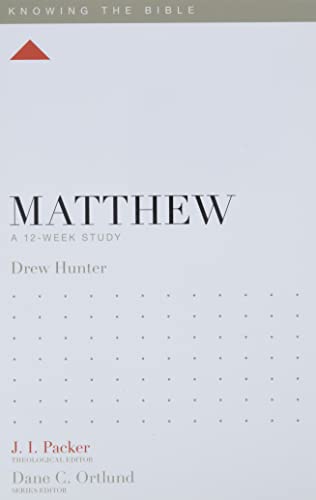
In this 12-week study, pastor Drew Hunter leads readers through the Gospel of Matthew, helping them come face to face with Jesus Christ, Israel’s long-awaited Messiah.
Die Inhaltsangabe kann sich auf eine andere Ausgabe dieses Titels beziehen.
Über die Autorin bzw. den Autor
Drew Hunter (MA, Wheaton College) is the teaching pastor at Zionsville Fellowship in Zionsville, Indiana. He is the author of Made for Friendship and the Isaiah and Matthew volumes in the Knowing the Bible series. Drew and his wife, Christina, live in Zionsville, Indiana, and have four children.
J. I. Packer (1926–2020) served as the Board of Governors’ Professor of Theology at Regent College. He authored numerous books, including the classic bestseller Knowing God. Packer also served as general editor for the English Standard Version Bible and as theological editor for the ESV Study Bible.
Dane C. Ortlund (PhD, Wheaton College) serves as senior pastor of Naperville Presbyterian Church in Naperville, Illinois. He is the author of Gentle and Lowly: The Heart of Christ for Sinners and Sufferers and Deeper: Real Change for Real Sinners. Dane and his wife, Stacey, have five children.
Lane T. Dennis (PhD, Northwestern University) is the former president and CEO of Crossway. Before joining Crossway in 1974, he served as a pastor in campus ministry at the University of Michigan (Sault Ste. Marie) and as the managing director of Verlag Grosse Freude in Switzerland. He is the author and/or editor of three books, including the Gold Medallion-award-winning book Letters of Francis A. Schaeffer, and he is the former chairman of the Evangelical Christian Publishers Association. Dennis serves as the chairman of the ESV (English Standard Version) Bible Translation Oversight Committee and as the executive editor of the ESV Study Bible. Lane and his wife, Ebeth, live in Wheaton, Illinois.
Auszug. © Genehmigter Nachdruck. Alle Rechte vorbehalten.
Knowing the Bible
Acts, A 12-Week Study
By Justin S. HolcombGood News Publishers
Copyright © 2014 Crossway
All rights reserved.
ISBN: 978-1-4335-4018-9All rights reserved.
Contents
Series Preface: J. I. Packer and Lane T. Dennis,
Week 1: Overview,
Week 2: You Will Be My Witnesses (Acts 1:1–26),
Week 3: Pentecost (Acts 2:1–47),
Week 4: Growing Witness and Opposition (Acts 3:1–5:42),
Week 5: Stephen (Acts 6:1–7:60),
Week 6: Saul (Acts 8:1–9:31),
Week 7: The Gospel to the Gentiles (Acts 9:32–12:25),
Week 8: Paul and Barnabas Are Sent (Acts 13:1–14:28),
Week 9: The Jerusalem Council (Acts 15:1–35),
Week 10: Paul's Second and Third Missionary Journeys (Acts 15:36–21:16),
Week 11: The Gospel Goes to Rome (Acts 21:17–28:31),
Week 12: Summary and Conclusion,
CHAPTER 1
Overview
Getting Acquainted
Acts is the story of God's grace flooding out to the world. Nothing is more prominent in Acts than the spread of the gospel. Jesus promises a geographic expansion at the outset, and Acts follows the news of his death and resurrection as it spreads from a small group of disciples in Jerusalem to Judea, Samaria, and the faraway capital of Rome.
Through the repeated preaching of the gospel to different people groups, the gospel of grace draws them in, constitutes them as the church centered on the grace of Jesus, and then sends them out in mission to the world. Acts is a historical account of how the resurrection of Jesus changes everything through the birth of the early church.
God is clearly central to the gospel's expansion. He is at the heart of the gospel message and, through the Holy Spirit, he is responsible for its remarkable growth. The gospel expands not through human strength but through the power of God over significant barriers of geography, ethnicity, culture, language, gender, wealth, persecutions, weaknesses, suffering, sickness, and imprisonments. Many of these barriers appear so inviolable that, when the gospel is preached to a new segment of society, riots ensue. But Acts makes clear that no one is beyond the scope of God's saving power, nor is anyone exempt from the need for God's redeeming grace. (For further background, see the ESV Study Bible, pages 2073–2079, or visit www.esvbible.org.)
Placing It in the Larger Story
Acts shows that the new Christian movement is not a fringe sect, but the culmination of God's plan of redemption. What was seen only as shadows in the Old Testament, God reveals finally and fully through Jesus Christ. The book of Acts does not primarily provide human patterns to emulate or avoid. Instead, it repeatedly calls us to reflect upon the work of God, fulfilled in Jesus Christ, establishing the church by the power of the Holy Spirit.
The gospel's expansion is the culmination of what God has been doing since the beginning. Acts consistently grounds salvation in the ancient purpose of God, which comes to fruition at God's own initiative. This reveals God to be the great benefactor who pours out blessings on all people. Even the opportunity to repent is God's gift.
Key Verse
"But you will receive power when the Holy Spirit has come upon you, and you will be my witnesses in Jerusalem and in all Judea and Samaria, and to the end of the earth" (Acts 1:8).
Date and Historical Background
Acts is the second part of a two-volume work, with the Gospel of Luke being the first volume. Neither book names its author, however the Lukan authorship of Luke–Acts is affirmed by both external evidence (church tradition) and internal evidence. Church tradition supporting Luke as the author is both early (from the mid-2nd century AD) and for over a century and a half unanimous (it was never doubted until the 19th century). The "we" sections of Acts (16:10–17; 20:5–21:18; 27:1–28:16) reveal that the author was a companion of Paul and participated in the events described in those sections. So the author of Acts was one of Paul's companions listed in his letters written during those periods (Luke is listed in Col. 4:14; 2 Tim. 4:11; Philem. 24) and not one of the men referred to in the third person in the "we" sections (see Acts 20:4–5). It seems clear that the author was from the second generation of the early church, since he was not an "eyewitness" of Jesus' ministry (Luke 1:2), and was a Gentile (Eusebius, Ecclesiastical History 3.4.6, says Luke was "by race an Antiochian and a physician by profession"; see Col. 4:14).
A number of scholars date Acts as early as AD 62, a guess based primarily on the abrupt conclusion of the book. Since Acts ends with Paul in Rome under house arrest, awaiting his trial before Caesar (28:30–31), it would seem strange if Luke knew about Paul's release (a proof of his innocence), about his defense before Caesar (fulfilling 27:24), and about his preaching the gospel as far as Spain (see note on 28:30–31), but then did not mention these events at the end of Acts. It seems most likely, then, that the abrupt ending is an indication that Luke completed Acts c. AD 62, before these later events occurred.
Outline
I. Preparation for Witness (1:1–2:13)
II. The Witness in Jerusalem (2:14–5:42)
III. The Witness beyond Jerusalem (6:1–12:25)
IV. The Witness in Cyprus and Southern Galatia (13:1–14:28)
V. The Jerusalem Council (15:1–35)
VI. The Witness in Greece (15:36–18:22)
VII. The Witness in Ephesus (18:23–21:16)
VIII. The Arrest in Jerusalem (21:17–23:35)
IX. The Witness in Caesarea (24:1–26:32)
X. The Witness in Rome (27:1–28:31)
As You Get Started ...
What is your understanding of how Acts relates to the storyline of the New Testament and of the whole Bible? How does it help you to better understand the cultures and people of other New Testament books?
_____________________________________________________________________
_____________________________________________________________________
_____________________________________________________________________
What is your overall understanding of how Acts relates to Luke, knowing that this is part 2 of a two-part narrative? Do you have any sense of what Acts uniquely contributes to that narrative? Do you have any sense of similarities and continuities between Luke and Acts?
_____________________________________________________________________
_____________________________________________________________________
_____________________________________________________________________
How do you understand the contribution of Acts to Christian theology? From your current knowledge of Acts, what do you think this book teaches us about God, the church, the gospel, and other doctrines?
_____________________________________________________________________
_____________________________________________________________________
_____________________________________________________________________
What aspects of Acts have confused you? Are there any specific questions that you hope to resolve through this study of Acts?
_____________________________________________________________________
_____________________________________________________________________
_____________________________________________________________________
As You...
„Über diesen Titel“ kann sich auf eine andere Ausgabe dieses Titels beziehen.
Suchergebnisse für Matthew: A 12-Week Study (Knowing the Bible)

Beispielbild für diese ISBN
Matthew: A 12-Week Study
Anbieter: ThriftBooks-Reno, Reno, NV, USA
Verkäuferbewertung 5 von 5 Sternen

Paperback. Zustand: Good. No Jacket. Pages can have notes/highlighting. Spine may show signs of wear. ~ ThriftBooks: Read More, Spend Less. Artikel-Nr. G1433540185I3N00
Gebraucht kaufen
EUR 5,95
Versand gratis
Versand innerhalb von USA
Versand innerhalb von USA
Anzahl: 1 verfügbar
Beispielbild für diese ISBN
Matthew: A 12-Week Study
Anbieter: ThriftBooks-Dallas, Dallas, TX, USA
Verkäuferbewertung 5 von 5 Sternen
Paperback. Zustand: Good. No Jacket. Pages can have notes/highlighting. Spine may show signs of wear. ~ ThriftBooks: Read More, Spend Less. Artikel-Nr. G1433540185I3N00
Gebraucht kaufen
EUR 5,95
Versand gratis
Versand innerhalb von USA
Versand innerhalb von USA
Anzahl: 1 verfügbar
Beispielbild für diese ISBN
Matthew: A 12-Week Study
Anbieter: ThriftBooks-Atlanta, AUSTELL, GA, USA
Verkäuferbewertung 5 von 5 Sternen
Paperback. Zustand: Good. No Jacket. Pages can have notes/highlighting. Spine may show signs of wear. ~ ThriftBooks: Read More, Spend Less. Artikel-Nr. G1433540185I3N00
Gebraucht kaufen
EUR 5,95
Versand gratis
Versand innerhalb von USA
Versand innerhalb von USA
Anzahl: 1 verfügbar
Beispielbild für diese ISBN
Matthew: A 12-Week Study
Anbieter: ThriftBooks-Phoenix, Phoenix, AZ, USA
Verkäuferbewertung 5 von 5 Sternen
Paperback. Zustand: Good. No Jacket. Pages can have notes/highlighting. Spine may show signs of wear. ~ ThriftBooks: Read More, Spend Less. Artikel-Nr. G1433540185I3N00
Gebraucht kaufen
EUR 5,95
Versand gratis
Versand innerhalb von USA
Versand innerhalb von USA
Anzahl: 1 verfügbar
Beispielbild für diese ISBN
Matthew: A 12-Week Study
Anbieter: ThriftBooks-Dallas, Dallas, TX, USA
Verkäuferbewertung 5 von 5 Sternen
Paperback. Zustand: Very Good. No Jacket. May have limited writing in cover pages. Pages are unmarked. ~ ThriftBooks: Read More, Spend Less. Artikel-Nr. G1433540185I4N00
Gebraucht kaufen
EUR 5,95
Versand gratis
Versand innerhalb von USA
Versand innerhalb von USA
Anzahl: 1 verfügbar
Beispielbild für diese ISBN
Matthew : A 12-Week Study
Anbieter: Better World Books, Mishawaka, IN, USA
Verkäuferbewertung 5 von 5 Sternen
Zustand: Good. 0th Edition. Pages intact with minimal writing/highlighting. The binding may be loose and creased. Dust jackets/supplements are not included. Stock photo provided. Product includes identifying sticker. Better World Books: Buy Books. Do Good. Artikel-Nr. 17790600-6
Gebraucht kaufen
EUR 6,38
Versand gratis
Versand innerhalb von USA
Versand innerhalb von USA
Anzahl: 2 verfügbar
Beispielbild für diese ISBN
Matthew : A 12-Week Study
Anbieter: Better World Books, Mishawaka, IN, USA
Verkäuferbewertung 5 von 5 Sternen
Zustand: Very Good. 0th Edition. Pages intact with possible writing/highlighting. Binding strong with minor wear. Dust jackets/supplements may not be included. Stock photo provided. Product includes identifying sticker. Better World Books: Buy Books. Do Good. Artikel-Nr. 17351653-6
Gebraucht kaufen
EUR 6,38
Versand gratis
Versand innerhalb von USA
Versand innerhalb von USA
Anzahl: 3 verfügbar
Beispielbild für diese ISBN
Matthew
Anbieter: PBShop.store UK, Fairford, GLOS, Vereinigtes Königreich
Verkäuferbewertung 5 von 5 Sternen
PAP. Zustand: New. New Book. Shipped from UK. Established seller since 2000. Artikel-Nr. FW-9781433540189
Neu kaufen
EUR 10,75
EUR 3,84 Versand
Versand von Vereinigtes Königreich nach USA
Versand von Vereinigtes Königreich nach USA
Anzahl: 15 verfügbar
Beispielbild für diese ISBN
Matthew A 12Week Study
Anbieter: Revaluation Books, Exeter, Vereinigtes Königreich
Verkäuferbewertung 5 von 5 Sternen
Paperback. Zustand: Brand New. 96 pages. 9.00x6.00x0.50 inches. In Stock. Artikel-Nr. __1433540185
Neu kaufen
EUR 7,36
EUR 11,68 Versand
Versand von Vereinigtes Königreich nach USA
Versand von Vereinigtes Königreich nach USA
Anzahl: 2 verfügbar
Beispielbild für diese ISBN
Matthew: A 12-Week Study (Knowing the Bible)
Anbieter: Ria Christie Collections, Uxbridge, Vereinigtes Königreich
Verkäuferbewertung 5 von 5 Sternen
Zustand: New. In English. Artikel-Nr. ria9781433540189_new
Neu kaufen
EUR 10,92
EUR 10,94 Versand
Versand von Vereinigtes Königreich nach USA
Versand von Vereinigtes Königreich nach USA
Anzahl: Mehr als 20 verfügbar