
Verwandte Artikel zu Christian Worldview: A Student's Guide (Reclaiming...
Christian Worldview: A Student's Guide (Reclaiming the Christian Intellectual Tradition) - Softcover
Buch 3 von 10: Reclaiming the Christian Intellectual Tradition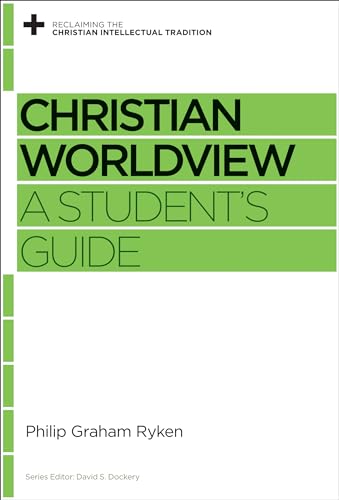
Inhaltsangabe
Our worldview shapes everything about us. In this student’s guide, Ryken explains the Christian worldview, from the existence of God to the nature of sin and redemption.
Die Inhaltsangabe kann sich auf eine andere Ausgabe dieses Titels beziehen.
Über die Autorin bzw. den Autor
Philip Graham Ryken (DPhil, University of Oxford) is the eighth president of Wheaton College. He preached at Philadelphia’s Tenth Presbyterian Church from 1995 until his appointment at Wheaton in 2010. Ryken has published more than fifty books, including When Trouble Comes and expository commentaries on Exodus, Ecclesiastes, and Jeremiah. He serves as a board member for the Gospel Coalition and the Lausanne Movement.
David S. Dockery (PhD, University of Texas System) serves as president of the International Alliance for Christian Education as well as president and distinguished professor of theology at Southwestern Baptist Theological Seminary. Previously, he served as president of Union University and Trinity Evangelical Divinity School. He is a much-sought-after speaker and lecturer, a former consulting editor for Christianity Today, and the author or editor of more than forty books. Dockery and his wife, Lanese, have three married sons and seven grandchildren.
Auszug. © Genehmigter Nachdruck. Alle Rechte vorbehalten.
Christian Worldview
A Student's Guide
By Philip Graham RykenGood News Publishers
Copyright © 2013 Philip Graham Ryken
All rights reserved.
ISBN: 978-1-4335-3540-6All rights reserved.
Contents
Series Preface,
Acknowledgments,
1 What Is a Worldview?,
2 The Center of Everything,
3 The Way We Were,
4 Paradise Lost,
5 A Work in Progress,
6 Paradise Consummated,
Questions for Reflection,
Glossary,
Resources for Further Study,
CHAPTER 1
WHAT IS A WORLDVIEW?
Everybody has a worldview. Whether we know it or not, we all have a fundamental perspective on the world that shapes the way we live.
By way of illustration, consider what the following everyday encounters tell us about the various ways that different people look at the world and how they interact with it as a result:
We are playing baseball at the park, and it's Jack's turn to bat. He's only four, but he knows what he's doing at the plate — better, as it turns out, than he knows what he's doing on the base paths. He hits a sharp grounder back to the mound, which I field and throw to his sister at first for the out. Jack veers sharply away from the baseline and runs haphazardly around the infield before returning to home plate. "I get to choose my own bases," he announces, in what sounds like a basic premise for postmodern ethics. Laughing, I say, "Okay, buddy. You can choose your own bases, but they're not the real bases, so you're still out."
I am out shoveling sixteen inches of snow into huge piles by the street when a neighbor stops by to speculate as to when (or even if) the snow will ever disappear. "Well, God brought it here," I say, "and only God can take it away." Taking clear objection to my reasoning, my neighbor sniffs, "It was a low pressure system, you know." I did know that, of course, yet I also happen to believe that even the weather system is under God's control.
Before I move halfway across the country, a friend invites me to his art studio and generously invites me to choose a painting to take with me as a gift. We walk back and forth, admiring his artwork and discussing each piece — where it was painted, how it is composed, what thoughts and feelings it expresses. Finally, I choose a watercolor depicting a street of row houses from a local city neighborhood. Today the painting has a treasured place in my home, as the memory of a familiar place and a symbol of a valued friendship.
It is two minutes before tip-off in the first round of the playoffs for an intramural basketball league. "Where's Eric?" I ask, referring to our star point guard. "He won't be here tonight. He's leading a high school Bible study." When we lose by four points, we all know that missing our best player cost us a shot at the championship. But we also know that some things in life — such as honoring a ministry commitment — are even more important than basketball.
These everyday encounters all reveal the worldviews of the people involved. What I hang on my wall bears witness to the beauty and truth that Jesus Christ has put into the world. The way I shovel snow is a testimony to what I believe about God's creation and providence. Even the way I play sports reflects the purpose of leisure in an ordered universe.
At the same time, the way other people respond reveals their worldview — their faithfulness in keeping a commitment, for example, or their unbelief in the existence and providence of God. Ideas have consequences. Even ordinary interactions reflect our commitments and convictions about the basic issues of art and science, work and play, family and society, life and death. Whenever we bump into the world, our worldview has a way of spilling out. It comes out in what we think and love, say and do, praise and choose.
Worldviews also have a way of bumping into one another. Some of the examples above deal with conflicting commitments at the level of daily life, but of course different views of the world also have culture-wide influence. Some of the major conflicts in today's society — between naturalism and supernaturalism, for example, or between freedom and terrorism, or between purity and promiscuity in popular entertainment, or between abortion and the right to life — come at the intersections where worldviews collide, sometimes violently.
The conflict of worldviews calls Christians to thoughtful cultural engagement. In an increasingly secularized society, the followers of Christ often find their ideas under attack. How can we maintain a Christ-centered perspective on the contested issues of our day? How can we think Christianly in every area of intellectual life? And how can we live out a faithful Christian testimony at home, at school, at church, at work, in government, and in the marketplace of ideas? The answer begins with having a worldview like the one introduced in this book: a consistently Christian worldview that shapes our thoughts, forms our desires, guides our words, and motivates our actions.
DEFINING WORLDVIEW
A worldview — or "world-and-life view," as some people call it — is the structure of understanding that we use to make sense of our world. Our worldview is what we presuppose. It is our way of looking at life, our interpretation of the universe, our orientation to reality. It is the "comprehensive framework of our basic belief about things," or "the set of hinges on which all our everyday thinking and doing turns." More complexly,
a worldview is a commitment, a fundamental orientation of the heart, that can be expressed as a story or in a set of presuppositions (assumptions which may be true, partially true or entirely false) which we hold (consciously or subconsciously, consistently or inconsistently) about the basic constitution of reality, and that provides the foundation on which we live and move and have our being.
Ideally, a worldview is a well-reasoned framework of beliefs and convictions that helps us see the big picture, giving a true and unified perspective on the meaning of human existence. Alternatively, we could say that our worldview is the story we tell to answer questions like these: Why is there anything at all? How can we know for sure? How did we get here, and what are we here for, anyway? Why have things gone so badly wrong? Is there any hope of fixing them? What should I do with my life? And where will it all end?
Not all worldviews are equally systematic or equally comprehensive. Often there is a difference between the worldview that we think we have and the one we actually live — our functional as opposed to our theoretical worldview. Worldviews can also change according to circumstance. But whether we realize it or not, all of us have basic beliefs about who we are, where we came from, and where we are going. This is unavoidable. Even people who never stop to think about their worldview in any self-reflective way nevertheless live on the basis of their tacit worldview. This is so basic to who we are that usually we hardly even notice our worldview but simply take it for granted. Sometimes a worldview is compared to a pair of spectacles, but, to use another optic metaphor, maybe our eyes themselves would be a better analogy. When was the last time you noticed that you were seeing? We rarely think about seeing; we just see, and we are seeing all the time. Similarly, even if we rarely, if ever, think about our worldview, we still view everything with it. Our worldview is what we think with and ultimately live by.
Many factors contribute...
„Über diesen Titel“ kann sich auf eine andere Ausgabe dieses Titels beziehen.
Suchergebnisse für Christian Worldview: A Student's Guide (Reclaiming...

Beispielbild für diese ISBN
Christian Worldview: A Student's Guide
Anbieter: ThriftBooks-Phoenix, Phoenix, AZ, USA
Verkäuferbewertung 5 von 5 Sternen

Paperback. Zustand: Good. No Jacket. Pages can have notes/highlighting. Spine may show signs of wear. ~ ThriftBooks: Read More, Spend Less. Artikel-Nr. G1433535408I3N00
Gebraucht kaufen
EUR 6,01
Versand gratis
Versand innerhalb von USA
Versand innerhalb von USA
Anzahl: 3 verfügbar
Beispielbild für diese ISBN
Christian Worldview: A Student's Guide
Anbieter: ThriftBooks-Atlanta, AUSTELL, GA, USA
Verkäuferbewertung 5 von 5 Sternen
Paperback. Zustand: Fair. No Jacket. Readable copy. Pages may have considerable notes/highlighting. ~ ThriftBooks: Read More, Spend Less. Artikel-Nr. G1433535408I5N00
Gebraucht kaufen
EUR 6,01
Versand gratis
Versand innerhalb von USA
Versand innerhalb von USA
Anzahl: 2 verfügbar
Beispielbild für diese ISBN
Christian Worldview: A Student's Guide
Anbieter: ThriftBooks-Atlanta, AUSTELL, GA, USA
Verkäuferbewertung 5 von 5 Sternen
Paperback. Zustand: Very Good. No Jacket. May have limited writing in cover pages. Pages are unmarked. ~ ThriftBooks: Read More, Spend Less. Artikel-Nr. G1433535408I4N00
Gebraucht kaufen
EUR 6,01
Versand gratis
Versand innerhalb von USA
Versand innerhalb von USA
Anzahl: 1 verfügbar
Beispielbild für diese ISBN
Christian Worldview: A Student's Guide
Anbieter: ThriftBooks-Dallas, Dallas, TX, USA
Verkäuferbewertung 5 von 5 Sternen
Paperback. Zustand: Fair. No Jacket. Readable copy. Pages may have considerable notes/highlighting. ~ ThriftBooks: Read More, Spend Less. Artikel-Nr. G1433535408I5N00
Gebraucht kaufen
EUR 6,01
Versand gratis
Versand innerhalb von USA
Versand innerhalb von USA
Anzahl: 2 verfügbar
Beispielbild für diese ISBN
Christian Worldview: A Student's Guide
Anbieter: ThriftBooks-Reno, Reno, NV, USA
Verkäuferbewertung 5 von 5 Sternen
Paperback. Zustand: Fair. No Jacket. Readable copy. Pages may have considerable notes/highlighting. ~ ThriftBooks: Read More, Spend Less. Artikel-Nr. G1433535408I5N00
Gebraucht kaufen
EUR 6,01
Versand gratis
Versand innerhalb von USA
Versand innerhalb von USA
Anzahl: 1 verfügbar
Beispielbild für diese ISBN
Christian Worldview: A Student's Guide
Anbieter: ThriftBooks-Reno, Reno, NV, USA
Verkäuferbewertung 5 von 5 Sternen
Paperback. Zustand: Good. No Jacket. Pages can have notes/highlighting. Spine may show signs of wear. ~ ThriftBooks: Read More, Spend Less. Artikel-Nr. G1433535408I3N00
Gebraucht kaufen
EUR 6,01
Versand gratis
Versand innerhalb von USA
Versand innerhalb von USA
Anzahl: 3 verfügbar
Beispielbild für diese ISBN
Christian Worldview: A Student's Guide
Anbieter: ThriftBooks-Phoenix, Phoenix, AZ, USA
Verkäuferbewertung 5 von 5 Sternen
Paperback. Zustand: Fair. No Jacket. Readable copy. Pages may have considerable notes/highlighting. ~ ThriftBooks: Read More, Spend Less. Artikel-Nr. G1433535408I5N00
Gebraucht kaufen
EUR 6,01
Versand gratis
Versand innerhalb von USA
Versand innerhalb von USA
Anzahl: 1 verfügbar
Beispielbild für diese ISBN
Christian Worldview: A Student's Guide
Anbieter: ThriftBooks-Phoenix, Phoenix, AZ, USA
Verkäuferbewertung 5 von 5 Sternen
Paperback. Zustand: Very Good. No Jacket. May have limited writing in cover pages. Pages are unmarked. ~ ThriftBooks: Read More, Spend Less. Artikel-Nr. G1433535408I4N00
Gebraucht kaufen
EUR 6,01
Versand gratis
Versand innerhalb von USA
Versand innerhalb von USA
Anzahl: 1 verfügbar
Beispielbild für diese ISBN
Christian Worldview: A Student's Guide
Anbieter: ThriftBooks-Atlanta, AUSTELL, GA, USA
Verkäuferbewertung 5 von 5 Sternen
Paperback. Zustand: Good. No Jacket. Pages can have notes/highlighting. Spine may show signs of wear. ~ ThriftBooks: Read More, Spend Less. Artikel-Nr. G1433535408I3N00
Gebraucht kaufen
EUR 6,03
Versand gratis
Versand innerhalb von USA
Versand innerhalb von USA
Anzahl: 4 verfügbar
Beispielbild für diese ISBN
Christian Worldview: A Student's Guide
Anbieter: ThriftBooks-Dallas, Dallas, TX, USA
Verkäuferbewertung 5 von 5 Sternen
Paperback. Zustand: Good. No Jacket. Pages can have notes/highlighting. Spine may show signs of wear. ~ ThriftBooks: Read More, Spend Less. Artikel-Nr. G1433535408I3N00
Gebraucht kaufen
EUR 6,03
Versand gratis
Versand innerhalb von USA
Versand innerhalb von USA
Anzahl: 3 verfügbar