
Verwandte Artikel zu Did Jesus Really Rise from the Dead?: A Surgeon-Scientist...
Inhaltsangabe
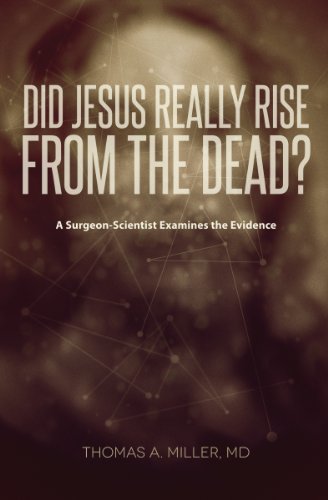
<p>Long-time surgeon Thomas Miller carefully investigates the evidence of the resurrection, making a compelling case for the empty tomb from a scientific perspective.</p>
Die Inhaltsangabe kann sich auf eine andere Ausgabe dieses Titels beziehen.
Über die Autorinnen und Autoren
<p><strong>Thomas A. Miller, MD </strong>(Temple University Medical School) has had a distinguished career in surgery spanning more than 35 years. Previously serving on the surgical faculties of the University of Texas (Houston) and Saint Louis University, he currently is Professor of Surgery at Virginia Commonwealth University in Richmond. In addition to being an active clinical surgeon and educator, he also has been involved in original investigation concerning various aspects of digestive function, much of it funded by the National Institutes of Health for some 26 years. He is the author of more than 200 scientific papers and the editor of three textbooks on surgical physiology.</p>
Thomas A. Miller, MD (Temple University Medical School) has had a distinguished career in surgery spanning more than 35 years. Previously serving on the surgical faculties of the University of Texas (Houston) and Saint Louis University, he currently is Professor of Surgery at Virginia Commonwealth University in Richmond. In addition to being an active clinical surgeon and educator, he also has been involved in original investigation concerning various aspects of digestive function, much of it funded by the National Institutes of Health for some 26 years. He is the author of more than 200 scientific papers and the editor of three textbooks on surgical physiology.
Auszug. © Genehmigter Nachdruck. Alle Rechte vorbehalten.
Did Jesus Really Rise from the Dead?
A Surgeon-Scientist Examines the Evidence
By Thomas A. MillerGood News Publishers
Copyright © 2013 Thomas A. Miller
All rights reserved.
ISBN: 978-1-4335-3307-5All rights reserved.
Contents
Acknowledgments,
Introduction,
1 Can a Credible Scientist Really Believe in the Resurrection?,
2 Can the New Testament (and Especially the Gospels) Be Trusted?,
3 Did Jesus Really Die by Crucifixion?,
4 What's So Important about an Empty Tomb and Undisturbed Grave Clothes?,
5 Are 500 Witnesses Enough?,
6 Was a Bodily Resurrection Really Necessary?,
7 What Does a Resurrection Mean?,
8 Jesus's Death: An Accident of History, or Divinely Planned?,
9 Epilogue: The Key That Fits the Lock,
CHAPTER 1
CAN A CREDIBLE SCIENTIST REALLY BELIEVE IN THE RESURRECTION?
I never intended to write a book on the resurrection. After all, isn't that a theological issue, and why would a person steeped in science all of his professional life write about something that is clearly outside of his field? And furthermore, we all know that if something can't be proved by science, it either can't be known or isn't worth knowing, including such things as God, the supernatural, and, of all absurdities, rising from the dead. Or might we be wrong, and might those religious types be right after all? What if a resurrection really did happen to a man named Jesus, as the Christian religion has claimed for nearly two thousand years? Wouldn't such an event be something worth knowing about? But I'm getting ahead of myself. Before dealing with these issues, you need to know something about me and how this all came about.
The Shaping of My Worldview
I grew up in a devoutly religious family with a strong Christian worldview. As such, I was exposed early on to the belief that the resurrection of Jesus had actually occurred and was not a figment of some theological imagination. The tenacity with which my parents embraced this belief rubbed off on me, and I too became a believer early in childhood. This belief was a borrowed one, however, and it was many years later before the reality of what the resurrection means became clear to me, not to mention the implications it would have on my own worldview. It was not until my undergraduate years at Wheaton College that I was exposed to any rigorous discussion of the resurrection.
Wheaton is a small Christian liberal arts college in Wheaton, Illinois, about twenty-five miles west of Chicago. Founded in the middle of the nineteenth century, its motto is "For Christ and His Kingdom." One might appropriately ask how I ended up at this school. Actually, it was quite logical. When a person is reared in the kind of family I was, a strong emphasis is placed on gaining one's education in a Christian environment. Hence, studying at a school like Wheaton would be quite consistent with that orientation.
Although Wheaton is sometimes maligned and accused of being anti-intellectual because of its religious underpinnings, my experience as a student at Wheaton was anything but that. I found the environment to be intellectually challenging, with an openness to a variety of thought processes, many in direct opposition to what Wheaton stood for foundationally. It is true that the Bible was taken seriously, but such commitment was never at the expense of free speech, open dialogue on controversial topics, or academic freedom. Although I was initially uncertain regarding which career path I would pursue, as most entering college students are, my early exposure to chemistry and biology quickly assured me that a career in medicine was the best fit. The premedical curriculum was excellent. While I majored in zoology and minored in chemistry, the liberal arts emphasis at Wheaton enabled me to take an abundance of courses in history, philosophy, and religion. It was the intellectual rigor with which these disciplines were taught that greatly impacted the Christian worldview that I ultimately embraced as my own. Further, an apologetics course I took as a senior absolved any doubts I might have had regarding the historicity of the resurrection. Thus, I became absolutely convinced that Jesus did in fact rise from the dead.
My medical school training was obtained at Temple University in Philadelphia. It was during my Temple years that I met Janet, who became my wife and soul mate. We were married during Christmas vacation of my junior year. After acquiring an MD degree, I interned in surgery at the University of Chicago Hospitals, followed by a residency in surgery at the University of Michigan Hospitals. While at Michigan, I made the decision to pursue a career in academic surgery. This means I decided to forego the private practice of surgery and instead pursue my clinical responsibilities in the context of being a medical school faculty member. This would allow me to teach, pursue research, and use my surgical skills to train residents (i.e., trainees) who were desirous of becoming surgeons like myself. After formal training in surgery at Michigan, I did two additional years of specialized study in gastrointestinal (GI) research to better prepare for an academic career. Since my clinical interests involved the GI tract, such research training seemed logical. Thus, our family (Janet and I had three children by this time) moved from Ann Arbor to Texas. The first research year was undertaken at the University of Texas Medical Branch in Galveston and the second at the University of Texas Medical School in Houston, forty miles away. My reason for choosing these two institutions was that they were both powerhouses of GI research at the time. I have never been disappointed with the research training received at these institutions.
It has now been more than thirty-five years since this formal training was completed. During these three-plus decades, I have had the good fortune of pursuing a very satisfying career in surgery as a faculty member at three excellent medical schools. This has enabled me to be at the forefront of advances in my field, assist in the care of thousands of patients, and have an almost daily involvement in teaching medical students the principles of surgery as well as training hundreds of residents for careers in surgery. I have also experienced the pleasure and excitement of running a research laboratory that has been actively engaged for more than a quarter of a century in studying the mechanisms by which the lining of the stomach and other portions of the GI tract protect themselves from injury. Much of this research has been funded by the National Institutes of Health, and the findings have been shared with colleagues through publications in numerous scientific journals.
The Inevitability of Death and Possibility of Resurrection
As I reflect back on this experience as a surgeon-scientist, many thoughts obviously come to mind, but two observations in particular surface that are directly germane to the reason for writing this book. The first relates to my continuous belief in the resurrection of Jesus. One might think that, having been immersed in science for these many years, I would long since have gotten over this "superstition." In actuality, the more I have reviewed and re-reviewed the evidence for this event, the more convinced I have become that it is not some theological myth but really did occur in our space-time world some twenty centuries ago. But how can one who calls himself a credible scientist accept a notion that clearly resides in the realm of the miraculous? And we all know that science has...
„Über diesen Titel“ kann sich auf eine andere Ausgabe dieses Titels beziehen.
Suchergebnisse für Did Jesus Really Rise from the Dead?: A Surgeon-Scientist...

Beispielbild für diese ISBN
Did Jesus Really Rise from the Dead?: A Surgeon-Scientist Examines the Evidence
Anbieter: ThriftBooks-Atlanta, AUSTELL, GA, USA
Verkäuferbewertung 5 von 5 Sternen

Paperback. Zustand: Very Good. No Jacket. Former library book; May have limited writing in cover pages. Pages are unmarked. ~ ThriftBooks: Read More, Spend Less. Artikel-Nr. G1433533073I4N10
Gebraucht kaufen
EUR 5,78
Versand gratis
Versand innerhalb von USA
Versand innerhalb von USA
Anzahl: 1 verfügbar
Beispielbild für diese ISBN
Did Jesus Really Rise from the Dead? : A Surgeon-Scientist Examines the Evidence
Anbieter: Better World Books: West, Reno, NV, USA
Verkäuferbewertung 5 von 5 Sternen
Zustand: Very Good. 1st Edition. Pages intact with possible writing/highlighting. Binding strong with minor wear. Dust jackets/supplements may not be included. Stock photo provided. Product includes identifying sticker. Better World Books: Buy Books. Do Good. Artikel-Nr. 14134503-6
Gebraucht kaufen
EUR 6,98
Versand gratis
Versand innerhalb von USA
Versand innerhalb von USA
Anzahl: 1 verfügbar
Beispielbild für diese ISBN
Did Jesus Really Rise from the Dead?: A Surgeon-Scientist Examines the Evidence
Anbieter: World of Books (was SecondSale), Montgomery, IL, USA
Verkäuferbewertung 5 von 5 Sternen
Zustand: Good. Item in good condition. Textbooks may not include supplemental items i.e. CDs, access codes etc. Artikel-Nr. 00098166245
Gebraucht kaufen
EUR 7,22
Versand gratis
Versand innerhalb von USA
Versand innerhalb von USA
Anzahl: 2 verfügbar
Beispielbild für diese ISBN
Did Jesus Really Rise from the Dead?: A Surgeon-Scientist Examines the Evidence Miller, Thomas A.
Anbieter: Hay-on-Wye Booksellers, Hay-on-Wye, HEREF, Vereinigtes Königreich
Verkäuferbewertung 4 von 5 Sternen

Zustand: Very Good. Some outer edges have minor scuffs. Cover has light scratches. Reading content is in like new condition. Artikel-Nr. 104604-09-04-2024-EE
Gebraucht kaufen
EUR 18,06
EUR 29,23 Versand
Versand von Vereinigtes Königreich nach USA
Versand von Vereinigtes Königreich nach USA
Anzahl: 1 verfügbar