
Verwandte Artikel zu Making Mathematics Meaningful - For Students in the...
Inhaltsangabe
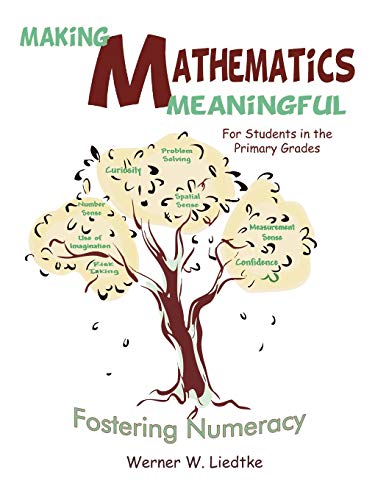
Making Mathematics Meaningful ¿ For Students in the Primary Grades shares practical suggestions and unique strategies that will contribute to making mathematics meaningful for young learners. Werner Liedtke is a former elementary educator who has partnered with primary teachers in the classroom environment and authored and co-authored several books and articles about mathematics teaching, learning and assessment, and specific aspects of the mathematics curriculum. He brings a wealth of expertise while sharing valuable information that helps educators, tutors, and parents who homeschool, reach the major goals of the mathematics curriculum. Liedtke includes suggestions for accurate assessment and reporting as well as prompts that illustrate question strategies, all while providing fun and imaginative activities that will help students: ¿ Develop number sense - visualize numbers. ¿ Develop spatial sense - imagery and visual thinking. ¿ Learn basic addition and subtraction facts. ¿ Develop mental mathematics strategies. ¿ Foster problem solving abilities, confidence, and mathematical reasoning. The strategies and activities included in this compendium will not only help young learners reach success with mathematics and encourage creative thinking, but will also contribute to their language development, reading comprehension, and the development of evaluative skills.
Die Inhaltsangabe kann sich auf eine andere Ausgabe dieses Titels beziehen.
Über die Autorin bzw. den Autor
Werner W. Liedtke is a Professor Emeritus at the University of Victoria, British Columbia, Canada. He has taught elementary school and courses in mathematics education and assessment and is the co-author of Making Mathematics Meaningful For Children Ages 4 to 7."
Auszug. © Genehmigter Nachdruck. Alle Rechte vorbehalten.
Making Mathematics Meaningful
For Students in Primary Grades
By Werner W. LiedtkeTrafford Publishing
Copyright © 2010 Werner W. Liedtke
All rights reserved.
ISBN: 978-1-4269-2344-9All rights reserved.
Contents
| Dedication and Acknowledgements............................................ | 8 |
| Chapter 1 – Teaching to Make Mathematics Meaningful........................ | 9 |
| Chapter 2 – The Framework and Assumptions.................................. | 15 |
| Chapter 3 – Teaching via Problem Solving................................... | 24 |
| Chapter 4 – Readiness for Understanding Number and Rational Counting....... | 32 |
| Chapter 5 – Developing Number Sense........................................ | 53 |
| Chapter 6 – The Four Operations: Fostering Operation Sense................. | 83 |
| Chapter 7 – Geometry and Developing Spatial Sense.......................... | 111 |
| Chapter 8 – Measurement.................................................... | 129 |
| Chapter 9 – Data Analysis and Game Settings................................ | 154 |
| Selected References........................................................ | 180 |
CHAPTER 1
Teaching to Make Mathematics Meaningful
To be a Teacher – Selective Challenges
The content and suggestions in this book are based on an assumption voiced by amathematics educator quite a few years ago,
There is not now, never has been, and is hoped never will be a genuine substitutefor a good teacher who knows how and what children need to learn and when theyneed to learn it.
The term 'good' in the quote is rather subjective and as far as one of the goals of thisbook is concerned lacks specificity. The descriptors knowledgeable and skilful couldbe substituted but they require elaboration or need to be illustrated with examples.Different types of knowledge and a wide range of skills related to teaching, learningand assessment are required to make mathematics meaningful to young learners.
The delivery of the critical components that young students must encounter in amathematics program and having these students reach the goals presented in themathematics curriculum requires having knowledge about:
• child development;
• general teaching strategies;
• specific strategies related to teaching about mathematics;
• a repertoire of assessment techniques;
• writing meaningful reports; and
• the mathematics content that is to be taught.
It has been suggested by some, 'that anyone who is qualified to teach one subject is thereforequalified to teach any subject.' The author of the reference concludes that such anassumption is analogous to suggesting that a dermatologist and an orthopedic surgeon oughtto be freely interchangeable. This seems absurd. Teaching about mathematics at any levelrequires specialized knowledge.
Is knowledge of the content alone, in this case mathematics, sufficient? The same authorconcludes that anyone who responds in a positive way to this question would agree to havesomeone with an anatomy degree practice medicine and declares, Education is at least asdifficult as medicine, and is more important to society (if not to the individual.) Makingmathematics meaningful, which implies fostering the development of conceptual understanding,requires specialized strategies and skills.
Making mathematics meaningful requires special teaching strategies, effective activitysettings, meaningful practice, methods of accommodating all types of students'responses, different types of assessment techniques and skills for translatingassessment results into meaningful reports. These requirements illustrate the key roleplayed by a teacher. It will become aparent that this role cannot be replaced by any printedmaterials or by components of technology.
To Teach – Selective Challenges
Everyone knows or seems to know something about teaching. The word 'teaching' is used inmany everyday settings. During conversations with people about teaching it becomes evidentthat many people think they know a lot about teaching. They have, after all, been through theschool system.
During conversations with representatives from different professions, be they pharmacists,dentists or lawyers, it becomes clear that each profession has areas of very specializedknowledge. If, by chance, an educator gets a turn to have a say about teaching, learning andassessment, everyone listening will want to make comments about education. Not only dothey want to identify what they think is wrong with the education system and with teaching,they have definite ideas about what needs to be or should be done. The suggestions theymake are likely to take them down memory lane to the good old days. It is not unusual to listento a conclusion like, 'It worked for me. I am successful therefore it must have been good oreffective.' Responses to requests for elaboration many times include references to roteprocedural skills that were learned and to results of memorization.
There are routines that are part of teaching which could easily be carried out by almostanyone who is not afraid of standing in front of a group of students. Routine tasks that arerelated to the management of a group include such things as taking attendance;establishing and reinforcing rules of conduct; asking simple and clear questions andeliciting responses; assigning tasks; and marking assignments. These tasks do notrequire any specialized knowledge. Teaching involves much more than dealing with routinetasks.
There exist ways of presenting mathematics content that may not require thespecialized knowledge that has been suggested. In a teacher-centered or teacher-ownedsetting the knowledge comes from the teacher and/or from a text. The thinkingis done for the students. Examples and rules are presented and these are followed byextensive practice. Teaching to make mathematics meaningful is much more thanbeing a textbook wired to sound; it requires a role as a coach of thinking.
The critical components and goals of the mathematics curriculum go beyondmemorizing facts and procedures. Having young learners reach these goals requiresspecial strategies that teachers have at their disposal and make part of their teaching– learning – assessment settings. The strategies include:
• Fostering self-confidence in students.
• Fostering ability to take cognitive risks.
• Getting students to think, to think flexibly, and to think about their thinking.
• Advancing thinking.
• Fostering perseverance.
• Arousing curiosity and use of imagination.
• Allowing for and accommodating spontaneity.
Teaching to Make Mathematics Meaningful – Selective Challenges
It is surprising how many people there are who have a definite opinion, not only about howmathematics should be taught, but also about what is wrong with how it is presently taught.One of the first things old-timers will say is that, 'Today's students do not know theirmultiplication facts as well as we do. When we went to school....' Some will take great pridein the fact that they can recite the...
„Über diesen Titel“ kann sich auf eine andere Ausgabe dieses Titels beziehen.
Suchergebnisse für Making Mathematics Meaningful - For Students in the...

Beispielbild für diese ISBN
Making Mathematics Meaningful - for Students in the Primary Grades : Fostering Numeracy
Anbieter: Better World Books: West, Reno, NV, USA
Verkäuferbewertung 5 von 5 Sternen

Zustand: Good. Pages intact with minimal writing/highlighting. The binding may be loose and creased. Dust jackets/supplements are not included. Stock photo provided. Product includes identifying sticker. Better World Books: Buy Books. Do Good. Artikel-Nr. 52603953-75
Gebraucht kaufen
EUR 18,71
Versand gratis
Versand innerhalb von USA
Versand innerhalb von USA
Anzahl: 1 verfügbar
Beispielbild für diese ISBN
Making Mathematics Meaningful - For Students in the Primary Grades: Fostering Numeracy
Anbieter: Ria Christie Collections, Uxbridge, Vereinigtes Königreich
Verkäuferbewertung 5 von 5 Sternen
Zustand: New. In English. Artikel-Nr. ria9781426923449_new
Neu kaufen
EUR 27,69
EUR 13,46 Versand
Versand von Vereinigtes Königreich nach USA
Versand von Vereinigtes Königreich nach USA
Anzahl: Mehr als 20 verfügbar
Foto des Verkäufers
Making Mathematics Meaningful for Students in the Primary Grades
Anbieter: moluna, Greven, Deutschland
Verkäuferbewertung 5 von 5 Sternen
Zustand: New. Artikel-Nr. 447622964
Neu kaufen
EUR 31,11
EUR 48,99 Versand
Versand von Deutschland nach USA
Versand von Deutschland nach USA
Anzahl: Mehr als 20 verfügbar