
Verwandte Artikel zu Here I Stand: A Life of Martin Luther
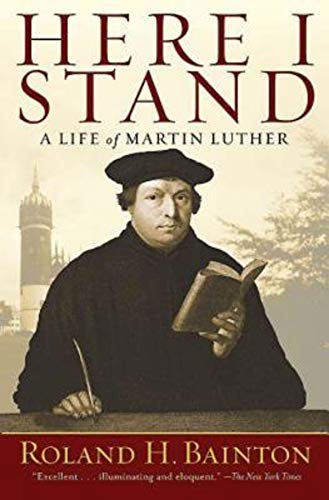
Inhaltsangabe
A vivid portrait of Martin Luther, the man of unshakable faith in God who helped bring about the Protestant Reformation The Reformation of the sixteenth century was a vast and complicated movement. It involved kings and peasants, cardinals and country priests, monks and merchants. It spread from one end of Europe to the other and manifested itself in widely differing forms. Yet in spite of its diverse and complex character, to begin to understand the Reformation you need know only one name: Martin Luther. Since it first was published more than fifty years ago, Roland H. Bainton’s Here I Stand: A Life of Martin Luther has sold millions of copies, and it remains the definitive introduction to the great Reformer and is essential reading for anyone seeking to understand this towering historical figure. “The most readable Luther biography in English.” —Time magazine “A sound and well-rounded picture of the man and his role in history.” —Chicago Tribune
Die Inhaltsangabe kann sich auf eine andere Ausgabe dieses Titels beziehen.
Über die Autorin bzw. den Autor
Roland H. Bainton (1894 1984) was born in England and came to the United States in 1902. A recipient of many degrees, Dr. Bainton was a specialist in Reformation history. For many years he was Titus Street Professor of Ecclesiastical History at Yale University. His other books include The Reformation of the Sixteenth Century, The Travail of Religious Liberty, The Age of Reformation, and Christian Attitudes Toward War and Peace.
Auszug. © Genehmigter Nachdruck. Alle Rechte vorbehalten.
HERE I STAND
A Life of Martin Luther
By Roland H. BaintonAbingdon Press
Copyright © 1978 Roland H. Bainton
All rights reserved.
ISBN: 978-1-4267-5443-2All rights reserved.
Contents
| HERE I STAND—After a Quarter of a Century.................................. | 1 |
| I. The Vow................................................................. | 5 |
| II. The Cloister........................................................... | 21 |
| III. The Gospel............................................................ | 37 |
| IV. The Onslaught.......................................................... | 54 |
| V. The Son of Iniquity..................................................... | 71 |
| VI. The Saxon Hus.......................................................... | 91 |
| VII. The German Hercules................................................... | 111 |
| VIII. The Wild Boar in the Vineyard........................................ | 128 |
| IX. The Appeal to Caesar................................................... | 144 |
| X. Here I Stand............................................................ | 162 |
| XI. My Patmos.............................................................. | 187 |
| XII. The Return of the Exile............................................... | 203 |
| XIII. No Other Foundation.................................................. | 214 |
| XIV. Rebuilding the Walls.................................................. | 233 |
| XV. The Middle Way......................................................... | 249 |
| XVI. Behemoth, Leviathan, and the Great Waters............................. | 269 |
| XVII. The School for Character............................................. | 292 |
| XVIII. The Church Territorial.............................................. | 313 |
| XIX. The Church Tutorial................................................... | 336 |
| XX. The Church Ministerial................................................. | 359 |
| XXI. The Struggle for Faith................................................ | 372 |
| XXII. The Measure of the Man............................................... | 387 |
| Bibliography............................................................... | 401 |
| References................................................................. | 415 |
| Sources of Illustrations................................................... | 430 |
| Index...................................................................... | 433 |
CHAPTER 1
The Vow
ON A SULTRY DAY in July of the year 1505a lonely traveler was trudging over a parchedroad on the outskirts of the Saxon village ofStotternheim. He was a young man, shortbut sturdy, and wore the dress of a universitystudent. As he approached the village, thesky became overcast. Suddenly there was a shower, then a crashingstorm. A bolt of lightning rived the gloom and knocked the man tothe ground. Struggling to rise, he cried in terror, "St. Anne help me! Iwill become a monk."
The man who thus called upon a saint was later to repudiate thecult of the saints. He who vowed to become a monk was later torenounce monasticism. A loyal son of the Catholic Church, he waslater to shatter the structure of medieval Catholicism. A devoted servantof the pope, he was later to identify the popes with Antichrist.For this young man was Martin Luther.
His demolition was the more devastating because it reinforceddisintegrations already in progress. Nationalism was in processof breaking the political unities when the Reformation destroyedthe religious. Yet this paradoxical figure revived the Christianconsciousness of Europe. In his day, as Catholic historians all agree,the popes of the Renaissance were secularized, flippant, frivolous,sensual, magnificent, and unscrupulous. The intelligentsia did notrevolt against the Church because the Church was so much of theirmind and mood as scarcely to warrant a revolt. Politics were emancipatedfrom any concern for the faith to such a degree that the MostChristian King of France and His Holiness the Pope did not disdaina military alliance with the Sultan against the Holy Roman Emperor.Luther changed all this. Religion became again a dominant factoreven in politics for another century and a half. Men cared enough forthe faith to die for it and to kill for it. If there is any sense remainingof Christian civilization in the West, this man Luther in no smallmeasure deserves the credit.
Very naturally he is a controversial figure. The multitudinous portrayalsfall into certain broad types already delineated in his own generation.His followers hailed him as the prophet of the Lord and thedeliverer of Germany. His opponents on the Catholic side called himthe son of perdition and the demolisher of Christendom. The agrarianagitators branded him as the sycophant of the princes, and the radicalsectaries compared him to Moses, who led the children of Israel outof Egypt and left them to perish in the wilderness. But such judgmentsbelong to an epilogue rather than a prologue. The first endeavor mustbe to understand the man.
One will not move far in this direction unless one recognizes atthe outset that Luther was above all else a man of religion. The greatoutward crises of his life which bedazzle the eyes of dramatic biographerswere to Luther himself trivial in comparison with the innerupheavals of his questing after God. For that reason this study mayappropriately begin with his first acute religious crisis in 1505 ratherthan with his birth in 1483. Childhood and youth will be drawn upononly to explain the entry into the monastery.
At Home and School
The vow requires interpretation because even at this early point inLuther's career judgments diverge. Those who deplore his subsequentrepudiation of the vow explain his defection on the ground that heought never to have taken it. Had he ever been a true monk, he wouldnot have abandoned the cowl. His critique of monasticism is madeto recoil upon himself in that he ispainted as a monk without vocation,and the vow is interpreted,not as a genuine call, but rather asthe resolution of an inner conflict,an escape from maladjustment athome and at school.
A few sparse items of evidenceare adduced in favor of this explanation.They are not of the highestreliability because they are all takenfrom the conversation of the older Luther as recorded, often inaccurately,by his students; and even if they are genuine, they cannot beaccepted at face value because the Protestant Luther was no longerin a position to recall objectively the motives of his Catholic period.Really there is only one saying which connects the taking of the cowlwith resentment against parental discipline. Luther is reported tohave said, "My mother caned me for stealinga nut, until the blood came. Such strict disciplinedrove me to the monastery, although shemeant it well." This saying is reinforced by twoothers: "My father once whipped me so thatI ran away and felt ugly toward him until hewas at pains to win me back." "[At school] Iwas caned in a single morning fifteen times fornothing at all. I was required to...
„Über diesen Titel“ kann sich auf eine andere Ausgabe dieses Titels beziehen.
Suchergebnisse für Here I Stand: A Life of Martin Luther

Beispielbild für diese ISBN
Here I Stand
Anbieter: World of Books (was SecondSale), Montgomery, IL, USA
Verkäuferbewertung 5 von 5 Sternen

Paperback. Zustand: Very Good. The Reformation of the sixteenth century was a vast and complicated movement. It involved kings and peasants, cardinals and country priests, monks and merchants. It spread from one end of Europe to the other, and manifested itself in widely differing forms. Yet in spite of its diverse and complex character, to start to understand the Reformation you need know only one name: Martin Luther. Roland Bainton's Here I Stand: A Life of Martin Luther remains the definitive introduction to the great Reformer and is essential reading for anyone seeking to understand this towering historical figure. Artikel-Nr. 00107884427
Gebraucht kaufen
EUR 5,99
Versand gratis
Versand innerhalb von USA
Versand innerhalb von USA
Anzahl: 1 verfügbar
Beispielbild für diese ISBN
Here I Stand
Anbieter: World of Books (was SecondSale), Montgomery, IL, USA
Verkäuferbewertung 5 von 5 Sternen
Paperback. Zustand: Good. The Reformation of the sixteenth century was a vast and complicated movement. It involved kings and peasants, cardinals and country priests, monks and merchants. It spread from one end of Europe to the other, and manifested itself in widely differing forms. Yet in spite of its diverse and complex character, to start to understand the Reformation you need know only one name: Martin Luther. Roland Bainton's Here I Stand: A Life of Martin Luther remains the definitive introduction to the great Reformer and is essential reading for anyone seeking to understand this towering historical figure. Artikel-Nr. 00108687292
Gebraucht kaufen
EUR 5,99
Versand gratis
Versand innerhalb von USA
Versand innerhalb von USA
Anzahl: 6 verfügbar
Beispielbild für diese ISBN
Here I Stand : A Life of Martin Luther
Anbieter: Better World Books, Mishawaka, IN, USA
Verkäuferbewertung 5 von 5 Sternen
Zustand: Good. Former library copy. Pages intact with minimal writing/highlighting. The binding may be loose and creased. Dust jackets/supplements are not included. Includes library markings. Stock photo provided. Product includes identifying sticker. Better World Books: Buy Books. Do Good. Artikel-Nr. 17374049-6
Gebraucht kaufen
EUR 7,61
Versand gratis
Versand innerhalb von USA
Versand innerhalb von USA
Anzahl: 1 verfügbar
Beispielbild für diese ISBN
Here I Stand : A Life of Martin Luther
Anbieter: Better World Books, Mishawaka, IN, USA
Verkäuferbewertung 5 von 5 Sternen
Zustand: Very Good. Former library copy. Pages intact with possible writing/highlighting. Binding strong with minor wear. Dust jackets/supplements may not be included. Includes library markings. Stock photo provided. Product includes identifying sticker. Better World Books: Buy Books. Do Good. Artikel-Nr. 11723727-75
Gebraucht kaufen
EUR 7,61
Versand gratis
Versand innerhalb von USA
Versand innerhalb von USA
Anzahl: 1 verfügbar
Beispielbild für diese ISBN
Here I Stand : A Life of Martin Luther
Anbieter: Better World Books, Mishawaka, IN, USA
Verkäuferbewertung 5 von 5 Sternen
Zustand: Good. Pages intact with minimal writing/highlighting. The binding may be loose and creased. Dust jackets/supplements are not included. Stock photo provided. Product includes identifying sticker. Better World Books: Buy Books. Do Good. Artikel-Nr. 14746399-6
Gebraucht kaufen
EUR 7,61
Versand gratis
Versand innerhalb von USA
Versand innerhalb von USA
Anzahl: 2 verfügbar
Beispielbild für diese ISBN
Here I Stand: A Life of Martin Luther
Anbieter: ThriftBooks-Dallas, Dallas, TX, USA
Verkäuferbewertung 5 von 5 Sternen
Paperback. Zustand: Fair. No Jacket. Readable copy. Pages may have considerable notes/highlighting. ~ ThriftBooks: Read More, Spend Less. Artikel-Nr. G1426754434I5N00
Gebraucht kaufen
EUR 7,63
Versand gratis
Versand innerhalb von USA
Versand innerhalb von USA
Anzahl: 1 verfügbar
Beispielbild für diese ISBN
Here I Stand: A Life of Martin Luther
Anbieter: Books From California, Simi Valley, CA, USA
Verkäuferbewertung 4 von 5 Sternen

paperback. Zustand: Fine. Artikel-Nr. mon0004170283
Gebraucht kaufen
EUR 6,74
EUR 4,43 Versand
Versand innerhalb von USA
Versand innerhalb von USA
Anzahl: 1 verfügbar
Beispielbild für diese ISBN
Here I Stand: A Life of Martin Luther
Anbieter: Ria Christie Collections, Uxbridge, Vereinigtes Königreich
Verkäuferbewertung 5 von 5 Sternen
Zustand: New. In English. Artikel-Nr. ria9781426754432_new
Neu kaufen
EUR 24,73
EUR 13,28 Versand
Versand von Vereinigtes Königreich nach USA
Versand von Vereinigtes Königreich nach USA
Anzahl: Mehr als 20 verfügbar
Beispielbild für diese ISBN
Here I Stand: A Life of Martin Luther
Anbieter: Revaluation Books, Exeter, Vereinigtes Königreich
Verkäuferbewertung 5 von 5 Sternen
Paperback. Zustand: Brand New. reprint edition. 464 pages. 8.50x5.60x0.70 inches. In Stock. Artikel-Nr. x-1426754434
Neu kaufen
EUR 27,84
EUR 14,71 Versand
Versand von Vereinigtes Königreich nach USA
Versand von Vereinigtes Königreich nach USA
Anzahl: 2 verfügbar
Foto des Verkäufers
Here I Stand : A Life of Martin Luther
Anbieter: AHA-BUCH GmbH, Einbeck, Deutschland
Verkäuferbewertung 5 von 5 Sternen
Taschenbuch. Zustand: Neu. Neuware - The Reformation of the sixteenth century was a vast and complicated movement. It involved kings and peasants, cardinals and country priests, monks and merchants. It spread from one end of Europe to the other, and manifested itself in widely differing forms. Yet in spite of its diverse and complex character, to start to understand the Reformation you need know only one name: Martin Luther. Roland Bainton's Here I Stand: A Life of Martin Luther remains the definitive introduction to the great Reformer and is essential reading for anyone seeking to understand this towering historical figure. Artikel-Nr. 9781426754432
Neu kaufen
EUR 29,83
EUR 35,00 Versand
Versand von Deutschland nach USA
Versand von Deutschland nach USA
Anzahl: 2 verfügbar