
Verwandte Artikel zu Globalization and Theology (Horizons in Theology)
Inhaltsangabe
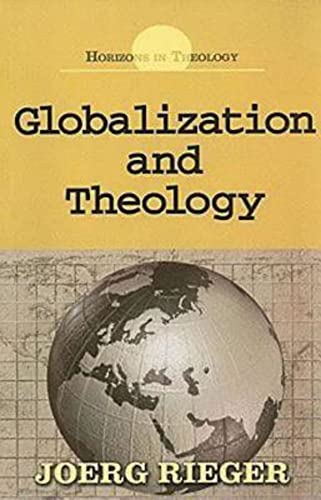
Globalization is a catchword of our time, referring to the interdependence that affects us all. But we often meet globalization with extreme ambivalence, recognizing that it has both positive and negative consequences for economics, politics, and culture. Joerg Rieger makes the point that even theology, itself, can be a manifestation of globalization. At its worst, theology can reflect Western intellectual imperialism and at its best, theology can encourage a compelling vision of diversity within unity. The author articulates a theology of globalization as a diverse phenomenon that respects different ways of seeing and knowing, thus encouraging harmony rather than homogeny.
Die Inhaltsangabe kann sich auf eine andere Ausgabe dieses Titels beziehen.
Über die Autorin bzw. den Autor
Joerg Rieger es profesor de teología y dirige la cátedra en estudios wesleyanos en la Escuela de Divinidad del Cal Turner y el Programa de Graduados en Religión de la Universidad de Vanderbilt. También es el Director Fundador del Programa Wendland-Cook de Religión y Justicia en Vanderbilt. Por más de dos décadas Rieger ha trabajado para unir la teología y las luchas por la justicia y la liberación que marcan nuestra época. Su trabajo aborda la relación de la teología con la vida pública, utilizando herramientas de estudios culturales, teoría crítica y estudios religiosos, a partir de la reflexión sobre el uso del poder en la religión, la política y la economía.
Auszug. © Genehmigter Nachdruck. Alle Rechte vorbehalten.
Globalization and Theology
By Joerg RiegerAbingdon Press
Copyright © 2010 The United Methodist Publishing HouseAll right reserved.
ISBN: 978-1-4267-0065-1
Chapter One
Globalization, Theology, and Hard Power
It is often forgotten today that globalization is not without precedent. A look at history tells us that globalization is an old phenomenon, which is closely connected to the emergence of a variety of empires in human history. While empires come in different forms and shapes, they share in common the effort to expand their reach as far as possible, geographically and otherwise, and to bring all of life under their control. Such control can be exercised in various ways, as we will see, but one of the most common forms of control is hard power.
Globalization, in this context, means the expansion of control primarily through the use of hard power over an ever larger geographical area, linked to the expansion of control over more and more aspects of life—not only economic and political but also cultural, religious, personal, emotional, and so on. This sort of globalization can be defined in terms of the expansion of top-down power at all levels of life, of mounting power differentials, of suppression of alternatives at all levels, and in terms of a concomitant erasure of local difference. This erasure of difference happens at the cultural level, as is often noted; for instance, as traditional ways of life and of thinking are abandoned. Nevertheless, this erasure of difference even manifests itself in the erasure of biological diversity, both past and present. For example, the Romans deeply influenced ecological circuits when they deforested large coastal regions in order to build their fleets. The landscape of the Mediterranean coasts still bears the marks of these actions. The goal of this sort of globalization is control over as much of the world and over as large a part of reality as possible, and one of the results is a growing gap between those on the top and those on the bottom, between the rich and the poor. Top-down globalization, in its various manifestations, creates concentrations of power and wealth in the hands of a few, to the detriment of the majority of people.
The Roman Empire will serve as our first example, as it provides the context in which Christianity was born—a context that deeply influenced Judeo-Christian traditions. The centralization of the Roman government under Gaius Julius Caesar constituted a major step in the Roman transition from being a republic to becoming an empire. In the process, power and wealth became even more concentrated at the top. The birth of Jesus occurred during the reign of the first official Roman emperor, Augustus, only a few decades later. This setting is important because the influence of empire extends to all aspects of life, and so it is not surprising that the Jesus movement ran into conflicts with the status quo and with all those who saw no alternative but to adapt to it. At the heart of these conflicts was the question of power and its theological justification: was divine power located at the top, with the various elites, or was divine power at work at the bottom, with the people—where the Jesus movement kept building?
The tensions between the Roman Empire, its supporters, and emerging Christianity can be seen in many of the writings of the New Testament, though only between the lines or in coded language. The writers needed to be cautious, as the influence of the Roman Empire was all-pervasive not just in the days of Jesus but also in their own time, in the latter parts of the first century. The writers of the Gospels, for instance, narrate the involvement of the Roman authorities in Jesus' crucifixion in slightly different ways, some of them more cautious than others. Nevertheless, they all preserve a "dangerous memory" of the fact that Jesus had been a threat to the aspirations of the empire.
In this context, politics and religion as well as the various actors are inextricably connected: the Roman Empire is not only represented by Pontius Pilate, the Roman governor, but also by the Jewish high priests, who were appointed by the Roman governors, and by vassals of Roman power such as Herod and his people. The hard power of the Roman Empire, which was brought to bear with special force in unruly and faraway provinces, was at work through all of these channels. Direct military exercises, brutal devastation of whole communities, and massacres were not uncommon; some of these manifestations of empire were mirrored in the life of Jesus. Soon after Jesus' birth, the Gospel of Matthew reports, Herod ordered the killing of all children in the area of Bethlehem in order to get rid of what might become a threat to his power. This way of terrorizing and traumatizing the population had consequences, one of which is still prevalent in the contemporary world in migrant and refugee communities: Jesus' family, too, was forced to migrate to Egypt as refugees (Matt. 2:13-18).
Keeping in mind this inextricable relation of religion and politics, Jesus' proverbial response to paying taxes must be seen in a new light: the advice to "give to the emperor the things that are the emperor's, and to God the things that are God's" is often referenced as if Jesus were arguing for a peaceful coexistence of empire and religion, as if the emperor would be the ruler of things political and God would be the ruler of things religious. But Jesus can hardly be accused of forgetting what every Jew knew, namely that God could never be relegated to the religious realm (an idea which, in essence, is a modern invention), leaving the political realm to the emperor. All three Gospels that report this story mention that the context of Jesus' advice was a trap—set by both religious and political adversaries (as Mark and Matthew note). Luke emphasizes that they were amazed that they were not able to trap Jesus "in the presence of the people." The people, therefore, must have gotten this deeper meaning, what James Scott has called the "hidden transcripts," which are an important part of the "arts of resistance" (see Luke 20:20-26). The globalizing empire's strategy of erasing local difference appears not to have worked in this situation.
These tensions with the hard power of the Roman Empire continued and intensified after Jesus' execution, supporting the impression that the Crucifixion cannot be seen as a one-time mistake of the empire. Early Christianity stood in sharp contrast with the emperor cult, which directed religious worship toward the emperor and was a much more significant part of the overall structure of the Roman Empire than theological scholarship has realized. The early Christian confession that "Jesus is Lord" was a direct challenge to the power of the empire, which held that the emperor was lord. Other statements of the Christian faith implied as much: confessing Jesus as savior when the emperor was considered savior, proclaiming faith in—and therefore allegiance to—Jesus when the object of faith was the emperor, and claiming that Jesus was the Son of God when the emperor was considered the son of the divine could not go unnoticed. Other language would have been available for Jesus, but it seems that Paul was not interested in using it.
It should be clear by now that a merely religious explanation of these tensions will not suffice. The Romans were religiously quite tolerant and managed to include gods of other religions, like the Egyptian gods Isis and Osiris, in their worship. In a globalizing world, both then and now, those in power often do not mind...
„Über diesen Titel“ kann sich auf eine andere Ausgabe dieses Titels beziehen.
Suchergebnisse für Globalization and Theology (Horizons in Theology)

Beispielbild für diese ISBN
Globalization and Theology
Anbieter: ThriftBooks-Dallas, Dallas, TX, USA
Verkäuferbewertung 5 von 5 Sternen

Paperback. Zustand: Very Good. No Jacket. May have limited writing in cover pages. Pages are unmarked. ~ ThriftBooks: Read More, Spend Less. Artikel-Nr. G1426700652I4N00
Gebraucht kaufen
EUR 5,85
Versand gratis
Versand innerhalb von USA
Versand innerhalb von USA
Anzahl: 1 verfügbar
Beispielbild für diese ISBN
Globalization and Theology (Horizons in Theology)
Anbieter: World of Books (was SecondSale), Montgomery, IL, USA
Verkäuferbewertung 5 von 5 Sternen
Zustand: Good. Item in good condition. Textbooks may not include supplemental items i.e. CDs, access codes etc. Artikel-Nr. 00105945977
Gebraucht kaufen
EUR 7,59
Versand gratis
Versand innerhalb von USA
Versand innerhalb von USA
Anzahl: 2 verfügbar
Beispielbild für diese ISBN
Globalization and Theology (Horizons in Theology)
Anbieter: Ria Christie Collections, Uxbridge, Vereinigtes Königreich
Verkäuferbewertung 5 von 5 Sternen
Zustand: New. In English. Artikel-Nr. ria9781426700651_new
Neu kaufen
EUR 15,91
EUR 10,93 Versand
Versand von Vereinigtes Königreich nach USA
Versand von Vereinigtes Königreich nach USA
Anzahl: Mehr als 20 verfügbar
Beispielbild für diese ISBN
Globalization and Theology
Anbieter: Revaluation Books, Exeter, Vereinigtes Königreich
Verkäuferbewertung 5 von 5 Sternen
Paperback. Zustand: Brand New. 96 pages. 8.25x5.50x0.25 inches. In Stock. Artikel-Nr. x-1426700652
Neu kaufen
EUR 16,84
EUR 11,66 Versand
Versand von Vereinigtes Königreich nach USA
Versand von Vereinigtes Königreich nach USA
Anzahl: 2 verfügbar
Foto des Verkäufers
Globalization and Theology
Anbieter: moluna, Greven, Deutschland
Verkäuferbewertung 5 von 5 Sternen
Zustand: New. Artikel-Nr. 4139168
Neu kaufen
EUR 17,53
EUR 48,99 Versand
Versand von Deutschland nach USA
Versand von Deutschland nach USA
Anzahl: Mehr als 20 verfügbar