
Verwandte Artikel zu Einstein's Jewish Science: Physics at the Intersection...
Inhaltsangabe
Finalist for the Gerrard and Ella Berman Memorial Award of the Jewish Book Council
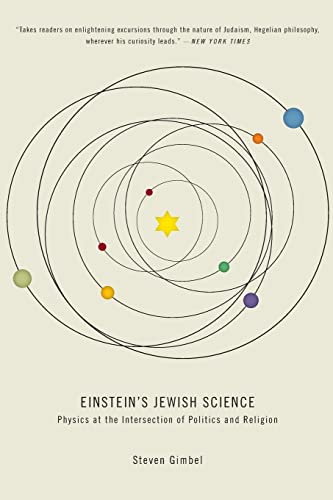
Is relativity Jewish? The Nazis denigrated Albert Einstein’s revolutionary theory by calling it "Jewish science," a charge typical of the ideological excesses of Hitler and his followers. Philosopher of science Steven Gimbel explores the many meanings of this provocative phrase and considers whether there is any sense in which Einstein’s theory of relativity is Jewish.
Arguing that we must take seriously the possibility that the Nazis were in some measure correct, Gimbel examines Einstein and his work to explore how beliefs, background, and environment may—or may not—have influenced the work of the scientist. You cannot understand Einstein’s science, Gimbel declares, without knowing the history, religion, and philosophy that influenced it.
No one, especially Einstein himself, denies Einstein's Jewish heritage, but many are uncomfortable saying that he was being a Jew while he was at his desk working. To understand what "Jewish" means for Einstein’s work, Gimbel first explores the many definitions of "Jewish" and asks whether there are elements of Talmudic thinking apparent in Einstein’s theory of relativity. He applies this line of inquiry to other scientists, including Isaac Newton, René Descartes, Sigmund Freud, and Émile Durkheim, to consider whether their specific religious beliefs or backgrounds manifested in their scientific endeavors.
Einstein's Jewish Science intertwines science, history, philosophy, theology, and politics in fresh and fascinating ways to solve the multifaceted riddle of what religion means—and what it means to science. There are some senses, Gimbel claims, in which Jews can find a special connection to E = mc2, and this claim leads to the engaging, spirited debate at the heart of this book.
Die Inhaltsangabe kann sich auf eine andere Ausgabe dieses Titels beziehen.
Über die Autorin bzw. den Autor
Steven Gimbel is the Edwin T. and Cynthia Shearer Johnson Professor for Distinguished Teaching in the Humanities and chair of the Department of Philosophy at Gettysburg College, where he won the Luther and Bernice Johnson Award for Distinguished Teaching. He is author of Exploring the Scientific Method: Cases and Questions; René Descartes: The Search for Certainty; and Defending Einstein: Hans Reichenbach's Writings on Space, Time, and Motion.
Von der hinteren Coverseite
The Nazis denigrated Albert Einstein’s theory of relativity by calling it “Jewish science,” a charge typical of the ideological excesses of Hitler and his followers. Philosopher of science Steven Gimbel explores the many meanings of this provocative phrase and considers whether there is any sense in which Einstein’s revolutionary theory is Jewish.
Arguing that we must take seriously the possibility that the Nazis were in some measure correct, Gimbel examines Einstein and his work to explore how beliefs, background, and environment may—or may not—have influenced the work of the scientist. You cannot understand Einstein’s science, Gimbel declares, without knowing the history, religion, and philosophy that influenced it.
"To understand Gimbel’s argument about the Jewish quality of Einstein’s approach—and to perceive the boldness of Gimbel’s decision to re-examine twentieth-century, anti-Semitic ideas about 'Jewish science'—it’s necessary first to understand the historical moment out of which the theory of relativity emerged."—Tikkun
"Gimbel . . . takes readers on enlightening excursions through the nature of Judaism, Hegelian philosophy, wherever his curiosity leads."—New York Times Book Review
"A fascinating and enlightening discussion of many aspects of the . . . 20th century that examines the many different ways in which one might understand the suggestion that Einstein’s physics expresses or reflects something distinctively Jewish."—Physics Today
"A lively, intentionally provocative and wholly compelling inquiry into the Jewishness of Einstein himself and the world-changing scientific revolution that he set in motion."—Jewish Journal
"Gimbel spins out what could have been a mere provocation into a wide-ranging and entertaining collision of science, history, philosophy, and religion."—Zocalo Public Square
"A fascinating engagement with the nature of Judaism and of science. By exploring and, in a sense, redeeming the Nazi accusation that Einstein's relativity theory is 'Jewish science,' Gimbel not only challenges the racist meanings of that charge but shows how scientific theories must in fact reflect the issues and concerns of the historical periods which give rise to them."—Rabbi Michael Lerner
Aus dem Klappentext
The Nazis denigrated Albert Einstein's theory of relativity by calling it "Jewish science," a charge typical of the ideological excesses of Hitler and his followers. Philosopher of science Steven Gimbel explores the many meanings of this provocative phrase and considers whether there is any sense in which Einstein's revolutionary theory is Jewish.
Arguing that we must take seriously the possibility that the Nazis were in some measure correct, Gimbel examines Einstein and his work to explore how beliefs, background, and environment may--or may not--have influenced the work of the scientist. You cannot understand Einstein's science, Gimbel declares, without knowing the history, religion, and philosophy that influenced it.
To understand Gimbel's argument about the Jewish quality of Einstein's approach--and to perceive the boldness of Gimbel's decision to re-examine twentieth-century, anti-Semitic ideas about 'Jewish science'--it's necessary first to understand the historical moment out of which the theory of relativity emerged.--Tikkun
Gimbel . . . takes readers on enlightening excursions through the nature of Judaism, Hegelian philosophy, wherever his curiosity leads.--New York Times Book Review
A fascinating and enlightening discussion of many aspects of the . . . 20th century that examines the many different ways in which one might understand the suggestion that Einstein's physics expresses or reflects something distinctively Jewish.--Physics Today
A lively, intentionally provocative and wholly compelling inquiry into the Jewishness of Einstein himself and the world-changing scientific revolution that he set in motion.--Jewish Journal
Gimbel spins out what could have been a mere provocation into a wide-ranging and entertaining collision of science, history, philosophy, and religion.--Zocalo Public Square
A fascinating engagement with the nature of Judaism and of science. By exploring and, in a sense, redeeming the Nazi accusation that Einstein's relativity theory is 'Jewish science, ' Gimbel not only challenges the racist meanings of that charge but shows how scientific theories must in fact reflect the issues and concerns of the historical periods which give rise to them.--Rabbi Michael Lerner
--Noah Efron, Graduate Program in Science, Technology and Society, Bar Ilan University "Tikkun"„Über diesen Titel“ kann sich auf eine andere Ausgabe dieses Titels beziehen.
Suchergebnisse für Einstein's Jewish Science: Physics at the Intersection...

Beispielbild für diese ISBN
Einstein's Jewish Science: Physics at the Intersection of Politics and Religion
Verlag:
Johns Hopkins University Press (edition Reprint), 2013
ISBN 10: 1421411822
ISBN 13: 9781421411828
Gebraucht
Paperback
Anbieter: BooksRun, Philadelphia, PA, USA
Verkäuferbewertung 5 von 5 Sternen

Paperback. Zustand: Very Good. Reprint. It's a well-cared-for item that has seen limited use. The item may show minor signs of wear. All the text is legible, with all pages included. It may have slight markings and/or highlighting. Artikel-Nr. 1421411822-11-1
Gebraucht kaufen
EUR 5,14
Versand gratis
Versand innerhalb von USA
Versand innerhalb von USA
Anzahl: 1 verfügbar
Beispielbild für diese ISBN
Einstein's Jewish Science: Physics at the Intersection of Politics and Religion
Verlag:
Johns Hopkins University Press, 2013
ISBN 10: 1421411822
ISBN 13: 9781421411828
Gebraucht
Paperback
Anbieter: ThriftBooks-Atlanta, AUSTELL, GA, USA
Verkäuferbewertung 5 von 5 Sternen
Paperback. Zustand: Very Good. No Jacket. May have limited writing in cover pages. Pages are unmarked. ~ ThriftBooks: Read More, Spend Less. Artikel-Nr. G1421411822I4N00
Gebraucht kaufen
EUR 6,06
Versand gratis
Versand innerhalb von USA
Versand innerhalb von USA
Anzahl: 1 verfügbar
Beispielbild für diese ISBN
Einstein's Jewish Science: Physics at the Intersection of Politics and Religion
Verlag:
Johns Hopkins University Press, 2013
ISBN 10: 1421411822
ISBN 13: 9781421411828
Neu
Softcover
Anbieter: Ria Christie Collections, Uxbridge, Vereinigtes Königreich
Verkäuferbewertung 5 von 5 Sternen
Zustand: New. In English. Artikel-Nr. ria9781421411828_new
Neu kaufen
EUR 36,21
EUR 13,48 Versand
Versand von Vereinigtes Königreich nach USA
Versand von Vereinigtes Königreich nach USA
Anzahl: Mehr als 20 verfügbar
Beispielbild für diese ISBN
Einstein`s Jewish Science Physics at the Intersection of Politics and Religion
Anbieter: Revaluation Books, Exeter, Vereinigtes Königreich
Verkäuferbewertung 5 von 5 Sternen
Paperback. Zustand: Brand New. reprint edition. 245 pages. 9.25x6.00x0.75 inches. In Stock. Artikel-Nr. x-1421411822
Neu kaufen
EUR 45,40
EUR 11,94 Versand
Versand von Vereinigtes Königreich nach USA
Versand von Vereinigtes Königreich nach USA
Anzahl: 2 verfügbar
Beispielbild für diese ISBN
Einstein s Jewish Science: Physics at the Intersection of Politics and Religion
Verlag:
Johns Hopkins University Press, 2013
ISBN 10: 1421411822
ISBN 13: 9781421411828
Neu
Softcover
Anbieter: Kennys Bookstore, Olney, MD, USA
Verkäuferbewertung 5 von 5 Sternen
Zustand: New. There are some senses, Gimbel claims, in which Jews can find a special connection to E = mc2, and this claim leads to the engaging, spirited debate at the heart of this book. Num Pages: 256 pages, black & white illustrations. BIC Classification: HRAM3; JFSR1; PDX; PHR. Category: (G) General (US: Trade). Dimension: 225 x 168 x 17. Weight in Grams: 362. . 2013. Reprint. Paperback. . . . . Books ship from the US and Ireland. Artikel-Nr. V9781421411828
Neu kaufen
EUR 49,78
EUR 9,37 Versand
Versand innerhalb von USA
Versand innerhalb von USA
Anzahl: Mehr als 20 verfügbar
Foto des Verkäufers
Einstein's Jewish Science : Physics at the Intersection of Politics and Religion
Verlag:
Hopkins Fulfillment Service Sep 2013, 2013
ISBN 10: 1421411822
ISBN 13: 9781421411828
Neu
Taschenbuch
Anbieter: AHA-BUCH GmbH, Einbeck, Deutschland
Verkäuferbewertung 5 von 5 Sternen
Taschenbuch. Zustand: Neu. Neuware - Is relativity Jewish The Nazis denigrated Albert Einstein's revolutionary theory by calling it 'Jewish science,' a charge typical of the ideological excesses of Hitler and his followers. Philosopher of science Steven Gimbel explores the many meanings of this provocative phrase and considers whether there is any sense in which Einstein's theory of relativity is Jewish. Arguing that we must take seriously the possibility that the Nazis were in some measure correct, Gimbel examines Einstein and his work to explore how beliefs, background, and environment may-or may not-have influenced the work of the scientist. You cannot understand Einstein's science, Gimbel declares, without knowing the history, religion, and philosophy that influenced it. No one, especially Einstein himself, denies Einstein's Jewish heritage, but many are uncomfortable saying that he was being a Jew while he was at his desk working. To understand what 'Jewish' means for Einstein's work, Gimbel first explores the many definitions of 'Jewish' and asks whether there are elements of Talmudic thinking apparent in Einstein's theory of relativity. He applies this line of inquiry to other scientists, including Isaac Newton, René Descartes, Sigmund Freud, and Émile Durkheim, to consider whether their specific religious beliefs or backgrounds manifested in their scientific endeavors. Einstein's Jewish Science intertwines science, history, philosophy, theology, and politics in fresh and fascinating ways to solve the multifaceted riddle of what religion means-and what it means to science. There are some senses, Gimbel claims, in which Jews can find a special connection to E = mc2, and this claim leads to the engaging, spirited debate at the heart of this book. Artikel-Nr. 9781421411828
Neu kaufen
EUR 50,53
EUR 35,00 Versand
Versand von Deutschland nach USA
Versand von Deutschland nach USA
Anzahl: 2 verfügbar