
Verwandte Artikel zu Anything But Typical
Inhaltsangabe
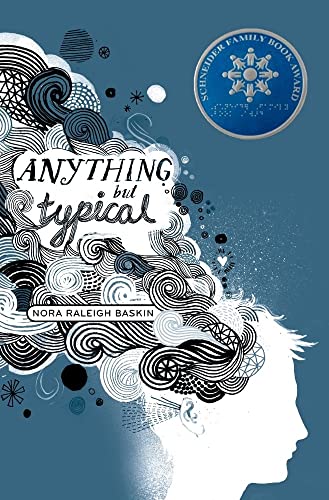
Told from the first-person perspective of an autistic boy, Nora Raleigh Baskin’s novel is an enlightening story for anyone who has ever worried about fitting in.
Jason Blake is an autistic twelve-year-old living in a neurotypical world. Most days it's just a matter of time before something goes wrong. But Jason finds a glimmer of understanding when he comes across PhoenixBird, who posts stories to the same online site as he does.
Jason can be himself when he writes and he thinks that PhoneixBird-her name is Rebecca-could be his first real friend. But as desperate as Jason is to met her, he's terrified that if they do meet, Rebecca wil only see his autism and not who Jason really is.
By acclaimed writer Nora Raleigh Baskin, this is the breathtaking depiction of an autistic boy's struggles-and a story for anyone who has ever worried about fitting in.
Die Inhaltsangabe kann sich auf eine andere Ausgabe dieses Titels beziehen.
Über die Autorin bzw. den Autor
Nora Raleigh Baskin is the ALA Schneider Family Book Award–winning author of Anything But Typical. She was chosen as a Publishers Weekly Flying Start for her novel What Every Girl (Except Me) Knows, and has since written a number of novels for middle graders and teens, including The Truth About My Bat Mitzvah, The Summer Before Boys, and Ruby on the Outside. Nora lives with her family in Connecticut. Visit her at NoraBaskin.com.
Auszug. © Genehmigter Nachdruck. Alle Rechte vorbehalten.
Anything But Typical
Chapter One
Most people like to talk in their own language.
They strongly prefer it. They so strongly prefer it that when they go to a foreign country they just talk louder, maybe slower, because they think they will be better understood. But more than talking in their own language, people like to hear things in a way they are most comfortable. The way they are used to. The way they can most easily relate to, as if that makes it more real. So I will try to tell this story in that way.
And I will tell this story in first person.
I not he. Me not him. Mine not his.
In a neurotypical way.
I will try—
To tell my story in their language, in your language.
I am Jason Blake.
And this is what someone would say, if they looked at me but could only see and could only hear in their own language:
That kid is weird (he’s in SPED, you know). He blinks his eyes, sometimes one at a time. Sometimes both together. They open and close, open and close, letting the light in, shutting it out. The world blinks on and off.
And he flaps his hands, like when he is excited or just before he is going to say something, or when he is thinking. He does that the most when he’s on the computer or reading a book. When his mind is focused on the words, it separates from his body, his body that almost becomes a burden, a weight.
Weight.
Wait.
Only his fingers don’t stand still while they wait. They flap at the ends of his hands, at the ends of his wrists.
Like insects stuck on a string, stuck in a net. Like maybe they want to fly away. Maybe he does too.
In first grade they put a thick, purple rubber band across the bottom bar of his desk chair, so Jason would have something to jiggle with his feet when he was supposed to be sitting still. In second grade Matthew Iverson sent around a note saying, If you think Jason Blake is a retard, sign this, and Matthew got sent to the principal’s office, which only made things worse for Jason.
In third grade Jason Blake was diagnosed with ASD, autistic spectrum disorder. But his mother will never use that term. She prefers three different letters: NLD, nonverbal learning disorder. Or these letters: PDD-NOS, pervasive developmental disorder– non-specific. When letters are put together, they can mean so much, and they can mean nothing at all.
From third grade until this year, sixth grade, Jason had a one-on-one aide, who followed him around school all day. She weighed two hundred and three pounds. (Jason asked her once, and she told him.) You couldn’t miss seeing her.
But the thing people see the most is his silence, because some kinds of silence are actually visible.
When I write, I can be heard. And known.
But nobody has to look at me. Nobody has to see me at all.
School doesn’t always go very well. It is pretty much a matter of time before the first thing of the day will go wrong.
But today I’ve gotten far. It is already third period. Mrs. Hawthorne is absent and so we are going to the library instead of art class. This is a good sign. You’d think art class would be one of the easiest classes, but it’s not. I mean, it’s not that it’s hard like math, but it’s hard like PE. A lot of space and time that is not organized.
Anything can go wrong in that kind of space.
But not in the library. There are computers in the library. And books. And computers. Keyboards and screens and desks that are built inside little compartments so you don’t have to look at the person sitting next to you. And they can’t look at me.
When we get into the library, somebody is already sitting in my seat, at my computer. At the one I want. Now I can’t breathe. I want to log on to my Storyboard website. I was thinking about it all the way here. I have already had to wait so long. I don’t know.
“Jason, this one is free,” the lady says. She puts her hands on my shoulders. This lady is a lady I should know, but her face looks like a lot of other faces I don’t know so well, and I group them all together. Her face is pinched, but her eyes are big, round like circles. Her hair doesn’t move, like it’s stuck in a ball. She belongs in the library or the front office or my dentist’s office.
But she is here now, so I will assume she is the librarian.
I know from experience that she is trying to help me, but it doesn’t. I can feel her weight on my shoulders like metal cutting my body right off my head. This is not a good thing.
I also know she wants me to look at her.
Neurotypicals like it when you look them in the eye. It is supposed to mean you are listening, as if the reverse were true, which it is not: Just because you are not looking at someone does not mean you are not listening. I can listen better when I am not distracted by a person’s face:
What are their eyes saying?
Is that a frown or a smile?
Why are they wrinkling their forehead or lifting their cheeks like that? What does that mean?
How can you listen to all those words when you have to think about all that stuff?
But I know I will get in trouble if I don’t look at the lady’s eyes. I can force myself. I turn my head, but I will look at her sideways.
I know the right words to use.
Last year Jane, my one-on-one, taught me to say, “I am okay just as I am.”
I am okay just as I am.
She told me I had to say something in this sort of situation. She said that people expect certain things. She said that people will misunderstand me if I don’t say something.
This is one of the many, many things I need to run through in my mind, every time. Also the things my OT, my occupational therapist, has taught me:
Look people in the eye when you are talking (even if this makes it harder for you to listen).
Talk, even when you have nothing to say (that’s what NTs do all the time).
Try to ignore everything else around you (even when those things may be very important).
If possible put your head and your body back together and try very hard not to shake or flap or twirl or twitch (even if it makes you feel worse to do this).
Don’t blink.
Don’t click your teeth. (These are the things people don’t like. These are the things they hear but can’t hear).
“I am okay just as I am,” I say, and I take a step forward. I want the librarian to take her hands off my shoulders. The weight of her hands is almost unbearable, like lead. Like the lead apron the dentist puts on you when you get an x-ray, a crushing rock while the technician counts to ten. And you can’t move.
Or they will have to do it all over again.
Also, I want to stand close, so there will be no confusion that I am next in line. The person at the computer turns around to the sound of my voice. It is a girl. Most girls look the same, and I can’t tell one from the other.
Long hair. Earrings. Different tone of voice.
A Girl.
I don’t know who this girl...
„Über diesen Titel“ kann sich auf eine andere Ausgabe dieses Titels beziehen.
Suchergebnisse für Anything But Typical

Beispielbild für diese ISBN
Anything But Typical
Verlag:
Simon & Schuster Books for Young Readers, 2009
ISBN 10: 1416963782
ISBN 13: 9781416963783
Gebraucht
Hardcover
Anbieter: World of Books (was SecondSale), Montgomery, IL, USA
Verkäuferbewertung 5 von 5 Sternen

Zustand: Good. Item in good condition. Textbooks may not include supplemental items i.e. CDs, access codes etc. Artikel-Nr. 00102869739
Gebraucht kaufen
EUR 3,71
Versand gratis
Versand innerhalb von USA
Versand innerhalb von USA
Anzahl: 1 verfügbar
Beispielbild für diese ISBN
Anything But Typical
Verlag:
Simon & Schuster Books for Young Readers, 2009
ISBN 10: 1416963782
ISBN 13: 9781416963783
Gebraucht
Hardcover
Anbieter: World of Books (was SecondSale), Montgomery, IL, USA
Verkäuferbewertung 5 von 5 Sternen
Zustand: Acceptable. Item in acceptable condition! Textbooks may not include supplemental items i.e. CDs, access codes etc. Artikel-Nr. 00081655144
Gebraucht kaufen
EUR 3,71
Versand gratis
Versand innerhalb von USA
Versand innerhalb von USA
Anzahl: 2 verfügbar
Beispielbild für diese ISBN
Anything But Typical
ISBN 10: 1416963782
ISBN 13: 9781416963783
Gebraucht
Hardcover
Anbieter: BooksRun, Philadelphia, PA, USA
Verkäuferbewertung 5 von 5 Sternen
Hardcover. Zustand: Very Good. 53021st. It's a well-cared-for item that has seen limited use. The item may show minor signs of wear. All the text is legible, with all pages included. It may have slight markings and/or highlighting. Artikel-Nr. 1416963782-11-1
Gebraucht kaufen
EUR 5,06
Versand gratis
Versand innerhalb von USA
Versand innerhalb von USA
Anzahl: 1 verfügbar
Beispielbild für diese ISBN
Anything but Typical
Verlag:
Simon & Schuster Books For Young Readers, 2009
ISBN 10: 1416963782
ISBN 13: 9781416963783
Gebraucht
Hardcover
Anbieter: Better World Books: West, Reno, NV, USA
Verkäuferbewertung 5 von 5 Sternen
Zustand: Good. Former library copy. Pages intact with minimal writing/highlighting. The binding may be loose and creased. Dust jackets/supplements are not included. Includes library markings. Stock photo provided. Product includes identifying sticker. Better World Books: Buy Books. Do Good. Artikel-Nr. GRP102690142
Gebraucht kaufen
EUR 6,54
Versand gratis
Versand innerhalb von USA
Versand innerhalb von USA
Anzahl: 1 verfügbar
Beispielbild für diese ISBN
Anything but Typical
Verlag:
Simon & Schuster Books For Young Readers, 2009
ISBN 10: 1416963782
ISBN 13: 9781416963783
Gebraucht
Hardcover
Anbieter: Better World Books, Mishawaka, IN, USA
Verkäuferbewertung 5 von 5 Sternen
Zustand: Good. Pages intact with minimal writing/highlighting. The binding may be loose and creased. Dust jackets/supplements are not included. Stock photo provided. Product includes identifying sticker. Better World Books: Buy Books. Do Good. Artikel-Nr. 10095134-6
Gebraucht kaufen
EUR 6,54
Versand gratis
Versand innerhalb von USA
Versand innerhalb von USA
Anzahl: 1 verfügbar
Beispielbild für diese ISBN
Anything But Typical
Verlag:
Simon & Schuster Books for Young Readers, 2009
ISBN 10: 1416963782
ISBN 13: 9781416963783
Gebraucht
Hardcover
Anbieter: ThriftBooks-Atlanta, AUSTELL, GA, USA
Verkäuferbewertung 5 von 5 Sternen
Hardcover. Zustand: Good. No Jacket. Former library book; Pages can have notes/highlighting. Spine may show signs of wear. ~ ThriftBooks: Read More, Spend Less. Artikel-Nr. G1416963782I3N10
Gebraucht kaufen
EUR 6,73
Versand gratis
Versand innerhalb von USA
Versand innerhalb von USA
Anzahl: 1 verfügbar
Beispielbild für diese ISBN
Anything But Typical
Verlag:
Simon & Schuster Books for Young Readers, 2009
ISBN 10: 1416963782
ISBN 13: 9781416963783
Gebraucht
Hardcover
Anbieter: ThriftBooks-Dallas, Dallas, TX, USA
Verkäuferbewertung 5 von 5 Sternen
Hardcover. Zustand: Good. No Jacket. Former library book; Pages can have notes/highlighting. Spine may show signs of wear. ~ ThriftBooks: Read More, Spend Less. Artikel-Nr. G1416963782I3N10
Gebraucht kaufen
EUR 6,73
Versand gratis
Versand innerhalb von USA
Versand innerhalb von USA
Anzahl: 1 verfügbar
Foto des Verkäufers
Anything But Typical
Anbieter: moluna, Greven, Deutschland
Verkäuferbewertung 5 von 5 Sternen
Gebunden. Zustand: New. Über den AutorrnrnNora Raleigh Baskin is the ALA Schneider Family Book Award-winning author of Anything But Typical. She was chosen as a Publishers Weekly Flying Start for her novel What Every Girl (Except Me) Knows, and has since written a. Artikel-Nr. 902452014
Neu kaufen
EUR 19,25
EUR 48,99 Versand
Versand von Deutschland nach USA
Versand von Deutschland nach USA
Anzahl: 3 verfügbar