
Verwandte Artikel zu Nobel Genes
Inhaltsangabe
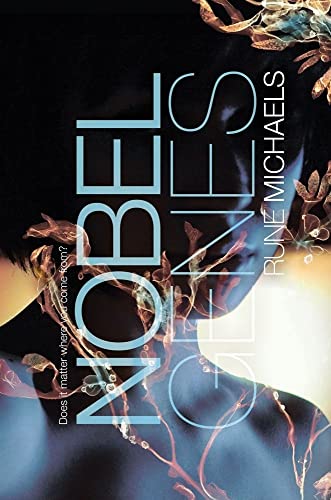
It's tough to measure up to your parents' expectations. Imagine how much harder it would be if your mother told you that your biological father—whom you'd never met—was a Nobel prize-winning genius? What if, after years of testing and tutoring, you never showed that particular spark of brilliance? What if you found out that you'd been living a lie, and that the truth was darker than you could have imagined?
Does it matter who you come from? Or are we all just made from dust?
In Rune Michaels's most powerful novel yet, she examines the fragile emotions surrounding finding out who we are and what we’re made of.
Die Inhaltsangabe kann sich auf eine andere Ausgabe dieses Titels beziehen.
Über die Autorin bzw. den Autor
Rune Michaels studied psychology at the University of Iceland and at the University of Copenhagen. Her books include Genesis Alpha, The Reminder, and Nobel Genes. She lives with her family in Reykjavik, Iceland.
Auszug. © Genehmigter Nachdruck. Alle Rechte vorbehalten.
Nobel Genes
1
I’m a donor baby.
But not just an ordinary donor baby. Mom wanted a genius baby, so she visited a special sperm bank, to buy me genes from a Nobel Prize winner. She wanted to ensure that her child would be a prodigy, someone special, someone who would give to the world something new and wonderful.
Something went wrong. I’m just a regular kid. I’m not a prodigy. Mom can’t understand why, why my Nobel genes aren’t showing themselves. She says she can’t understand why my phenotype doesn’t correspond better with my genotype. That sounds really weird, but it means she can’t understand why I’m not what I’m supposed to be.
Once I suggested she must have strong genes, stronger than the Nobel genes. I meant it as a compliment, but I guess it wasn’t. She laughed, and then she stopped laughing and just looked at me funny, and then she started to cry and wouldn’t eat anything that evening.
I’ve had my IQ tested about a million times, although it’s been a while now. Mom keeps hoping I’ll start to “blossom,” but it hasn’t happened yet, and I don’t think it ever will. I’ve learned some of the correct answers on the tests, and I’m getting pretty practiced at the puzzles, but it doesn’t help an awful lot. I’ve never made it into the genius category. I’ve seen my numbers, and they call it highaverage. Mom’s disappointed. I’ve seen the way her gaze skims over “high” and settles on “average” and then moves to me; that heavy, sad gaze that makes me feel like I’m something tiny enough to fit under a microscope. Sometimes I think she’d like to take me back to the sperm bank and ask for a refund.
I’ve wondered if something’s wrong with my brain, if I’m only average because something went wrong. Maybe I didn’t get enough oxygen to my brain when I was born or something, but because genetically I was meant to be a genius to begin with, I was brought down to normal instead of further down. Sometimes that’s almost comforting, to imagine that deep down in my genes I’m as brilliant as my dad is, as brilliant as my mother wants me to be.
Maybe it skips a generation. Maybe my kids will be brilliant and then Mom will finally be happy again—she’ll have a genius grandchild.
I’m not going to let my kids know they carry brilliant Nobel genes, and I hope Mom doesn’t say anything. I’ll just watch silently and if they show promise, I’ll help them find the right direction. That’s all. It doesn’t work, trying to force yourself to become a genius. I’ve tried that and it’s impossible. When I try to understand complicated things, like the relativity theory, it’s like trying to get ahold of something while wearing a thick glove.
I do well enough at school, but there are other kids who do just as well. The only class I’m really good at is art, but there’s no Nobel Prize for drawing or painting.
Mom wanted me to get a scholarship to a school for the gifted, she wanted that ever since kindergarten, but I never scored high enough on their tests for that. We’re not doing that anymore. I’m glad. Mom thinks I’m not trying hard enough, I guess, not applying myself. Sometimes she blames the school, because often gifted children don’t do well in school because they’re bored, the school isn’t challenging enough for them. Sometimes she blames herself for not having sent me to a special preschool for gifted toddlers, to kick-start my gifts and my love of learning, and when I try to comfort her by telling her it wouldn’t have made any difference, she gets angry.
A while ago my mom started thinking my Nobel dad might not have been a scientist after all—he could have been a writer, he could have won the literature prize, and if so, my genius would not be in mathematics and physics, it would be in creative writing. She laughed when she realized this, laughed and clasped her hands around my head, saying something about the wrong brain hemisphere.
And for a while she was happy. She sent me to a summer camp where we read literature and wrote short stories and poems. It was the first time I was away from home, ever. It was fun, although I couldn’t help worrying about Mom. It was the first time she was alone too, the first time since I was born that she wouldn’t have anyone to tuck in at night and check up on five times before morning.
But it was okay. When I went home they sent a big file with me, filled with everything I’d written. Of course, when you’ve been playing around at writing your thoughts down, you don’t want your mom to see it all. It’s private—and well, there are a lot of things Mom can’t handle, a lot of things that make her problems worse. So I had to do some serious censoring on the bus back home.
I took out everything that had to do with my feelings about my dad, and everything that had to do with my worries about my lack of genius, and also some other private stuff. There was a lot left, all the exercises we’d done, and a lot of silly poetry and what the teacher called “philosophical musings,” just general pondering about how the world worked and stuff.
Mom didn’t suspect I’d left stuff out. I’m not sure she read it all. She couldn’t have had the time. While I was away she’d researched literary agents and had a stack of envelopes ready on the kitchen table, names neatly printed on the front. It must have taken her ages, and she spent the night after I came home going through my folder and putting examples of my work in the envelopes.
The next morning she sent me to the post office with the whole bunch. I thought about throwing them away, but I was afraid she’d somehow find out, so I mailed them all.
Over the next few months the replies dropped in through the mail slot. At first Mom rushed to the door every day when she heard the postman, but then she stopped caring. She left the mail on the dresser by the door for days, sometimes, before ripping the envelopes open with her lips pinched, scanning the few lines, and then tearing the letters up and throwing them into the trash can she kept there for junk mail. I guess I don’t write very well.
Whenever she was asleep when the mail arrived, I’d tear up the responses myself to save her the trouble and prevent bad days. That turned out to be a mistake. She had a checklist of all the people she’d contacted, and after a while she started calling those who hadn’t replied, even though she hates to talk on the phone. She’d get angry with them sometimes. I wasn’t caught, though.
After that, my mother thought my father might have been a Peace Prize winner. You don’t have to have any special talents to win the Nobel Peace Prize, you just need to have done something good for mankind. So you don’t have to be a genius in the traditional sense; there’s no need to be good at physics or mathematics or even creative writing.
She was really excited about that for a while, and I was glad, because she was happy again, and when she’s happy, nothing very scary happens. She got me books on sociology and politics, bought me a huge revolving globe from a catalogue, and signed me up with Amnesty International. She spent days in front of the muted television with a...
„Über diesen Titel“ kann sich auf eine andere Ausgabe dieses Titels beziehen.
Suchergebnisse für Nobel Genes

Beispielbild für diese ISBN
Nobel Genes
Verlag:
Simon & Schuster Children's Publishing, 2010
ISBN 10: 1416912592
ISBN 13: 9781416912590
Gebraucht
Hardcover
Erstausgabe
Anbieter: Better World Books, Mishawaka, IN, USA
Verkäuferbewertung 5 von 5 Sternen

Zustand: Good. 1st Edition. Former library copy. Pages intact with minimal writing/highlighting. The binding may be loose and creased. Dust jackets/supplements are not included. Includes library markings. Stock photo provided. Product includes identifying sticker. Better World Books: Buy Books. Do Good. Artikel-Nr. 15863535-6
Gebraucht kaufen
EUR 7,21
Versand gratis
Versand innerhalb von USA
Versand innerhalb von USA
Anzahl: 1 verfügbar
Beispielbild für diese ISBN
Nobel Genes
Verlag:
Simon & Schuster Children's Publishing, 2010
ISBN 10: 1416912592
ISBN 13: 9781416912590
Gebraucht
Hardcover
Erstausgabe
Anbieter: Better World Books: West, Reno, NV, USA
Verkäuferbewertung 5 von 5 Sternen
Zustand: Good. 1st Edition. Former library copy. Pages intact with minimal writing/highlighting. The binding may be loose and creased. Dust jackets/supplements are not included. Includes library markings. Stock photo provided. Product includes identifying sticker. Better World Books: Buy Books. Do Good. Artikel-Nr. 15863535-6
Gebraucht kaufen
EUR 7,21
Versand gratis
Versand innerhalb von USA
Versand innerhalb von USA
Anzahl: 2 verfügbar