
Verwandte Artikel zu Why We Buy: The Science of Shopping--Updated and Revised...
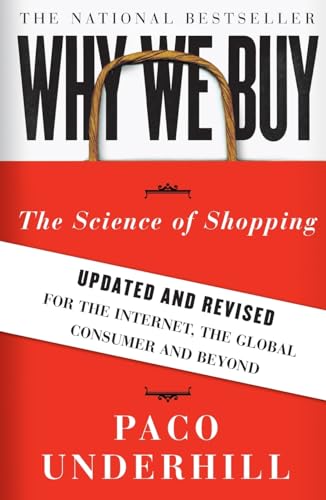
Why We Buy: The Science of Shopping--Updated and Revised for the Internet, the Global Consumer, and Beyond - Softcover
Inhaltsangabe
Revolutionary retail guru Paco Underhill is back with fresh observations and important lessons in this completely revised edition of his classic, witty bestselling book on our ever-evolving consumer culture.
This enlightening edition includes new information on:
-The latest trends in online retail—what retailers are doing right and what they’re doing wrong—and how nearly every Internet retailer from iTunes to Amazon can drastically improve how it serves its customers.
-A guided tour of the most innovative stores, malls and retail environments around the world—almost all of which are springing up in countries where prosperity is new. An enormous indoor ski slope attracts shoppers to a mall in Dubai; an uber-luxurious Sao Paolo department store provides its customers with personal shoppers; a mall in South Africa has a wave pool for surfing.
The new Why We Buy is an essential guide that offers advice on how to keep your changing customers and entice new and eager ones.
Die Inhaltsangabe kann sich auf eine andere Ausgabe dieses Titels beziehen.
Über die Autorin bzw. den Autor
Paco Underhill was the founder of Envirosell, Inc., a global research and consulting firm. His clients include more than a third of the Fortune 100 list, and he has worked on supermarket, convenience store, food, beverage, and restaurant issues in fifty countries. He is the bestselling author of Why We Buy, The Call of the Mall, What Women Want, and his newest book, How We Eat. He has also written articles for or been profiled in The New York Times, The Wall Street Journal, The Washington Post, The New Yorker, Smithsonian Magazine, and more. Paco divides his time between New York City and Madison, Connecticut.
Von der hinteren Coverseite
Revolutionary retail guru Paco Underhill is back with fresh observations and important lessons in this completely revised edition of his classic, witty bestselling book on our ever-evolving consumer culture.
This enlightening edition includes new information on:
-The latest trends in online retail―what retailers are doing right and what they’re doing wrong―and how nearly every Internet retailer from iTunes to Amazon can drastically improve how it serves its customers.
-A guided tour of the most innovative stores, malls and retail environments around the world―almost all of which are springing up in countries where prosperity is new. An enormous indoor ski slope attracts shoppers to a mall in Dubai; an uber-luxurious Sao Paolo department store provides its customers with personal shoppers; a mall in South Africa has a wave pool for surfing.
The new Why We Buy is an essential guide that offers advice on how to keep your changing customers and entice new and eager ones.
Auszug. © Genehmigter Nachdruck. Alle Rechte vorbehalten.
ONE
A Science Is Born
Okay, stroll, stroll, stroll...stop.
Shhh. Stay behind that potted palm. Get out your clipboard and pen.
Our subject is the fortyish woman in the tan trench coat and blue skirt. She's in the bath section. She's touching towels. Mark this down -- she's petting one, two, three, four of them so far. She just checked the price tag on one. Mark that down, too. Careful -- don't get too close -- you don't want her to see you. She picked up two towels from the tabletop display and is leaving the section with them. Mark the time. Now, tail her into the aisle and on to her next stop.
Thus begins another day in the vineyards of science, specifically the science of shopping. But let's start by addressing a fundamental question: Since when does such a scholarly discipline even exist?
Well, if, say, anthropology had devoted a branch of itself to the study of shoppers in situ (a fancy Latin way of saying shoppers out shopping), interacting with retail environments (stores, but also banks and restaurants), the actual, physical premises, including but not limited to every rack, shelf, counter and table display of merchandise, every sign, banner, brochure, directional aid and computerized interactive informational fixture, the entrances and exits, the windows and walls, the elevators and escalators and stairs and ramps, the cashier lines and teller lines and counter lines and restroom lines, and every inch of every aisle -- in short, every nook and cranny from the farthest reach of the parking lot to the deepest penetration of the store itself, if anthropology had already been studying all that...and not simply studying the store, of course, but what, exactly and precisely -- scientifically -- human beings do in it, where they go and don't go, and by what path they go there; what they see and fail to see, or read and decline to read; and how they deal with the objects they come upon, how they shop, you might say -- the precise anatomical mechanics and behavioral psychology of how they pull a sweater from a rack to examine it, or read a box of heartburn pills or a fast-food restaurant menu, or grab a shopping basket, or react to the sight of a line at the ATMs...again, as I say, if anthropology had been paying attention, and not just paying attention but then collecting, collating, digesting, tabulating and cross-referencing every little bit of data, from the extremely broad (How many people enter this store on a typical Saturday morning, broken down by age, sex and size of shopper group?) to the extremely narrow (Do more male supermarket shoppers under thirty-five who read the nutritional information on the side panel of a cereal box actually buy the cereal compared to those who just look at the picture on the front?), well, then, we wouldn't have had to invent the science of shopping. In 1997, when this volume was originally written, the academic world knew more about the marketplace in Papua New Guinea than what happened at your local supermarket or shopping mall. Twentieth-century anthropology wasn't about what happened in your backyard.
In 1997, I'd been fighting for what I knew was right for more than ten years -- and since then, a whole lot has changed. Companies across the world are now employing anthropologists to staff what have been popularly titled shopper and consumer insight groups. Ethnologic studies (that is to say, a science that breaks down humans into races, cultures and their various obvious and not-so-obvious characteristics) are part of mainstream market research. But when I first hung out my shingle, my academic colleagues thought I was selling out, and the marketers and merchants I sought to serve looked at me as an alien from a distant planet.
Down the hall from my office then and now is an equipment room with more than one hundred cameras. Eight-millimeter video cameras, direct to hard drive, digital, even a few ancient Super 8 time-lapse film cameras. To keep track of them, every camera is assigned a name -- the video cameras are named after rock stars, the digital stills are signs of the zodiac. We find giving a camera a name rather than a number helps it last longer, and when Jimi Hendrix feels poorly, he gets to the shop faster than if he were camera number 26. In that same equipment room are piled cases of blank eight-millimeter videotapes, two hours per tape, five hundred tapes to a case. Across the world, we have now shot more than fifty thousand hours of tape per year. We also have dozens of handheld computers, or PDAs, on which we painstakingly jot down the answers from the thousands of shopper interviews we conduct; there are laptops in there, too, plus all manner of tripods, mounts, lenses and other camera accessories, including lots of duct tape. Oh, and many well-worn hard-shell cases for everything, because it all travels. A lot. The studio next to the equipment room has two complete digital editing suites and eleven stations at which to watch all those tapes -- because everything we shoot, we look at. We have more than enough gear in that room to make broadcast-quality documentaries and, while we're at it, to equip a good-sized university's school of social anthropology or experimental psychology, assuming the university has a deserved reputation for generating tons of original research gathered from all over the globe.
Even with all that high-tech equipment, though, our most important research tool for the past thirty years remains the piece of paper we call the track sheet, in the hands of the individuals we call trackers. Trackers are the field researchers of the science of shopping, the scholars of shopping, or, more precisely, of shoppers. Essentially, trackers stealthily make their way through stores following shoppers and noting everything they do. Usually a tracker begins by loitering inconspicuously near a store's entrance, waiting for a shopper to enter, at which point the "track" starts. The tracker will stick with the unsuspecting individual (or individuals) as long as he or she is in the store (excluding trips to the dressing room or the restroom) and will record on the track sheet virtually everything the shopper does.
Befitting a science that has grown up in the real world, meaning far from the ivory towers of academia, our trackers are not stamped from the usual researcher mold. In the beginning we hired graduate environmental psychology students, but we found they were often unsuited to the work -- more often than not, they came to the job burdened with newly learned textbook theories they wished to prove or disprove. As a result, they didn't possess the patience necessary to watch many shoppers at great length to see what they actually do. Creative people, however -- playwrights, artists, actors, novelists, a puppeteer -- have proven to be perfect for this work. They have no theories to uphold or demolish, just open minds and boundless curiosity about what people do and how and why they do it. They are dispassionate yet avid observers with no agenda except for wanting to accurately document how human behavior plays out in the retail arena. They manage to see the forest, the trees and everything in between.
When we find someone with the temperament and the intelligence for this work, we first put them through a training session in our office. There's a lot to learn -- how do I watch and simultaneously take notes, for instance, or how can I tell whether someone is reading a sign or just staring at the mirror next to it? We have to teach the most important tracker skill of all: How do I stand close enough to study someone without being noticed? Because it's crucial to our work that shoppers don't realize they're being observed. There's no other way to be sure that we're seeing natural behavior. Fact is, we're all still surprised by how close you can...
„Über diesen Titel“ kann sich auf eine andere Ausgabe dieses Titels beziehen.
Suchergebnisse für Why We Buy: The Science of Shopping--Updated and Revised...

Beispielbild für diese ISBN
Why We Buy
Anbieter: World of Books (was SecondSale), Montgomery, IL, USA
Verkäuferbewertung 5 von 5 Sternen

Paperback. Zustand: Good. Synopsis coming soon. Artikel-Nr. 00099431577
Gebraucht kaufen
EUR 4,05
Versand gratis
Versand innerhalb von USA
Versand innerhalb von USA
Anzahl: Mehr als 20 verfügbar
Beispielbild für diese ISBN
Why We Buy: The Science of Shopping--Updated and Revised for the Internet, the Global Consumer, and Beyond
Verlag:
Simon & Schuster (edition Updated), 2008
ISBN 10: 1416595244
ISBN 13: 9781416595243
Gebraucht
Paperback
Anbieter: BooksRun, Philadelphia, PA, USA
Verkäuferbewertung 5 von 5 Sternen
Paperback. Zustand: Very Good. Updated. It's a well-cared-for item that has seen limited use. The item may show minor signs of wear. All the text is legible, with all pages included. It may have slight markings and/or highlighting. Artikel-Nr. 1416595244-11-1
Gebraucht kaufen
EUR 4,73
Versand gratis
Versand innerhalb von USA
Versand innerhalb von USA
Anzahl: 2 verfügbar
Beispielbild für diese ISBN
Why We Buy: The Science of Shopping--Updated and Revised for the Internet, the Global Consumer, and Beyond
Verlag:
Simon & Schuster (edition Updated), 2008
ISBN 10: 1416595244
ISBN 13: 9781416595243
Gebraucht
Paperback
Anbieter: BooksRun, Philadelphia, PA, USA
Verkäuferbewertung 5 von 5 Sternen
Paperback. Zustand: Fair. Updated. The item might be beaten up but readable. May contain markings or highlighting, as well as stains, bent corners, or any other major defect, but the text is not obscured in any way. Artikel-Nr. 1416595244-7-1
Gebraucht kaufen
EUR 4,85
Versand gratis
Versand innerhalb von USA
Versand innerhalb von USA
Anzahl: 1 verfügbar
Beispielbild für diese ISBN
Why We Buy: The Science of Shopping--Updated and Revised for the Internet, the Global Consumer, and Beyond
Verlag:
Simon & Schuster (edition Updated), 2008
ISBN 10: 1416595244
ISBN 13: 9781416595243
Gebraucht
Paperback
Anbieter: BooksRun, Philadelphia, PA, USA
Verkäuferbewertung 5 von 5 Sternen
Paperback. Zustand: Fair. Updated. The item might be beaten up but readable. May contain markings or highlighting, as well as stains, bent corners, or any other major defect, but the text is not obscured in any way. Artikel-Nr. 1416595244-7-1-13
Gebraucht kaufen
EUR 5,01
Versand gratis
Versand innerhalb von USA
Versand innerhalb von USA
Anzahl: 1 verfügbar
Beispielbild für diese ISBN
Why We Buy: The Science of Shopping--Updated and Revised for the Internet, the Global Consumer, and Beyond
Anbieter: ThriftBooks-Atlanta, AUSTELL, GA, USA
Verkäuferbewertung 5 von 5 Sternen
Paperback. Zustand: Good. No Jacket. Former library book; Pages can have notes/highlighting. Spine may show signs of wear. ~ ThriftBooks: Read More, Spend Less. Artikel-Nr. G1416595244I3N10
Gebraucht kaufen
EUR 6,00
Versand gratis
Versand innerhalb von USA
Versand innerhalb von USA
Anzahl: 1 verfügbar
Beispielbild für diese ISBN
Why We Buy: The Science of Shopping--Updated and Revised for the Internet, the Global Consumer, and Beyond
Anbieter: ThriftBooks-Reno, Reno, NV, USA
Verkäuferbewertung 5 von 5 Sternen
Paperback. Zustand: Good. No Jacket. Pages can have notes/highlighting. Spine may show signs of wear. ~ ThriftBooks: Read More, Spend Less. Artikel-Nr. G1416595244I3N00
Gebraucht kaufen
EUR 6,00
Versand gratis
Versand innerhalb von USA
Versand innerhalb von USA
Anzahl: 3 verfügbar
Beispielbild für diese ISBN
Why We Buy: The Science of Shopping--Updated and Revised for the Internet, the Global Consumer, and Beyond
Anbieter: ThriftBooks-Dallas, Dallas, TX, USA
Verkäuferbewertung 5 von 5 Sternen
Paperback. Zustand: Very Good. No Jacket. May have limited writing in cover pages. Pages are unmarked. ~ ThriftBooks: Read More, Spend Less. Artikel-Nr. G1416595244I4N00
Gebraucht kaufen
EUR 6,00
Versand gratis
Versand innerhalb von USA
Versand innerhalb von USA
Anzahl: 1 verfügbar
Beispielbild für diese ISBN
Why We Buy: The Science of Shopping--Updated and Revised for the Internet, the Global Consumer, and Beyond
Anbieter: ThriftBooks-Dallas, Dallas, TX, USA
Verkäuferbewertung 5 von 5 Sternen
Paperback. Zustand: Good. No Jacket. Pages can have notes/highlighting. Spine may show signs of wear. ~ ThriftBooks: Read More, Spend Less. Artikel-Nr. G1416595244I3N00
Gebraucht kaufen
EUR 6,00
Versand gratis
Versand innerhalb von USA
Versand innerhalb von USA
Anzahl: 4 verfügbar
Beispielbild für diese ISBN
Why We Buy: The Science of Shopping--Updated and Revised for the Internet, the Global Consumer, and Beyond
Anbieter: ThriftBooks-Phoenix, Phoenix, AZ, USA
Verkäuferbewertung 5 von 5 Sternen
Paperback. Zustand: Good. No Jacket. Pages can have notes/highlighting. Spine may show signs of wear. ~ ThriftBooks: Read More, Spend Less. Artikel-Nr. G1416595244I3N00
Gebraucht kaufen
EUR 6,00
Versand gratis
Versand innerhalb von USA
Versand innerhalb von USA
Anzahl: 3 verfügbar
Beispielbild für diese ISBN
Why We Buy: The Science of Shopping--Updated and Revised for the Internet, the Global Consumer, and Beyond
Anbieter: ThriftBooks-Atlanta, AUSTELL, GA, USA
Verkäuferbewertung 5 von 5 Sternen
Paperback. Zustand: Good. No Jacket. Pages can have notes/highlighting. Spine may show signs of wear. ~ ThriftBooks: Read More, Spend Less. Artikel-Nr. G1416595244I3N00
Gebraucht kaufen
EUR 6,00
Versand gratis
Versand innerhalb von USA
Versand innerhalb von USA
Anzahl: 4 verfügbar