
Verwandte Artikel zu Your Aching Back: A Doctor's Guide to Relief
Inhaltsangabe
THREE OUT OF FIVE ADULTS WILL EXPERIENCE SIGNIFICANT BACK PAIN AT SOME POINT IN THEIR LIVES, MAKING BACK PAIN AMERICA’S NUMBER ONE AILMENT
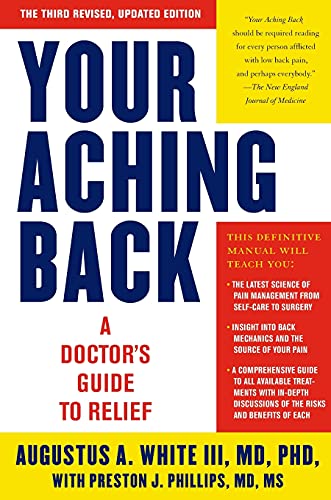
NOW IN ITS THIRD EDITION, the classic back pain manual Your Aching Back has been revised and updated to ensure that you have the latest science to speed your recovery.
Drawing on new research as well as decades of clinical experience, leading specialists Dr. Augustus White and Dr. Preston Phillips give you everything you need to know to manage this frustrating condition. To help you hone in on the source of your pain, they give a short primer on the basics of back mechanics as well as a discussion of the wide array of possible causes.
Treatment is the primary focus of the book. Emphasizing evidence-based medicine, the authors give a full account of the risks and benefits associated with treatments from acupuncture to spine surgery. You will find out when self-care makes sense, when you need to see a doctor, what questions to ask, and how to tell if you need a second opinion. Along the way, you’ll learn about exciting advances in implant technology, recent studies on ergonomics, cutting-edge imaging technology, the newest forms of alternative care, and much more. And because dealing with chronic back pain can have an effect on every aspect of your life, this book offers sensible, empathic advice on everything from sex and sports to the financial and emotional consequences of long-term disability.
In its trademark conversational and unintimidating style, Your Aching Back places you back in control of your health and puts you on the path toward relief.
Die Inhaltsangabe kann sich auf eine andere Ausgabe dieses Titels beziehen.
Über die Autorin bzw. den Autor
Augustus A. White III, M.D, is professor of orthopaedic surgery at Harvard Medical School and orthopaedic surgeon-in-chief at Beth Israel Hospital in Boston.
Auszug. © Genehmigter Nachdruck. Alle Rechte vorbehalten.
Chapter I
Who Suffers?
Try listing the names of ten adult friends at random. If seven of them are backache victims, and only three are free of the sufferings addressed in this book, they're a set of typical persons. If you are one of the seven unfortunates (and the fact that you're opening this book means you probably are), the problem becomes acutely personal in terms of pain and inconvenience. However, the probabilities are that if this is a new backache, you will be just fine within the next four to five weeks.
In any case, you're not alone. In the Western world, epidemiological studies reveal that back pain afflicts a staggering sixty to eighty percent of the population. Out of every ten people under forty-five who have chronic medical conditions limiting their activities, four are back and spine pain victims. Backache takes a backseat only to headache as the most common medical complaint, and is second only to the common cold as a reason for missed work. In fact, absence from the workplace due to disabling back pain has soared.
There was a fourteen-fold increase in the prevalence of low back pain in the United States between 1970 and 1981, and even more of an increase in England and Sweden. Unfortunately, five percent of the population will complain of low back pain in a given year. Furthermore, sciatica, pain in the leg, may be associated with back pain. It is known that forty percent of all adults will have sciatica at some point in their lives.
A sore back becomes even more sobering when you realize how often it can become chronic, debilitating, and life-diminishing. If you're laboring under a difficult back, you don't have to be reminded of this -- but consider: If you're a worker who is absent from work for more than six months with a bad back, statistics show you have only a fifty percent chance of ever regaining full productivity. After a year, your chances dip to twenty-five percent. Add the high cost of treatment and you have a more graphic portrait of the social and financial sufferings involved. The average bad-back episode will run you $4,300, and the diagnosis and treatment of backaches in the United States costs $5 billion every year. If we count up loss of productivity, cost of disability payments, Workmen's Compensation, and lawsuits, the figure soars to about $14 billion. You should not leave this pessimistic paragraph without being reassured that over eighty-five percent of people with an acute backache will be over it in a month's time.
Here's one more way you can grasp the magnitude of the financial problem. The U.S. Postal Service is one of the largest employers in the country. There was a time when we paid 20¢ for a first-class postage stamp. Guess how much of that 20¢ was applied to the medical care, compensation, and related expenses of postal employees with backache? About five percent -- 0.9¢ -- nearly one cent!
The purpose of dragging in statistics like these is not to depress you, but rather to convince you, if you need convincing, that back pain is a major social problem. What cannot be expressed in numbers, although it is of equal or greater importance, is the profound human suffering and compromise in quality of life that the back pain sufferer experiences.
The question that may occur to you at this point is, why? Why is the human back such a vulnerable, annoying, and frequently painful part of the anatomy? Has it always been thus? Certainly the spine has been a preoccupation for centuries -- as attested to by sayings such as "He's a spineless person" and "She really has her back up about it," or "He's got a yellow streak down his back" and "She's carrying the team on her back." Shakespeare aficionados will recall the insinuating words of Iago, who whispers to Desdemona's father: "Your daughter and the Moor [Othello] are now making the beast with two backs" -- Elizabethan jargon for "having sex." Perhaps echoing the Elizabethans, Jamaican men complaining of impotence will say they have lost the strength of their backs. Treachery, we know, is conveyed as a "stab in the back," and paranoia in the phrase "They're laughing behind my back." We could go on cataloguing spinal expressions in art and life, but if you're lying on a painful back or "with your back against the wall" you'll probably want to get to the treatment/prevention chapter pretty quickly.
Some researchers have reflected that we humans have only recently evolved into two-legged creatures, and that staying on all fours might have saved us from backaches. There are several problems with this theory. One is that the treatment implied, reversion to four-legged locomotion, would require some radical life-style changes, perhaps driving shoemakers out of business or placing undue market demands on glove and knee-pad manufacturers. Besides, animals have back pain too; they just don't complain about it. Most important, the hypothesis doesn't fit the anatomic and evolutionary facts: Our spines are perfectly suited to an upright stance and don't differ significantly from those of our hominid ancestors. Finally, even though there are sexual problems associated with backache (Chapter VIII), back problems could not play a part in the process of evolution because the genes can be readily passed on well before the onset of backache, which is usually in one's thirties.
If we are to look for reasons, we'd do better to examine the quality of our lives -- especially what we do with our backs. Frankly, even an extensive analysis of all the data does not provide a simple, clear answer. Nevertheless, you will certainly get a better understanding, so read on!
WHO'S AT RISK?
Of course, if you're a backache sufferer, your interest in this book is more apt to be personal than sociological. How do the back statistics apply to you? What category of back sufferer do you fall into? What are your risks -- and how can you reduce them? One of the goals of this book is to provide this information, along with specific recommendations for managing your back on the job and at home. The following facts, gathered from epidemiological studies, can help you calculate your risks -- for we now know that sex, age, occupation, leisure activities, and life-style all influence the state of your back.
Age
Back pain patients tend to be between thirty and fifty-five years old. Why? Very simply, the discs between the vertebrae of your lower back change in the normal course of aging. The young disc is elastic and full of fluid, but starting at about age thirty, it gradually becomes dry or scarred and its mechanics change, making it more likely to fragment, move out of place, or cause pain. This is analogous to a jelly doughnut. When it's fresh, the pastry is pliable, resilient, and the center contains jelly. As it ages, the outer portion hardens, becomes more brittle, cracks, and flakes. The jelly in the middle dries out.
The puzzle, however, is that while all discs undergo this transformation, not all cause pain -- and certainly all do not herniate.
Actually, back-pain risk decreases for men after age fifty, but this is not so for women. This is because the problem of osteoporosis begins to occur in women and causes backache. In the next section, gender-related issues in low back pain are discussed.
Sex
Epidemiological studies suggest that males are slightly more prone to herniated discs (this is a situation in which a part of the disc moves out from its normal position between the vertebral bodies, causing severe back and/or leg pain) and more likely to undergo surgery than females with problems of equal severity. Perhaps differences in occupation, athletics, and amount of driving, rather than genetics, account for the male's greater weakness. Or perhaps men simply tolerate pain badly and are...
„Über diesen Titel“ kann sich auf eine andere Ausgabe dieses Titels beziehen.
Suchergebnisse für Your Aching Back: A Doctor's Guide to Relief

Beispielbild für diese ISBN
Your Aching Back A Doctors Gui
Anbieter: World of Books (was SecondSale), Montgomery, IL, USA
Verkäuferbewertung 5 von 5 Sternen

Zustand: Good. Item in good condition and has highlighting/writing on text. Used texts may not contain supplemental items such as CDs, info-trac etc. Artikel-Nr. 00101086019
Gebraucht kaufen
EUR 6,32
Versand gratis
Versand innerhalb von USA
Versand innerhalb von USA
Anzahl: 1 verfügbar
Beispielbild für diese ISBN
Your Aching Back : A Doctor's Guide to Relief
Anbieter: Better World Books, Mishawaka, IN, USA
Verkäuferbewertung 5 von 5 Sternen
Zustand: Good. 3rd Revised, Updated ed. Former library copy. Pages intact with minimal writing/highlighting. The binding may be loose and creased. Dust jackets/supplements are not included. Includes library markings. Stock photo provided. Product includes identifying sticker. Better World Books: Buy Books. Do Good. Artikel-Nr. 2654760-6
Gebraucht kaufen
EUR 6,33
Versand gratis
Versand innerhalb von USA
Versand innerhalb von USA
Anzahl: 3 verfügbar
Beispielbild für diese ISBN
Your Aching Back
Anbieter: ThriftBooks-Atlanta, AUSTELL, GA, USA
Verkäuferbewertung 5 von 5 Sternen
Paperback. Zustand: Fair. No Jacket. Readable copy. Pages may have considerable notes/highlighting. ~ ThriftBooks: Read More, Spend Less. Artikel-Nr. G1416593012I5N00
Gebraucht kaufen
EUR 11,37
Versand gratis
Versand innerhalb von USA
Versand innerhalb von USA
Anzahl: 1 verfügbar
Beispielbild für diese ISBN
Your Aching Back
Anbieter: ThriftBooks-Atlanta, AUSTELL, GA, USA
Verkäuferbewertung 5 von 5 Sternen
Paperback. Zustand: Good. No Jacket. Pages can have notes/highlighting. Spine may show signs of wear. ~ ThriftBooks: Read More, Spend Less. Artikel-Nr. G1416593012I3N00
Gebraucht kaufen
EUR 11,37
Versand gratis
Versand innerhalb von USA
Versand innerhalb von USA
Anzahl: 1 verfügbar
Beispielbild für diese ISBN
Your Aching Back: A Doctor's Guide to Relief
Anbieter: Books From California, Simi Valley, CA, USA
Verkäuferbewertung 4 von 5 Sternen

paperback. Zustand: Very Good. Artikel-Nr. mon0004145083
Gebraucht kaufen
EUR 12,79
EUR 4,43 Versand
Versand innerhalb von USA
Versand innerhalb von USA
Anzahl: 1 verfügbar
Beispielbild für diese ISBN
Your Aching Back: A Doctor's Guide to Relief
Anbieter: Revaluation Books, Exeter, Vereinigtes Königreich
Verkäuferbewertung 5 von 5 Sternen
Paperback. Zustand: Brand New. 3rd revised updated edition. 351 pages. 9.25x6.25x1.00 inches. In Stock. Artikel-Nr. x-1416593012
Neu kaufen
EUR 27,22
EUR 11,79 Versand
Versand von Vereinigtes Königreich nach USA
Versand von Vereinigtes Königreich nach USA
Anzahl: 2 verfügbar
Foto des Verkäufers
Your Aching Back: A Doctor\ s Guide to Relief
Verlag:
SIMON & SCHUSTER, 2010
ISBN 10: 1416593012
ISBN 13: 9781416593010
Neu
Kartoniert / Broschiert
Anbieter: moluna, Greven, Deutschland
Verkäuferbewertung 5 von 5 Sternen
Kartoniert / Broschiert. Zustand: New. Über den AutorAugustus A. White, III, M.D.,Ph.D. with Preston J. Phillips, M.D., M.S.InhaltsverzeichnisrnrnContentsAcknowledgmentsIntroductionCHAPTER I: WHO SUFFERS?C. Artikel-Nr. 902450095
Neu kaufen
EUR 29,40
EUR 48,99 Versand
Versand von Deutschland nach USA
Versand von Deutschland nach USA
Anzahl: Mehr als 20 verfügbar