
Verwandte Artikel zu World Class Manufacturing: The Lessons of Simplicity...
Inhaltsangabe
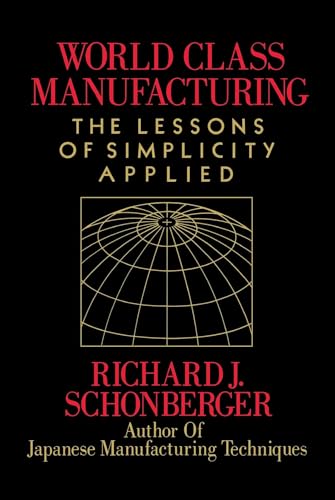
In his best-selling book Japanese Manufacturing Techniques, Richard J. Schonberger revolutionized American manufacturing theory and, more important, practice. In that breakthrough book, he revealed that Japanese manufacturing excellence was not culturally bound. Offering the first demystified explanation of the simple techniques that fueled Japan's industrial success, he demonstrated how the same methods could be put to work as effectively in U.S. plants.
Now, in World Class Manufacturing, Schonberger returns to tell the success stories of nearly 100 American corporations -- including Hewlett-Packard, Harley-Davidson, General Motors, Honeywell, and Uniroyal -- that have adopted the famed just-in-time production and "total quality control" strategies. Based on his firsthand experience as a major consultant to American industry, he examines how they did it -- and illustrates how the same concrete, specific steps used by these top companies can be implemented in any factory today. What's more, Schonberger shows that his bold concepts and reforms apply equally to all industries, whether the product is computers, pasta, or trucks, and to all divisions -- from manufacturing and engineering to accounting and marketing.
According to Schonberger, world-class manufacturing depends on blended management -- rather than domination by a separate group of managers -- which marshalls resources for continual rapid improvement. To achieve world-class status, companies must change procedures and concepts, which in turn leads to recasting relations among suppliers, purchasers, producers, and customers. Acknowledging the difficulty inherent in such changes, Schonberger stresses that employee involvement and interaction, both on the shop floor and in the decision-making/problem-solving process, is key. Wary of those who view improvement in terms of modernizing equipment, he points out that making maximum use of people and current machinery is a company's first priority; automation, if necessary, should come much later.
World Class Manufacturing also includes Schonberger's 17-point action agenda to guide innovators toward manufacturing excellence, from getting to know the customer to cutting the number of suppliers, reducing error in production, and deciding when and how to automate.
Indispensable for all manufacturing innovators who aim to keep ahead of the competition, this inspiring, groundbreaking volume does much more than just recommend or theorize about the new manufacturing approach. Plainly, realistically, and logically, it explains how it's done.
Die Inhaltsangabe kann sich auf eine andere Ausgabe dieses Titels beziehen.
Über die Autorin bzw. den Autor
Richard J. Schonberger, PhD, is president of Schonberger & Associates of Seattle. He is the author of more than 170 articles and papers, a twelve-volume video set, and several books.
Von der hinteren Coverseite
Since the invention of double-entry bookkeeping, managers have judged a company's worth by sales and profits. Now, Richard J. Schonberger, the architect of the worldwide Just-In-Time revolution, reaches beyond "financials" to redefine excellence - and reveals, with new benchmark data, how pioneers become dynasties. This book will be indispensable reading for manufacturing and general managers in all industries, as well as for pension fund managers, institutional investors, stock analysts, and stockbrokers.
Auszug. © Genehmigter Nachdruck. Alle Rechte vorbehalten.
Chapter 1
Faster, Higher, Stronger
In the 1950s through the 1970s, running manufacturing companies became gentlemen's work. Decisions and policies were made by people twice and thrice removed from the manufacturing arena. Authority was in the hands of staff people who sifted data from other staff people. Venturing out into the plant was, well, venturing. It was prudent to stick around offices and conference rooms and make sure your backside was covered. Excitement in industry was confined to high-tech R&D. Manufacturing was stagnant.
How quickly things change. While the changes have scarcely touched small companies, the well-known manufacturers are caught up in revival, renewal, recovery, and renaissance. A popular term among those caught up is world-class manufacturing or a term like it. World-class manufacturing may sound like Madison Avenue hyperbole, but it is not. The term nicely captures the breadth and the essence of fundamental changes taking place in larger industrial enterprises. A full range of elements of production are affected: management of quality, job classifications, labor relations, training, staff support, sourcing, supplier and customer relations, product design, plant organization, scheduling, inventory management, transport, handling, equipment selection, equipment maintenance, the product line, the accounting system, the role of the computer, automation, and others.
The Goal and the Path
World-class manufacturing (WCM) has an overriding goal and an underlying mind set for achieving it. The overriding goal may be summarized by a slogan suggested to me by a manager at the Steelcraft division of American Standard, where I was presenting a seminar. During the afternoon break, the fellow told me that he had digested all that had been said, and he concluded that the whole thing was like the motto of the Olympic Games: citius, altius, fortius. From the Latin the English translation is "faster, higher, stronger." The WCM equivalent is continual and rapid improvement.
A few years ago we didn't even know the factors of manufacturing that ought to improve. There was little agreement on what excellence in manufacturing is, because we thought in terms of tradeoffs. Plant managers or their corporate overseers picked one set of high-priority targets one year (for example, defect rates and warranty costs) and another, seemingly conflicting, set to work on the next (perhaps overhead costs and customer service rates). The high priorities were where problems seemed most severe. Lacking manufacturing principles, we tackled the problem with trade-off analysis.
Today there is wide agreement among the WCM "revisionists" that continual improvement in quality, cost, lead time, and customer service is possible, realistic, and necessary. There is now good reason to believe that those goals may be pursued in concert, that they are not in opposition. One more primary goal, improved flexibility, is also a part of the package. While some of our leading manufacturers have trouble avoiding pitfalls that lead to inflexibility (pitfalls that are avoidable), the goal itself is not an issue. With agreement on the goals, the management challenge is reduced to speeding up the pace of improvement.
The improvement journey follows a surprisingly well-defined path. The journey requires clearing away obstacles so that production can be simplified. A fast-growing body of writings (including my own 1982 book, Japanese Manufacturing Techniques: Nine Hidden Lessons in Simplicity) offers lists of obstacles to remove and ways to simplify: fewer suppliers, reduced part counts, focused factories (focused on a narrow line of products or technologies), scheduling to a rate instead of scheduling by lots, fewer racks, more frequent deliveries, smaller plants, shorter distances, less reporting, fewer inspectors, less buffer stock, fewer job classifications.
Beyond the Basics
In the pre-WCM era we thought that production could be managed "by the numbers." The numbers would show what to make, what to buy, whom to blame. If, for example, the latest cost report shows a negative cost variance in welding, the onus is on the welding supervisor to cut costs. But how? There are no data on the causes of the cost overage. The supervisor may crack the whip to get more output for the same labor cost. Alternatively, ask industrial engineering or quality engineering to "do a study."
The numbers failed to show causes. Mostly they did not even show symptoms of real problems.
Numbers do serve the world-class manufacturer -- when they show how good the product and service are, how much improvement is occurring, what problems to attack next, and what the likely causes are. WCM mandates simplification and direct action: Do it, judge it, measure it, diagnose it, fix it, manage it on the factory floor. Don't wait to find out about it by reading a report later.
Some of that may sound like "back to basics." Basics they are, but going back we are not. It is true that some of the emergent WCM techniques were in use in an earlier era -- and then forgotten. In the main, however, the good old days in manufacturing never were all that good. Quality concepts were primitive by today's standards. While some plants had an ethic of continual improvement (applied very selectively), the norm was to transform simplicity into complexity, which sowed the seeds of decline.
Turning Point
There is reseeding going on, and there seems to be a single year that could be called the turning point: the year 1980. In that year a few North American companies (and perhaps some in Europe) began overhauling their manufacturing apparatus. Those first WCM thrusts followed two parallel paths. One was the quality path, and the other was the just-in-time (JIT) production path.
One of the first to try just-in-time in North America was General Electric, which started up two JIT projects in 1980. Kawasaki in Nebraska and Toyota truck in Long Beach, California, began shifting from standard to JIT production in the same year.
The first North American companies to take the quality path, also in 1980 (give or take a few months) were Nashua Corp. in New Hampshire, Tennant Co. in Minneapolis, and IBM. (A bit earlier Matsushita in Franklin Park, Illinois; Sanyo in Forrest City, Arkansas; and Sony in San Diego began their U. S. operations with a quality focus. These may be thought of as imports from Japan rather than as turning points in existing North American companies.) Nashua got its start by bringing in W. Edwards Deming, the American who, along with Joseph Juran, was instrumental in getting Japan's quality movement going in the 1950s. Tennant and IBM hired Philip Crosby, who was known to a few people as the author of a fine little 1979 book, Quality Is Free. Tennant provided early support for Crosby to form a quality college in Florida.
Those stirrings in a few companies in 1980 may someday be chronicled as the third major event in the history of manufacturing management. The first two: (1) coordinating the factory through use of standard methods and times, Frederick W. Taylor, Frank Gilbreth, et al., circa 1900; and (2) showing that motivation comes in no small measure from recognition, the Hawthorne Studies at Western Electric, circa 1930.
The 5-10-20s
World-class manufacturing could not become the third major event if it were to peter out. The signs that it will not, that WCM is much more than a fad, are persuasive. The list of companies that have already made order-of-magnitude improvements in quality and manufacturing lead time is getting long. For example, I have compiled (and continue to update) a list of the "5-10-20s," which refers to companies, factories, or parts of...
„Über diesen Titel“ kann sich auf eine andere Ausgabe dieses Titels beziehen.
Suchergebnisse für World Class Manufacturing: The Lessons of Simplicity...

Beispielbild für diese ISBN
World Class Manufacturing
Anbieter: World of Books (was SecondSale), Montgomery, IL, USA
Verkäuferbewertung 5 von 5 Sternen

Zustand: Good. Item in good condition. Textbooks may not include supplemental items i.e. CDs, access codes etc. Artikel-Nr. 00107304864
Gebraucht kaufen
EUR 3,93
Versand gratis
Versand innerhalb von USA
Versand innerhalb von USA
Anzahl: 1 verfügbar
Foto des Verkäufers
World Class Manufacturing
Anbieter: Dream Books Co., Denver, CO, USA
Verkäuferbewertung 5 von 5 Sternen
Zustand: acceptable. This copy has clearly been enjoyedâ"expect noticeable shelf wear and some minor creases to the cover. Binding is strong, and all pages are legible. May contain previous library markings or stamps. Artikel-Nr. DBV.1416592547.A
Gebraucht kaufen
EUR 3,94
Versand gratis
Versand innerhalb von USA
Versand innerhalb von USA
Anzahl: 1 verfügbar
Beispielbild für diese ISBN
World Class Manufacturing
Anbieter: ThriftBooks-Phoenix, Phoenix, AZ, USA
Verkäuferbewertung 5 von 5 Sternen
Paperback. Zustand: Good. No Jacket. Pages can have notes/highlighting. Spine may show signs of wear. ~ ThriftBooks: Read More, Spend Less. Artikel-Nr. G1416592547I3N00
Gebraucht kaufen
EUR 5,82
Versand gratis
Versand innerhalb von USA
Versand innerhalb von USA
Anzahl: 1 verfügbar
Beispielbild für diese ISBN
World Class Manufacturing
Anbieter: ThriftBooks-Reno, Reno, NV, USA
Verkäuferbewertung 5 von 5 Sternen
Paperback. Zustand: As New. No Jacket. Pages are clean and are not marred by notes or folds of any kind. ~ ThriftBooks: Read More, Spend Less. Artikel-Nr. G1416592547I2N00
Gebraucht kaufen
EUR 5,82
Versand gratis
Versand innerhalb von USA
Versand innerhalb von USA
Anzahl: 1 verfügbar
Beispielbild für diese ISBN
World Class Manufacturing
Anbieter: ThriftBooks-Reno, Reno, NV, USA
Verkäuferbewertung 5 von 5 Sternen
Paperback. Zustand: Good. No Jacket. Pages can have notes/highlighting. Spine may show signs of wear. ~ ThriftBooks: Read More, Spend Less. Artikel-Nr. G1416592547I3N00
Gebraucht kaufen
EUR 5,82
Versand gratis
Versand innerhalb von USA
Versand innerhalb von USA
Anzahl: 1 verfügbar
Beispielbild für diese ISBN
World Class Manufacturing
Anbieter: ThriftBooks-Atlanta, AUSTELL, GA, USA
Verkäuferbewertung 5 von 5 Sternen
Paperback. Zustand: Very Good. No Jacket. May have limited writing in cover pages. Pages are unmarked. ~ ThriftBooks: Read More, Spend Less. Artikel-Nr. G1416592547I4N00
Gebraucht kaufen
EUR 5,84
Versand gratis
Versand innerhalb von USA
Versand innerhalb von USA
Anzahl: 1 verfügbar
Beispielbild für diese ISBN
World Class Manufacturing
Anbieter: ThriftBooks-Atlanta, AUSTELL, GA, USA
Verkäuferbewertung 5 von 5 Sternen
Paperback. Zustand: As New. No Jacket. Pages are clean and are not marred by notes or folds of any kind. ~ ThriftBooks: Read More, Spend Less. Artikel-Nr. G1416592547I2N00
Gebraucht kaufen
EUR 5,84
Versand gratis
Versand innerhalb von USA
Versand innerhalb von USA
Anzahl: 1 verfügbar
Beispielbild für diese ISBN
World Class Manufacturing
Anbieter: ThriftBooks-Atlanta, AUSTELL, GA, USA
Verkäuferbewertung 5 von 5 Sternen
Paperback. Zustand: Good. No Jacket. Pages can have notes/highlighting. Spine may show signs of wear. ~ ThriftBooks: Read More, Spend Less. Artikel-Nr. G1416592547I3N00
Gebraucht kaufen
EUR 5,84
Versand gratis
Versand innerhalb von USA
Versand innerhalb von USA
Anzahl: 1 verfügbar
Beispielbild für diese ISBN
World Class Manufacturing
Anbieter: ThriftBooks-Dallas, Dallas, TX, USA
Verkäuferbewertung 5 von 5 Sternen
Paperback. Zustand: Good. No Jacket. Pages can have notes/highlighting. Spine may show signs of wear. ~ ThriftBooks: Read More, Spend Less. Artikel-Nr. G1416592547I3N00
Gebraucht kaufen
EUR 5,84
Versand gratis
Versand innerhalb von USA
Versand innerhalb von USA
Anzahl: 1 verfügbar
Beispielbild für diese ISBN
World Class Manufacturing
Anbieter: Better World Books, Mishawaka, IN, USA
Verkäuferbewertung 5 von 5 Sternen
Zustand: Good. Former library copy. Pages intact with minimal writing/highlighting. The binding may be loose and creased. Dust jackets/supplements are not included. Includes library markings. Stock photo provided. Product includes identifying sticker. Better World Books: Buy Books. Do Good. Artikel-Nr. 45787910-6
Gebraucht kaufen
EUR 6,97
Versand gratis
Versand innerhalb von USA
Versand innerhalb von USA
Anzahl: 1 verfügbar