
Verwandte Artikel zu Testing for Kindergarten: Simple Strategies to Help...
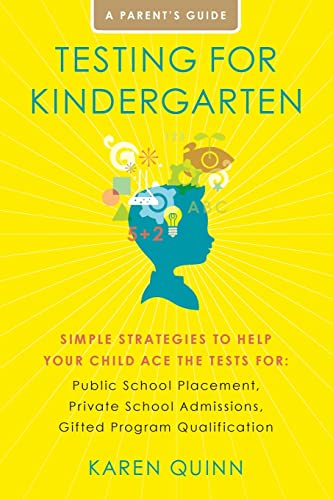
Testing for Kindergarten: Simple Strategies to Help Your Child Ace the Tests for: Public School Placement, Private School Admissions, Gifted Program Qualification - Softcover
Inhaltsangabe
Karen Quinn has successfully taught hundreds of parents how to prepare their children for testing, and Testing For Kindergarten is her ultimate, comprehensive guide to having fun while teaching to the underlying abilities every test assesses.
Whether your child is going to a private kindergarten or a public school, he or she will most likely be tested—and placed in classrooms according to those results. But information about intelligence tests is closely guarded, and it can be difficult to understand what your kids need to know.
As an expert who has successfully taught hundreds of parents how to work with their own children, Karen Quinn has written the ultimate guide to preparing your child for kindergarten testing. The activities she suggests are not about “teaching to the test.” They are about having fun while teaching to the underlying abilities every test assesses.
From the “right” way to have a conversation to natural ways to bring out your child’s inner math geek, Quinn shares the techniques that every parent can do with their kids to give them the best chance to succeed in school and beyond. It’s just good parenting—and better test scores are icing on the cake.
Die Inhaltsangabe kann sich auf eine andere Ausgabe dieses Titels beziehen.
Über die Autorin bzw. den Autor
Karen Quinn has tutored scores of children and taught hundreds of parents how to work with their own kids to prepare them for the rigorous kindergarten admissions tests for Manhattan's most in-demand programs. She has been a featured expert on school admissions on ABC's 20/20 and The View and in The New York Times, Forbes, Redbook, Woman's Day, and more. Karen is also the author of three novels: Holly Would Dream, The Ivy Chronicles and Wife in the Fast Lane. She lives in Miami, FL with her husband and two children. Visit her at www.karenquinn.net.
Auszug. © Genehmigter Nachdruck. Alle Rechte vorbehalten.
Testing for Kindergarten 1. What Educators Know and Parents Don’t CONFESSIONS OF A MOM WHO HAD TO FIGURE THIS OUT FOR HERSELF
Did you know that by the age of 5 most children in America will have been given some kind of intelligence test? These tests cover all the abilities educators believe children must have to do well in the classroom. If you want your child to attend a top private school or a competitive gifted program, his scores will impact and in some cases determine whether he’s in or out.
If you choose public kindergarten for your child, testing serves a different purpose. American public schools commonly engage in a practice known as “ability tracking,” where students are grouped together by slow, average, and advanced skill levels and instructed differently depending on where they are assigned. Over time, children who make the advanced track get teachers who focus more on academic achievement and provide deeper, richer content. Those placed in slow groups are taught through drills, worksheets, and an easier curriculum, which limits their ability to handle harder work later. Their peers jump ahead of them and the gap between the two groups widens, limiting the educational opportunities of kids assigned to the slow track. Your child’s ability group placement will depend on how he scores on the tests he’ll be given when he starts kindergarten.
Considering how these high-stakes tests are used to make school placement decisions that affect our children’s educational futures, you’d think we would be given a heads-up on what they cover. Instead, information about intelligence tests is as closely guarded as the Academy Award envelopes. Parents who want the best for their children don’t understand what their kids need to know, much less how to make sure they’ve given them the right kinds of experiences to pick up these abilities. When I found out my daughter had to take one of these tests, she couldn’t even draw a triangle. I had completely fallen down on the job.
The first time I heard that children her age could even be tested was at her end-of-school meeting at nursery school. Our preschool director had gathered the parents for a briefing on transitioning our children from preschool to kindergarten—“ex-missions,” she called it. The word strikes terror in the hearts and minds of Manhattan parents.
In New York City—and many parts of the country—getting into a private kindergarten, a gifted (also called “G&T,” “TAG,” and “GATE”) program, and even many selective magnet or charter schools has become impossibly competitive. It seems absurd to test 4-year-olds for admissions. And yet, if that is the process where you live, your choice is to play the game or find the best public school program you can. In some markets, public school options are fantastic; in others, not so much.
Most parents who decide to jump through the hoops and apply their kids to more selective public or private schools go into it determined to retain their sanity. It’s a noble intention that isn’t always possible. These are our children we are talking about, our adorable, bright (in most cases, genius) 4-year-olds who do not deserve to be judged by those wart-faced, fire-breathing admissions directors. I have seen icy-veined CEOs reduced to tears over this process.
Your Kid Can’t Spell Her Own Name? Forget Yale.
But back to my first ex-missions meeting. Before I arrived, parents were offered tiny wooden seats next to pint-sized tables with coloring-box centerpieces. Me, I was late, so I sat cross-legged on the floor until my foot fell asleep. Standing, waiting for the numbness to subside, I gazed at the competition. There was Margarita Gonzalas-Baikov, Ben’s mom. She had hired a Chinese nanny just so her son would learn to speak Mandarin before the age of 4. The kid already spoke Spanish and Russian. Showoff, I thought. After Kim Memolis’s mother heard that shapes were on the test, she taught her daughter to make three-dimensional boxes and cones. Was that really necessary? According to his dad, Matthew Stein was already reading Dr. Seuss books. Spare me! That little nose picker had memorized Green Eggs and Ham after hearing it sixty-eight times. My future honor student, Schuyler, knew it after a mere fourteen readings. On the other hand, “Thkyler” (as she so adorably called herself) favored books she could easily stuff down the back of her underpants and couldn’t spell her own name. I wondered, Is it too late to change it?
We lived in Manhattan, in a neighborhood with poor-performing schools, so we had three choices: apply her to private school, try for our local G&T program, or move to a different neighborhood zoned for a better kindergarten. The first two options would require she be tested.
Mark and I wanted to stay in our neighborhood, so our goal was to get Schuyler into either our local G&T program (which would be excellent and free) or a private school (which would be excellent and expensive). I asked our preschool director if there was anything we should be doing at home so she might score better on the all-important test. She gave me one of those “What kind of parent are you?” looks that you never want to get from your nursery school director the year you’re depending on her to recommend your family to an in-demand kindergarten. This was before toddler test prep became de rigueur in NYC and around the country.
“Puh-leaze,” she groaned. “It’s one thing to prep a teenager for an SAT, but to tutor a child barely out of Pampers?” You sicken me. Her lips didn’t say that, but her eyes did. “Relax,” she said, “you just need to trust that between preschool and life, she has absorbed everything she needs to know to do well.”
Obedient by nature, I followed my director’s advice. She was the professional and I was the amateur. In the end, Schuyler tested well enough to get into private school, but not well enough to qualify for the G&T program. We were disappointed because private school was so expensive and a G&T program would have been free, but the outcome wasn’t entirely unexpected (what with her habit of stuffing books down her pants and all).
Your Son Is No Baby Einstein
Over the next year, our younger son, Sam, suffered from recurring ear infections. I noticed that his language was developing more slowly than Schuyler’s had. At 3, Sam often didn’t look at me when I spoke to him, and he barely used words, pointing instead to what he wanted. When I brought this up with my pediatrician, he told me not to worry, that children develop at different rates, and Sam would naturally catch up with his sister.
Despite the doctor’s assurances, I was secretly afraid that Sam might have autism or have some other devastating condition. The possibility that something was seriously wrong with my child was too much to bear. I ignored my doctor’s advice and took Sam to a specialist.
The new doctor immediately ran a battery of physical and psychological tests. He told me there was good news and bad. The good news was that the delays stemmed from the fact that Sam couldn’t hear, the result of fluid buildup from all the ear infections. That could be corrected with surgery. I jumped with joy and hugged the doctor.
“Not so fast. There’s bad news,” he said. “We gave Sam the WPPSI, the test he’ll need to take to get into school next year. His scores were abysmal.”
“So I guess that rules out G&T programs,” I said.
“I guess it does. Your son will never be very smart. And with scores as low as his,...
„Über diesen Titel“ kann sich auf eine andere Ausgabe dieses Titels beziehen.
Suchergebnisse für Testing for Kindergarten: Simple Strategies to Help...

Beispielbild für diese ISBN
Testing for Kindergarten: Simple Strategies to Help Your Child Ace the Tests for: Public School Placement, Private School Admissions, Gifted Program Qualification
Anbieter: World of Books (was SecondSale), Montgomery, IL, USA
Verkäuferbewertung 5 von 5 Sternen

Zustand: Very Good. Item in very good condition! Textbooks may not include supplemental items i.e. CDs, access codes etc. Artikel-Nr. 00101711720
Gebraucht kaufen
EUR 3,67
Versand gratis
Versand innerhalb von USA
Versand innerhalb von USA
Anzahl: 1 verfügbar
Beispielbild für diese ISBN
Testing for Kindergarten: Simple Strategies to Help Your Child Ace the Tests for: Public School Placement, Private School Admissions, Gifted Program Qualification
Anbieter: World of Books (was SecondSale), Montgomery, IL, USA
Verkäuferbewertung 5 von 5 Sternen
Zustand: Good. Item in good condition. Textbooks may not include supplemental items i.e. CDs, access codes etc. Artikel-Nr. 00087114472
Gebraucht kaufen
EUR 3,67
Versand gratis
Versand innerhalb von USA
Versand innerhalb von USA
Anzahl: 6 verfügbar
Beispielbild für diese ISBN
Testing for Kindergarten: Simple Strategies to Help Your Child Ace the Tests for: Public School Placement, Private School Admissions, Gifted Program Qualification
Anbieter: World of Books (was SecondSale), Montgomery, IL, USA
Verkäuferbewertung 5 von 5 Sternen
Zustand: Acceptable. Item in good condition. Textbooks may not include supplemental items i.e. CDs, access codes etc. Artikel-Nr. 00071929608
Gebraucht kaufen
EUR 3,67
Versand gratis
Versand innerhalb von USA
Versand innerhalb von USA
Anzahl: 1 verfügbar
Beispielbild für diese ISBN
Testing for Kindergarten: Simple Strategies to Help Your Child Ace the Tests for: Public School Placement, Private School Admissions, Gifted Program Qualification
Verlag:
Touchstone (edition Illustrated), 2010
ISBN 10: 1416591079
ISBN 13: 9781416591078
Gebraucht
Paperback
Anbieter: BooksRun, Philadelphia, PA, USA
Verkäuferbewertung 5 von 5 Sternen
Paperback. Zustand: Very Good. Illustrated. It's a well-cared-for item that has seen limited use. The item may show minor signs of wear. All the text is legible, with all pages included. It may have slight markings and/or highlighting. Artikel-Nr. 1416591079-8-1
Gebraucht kaufen
EUR 5,07
Versand gratis
Versand innerhalb von USA
Versand innerhalb von USA
Anzahl: 1 verfügbar
Beispielbild für diese ISBN
Testing for Kindergarten: Simple Strategies to Help Your Child Ace the Tests for: Public School Placement, Private School Admissions, Gifted Program Qualification
Verlag:
Touchstone (edition Illustrated), 2010
ISBN 10: 1416591079
ISBN 13: 9781416591078
Gebraucht
Paperback
Anbieter: BooksRun, Philadelphia, PA, USA
Verkäuferbewertung 5 von 5 Sternen
Paperback. Zustand: Very Good. Illustrated. It's a well-cared-for item that has seen limited use. The item may show minor signs of wear. All the text is legible, with all pages included. It may have slight markings and/or highlighting. Artikel-Nr. 1416591079-11-18
Gebraucht kaufen
EUR 5,23
Versand gratis
Versand innerhalb von USA
Versand innerhalb von USA
Anzahl: 1 verfügbar
Beispielbild für diese ISBN
Testing for Kindergarten: Simple Strategies to Help Your Child Ace the Tests for: Public School Placement, Private School Admissions, Gifted Program Qualification
Verlag:
Touchstone (edition Illustrated), 2010
ISBN 10: 1416591079
ISBN 13: 9781416591078
Gebraucht
Paperback
Anbieter: BooksRun, Philadelphia, PA, USA
Verkäuferbewertung 5 von 5 Sternen
Paperback. Zustand: Very Good. Illustrated. It's a well-cared-for item that has seen limited use. The item may show minor signs of wear. All the text is legible, with all pages included. It may have slight markings and/or highlighting. Artikel-Nr. 1416591079-11-1
Gebraucht kaufen
EUR 5,71
Versand gratis
Versand innerhalb von USA
Versand innerhalb von USA
Anzahl: 1 verfügbar
Beispielbild für diese ISBN
Testing for Kindergarten: Simple Strategies to Help Your Child Ace the Tests For: Public School Placement, Private School Admissions, Gifted Program Q
Anbieter: ThriftBooks-Reno, Reno, NV, USA
Verkäuferbewertung 5 von 5 Sternen
Paperback. Zustand: Very Good. No Jacket. May have limited writing in cover pages. Pages are unmarked. ~ ThriftBooks: Read More, Spend Less. Artikel-Nr. G1416591079I4N00
Gebraucht kaufen
EUR 5,99
Versand gratis
Versand innerhalb von USA
Versand innerhalb von USA
Anzahl: 1 verfügbar
Beispielbild für diese ISBN
Testing for Kindergarten: Simple Strategies to Help Your Child Ace the Tests For: Public School Placement, Private School Admissions, Gifted Program Q
Anbieter: ThriftBooks-Atlanta, AUSTELL, GA, USA
Verkäuferbewertung 5 von 5 Sternen
Paperback. Zustand: Very Good. No Jacket. May have limited writing in cover pages. Pages are unmarked. ~ ThriftBooks: Read More, Spend Less. Artikel-Nr. G1416591079I4N00
Gebraucht kaufen
EUR 5,99
Versand gratis
Versand innerhalb von USA
Versand innerhalb von USA
Anzahl: 1 verfügbar
Beispielbild für diese ISBN
Testing for Kindergarten: Simple Strategies to Help Your Child Ace the Tests For: Public School Placement, Private School Admissions, Gifted Program Q
Anbieter: ThriftBooks-Dallas, Dallas, TX, USA
Verkäuferbewertung 5 von 5 Sternen
Paperback. Zustand: Very Good. No Jacket. May have limited writing in cover pages. Pages are unmarked. ~ ThriftBooks: Read More, Spend Less. Artikel-Nr. G1416591079I4N00
Gebraucht kaufen
EUR 5,99
Versand gratis
Versand innerhalb von USA
Versand innerhalb von USA
Anzahl: 1 verfügbar
Beispielbild für diese ISBN
Testing for Kindergarten: Simple Strategies to Help Your Child Ace the Tests for: Public School Placement, Private School Admissions, Gifted Program Qualification
Anbieter: Wonder Book, Frederick, MD, USA
Verkäuferbewertung 5 von 5 Sternen
Zustand: Very Good. Very Good condition. A copy that may have a few cosmetic defects. May also contain light spine creasing or a few markings such as an owner's name, short gifter's inscription or light stamp. Artikel-Nr. V18A-05444
Gebraucht kaufen
EUR 6,33
Versand gratis
Versand innerhalb von USA
Versand innerhalb von USA
Anzahl: 1 verfügbar