
Verwandte Artikel zu 40 More Years: How the Democrats Will Rule the Next...
Inhaltsangabe
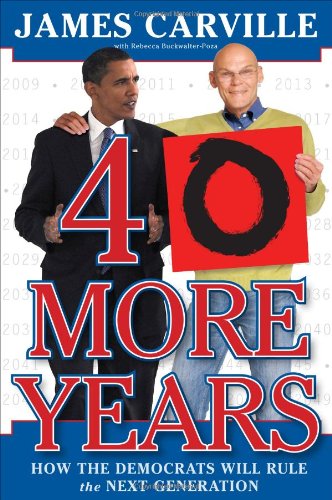
The political strategist and best-selling author of Take It Back provides a call-to-arms for political progressives that shares definitive guidelines on how to fix what is wrong with America's political system, covering such topics as campaign funding, corporate interests, entitlements, and more. 125,000 first printing.
Die Inhaltsangabe kann sich auf eine andere Ausgabe dieses Titels beziehen.
Über die Autorin bzw. den Autor
James Carville is the best-known and most-loved political consultant in American history. He is also a speaker, talk-show host, actor, and author with six New York Times bestsellers to his credit. Part of a large Southern family, he grew up without a television and loved to listen to the stories his mama told. Mr. Carville lives with his wife, Mary Matalin, and their two daughters in New Orleans.
Auszug. © Genehmigter Nachdruck. Alle Rechte vorbehalten.
Introduction
When historians or scientists look back over huge cataclysmic events, they generally find some harbinger that went unnoticed at the time.
There’s always a warning. If you’re a chaos theorist, it’s the flapping of the proverbial butterfly’s wings in New York that caused a tsunami in Hong Kong. A meteorologist might think of it in terms of a category five hurricane that began as a low-pressure area off the Cape Verde Islands on the African coast. Historians remember the assassination of the Archduke Ferdinand as the spark for World War I.
When future historians begin to examine the absolutely disastrous events during the term of President Bush, from massive incompetence to blatant falsehoods and the trampling of the Constitution to the savaging of the good name of the United States around the world, they will look for one of these events.
The stealing of the election of 2000 in Florida is going to be a leading qualifier. But it isn’t the one to focus on, for several reasons. (After all, there’s really nothing that unusual in people resorting to the courts to try to win an election that they didn’t win in the first place.)
Two events occurred within a sixty-day time frame that really set the stage for the current state of America and, more to the point, the sorry state of the Republican Party. The first was a memo written by Matthew Dowd in late November or early December of 2000. At the time, it probably escaped the majority of Republicans’ notice, and it was certainly well under the Democratic and national radar.
The exact content and evidence he used is largely unknown. I certainly don’t know what exactly was in it, and I don’t know of anyone who’d let me borrow a copy as I was writing this book. The best authority on the content of the Matthew Dowd memo that I know of is Thomas Edsall, who wrote about it in Building Red America. Here’s Edsall’s summary of the momentous memo that sealed the fate of the Republicans in 2008 and beyond:
Dowd analyzed poll data and found that the percentage of voters who could be classified as genuinely “swing” or persuadable voters had shrunk from roughly 24 percent of the electorate, to 6 percent or less. This meant that developing governing and election strategies geared at building up turnout among base votes became much more important than developing governing and election strategies designed to appeal to swing, or middle-of-the-road, voters. Persuading a non-voting conservative, a regular listener to Rush Limbaugh, or a hunter determined to protect gun rights to register and get to the polls became much more important and more cost effective than going after the voter who is having trouble making up his mind as to which candidate to vote for. The result was the adoption of policies designed to please the base (tax cuts for the wealthy, restricting abortion, appointing very conservative judges, opposition to stem cell research) that ran counter to Bush’s 2000 claim to be a “uniter, not a divider.”1
Essentially Dowd concluded that trying to win elections by appealing to people in the middle, the vaunted swing vote, was a waste of time. Dowd posited that the real way to win elections was to appeal to and mobilize base voters. In essence Dowd repackaged a strategy many other Republicans, including Reagan, had used before, playing to the base to get elected, and suggested taking it quite a ways further than the GOP had ever dreamed. The Bush team embraced Dowd’s memo enthusiastically.
The Bush administration thoroughly and relentlessly implemented the recommendation of the Dowd memo. The result was the rise of the Christian right in U.S. politics and the establishment of a near neo-theocracy, and, of course, a disastrous war, among other things. That memo may well go down in history as one of the most important, influential political documents of the century (if anyone can find it).
Now we come to our second harbinger of disaster. The Bush administration, like a bunch of teenagers with a new car, was eager to take Dowd’s strategy for a test drive as they came into office. They wanted to see how far from the middle, how distant from truth, they could go.
And here let’s take a quick minute for Carville’s story time. I’ve got a real good one, courtesy of my friend Terry McAuliffe, who’s done exhaustive, and, I might add, unchallenged research on the subject of Republican falsehoods. I’ll tell you this story because it gives us great insight into just how far they were willing to go and how great the consequences of such a comparatively small lie were.
When the Bush administration was first moving into the White House, doing whatever it is Republicans do to feel at home, someone decided the staff would claim that the “Clinton people” trashed the White House.2 Although I’m not prepared to name a suspect at this point in time, I might venture a general guess that the suspect’s initials are Karl Rove.
It was a very involved process, putting out this rumor. The Bush people got creative, giving us an early inkling of that loose relationship with the truth we’d see so much of later on. They told everyone that these Clinton maniacs had removed all the “W” keys from the keyboards of the computer. (I have a lot of things in my closet, but no keyboard keys.) Then the Bush folks set about shopping this rumor to see if the press would bite, if the Democrats would protest, and generally just see how far they could take the strategy.3
Ari Fleischer got out and said that the Bush administration staff would be “cataloging” the extensive vandalism that was being rumored of the Clinton staffers. The exact quote? As reported by the New York Post, Fleischer said, “What we are doing is cataloging [what] took place.” Fleischer volunteered that the White House might itemize the cost of the pranks to taxpayers, but graciously conceded that the cataloging was “very informal—we’re going to note it and that’s that. Nothing will ever come of it.”4
The ease with which Republicans were able to feed fiction into the national news cycle told the White House that (a) they could say whatever they wanted and the press would not challenge them; (b) the Democrats were too confused or afraid to mount a vigorous defense; and (c) the public was willing to believe their lies. It wasn’t until May that the media finally conceded to debunk the rumor.5
Republicans were so successful that their carefully crafted rumor about the Clinton staffers even resurfaced, no doubt by design, this year during the Obama administration transition. In the Christian Science Monitor, Jimmy Orr wrote on January 15, 2009, “Remember eight years ago when dozens of computer keyboards in the White House had the W keys removed?”6
The Dowd memo and the story about the Clintons trashing the White House were the flapping of the butterfly’s wings that caused the tsunami. They were the low-pressure depression of the Cape Verde Islands that caused a category five storm or the assassination of Archduke Ferdinand in Sarajevo. The Republicans had gotten away with stealing the election, and now they knew they could get away with a lot more.
“How did they get away with this?” It’s the question I’ve been asked most frequently during the Bush era. It has many variations. I hear it every time...
„Über diesen Titel“ kann sich auf eine andere Ausgabe dieses Titels beziehen.
Suchergebnisse für 40 More Years: How the Democrats Will Rule the Next...

Beispielbild für diese ISBN
40 More Years: How the Democrats Will Rule the Next Generation
Anbieter: World of Books (was SecondSale), Montgomery, IL, USA
Verkäuferbewertung 5 von 5 Sternen

Hardback. Zustand: Very Good. Artikel-Nr. 00087862794
Gebraucht kaufen
EUR 4,47
Versand gratis
Versand innerhalb von USA
Versand innerhalb von USA
Anzahl: 3 verfügbar
Beispielbild für diese ISBN
40 More Years: How the Democrats Will Rule the Next Generation
Anbieter: World of Books (was SecondSale), Montgomery, IL, USA
Verkäuferbewertung 5 von 5 Sternen
Hardback. Zustand: Good. Artikel-Nr. 00098966681
Gebraucht kaufen
EUR 4,47
Versand gratis
Versand innerhalb von USA
Versand innerhalb von USA
Anzahl: 3 verfügbar
Beispielbild für diese ISBN
40 More Years: How the Democrats Will Rule the Next Generation
Verlag:
Simon & Schuster (edition 1), 2009
ISBN 10: 1416569898
ISBN 13: 9781416569893
Gebraucht
Hardcover
Anbieter: BooksRun, Philadelphia, PA, USA
Verkäuferbewertung 5 von 5 Sternen
Hardcover. Zustand: Very Good. 1. With dust jacket. It's a well-cared-for item that has seen limited use. The item may show minor signs of wear. All the text is legible, with all pages included. It may have slight markings and/or highlighting. Artikel-Nr. 1416569898-11-22-29
Gebraucht kaufen
EUR 5,43
Versand gratis
Versand innerhalb von USA
Versand innerhalb von USA
Anzahl: 1 verfügbar
Beispielbild für diese ISBN
40 More Years: How the Democrats Will Rule the Next Generation
Anbieter: ThriftBooks-Atlanta, AUSTELL, GA, USA
Verkäuferbewertung 5 von 5 Sternen
Hardcover. Zustand: As New. No Jacket. Pages are clean and are not marred by notes or folds of any kind. ~ ThriftBooks: Read More, Spend Less. Artikel-Nr. G1416569898I2N00
Gebraucht kaufen
EUR 6,42
Versand gratis
Versand innerhalb von USA
Versand innerhalb von USA
Anzahl: 1 verfügbar
Beispielbild für diese ISBN
40 More Years: How the Democrats Will Rule the Next Generation
Anbieter: Wonder Book, Frederick, MD, USA
Verkäuferbewertung 5 von 5 Sternen
Zustand: Good. Good condition. Very Good dust jacket. With remainder mark. A copy that has been read but remains intact. May contain markings such as bookplates, stamps, limited notes and highlighting, or a few light stains. Artikel-Nr. B12C-02934
Gebraucht kaufen
EUR 6,43
Versand gratis
Versand innerhalb von USA
Versand innerhalb von USA
Anzahl: 1 verfügbar
Beispielbild für diese ISBN
40 More Years: How the Democrats Will Rule the Next Generation
Anbieter: ThriftBooks-Dallas, Dallas, TX, USA
Verkäuferbewertung 5 von 5 Sternen
Hardcover. Zustand: As New. No Jacket. Pages are clean and are not marred by notes or folds of any kind. ~ ThriftBooks: Read More, Spend Less. Artikel-Nr. G1416569898I2N00
Gebraucht kaufen
EUR 6,43
Versand gratis
Versand innerhalb von USA
Versand innerhalb von USA
Anzahl: 1 verfügbar
Beispielbild für diese ISBN
40 More Years : How the Democrats Will Rule the Next Generation
Anbieter: Better World Books, Mishawaka, IN, USA
Verkäuferbewertung 5 von 5 Sternen
Zustand: Very Good. Pages intact with possible writing/highlighting. Binding strong with minor wear. Dust jackets/supplements may not be included. Stock photo provided. Product includes identifying sticker. Better World Books: Buy Books. Do Good. Artikel-Nr. 38724973-75
Gebraucht kaufen
EUR 6,57
Versand gratis
Versand innerhalb von USA
Versand innerhalb von USA
Anzahl: 1 verfügbar
Beispielbild für diese ISBN
40 More Years : How the Democrats Will Rule the Next Generation
Anbieter: Better World Books, Mishawaka, IN, USA
Verkäuferbewertung 5 von 5 Sternen
Zustand: Very Good. Former library copy. Pages intact with possible writing/highlighting. Binding strong with minor wear. Dust jackets/supplements may not be included. Includes library markings. Stock photo provided. Product includes identifying sticker. Better World Books: Buy Books. Do Good. Artikel-Nr. 38424842-6
Gebraucht kaufen
EUR 6,57
Versand gratis
Versand innerhalb von USA
Versand innerhalb von USA
Anzahl: 1 verfügbar
Beispielbild für diese ISBN
40 More Years
Anbieter: Majestic Books, Hounslow, Vereinigtes Königreich
Verkäuferbewertung 4 von 5 Sternen

Zustand: New. pp. 209. Artikel-Nr. 6759704
Neu kaufen
EUR 10,38
EUR 7,68 Versand
Versand von Vereinigtes Königreich nach USA
Versand von Vereinigtes Königreich nach USA
Anzahl: 1 verfügbar
Foto des Verkäufers
40 MORE YEARS: HOW THE DEMOCRATS WILL RULE THE NEXT GENERATION. (SIGNED)
Verlag:
Simon & Schuster, New York,, 2009
ISBN 10: 1416569898
ISBN 13: 9781416569893
Gebraucht
Hardcover
Erstausgabe
Signiert
Anbieter: Burwood Books, Wickham Market, Vereinigtes Königreich
Verkäuferbewertung 5 von 5 Sternen
Hardcover. Zustand: Fine. First Edition. Hardback. Dust Jacket. 8vo. Original publisher's dark blue cloth, lettered silver at the spine. Signed by the author on the title page. ISBN: 1416569898 Pages: 224 Fine in fine dust jacket. Signedes. Artikel-Nr. C84565
Gebraucht kaufen
EUR 26,77
EUR 26,59 Versand
Versand von Vereinigtes Königreich nach USA
Versand von Vereinigtes Königreich nach USA
Anzahl: 1 verfügbar