
Verwandte Artikel zu The Answer: Grow Any Business, Achieve Financial Freedom,...
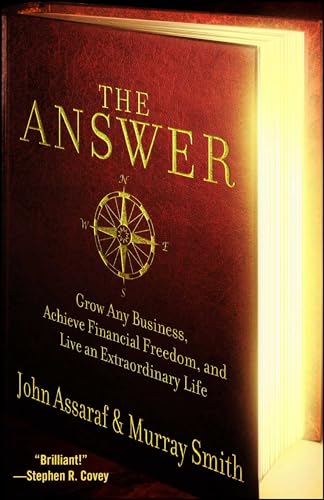
The Answer: Grow Any Business, Achieve Financial Freedom, and Live an Extraordinary Life (A Guide to Business Success) - Softcover
Inhaltsangabe
A key team member behind The Secret and his business partner offer the specific tools and mental strategies to help readers leap ahead in any career or business venture and achieve major financial success.
In this visionary work, New York Times bestselling author John Assaraf and business guru Murray Smith reinvent the business book for the twenty-first century. Two of the most successful entrepreneurs in the world, they combine forces to bring their special insights and techniques together in a revolutionary guide for success in the modern business environment.
Assaraf and Smith know how to minimize risk and maximize success, and The Answer provides a framework for sharing their wisdom, experience, and skills with the millions of people who want to accomplish their own dreams in life. Using cutting-edge research into brain science and quantum physics, they show how readers can actually rewire their brains for success and create the kind of extraordinary lives they want. By teaching readers how to attract and use newly discovered "uncommon" senses to achieve business success, the authors demonstrate the beliefs, habits, thoughts, and actions that they have used to build eighteen multimillion-dollar companies.
Any reader who follows this step-by-step process to build his or her career will experience an enormous life transformation and reach an exceptional level of living.
Die Inhaltsangabe kann sich auf eine andere Ausgabe dieses Titels beziehen.
Über die Autorinnen und Autoren
John Assaraf is one of the experts featured in the film and book The Secret, which he helped launch into a worldwide phenomenon. He has shared his expertise on achieving financial freedom and living an extraordinary life with millions of viewers on The Ellen DeGeneres Show, and dozens of other media venues worldwide. Visit John online at JohnAssaraf.com.
Murray Smith is a business growth expert who has built thirteen businesses, including Indian Motorcycle which he bought just the name from bankruptcy and built it into the second largest U.S. motorcycle company. He has helped thousands of small business owners in thirty countries and has been featured in national and international media, including Forbes, Entrepreneur, CBC, CNN, and NBC. Murray currently owns three companies that help business owners discover new and untapped revenues by focusing on strategies to help increase revenues from their existing clients and attract new clients. Learn more at www.gettheanswer.com and www.accessmainstreet.com.
Auszug. © Genehmigter Nachdruck. Alle Rechte vorbehalten.
The Answer
Grow Any Business, Achieve Financial Freedom, and Live an Extraordinary LifeBy John AssarafAtria
Copyright © 2009 John AssarafAll right reserved.
ISBN: 9781416562009
2
THE SEARCH FOR HOW THE WORLD WORKS
In 1633, an aging Italian astronomer named Galileo Galilei was taken before the Roman Inquisition, tried, convicted of heresy, and sentenced to spend the rest of his life in prison.
Galileo's crime? He endorsed the idea, proposed a century earlier by the great Catholic astronomer Nicolaus Copernicus, that the earth is not the center of the solar system. In fact, said Galileo, it is the other way around: The sun sits at the center, and the earth is simply one of a handful of planets that revolve around it.
This idea was judged as being diametrically opposed to the position taken by Holy Scripture. Galileo was forced to publicly recant his views, and his book containing the offending idea, Dialogue Concerning the Two Chief World Systems, was banned. The old man's sentence was later commuted to house arrest, and he lived out the rest of his days confined to his villa outside Florence, where he eventually went blind.
Still, Galileo's views persisted, and the meticulous experiments and mathematical models he used in his search to understand nature set the stage for all the developments of modern science that followed. Three centuries later, a German physicist named Albert Einstein called him "the father of modern science."
For more than a thousand years leading up to the time of Galileo, science had been more interested in creating intellectually satisfying descriptions of reality than in trying to see if those descriptions could be supported by proof. But with the age of Copernicus and Galileo, European scientists began the vigorous pursuit of empirical evidence. Thought experiments gave way to actual physical experiments, such as the famous moment when Galileo dropped two objects from the Leaning Tower of Pisa to test out Aristotle's assertion that heavier objects fall faster than lighter objects. (They don't.)
From Galileo's time onward, scientists' precise observations contributed to a picture of the world that looked very much like a massive piece of mechanical clockwork; they had little practical use for such ideas as soul, spirit, or consciousness. The French philosopher and mathematician René Descartes, a contemporary of Galileo's who is today regarded as "the father of modern philosophy," declared that the best way to understand how the world works would be to divide existence into two parts: the objective or material world, governed by the principles of science, and the subjective world of the mind and the soul, which would be the province of the church.
Descartes is especially famous for the statement I think, therefore I am. But the truth is, the think part of that declaration puzzled Descartes, much as it has puzzled scientists for centuries since. Just how is it that we think? Where do our thoughts come from? How do the bits of physical matter that constitute our brains generate consciousness? As contemporary physicist John Hagelin has said, "There is a deep philosophical problem surrounding how you get consciousness out of a hunk of meat."
Despite Descartes' neat division of reality, common sense suggested that our thoughts must be connected to the rest of existence somehow. But how, exactly? The answers to those questions open up a tremendous new world of possibility for what we can achieve in our lives, and they form a central part of The Answer.
A WORLD INSIDE THE ATOMIn the generations following Galileo and Descartes, Sir Isaac Newton took the idea of nature-as-machine much further, detailing the precise laws that govern how that machine operates. All of classical physics, and in fact, all of modern science, has been built upon the foundation created by Newton, who described a universe of empty, three-dimensional space, through which physical objects move according to immutable laws. These laws of motion made possible the advance of modern technology, from simple steam engines to the space probes that have analyzed soil samples on Mars.
What we have been able to accomplish by applying Newton's laws has been truly astonishing. But scientists eventually reached the limits of the Newtonian worldview. As their tools grew more sophisticated, their explorations of the physical world took them deep into the heart of the atom, where the nature of reality proved to be something quite different from anything Descartes or Newton ever imagined.
At the dawn of the twentieth century, the tidy, objective, mechanistic view of the world began to fall apart. With the discovery of radioactivity in the late 1890s, scientists began looking into the world within the atomic nucleus, and they were shocked to discover that on the subatomic level, the physical world did not behave at all the way Newton said it should. In fact, the "atom" itself turned out to be a sort of illusion: The closer scientists looked, the less it really appeared to be there.
Coined in ancient Greece, the term atom means "indivisible unit," and through the nineteenth century, scientists believed that our entire physical universe was composed of these elementary particles. But radioactivity showed us that the atom was divisible after all -- in fact, there was a whole new world of phenomena inside the atom, waiting to be explored, measured, and described. And when our vision of the atom fractured, the foundation of classical physics fractured along with it. Our view of how the world works was in for a radical transformation.
EVERYTHING IS ENERGYWhen we say the name Albert Einstein, what comes to mind? Perhaps you think of his wild mane of white hair, or that famous picture of the distinguished physicist sticking out his tongue. Or maybe you think simply, "Genius." But whatever picture you have, you will also probably come up with "E=MC2." Why on earth would a mathematical equation for a sophisticated theory be so famous that even nonscientists recognize it immediately? Because with that simple equation, "Energy equals mass times the speed of light squared," Einstein shattered centuries of thinking and radically altered our view of how the world works.
In his effort to explain the puzzling behavior of light, Einstein found the only viable solution was to stop looking within the neat framework of Newtonian physics. Instead, he introduced his own picture of how the world works: the theory of relativity. One reason Einstein's idea was so transformative was that for the first time ever, it described how energy and matter are not only related, but can be transformed back and forth into each other. A chink had been found in the wall separating the worlds of matter and energy. Now the elegant, clear-cut world of classical, Newtonian physics would be forced to move over and make room for the fuzzy, strange, nearly unimaginable world of quantum physics.
Quantum physics is the study of how the world works on the smallest scale, at a level far smaller than the atom. And as scientists studied the nature of reality on a smaller and smaller scale, something strange began to happen: The deeper we went into reality, the more it seemed to dissolve from view. The search for the smallest known particle of matter had instead turned up distinct yet elusive little packets of energy, which physicists called quanta.
The Einstein breakthrough comes down to this: Everything is energy. A rock, a planet, a glass of water, your hand, everything you can...
„Über diesen Titel“ kann sich auf eine andere Ausgabe dieses Titels beziehen.
Suchergebnisse für The Answer: Grow Any Business, Achieve Financial Freedom,...

Beispielbild für diese ISBN
The Answer
Anbieter: World of Books (was SecondSale), Montgomery, IL, USA
Verkäuferbewertung 5 von 5 Sternen

Paperback. Zustand: Good. Synopsis coming soon. Artikel-Nr. 00103333850
Gebraucht kaufen
EUR 6,05
Versand gratis
Versand innerhalb von USA
Versand innerhalb von USA
Anzahl: 1 verfügbar
Beispielbild für diese ISBN
The Answer: Grow Any Business, Achieve Financial Freedom, and Live an Extraordinary Life
Anbieter: ThriftBooks-Dallas, Dallas, TX, USA
Verkäuferbewertung 5 von 5 Sternen
Paperback. Zustand: Very Good. No Jacket. May have limited writing in cover pages. Pages are unmarked. ~ ThriftBooks: Read More, Spend Less. Artikel-Nr. G1416562001I4N00
Gebraucht kaufen
EUR 6,06
Versand gratis
Versand innerhalb von USA
Versand innerhalb von USA
Anzahl: 1 verfügbar
Beispielbild für diese ISBN
The Answer: Grow Any Business, Achieve Financial Freedom, and Live an Extraordinary Life
Anbieter: ThriftBooks-Reno, Reno, NV, USA
Verkäuferbewertung 5 von 5 Sternen
Paperback. Zustand: Very Good. No Jacket. May have limited writing in cover pages. Pages are unmarked. ~ ThriftBooks: Read More, Spend Less. Artikel-Nr. G1416562001I4N00
Gebraucht kaufen
EUR 6,06
Versand gratis
Versand innerhalb von USA
Versand innerhalb von USA
Anzahl: 1 verfügbar
Beispielbild für diese ISBN
The Answer: Grow Any Business, Achieve Financial Freedom, and Live an Extraordinary Life
Anbieter: ThriftBooks-Phoenix, Phoenix, AZ, USA
Verkäuferbewertung 5 von 5 Sternen
Paperback. Zustand: Very Good. No Jacket. May have limited writing in cover pages. Pages are unmarked. ~ ThriftBooks: Read More, Spend Less. Artikel-Nr. G1416562001I4N00
Gebraucht kaufen
EUR 6,06
Versand gratis
Versand innerhalb von USA
Versand innerhalb von USA
Anzahl: 1 verfügbar
Beispielbild für diese ISBN
The Answer: Grow Any Business, Achieve Financial Freedom, and Live an Extraordinary Life
Anbieter: ThriftBooks-Atlanta, AUSTELL, GA, USA
Verkäuferbewertung 5 von 5 Sternen
Paperback. Zustand: Very Good. No Jacket. May have limited writing in cover pages. Pages are unmarked. ~ ThriftBooks: Read More, Spend Less. Artikel-Nr. G1416562001I4N00
Gebraucht kaufen
EUR 6,06
Versand gratis
Versand innerhalb von USA
Versand innerhalb von USA
Anzahl: 1 verfügbar
Beispielbild für diese ISBN
The Answer : Grow Any Business, Achieve Financial Freedom, and Live an Extraordinary Life
Anbieter: Better World Books: West, Reno, NV, USA
Verkäuferbewertung 5 von 5 Sternen
Zustand: Very Good. Pages intact with possible writing/highlighting. Binding strong with minor wear. Dust jackets/supplements may not be included. Stock photo provided. Product includes identifying sticker. Better World Books: Buy Books. Do Good. Artikel-Nr. 5356536-75
Gebraucht kaufen
EUR 6,49
Versand gratis
Versand innerhalb von USA
Versand innerhalb von USA
Anzahl: 1 verfügbar
Beispielbild für diese ISBN
The Answer : Grow Any Business, Achieve Financial Freedom, and Live an Extraordinary Life
Anbieter: Better World Books: West, Reno, NV, USA
Verkäuferbewertung 5 von 5 Sternen
Zustand: Good. Pages intact with minimal writing/highlighting. The binding may be loose and creased. Dust jackets/supplements are not included. Stock photo provided. Product includes identifying sticker. Better World Books: Buy Books. Do Good. Artikel-Nr. 4795855-6
Gebraucht kaufen
EUR 6,49
Versand gratis
Versand innerhalb von USA
Versand innerhalb von USA
Anzahl: 2 verfügbar
Beispielbild für diese ISBN
The Answer : Grow Any Business, Achieve Financial Freedom, and Live an Extraordinary Life
Anbieter: Better World Books, Mishawaka, IN, USA
Verkäuferbewertung 5 von 5 Sternen
Zustand: Good. Pages intact with minimal writing/highlighting. The binding may be loose and creased. Dust jackets/supplements are not included. Stock photo provided. Product includes identifying sticker. Better World Books: Buy Books. Do Good. Artikel-Nr. 4795855-6
Gebraucht kaufen
EUR 6,49
Versand gratis
Versand innerhalb von USA
Versand innerhalb von USA
Anzahl: 3 verfügbar
Beispielbild für diese ISBN
The Answer: Grow Any Business, Achieve Financial Freedom, and Live an Extraordinary Life
Anbieter: Wonder Book, Frederick, MD, USA
Verkäuferbewertung 5 von 5 Sternen
Zustand: Very Good. Very Good condition. A copy that may have a few cosmetic defects. May also contain light spine creasing or a few markings such as an owner's name, short gifter's inscription or light stamp. Artikel-Nr. L07A-04770
Gebraucht kaufen
EUR 7,06
Versand gratis
Versand innerhalb von USA
Versand innerhalb von USA
Anzahl: 1 verfügbar
Beispielbild für diese ISBN
The Answer: Grow Any Business, Achieve Financial Freedom, and Live an Extraordinary Life (A Guide to Business Success)
Anbieter: WorldofBooks, Goring-By-Sea, WS, Vereinigtes Königreich
Verkäuferbewertung 5 von 5 Sternen
Paperback. Zustand: Very Good. The book has been read, but is in excellent condition. Pages are intact and not marred by notes or highlighting. The spine remains undamaged. Artikel-Nr. GOR002668201
Gebraucht kaufen
EUR 3,36
EUR 6,53 Versand
Versand von Vereinigtes Königreich nach USA
Versand von Vereinigtes Königreich nach USA
Anzahl: 3 verfügbar