
Verwandte Artikel zu Women Food and God: An Unexpected Path to Almost Everything
Inhaltsangabe
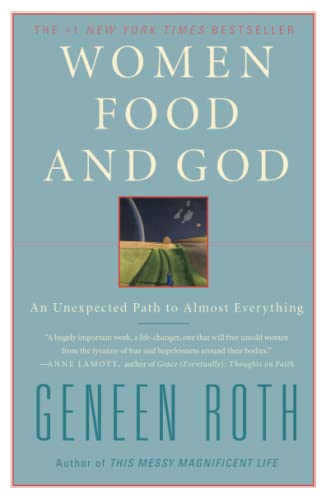
Embraced by Oprah, the #1 New York Times bestselling guide that explains the connection between eating and emotion from Geneen Roth—noted authority on mindful eating.
No matter how sophisticated or wealthy or broke or enlightened you are, how you eat tells all.
After three decades of studying, teaching, and writing about our compulsions with food, bestselling author Geneen Roth adds a powerful new dimension to her work in Women Food and God. She begins with her most basic concept: the way you eat is inseparable from your core beliefs about being alive. Your relationship with food is an exact mirror of your feelings about love, fear, anger, meaning, transformation and, yes, even God.
A timeless and seminal work, Women Food and God shows how going beyond the food and the feelings takes you deeper into realms of spirit and soul—to the bright center of your own life.
Die Inhaltsangabe kann sich auf eine andere Ausgabe dieses Titels beziehen.
Über die Autorin bzw. den Autor
Geneen Roth is the author of ten books, including the New York Times bestsellers When Food Is Love, Lost and Found, and Women Food and God, as well as The Craggy Hole in My Heart and the Cat Who Fixed It. She has been speaking, teaching groundbreaking workshops, and offering retreats for over thirty years and has appeared on numerous national shows, including The Oprah Winfrey Show, 20/20, the Today show, Good Morning America, and The View. For more information about her work, please visit GeneenRoth.com
Von der hinteren Coverseite
The bestselling author of "When Food Is Love" helps overeaters find the underlying reasons for using food as an emotional buffer. Roth also provides seven basic guidelines for eating and other therapeutic self-help tools.
Auszug. © Genehmigter Nachdruck. Alle Rechte vorbehalten.
Women Food and God PROLOGUE
The World on Our Plates
Eighty hungry women are sitting in a circle with bowls of cold tomato vegetable soup; they are glowering at me, furious. It is lunchtime on the third day of the retreat. During these daily eating meditations each woman approaches the buffet table, lines up to be served, takes her seat in the circle, and waits until we all sit down to eat. The process is agonizingly slow—fifteen minutes or so—especially if food is your drug of choice.
Although the retreat is going well and many people here have had life-changing insights, at this moment no one cares. They don’t care about stunning breakthroughs or having ninety pounds to lose or whether God exists. They want to be left alone with their food, period. They want me to take my fancy ideas about the link between spirituality and compulsive eating and go away. It is one thing to be conscious about food in the meditation hall, and another to be sitting in the dining room, refraining from taking even one bite until the entire group has been served. Also, I’ve asked that silence be observed, so there are no frissons of laughter or chatty how-are-yous to distract attention from hunger or lack of it, since not everyone is hungry.
The retreat is based on a philosophy I’ve developed over the past thirty years: that our relationship to food is an exact microcosm of our relationship to life itself. I believe we are walking, talking expressions of our deepest convictions; everything we believe about love, fear, transformation and God is revealed in how, when and what we eat. When we inhale Reese’s peanut butter cups when we are not hungry, we are acting out an entire world of hope or hopelessness, of faith or doubt, of love or fear. If we are interested in finding out what we actually believe—not what we think, not what we say, but what our souls are convinced is the bottom-line truth about life and afterlife—we need go no further than the food on our plates. God is not just in the details; God is also in the muffins, the fried sweet potatoes and the tomato vegetable soup. God—however we define him or her—is on our plates.
Which is why eighty women and I are sitting in a circle with cold vegetable soup. I look around the room. Photographs of flowers—intricate close-ups of a red dahlia, the golden edges of a white rose—are hung on the wall. A bouquet of peach gladiolas is splayed so extravagantly on a side table that it looks as if it is prancing at the prom in its finery. Then I begin noticing the faces of my students. Marjorie, a psychologist in her fifties, is playing with her spoon and doesn’t meet my eyes. A twenty-year-old gymnast named Patricia is wearing black tights and a lemon-colored tank top. Her tiny body sits like an origami bird on her cushion—delicate, perfectly erect. On her plate is a handful of sprouts and a fistful of salad, that’s all. I look to my right and see Anna, a surgeon from Mexico City, biting one of her lips and tapping her fork on the plate impatiently. There are three pieces of bread with thick slabs of butter on her plate, a bit of salad, no soup, no vegetables. Her food says, “Fuck you, Geneen, I don’t have to play this ridiculous game. Watch me binge the second I get the chance.” I nod at her as if to say, “Yup, I understand how hard it is to slow down.” I take a quick glance around the rest of the room, at faces, at plates. The air is thick with resistance to this eating meditation, and since I am the one who makes the rules, I am also the one at whom the fury is directed. Getting between people and their food is like standing in front of a speeding train; the act of being stopped in compulsive behavior is not exactly met with good cheer.
“Anyone want to say anything before we begin?” I ask.
Silence.
“Then, blessings on our food and all that made it possible. The rain, the sun, the people who grew it, brought it here, served it here,” I say.
I can hear Amanda, who is sitting to my right, taking a deep breath at the sound of the prayer. Across the room Zoe nods her head, as if to say, “Oh, right. The earth, the sun, the rain. Glad they’re there.” But not everyone is grateful to take one more second to do anything but eat. Louisa in her bright red running suit sighs and grunts an almost indiscernible “Oh for God’s sakes. Can we puh-leese get on with this?!” She looks as if she is ready to kill me. Humanely, of course, and only with the slightest bit of suffering, but still.
“Now, take some time and notice what you put on your plate,” I say. “Notice if you were hungry when you chose the food. If you weren’t physically hungry, was there another kind of hunger present?
“And looking at your plates, decide what you want to eat first and take a few bites. Notice how the food feels in your mouth. If it tastes like you thought it would taste. If it does what you thought it would do.”
Three, four minutes pass amid the symphony of eating sounds: rustling, chewing, swallowing, clinking. I notice that Izzy, a six-foot-two willowy woman from France, is looking out the window and seems to have forgotten that we are eating. But most people are holding the plates up to their mouths so they can get the bites in faster.
Laurie, a thirty-five-year-old CEO of a Boston mortgage company, raises her hand. “I am not hungry, but I want to be. I want to eat anyway.”
“Why is that?” I ask.
“Because it looks good and it’s here, right now. It’s the best comfort in town. What’s wrong with wanting comfort from food?”
“Not a thing,” I say. “Food is good and comfort is good. Except that when you are not hungry and you want comfort, food is only a temporary palliative; why not address the discomfort directly?”
“It’s too hard to address things directly, too painful, and there isn’t any end to it. And if it’s going to be endlessly painful, then at least I have food,” she answers.
“So you figure that the best you can get out of life is cold vegetable soup?”
When she talks again, her voice is quivering. “It’s the only true comfort I have, and I am not going to deprive myself of it.” A tear jogs down her right cheek, hovers on her top lip. Heads nod in assent. A wave of murmurs passes around the circle.
Laurie says, “This thing we do here—waiting in silence until everyone gets their food—reminds me of what it was like to eat dinner in our family. My mother was drinking, my father was furious and no one was talking. It was horrible.”
“What were you feeling during those times?” I ask.
“Lonely, miserable, like I was born into the wrong family. I wanted to escape but there was no place to go; I felt trapped. And this feels the same way. Like all of you are crazy and I am trapped here, with a bunch of loonies.”
More head nods. More murmurs. A woman from Australia looks at me defiantly, her black waist-length hair brushing the edge of the soup bowl. I imagine she is thinking that Laurie is right and can she get a ride to the airport in fifteen minutes.
But right here, right now, in the center of this wound—I’ve been abandoned and betrayed by who and what really matters and what I’ve got left is food—is where the link between food and God exists. It marks the moment when we gave up on ourselves, on change, on life. It marks the place where we are afraid. It marks the feelings we won’t allow ourselves to feel, and in so doing, keeps our lives constricted and dry...
„Über diesen Titel“ kann sich auf eine andere Ausgabe dieses Titels beziehen.
Suchergebnisse für Women Food and God: An Unexpected Path to Almost Everything

Beispielbild für diese ISBN
Women Food and God: An Unexpected Path to Almost Everything
Anbieter: World of Books (was SecondSale), Montgomery, IL, USA
Verkäuferbewertung 5 von 5 Sternen

Paperback. Zustand: Good. Embraced by Oprah, the #1 New York Times bestselling guide that explains the connection between eating and emotion from Geneen Roth--noted authority on mindful eating. No matter how sophisticated or wealthy or broke or enlightened you are, how you eat tells all. After three decades of studying, teaching, and writing about our compulsions with food, bestselling author Geneen Roth adds a powerful new dimension to her work in Women Food and God. She begins with her most basic concept: the way you eat is inseparable from your core beliefs about being alive. Your relationship with food is an exact mirror of your feelings about love, fear, anger, meaning, transformation, and, yes, even God. A timeless and seminal work, Women Food and God shows how going beyond the food and the feelings takes you deeper into realms of spirit and soul--to the bright center of your own life. Artikel-Nr. 00095068248
Gebraucht kaufen
EUR 3,80
Versand gratis
Versand innerhalb von USA
Versand innerhalb von USA
Anzahl: Mehr als 20 verfügbar
Beispielbild für diese ISBN
Women Food and God: An Unexpected Path to Almost Everything
Anbieter: World of Books (was SecondSale), Montgomery, IL, USA
Verkäuferbewertung 5 von 5 Sternen
Paperback. Zustand: Fair. Embraced by Oprah, the #1 New York Times bestselling guide that explains the connection between eating and emotion from Geneen Roth--noted authority on mindful eating. No matter how sophisticated or wealthy or broke or enlightened you are, how you eat tells all. After three decades of studying, teaching, and writing about our compulsions with food, bestselling author Geneen Roth adds a powerful new dimension to her work in Women Food and God. She begins with her most basic concept: the way you eat is inseparable from your core beliefs about being alive. Your relationship with food is an exact mirror of your feelings about love, fear, anger, meaning, transformation, and, yes, even God. A timeless and seminal work, Women Food and God shows how going beyond the food and the feelings takes you deeper into realms of spirit and soul--to the bright center of your own life. Artikel-Nr. 00084962857
Gebraucht kaufen
EUR 3,80
Versand gratis
Versand innerhalb von USA
Versand innerhalb von USA
Anzahl: 18 verfügbar
Beispielbild für diese ISBN
Women Food and God: An Unexpected Path to Almost Everything
Anbieter: World of Books (was SecondSale), Montgomery, IL, USA
Verkäuferbewertung 5 von 5 Sternen
Paperback. Zustand: Very Good. Embraced by Oprah, the #1 New York Times bestselling guide that explains the connection between eating and emotion from Geneen Roth--noted authority on mindful eating. No matter how sophisticated or wealthy or broke or enlightened you are, how you eat tells all. After three decades of studying, teaching, and writing about our compulsions with food, bestselling author Geneen Roth adds a powerful new dimension to her work in Women Food and God. She begins with her most basic concept: the way you eat is inseparable from your core beliefs about being alive. Your relationship with food is an exact mirror of your feelings about love, fear, anger, meaning, transformation, and, yes, even God. A timeless and seminal work, Women Food and God shows how going beyond the food and the feelings takes you deeper into realms of spirit and soul--to the bright center of your own life. Artikel-Nr. 00107656654
Gebraucht kaufen
EUR 3,80
Versand gratis
Versand innerhalb von USA
Versand innerhalb von USA
Anzahl: 10 verfügbar
Beispielbild für diese ISBN
Women Food and God: An Unexpected Path to Almost Everything
Anbieter: BooksRun, Philadelphia, PA, USA
Verkäuferbewertung 5 von 5 Sternen
Paperback. Zustand: Very Good. It's a well-cared-for item that has seen limited use. The item may show minor signs of wear. All the text is legible, with all pages included. It may have slight markings and/or highlighting. Artikel-Nr. 1416543082-8-1
Gebraucht kaufen
EUR 5,72
Versand gratis
Versand innerhalb von USA
Versand innerhalb von USA
Anzahl: 1 verfügbar
Beispielbild für diese ISBN
Women Food and God: An Unexpected Path to Almost Everything
Anbieter: BooksRun, Philadelphia, PA, USA
Verkäuferbewertung 5 von 5 Sternen
Paperback. Zustand: Fair. The item might be beaten up but readable. May contain markings or highlighting, as well as stains, bent corners, or any other major defect, but the text is not obscured in any way. Artikel-Nr. 1416543082-7-1
Gebraucht kaufen
EUR 5,73
Versand gratis
Versand innerhalb von USA
Versand innerhalb von USA
Anzahl: 1 verfügbar
Beispielbild für diese ISBN
Women Food and God: An Unexpected Path to Almost Everything
Anbieter: ThriftBooks-Dallas, Dallas, TX, USA
Verkäuferbewertung 5 von 5 Sternen
Paperback. Zustand: Very Good. No Jacket. Former library book; May have limited writing in cover pages. Pages are unmarked. ~ ThriftBooks: Read More, Spend Less. Artikel-Nr. G1416543082I4N10
Gebraucht kaufen
EUR 5,96
Versand gratis
Versand innerhalb von USA
Versand innerhalb von USA
Anzahl: 1 verfügbar
Beispielbild für diese ISBN
Women Food and God: An Unexpected Path to Almost Everything
Anbieter: ThriftBooks-Dallas, Dallas, TX, USA
Verkäuferbewertung 5 von 5 Sternen
Paperback. Zustand: Very Good. No Jacket. May have limited writing in cover pages. Pages are unmarked. ~ ThriftBooks: Read More, Spend Less. Artikel-Nr. G1416543082I4N00
Gebraucht kaufen
EUR 5,96
Versand gratis
Versand innerhalb von USA
Versand innerhalb von USA
Anzahl: 4 verfügbar
Beispielbild für diese ISBN
Women Food and God: An Unexpected Path to Almost Everything
Anbieter: ThriftBooks-Phoenix, Phoenix, AZ, USA
Verkäuferbewertung 5 von 5 Sternen
Paperback. Zustand: Very Good. No Jacket. May have limited writing in cover pages. Pages are unmarked. ~ ThriftBooks: Read More, Spend Less. Artikel-Nr. G1416543082I4N00
Gebraucht kaufen
EUR 5,96
Versand gratis
Versand innerhalb von USA
Versand innerhalb von USA
Anzahl: 4 verfügbar
Beispielbild für diese ISBN
Women Food and God: An Unexpected Path to Almost Everything
Anbieter: ThriftBooks-Reno, Reno, NV, USA
Verkäuferbewertung 5 von 5 Sternen
Paperback. Zustand: Very Good. No Jacket. May have limited writing in cover pages. Pages are unmarked. ~ ThriftBooks: Read More, Spend Less. Artikel-Nr. G1416543082I4N00
Gebraucht kaufen
EUR 5,96
Versand gratis
Versand innerhalb von USA
Versand innerhalb von USA
Anzahl: 4 verfügbar
Beispielbild für diese ISBN
Women Food and God: An Unexpected Path to Almost Everything
Anbieter: ThriftBooks-Atlanta, AUSTELL, GA, USA
Verkäuferbewertung 5 von 5 Sternen
Paperback. Zustand: Very Good. No Jacket. May have limited writing in cover pages. Pages are unmarked. ~ ThriftBooks: Read More, Spend Less. Artikel-Nr. G1416543082I4N00
Gebraucht kaufen
EUR 5,96
Versand gratis
Versand innerhalb von USA
Versand innerhalb von USA
Anzahl: 5 verfügbar