Inhaltsangabe
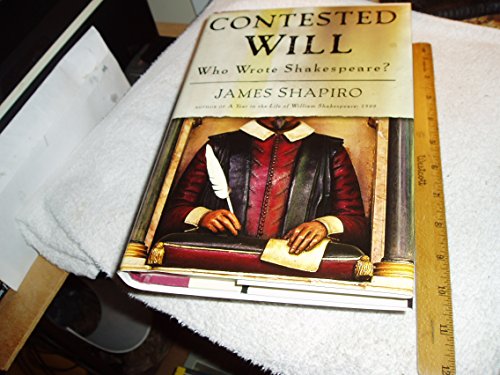
For more than two hundred years after William Shakespeare's death, no one doubted that he had written his plays. Since then, however, dozens of candidates have been proposed for the authorship of what is generally agreed to be the finest body of work by a writer in the English language. In this remarkable book, Shakespeare scholar James Shapiro explains when and why so many people began to question whether Shakespeare wrote his plays. Among the doubters have been such writers and thinkers as Sigmund Freud, Henry James, Mark Twain, and Helen Keller. It is a fascinating story, replete with forgeries, deception, false claimants, ciphers and codes, conspiracy theories—and a stunning failure to grasp the power of the imagination.
As Contested Will makes clear, much more than proper attribution of Shakespeare’s plays is at stake in this authorship controversy. Underlying the arguments over whether Christopher Marlowe, Francis Bacon, or the Earl of Oxford wrote Shakespeare’s plays are fundamental questions about literary genius, specifically about the relationship of life and art. Are the plays (and poems) of Shakespeare a sort of hidden autobiography? Do Hamlet, Macbeth, and the other great plays somehow reveal who wrote them?
Shapiro is the first Shakespeare scholar to examine the authorship controversy and its history in this way, explaining what it means, why it matters, and how it has persisted despite abundant evidence that William Shakespeare of Stratford wrote the plays attributed to him. This is a brilliant historical investigation that will delight anyone interested in Shakespeare and the literary imagination.
Die Inhaltsangabe kann sich auf eine andere Ausgabe dieses Titels beziehen.
Über die Autorin bzw. den Autor
James Shapiro is the Larry Miller Professor of English and Comparative Literature at Columbia University, where he has taught since 1985. Born and raised in Brooklyn, New York, he studied at Columbia and the University of Chicago. He is the author of several books, most recently A Year in the Life of William Shakespeare: 1599. He has been awarded numerous fellowships and grants from institutions such as the Guggenheim Foundation, the National Endowment for the Humanities, and the New York Public Library’s Cullman Center for Scholars and Writers. He has written for The New York Times, the Financial Times, the Los Angeles Times, and other publications. Mr. Shapiro lives in New York with his wife and son.
Auszug. © Genehmigter Nachdruck. Alle Rechte vorbehalten.
PROLOGUE
This is a book about when and why many people began to question whether William Shakespeare wrote the plays long attributed to him, and, if he didn’t write them, who did.
There’s surprising consensus on the part of both skeptics and defenders of Shakespeare’s authorship about when the controversy first took root. Whether you get your facts from the Dictionary of National Biography or Wikipedia, the earliest documented claim dates back to 1785, when James Wilmot, an Oxford-trained scholar who lived a few miles outside of Stratford-upon-Avon, began searching locally for Shakespeare’s books, papers, or any indication that he had been an author—and came up empty-handed. Wilmot gradually came to the conclusion that someone else, most likely Sir Francis Bacon, had written the plays. Wilmot never published what he learned and near the end of his life burned all his papers. But before he died he spoke with a fellow researcher, a Quaker from Ipswich named James Corton Cowell, who later shared these findings with members of the Ipswich Philosophic Society.
Cowell did so in a pair of lectures delivered in 1805 that survive in a manuscript now located in the University of London’s Senate House Library, in which he confesses to being “a renegade” to the Shakespearean “faith.” Cowell was converted by Wilmot’s argument that “there is nothing in the writings of Shakespeare that does not argue the long and early training of the schoolman, the traveler, and the associate of the great and learned. Yet there is nothing in the known life of Shakespeare that shows he had any one of the qualities.” Wilmot is credited with being the first to argue, as far back as the late eighteenth century, for an unbridgeable rift between the facts of Shakespeare’s life and what the plays and poems reveal about their author’s education and experience. But both Wilmot and Cowell were ahead of their time, for close to a half-century passed before the controversy resurfaced in any serious or sustained way.
Since 1850 or so, thousands of books and articles have been published urging that someone other than Shakespeare wrote the plays. At first, bibliographers tried to keep count of all the works inspired by the controversy. By 1884 the list ran to 255 items; by 1949, it had swelled to over 4,500. Nobody bothered trying to keep a running tally after that, and in an age of blogs, websites, and online forums it’s impossible to do justice to how much intellectual energy has been—and continues to be—devoted to the subject. Over time, and for all sorts of reasons, leading artists and intellectuals from all walks of life joined the ranks of the skeptics. I can think of little else that unites Henry James and Malcolm X, Sigmund Freud and Charlie Chaplin, Helen Keller and Orson Welles, or Mark Twain and Sir Derek Jacobi.
It’s not easy keeping track of all the candidates promoted as the true author of Shakespeare’s plays and poems. The leading contenders nowadays are Edward de Vere (the Earl of Oxford) and Sir Francis Bacon. Christopher Marlowe, Mary Sidney, the Earl of Derby, and the Earl of Rutland have attracted fewer though no less ardent supporters. And more than fifty others have been proposed as well—working alone or collaboratively—including Sir Walter Ralegh, John Donne, Anne Whateley, Robert Cecil, John Florio, Sir Philip Sidney, the Earl of Southampton, Queen Elizabeth, and King James. A complete list is pointless, for it would soon be outdated. During the time I’ve been working on this book, four more names have been put forward: the poet and courtier Fulke Greville, the Irish rebel William Nugent, the poet Aemelia Lanier (of Jewish descent and thought by some to be the unnamed Dark Lady of the Sonnets), and the Elizabethan diplomat Henry Neville. New candidates will almost surely be proposed in years to come. While the chapters that follow focus on Francis Bacon and the Earl of Oxford—whose candidacies are the best documented and most consequential—it’s not because I believe that their claims are necessarily stronger than any of these others. An exhaustive account of all the candidates, including those already advanced and those waiting in the wings, would be both tedious and futile, and for reasons that will soon become clear, Bacon and Oxford can be taken as representative.
Much of what has been written about the authorship of Shakespeare’s plays follows the contours of a detective story, which is not all that surprising, since the authorship question and the “whodunit” emerged at the same historical moment. Like all good detective fiction, the Shakespeare mystery can be solved only by determining what evidence is credible, retracing steps, and avoiding false leads. My own account in the pages that follow is no different. I’ve spent the past twenty-five years researching and teaching Shakespeare’s works at Columbia University. For some, that automatically disqualifies me from writing fairly about the controversy on the grounds that my professional investments are so great that I cannot be objective. There are a few who have gone so far as to hint at a conspiracy at work among Shakespeare professors and institutions, with scholars paid off to suppress information that would undermine Shakespeare’s claim. If so, somebody forgot to put my name on the list.
My graduate school experience taught me to be skeptical of unexamined historical claims, even ones that other Shakespeareans took on faith. I had wanted to write my doctoral dissertation on “Shakespeare and the Jews” but was told that since there were no Jews in Shakespeare’s England there were no Jewish questions, and I should turn my attention elsewhere. I reluctantly did so, but years later, after a good deal of research, I learned that both claims were false: there was in fact a small community of Jews living in Elizabethan London, and many leading English writers at that time wrestled in their work with questions of Jewish difference (in an effort to better grasp what constituted English identity). That experience, and the book that grew out of it, taught me the value of revisiting truths universally acknowledged.
There yet remains one subject walled off from serious study by Shakespeare scholars: the authorship question. More than one fellow Shakespearean was disheartened to learn that I was committing my energies to it, as if somehow I was wasting my time and talent, or worse, at risk of going over to the dark side. I became increasingly interested in why this subject remains virtually taboo in academic circles, as well as in the consequences of this collective silence. One thing is certain: the decision by professors to all but ignore the authorship question hasn’t made it disappear. If anything, more people are drawn to it than ever. And because prominent Shakespeareans—with the notable exceptions of Samuel Schoenbaum, Jonathan Bate, Marjorie Garber, Gary Taylor, Stanley Wells, and Alan Nelson—have all but surrendered the field, general readers curious about the subject typically learn about it through the books and websites of those convinced that Shakespeare could never have written the plays.
This was forcefully brought home not long ago when I met with a group of nine-year-olds at a local elementary school to talk about Shakespeare’s poetry. When toward the end of the class I invited questions, a quiet boy on my left raised his hand and said: “My brother told me that Shakespeare really didn’t write Romeo and Juliet. Is that true?” It was the kind of question I was used to hearing from undergraduates on the first day of a Shakespeare course or from audience members at popular lectures, but I...
„Über diesen Titel“ kann sich auf eine andere Ausgabe dieses Titels beziehen.
Weitere beliebte Ausgaben desselben Titels

Suchergebnisse für Contested Will: Who Wrote Shakespeare?

Beispielbild für diese ISBN
Contested Will: Who Wrote Shakespeare?
Verlag:
Simon & Schuster (edition 1), 2010
ISBN 10: 1416541624
ISBN 13: 9781416541622
Gebraucht
Hardcover
Anbieter: BooksRun, Philadelphia, PA, USA
Verkäuferbewertung 5 von 5 Sternen

Hardcover. Zustand: Good. 1. It's a preowned item in good condition and includes all the pages. It may have some general signs of wear and tear, such as markings, highlighting, slight damage to the cover, minimal wear to the binding, etc., but they will not affect the overall reading experience. Artikel-Nr. 1416541624-11-1
Beispielbild für diese ISBN
Contested Will: Who Wrote Shakespeare?
Anbieter: Wonder Book, Frederick, MD, USA
Verkäuferbewertung 5 von 5 Sternen
Zustand: Very Good. Very Good condition. Very Good dust jacket. With remainder mark. A copy that may have a few cosmetic defects. May also contain light spine creasing or a few markings such as an owner's name, short gifter's inscription or light stamp. Artikel-Nr. L20A-03246
Beispielbild für diese ISBN
Contested Will: Who Wrote Shakespeare?
Anbieter: Wonder Book, Frederick, MD, USA
Verkäuferbewertung 5 von 5 Sternen
Zustand: Good. Good condition. Very Good dust jacket. In protective mylar cover. With remainder mark. A copy that has been read but remains intact. May contain markings such as bookplates, stamps, limited notes and highlighting, or a few light stains. Artikel-Nr. F14C-01648
Beispielbild für diese ISBN
Contested Will : Who Wrote Shakespeare?
Verlag:
Simon & Schuster, 2010
ISBN 10: 1416541624
ISBN 13: 9781416541622
Gebraucht
Hardcover
Erstausgabe
Anbieter: Better World Books, Mishawaka, IN, USA
Verkäuferbewertung 5 von 5 Sternen
Zustand: Good. 1st Edition. Former library book; may include library markings. Used book that is in clean, average condition without any missing pages. Artikel-Nr. GRP61954101
Beispielbild für diese ISBN
Contested Will : Who Wrote Shakespeare?
Verlag:
Simon & Schuster, 2010
ISBN 10: 1416541624
ISBN 13: 9781416541622
Gebraucht
Hardcover
Erstausgabe
Anbieter: Better World Books: West, Reno, NV, USA
Verkäuferbewertung 5 von 5 Sternen
Zustand: Good. 1st Edition. Used book that is in clean, average condition without any missing pages. Artikel-Nr. 1328187-6
Beispielbild für diese ISBN
Contested Will : Who Wrote Shakespeare?
Verlag:
Simon & Schuster, 2010
ISBN 10: 1416541624
ISBN 13: 9781416541622
Gebraucht
Hardcover
Erstausgabe
Anbieter: Better World Books, Mishawaka, IN, USA
Verkäuferbewertung 5 von 5 Sternen
Zustand: Very Good. 1st Edition. Former library book; may include library markings. Used book that is in excellent condition. May show signs of wear or have minor defects. Artikel-Nr. GRP61919004
Beispielbild für diese ISBN
Contested Will: Who Wrote Shakespeare?
Anbieter: ThriftBooks-Atlanta, AUSTELL, GA, USA
Verkäuferbewertung 5 von 5 Sternen
Hardcover. Zustand: Very Good. No Jacket. Former library book; May have limited writing in cover pages. Pages are unmarked. ~ ThriftBooks: Read More, Spend Less. Artikel-Nr. G1416541624I4N10
Beispielbild für diese ISBN
Contested Will: Who Wrote Shakespeare?
Anbieter: ThriftBooks-Atlanta, AUSTELL, GA, USA
Verkäuferbewertung 5 von 5 Sternen
Hardcover. Zustand: Good. No Jacket. Pages can have notes/highlighting. Spine may show signs of wear. ~ ThriftBooks: Read More, Spend Less. Artikel-Nr. G1416541624I3N00
Beispielbild für diese ISBN
Contested Will: Who Wrote Shakespeare?
Anbieter: ThriftBooks-Phoenix, Phoenix, AZ, USA
Verkäuferbewertung 5 von 5 Sternen
Hardcover. Zustand: Very Good. No Jacket. Former library book; May have limited writing in cover pages. Pages are unmarked. ~ ThriftBooks: Read More, Spend Less. Artikel-Nr. G1416541624I4N10
Beispielbild für diese ISBN
Contested Will: Who Wrote Shakespeare?
Anbieter: ThriftBooks-Dallas, Dallas, TX, USA
Verkäuferbewertung 5 von 5 Sternen
Hardcover. Zustand: Good. No Jacket. Missing dust jacket; Pages can have notes/highlighting. Spine may show signs of wear. ~ ThriftBooks: Read More, Spend Less. Artikel-Nr. G1416541624I3N01