
Verwandte Artikel zu The First National Bank of Dad: A Foolproof Method...
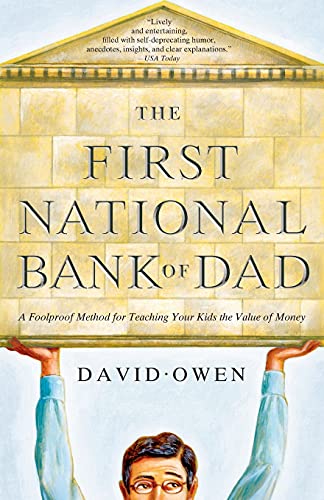
The First National Bank of Dad: A Foolproof Method for Teaching Your Kids the Value of Money - Softcover
Inhaltsangabe
Every parent wants to raise financially responsible children, but often, any efforts to teach kids about money are doomed from the start. As David Owen learned with his own daughter and son, parents who take a traditional approach to talking about money will find that their children learn all the fiscal restraint of an Enron executive.
So Owen devised a novel approach: he established the Bank of Dad, offering simple terms and generous incentives for saving, and then stepped aside and gave his young children the freedom to use their money as they wanted. Instead of blowing it all on candy and toys, they developed a strong sense of financial discipline and responsibility. As they grew older, he added a stock exchange to the Bank of Dad to broaden their understanding of investing.
It sounds complicated, but it's not. His kids will have to work for a living someday, but they are well armed to meet their financial needs and responsibilities. They are avid savers; they know how to balance their checkbooks; they understand the principles of investing in stocks and bonds.
The First National Bank of Dad is a highly accessible guide that offers excellent financial tips for any family and shows readers just how to implement this unusual and innovative plan in their own households.
Die Inhaltsangabe kann sich auf eine andere Ausgabe dieses Titels beziehen.
Über die Autorin bzw. den Autor
David Owen plays in a weekly foursome, takes mulligans off the first tee, practices intermittently at best, wore a copper wristband because Steve Ballesteros said so, and struggles for consistency even though his swing is consistent -- just mediocre. He is a staff writer for The New Yorker, a contributing editor to Golf Digest, and a frequent contributor to The Atlantic Monthly. His other books include The First National Bank of Dad, The Chosen One, The Making of the Masters, and My Usual Game. He lives in Washington, Connecticut.
Auszug. © Genehmigter Nachdruck. Alle Rechte vorbehalten.
Chapter One: Children and Money: An Introduction
When our son was born, my wife and I needed a baby blanket for his crib. Our daughter, who was three and a half, had several old ones in her closet.
"What are you doing in my closet?" she demanded.
"Just getting one of these old blankets," my wife said.
"Why?"
"To give it to your new baby brother."
"I want it!" our daughter screamed.
"But, honey," I said, "you didn't even know that old blanket was there."
"I need it!"
"It's a baby blanket. Don't you want to give it to a baby?"
"I want it!"
My wife and I looked at each other in despair. What to do? Suddenly, my wife had an inspiration.
"Would you take five bucks for it?" she asked.
(No more crying.) "O.K."
Money is a handy tool if you use it wisely. Even very young children get the hang of it in a hurry. In the baby-blanket incident just described, my wife narrowly averted a family crisis by offering to swap an emotionally neutral symbol (money) for an emotionally loaded one (the old blanket). With a crisp five-dollar bill in her piggy bank, our daughter felt justly compensated for this latest unpleasant ramification of the birth of her baby brother. And my wife and I were delighted to give her the cash, because doing so let us go back to what we had been doing before the argument arose: changing diapers, ignoring laundry, and not getting enough sleep.
If my wife hadn't suddenly thought of monetary compensation, our fight would have escalated along a predictable trajectory: my wife and I would have stepped up our efforts to make our daughter feel like a bad child, and our daughter would have stepped up her efforts to make us feel like bad parents. Instead, everyone went to bed that night in a pretty good mood. A couple of months later, our daughter even reconciled herself to the idea of no longer being an only child. Walking alongside her brother's stroller, she said suddenly, with a sigh of resignation, "I don't know who I'll marry. Him, I guess."
GROWN-UPS ARE DUMB
Money is so easy to understand in theory that you'd think more people would do a good job of handling it in practice. But they don't. In many families, financial matters become a psychological theater of war not only between parents and children but also between parents and parents. Why does that happen? We probably don't want to know the real reasons. (One family's story: I claim to think money is pure pragmatism, while my wife believes it's all symbolism and neurosis.) But there are ways of sidestepping the problem altogether, especially where children are concerned -- as long as parents take advantage of human nature instead of ignoring it or futilely attempting to change it.
Most efforts by most parents to teach most kids about money are doomed from the start. Those efforts usually begin (and often end) with the opening of savings accounts. The parents suddenly decide that the time has come to impose order on their children's chaotic financial affairs, so they march the kids down to the bank and sign them up for passbooks. The children are intrigued at first by the notion that a bank will pay them for doing nothing, but their enthusiasm fades when they realize that the interest rate is minuscule and, furthermore, that their parents don't intend to give them access to their principal. To a kid, a savings account is just a black hole that swallows birthday checks.
Kid: "Grandma gave me twenty-five dollars!"
Parent: "How nice. We'll put that check straight into your savings account."
Kid: "But she gave it to me! I want it!"
Parent: "Oh, it will still be yours. You just have to keep it in the bank so that it can grow."
Kid (suspicious): "What do you mean 'grow'?"
Parent: "Well, if you leave your twenty-five dollars in the bank for just one year, the bank will pay you fifty cents. And if you leave all of that in the bank for just one more year, the bank will give you another fifty cents, plus an extra penny besides. That's called compound interest. It will help you go to college."
The main problem with these schemes is that there's nothing in them for the kids. College seems a thousand years away to young children -- who, at this point, probably think they'd just as soon stay home, anyway -- and the promised annual return wouldn't cover even the cost of a pack of chewing gum. Most children immediately realize that banking plans implemented by their parents are actually punitive in intent: their true purpose is not to promote saving but to prevent consumption. Appalled by what their children spend on candy and video games -- and also appalled, perhaps, by the degree to which their children's profligacy seems to mimic their own -- the parents devise stratagems for impounding excess resources.
Almost every family has its unspoken point of no return -- a limit above which monetary gifts are considered too large to be entrusted to young spenders. According to the perverse arithmetic that parents thus impose, a five-dollar bill (which a child is usually allowed to keep) is far more valuable to the child than a hundred-dollar check (which parents usually expropriate and "save"). Not surprisingly, kids soon decide that large sums aren't real money and that all cash should either be spent immediately or hidden in a drawer.
I know these things happen, because I made all the same mistakes. When my daughter reached kindergarten, I gave her a lecture on the virtues of fiscal prudence, then opened a savings account in her name with a deposit of a hundred dollars. Her excitement about my scheme, never great, sank to zero when I told her that she would not be allowed to touch that money any time soon. No matter how enthusiastically I praised the American banking system, she viewed her savings account as a fiction.
My first reaction was that she must be too young, or maybe too lazy, to plan, in a mature and responsible fashion, for her old age. However, on further reflection (over the course of several years, unfortunately), I realized that the problem wasn't a defect in her character; the problem was a defect in my plan. After all, I don't have a savings account myself -- and why should I? I'd rather keep money in a mattress than do all that driving back and forth to the bank for a lousy 2 percent per annum. I store my wealth in the same places you store yours: in stocks and bonds and real estate and money-market accounts and other investments, all of which generate better returns over time than a dumb old savings account. Why had I believed that a five-year-old, for whom a year seems to last at least a decade, would be impressed by handfuls of pennies doled out over eons? Hadn't I closed out my own childhood savings account the moment it came under my sole control? (Yes.)
I had also forgotten that, to a kid, "long term" does not mean "long term" -- it means "never." Encouraging a nursery-schooler to save for college is like encouraging a fifty-year-old to save for the colonization of Mars. When I was five, a century did not seem longer to me than the period between my first day of kindergarten and the day when I would finally be old enough to do the one thing I wanted to do more than anything in life: drive a car. (A further proof, as if any were needed, that time passes more slowly for children than it does for adults: you never hear a grown-up say, "I'm six hundred and seventy-three months old" -- although I did once hear a forty-year-old say, "I'm half-dead now.")
This perception of the passage of time isn't even an illusion where children are concerned; when parents talk to their kids about "long term" in connection with money, the parents usually do mean "never." Parents force their children to lock...
„Über diesen Titel“ kann sich auf eine andere Ausgabe dieses Titels beziehen.
Suchergebnisse für The First National Bank of Dad: A Foolproof Method...

Beispielbild für diese ISBN
The First National Bank of Dad: A Foolproof Method for Teaching Your Kids the Value of Money
Anbieter: World of Books (was SecondSale), Montgomery, IL, USA
Verkäuferbewertung 5 von 5 Sternen

Paperback. Zustand: Good. Synopsis coming soon. Artikel-Nr. 00089950090
Gebraucht kaufen
EUR 4,65
Versand gratis
Versand innerhalb von USA
Versand innerhalb von USA
Anzahl: 2 verfügbar
Beispielbild für diese ISBN
The First National Bank of Dad: A Foolproof Method for Teaching Your Kids the Value of Money
Verlag:
Simon & Schuster (edition Reprint), 2007
ISBN 10: 1416534253
ISBN 13: 9781416534259
Gebraucht
Paperback
Anbieter: BooksRun, Philadelphia, PA, USA
Verkäuferbewertung 5 von 5 Sternen
Paperback. Zustand: Fair. Reprint. The item might be beaten up but readable. May contain markings or highlighting, as well as stains, bent corners, or any other major defect, but the text is not obscured in any way. Artikel-Nr. 1416534253-7-1-13
Gebraucht kaufen
EUR 4,66
Versand gratis
Versand innerhalb von USA
Versand innerhalb von USA
Anzahl: 1 verfügbar
Beispielbild für diese ISBN
The First National Bank of Dad
Anbieter: ThriftBooks-Dallas, Dallas, TX, USA
Verkäuferbewertung 5 von 5 Sternen
Paperback. Zustand: Very Good. No Jacket. May have limited writing in cover pages. Pages are unmarked. ~ ThriftBooks: Read More, Spend Less. Artikel-Nr. G1416534253I4N00
Gebraucht kaufen
EUR 6,04
Versand gratis
Versand innerhalb von USA
Versand innerhalb von USA
Anzahl: 1 verfügbar
Beispielbild für diese ISBN
The First National Bank of Dad
Anbieter: ThriftBooks-Dallas, Dallas, TX, USA
Verkäuferbewertung 5 von 5 Sternen
Paperback. Zustand: Very Good. No Jacket. Missing dust jacket; May have limited writing in cover pages. Pages are unmarked. ~ ThriftBooks: Read More, Spend Less. Artikel-Nr. G1416534253I4N01
Gebraucht kaufen
EUR 6,04
Versand gratis
Versand innerhalb von USA
Versand innerhalb von USA
Anzahl: 1 verfügbar
Beispielbild für diese ISBN
The First National Bank of Dad
Anbieter: ThriftBooks-Atlanta, AUSTELL, GA, USA
Verkäuferbewertung 5 von 5 Sternen
Paperback. Zustand: Very Good. No Jacket. May have limited writing in cover pages. Pages are unmarked. ~ ThriftBooks: Read More, Spend Less. Artikel-Nr. G1416534253I4N00
Gebraucht kaufen
EUR 6,04
Versand gratis
Versand innerhalb von USA
Versand innerhalb von USA
Anzahl: 1 verfügbar
Beispielbild für diese ISBN
The First National Bank of Dad : A Foolproof Method for Teaching Your Kids the Value of Money
Anbieter: Better World Books, Mishawaka, IN, USA
Verkäuferbewertung 5 von 5 Sternen
Zustand: Good. Reprint. Pages intact with minimal writing/highlighting. The binding may be loose and creased. Dust jackets/supplements are not included. Stock photo provided. Product includes identifying sticker. Better World Books: Buy Books. Do Good. Artikel-Nr. 1327953-6
Gebraucht kaufen
EUR 6,19
Versand gratis
Versand innerhalb von USA
Versand innerhalb von USA
Anzahl: 1 verfügbar
Beispielbild für diese ISBN
The First National Bank of Dad : A Foolproof Method for Teaching Your Kids the Value of Money
Anbieter: Better World Books, Mishawaka, IN, USA
Verkäuferbewertung 5 von 5 Sternen
Zustand: Very Good. Reprint. Former library copy. Pages intact with possible writing/highlighting. Binding strong with minor wear. Dust jackets/supplements may not be included. Includes library markings. Stock photo provided. Product includes identifying sticker. Better World Books: Buy Books. Do Good. Artikel-Nr. 9172065-6
Gebraucht kaufen
EUR 6,19
Versand gratis
Versand innerhalb von USA
Versand innerhalb von USA
Anzahl: 1 verfügbar
Beispielbild für diese ISBN
The First National Bank of Dad : A Foolproof Method for Teaching Your Kids the Value of Money
Anbieter: Better World Books: West, Reno, NV, USA
Verkäuferbewertung 5 von 5 Sternen
Zustand: Good. Reprint. Pages intact with minimal writing/highlighting. The binding may be loose and creased. Dust jackets/supplements are not included. Stock photo provided. Product includes identifying sticker. Better World Books: Buy Books. Do Good. Artikel-Nr. 1327953-6
Gebraucht kaufen
EUR 6,19
Versand gratis
Versand innerhalb von USA
Versand innerhalb von USA
Anzahl: 1 verfügbar
Beispielbild für diese ISBN
The First National Bank of Dad : A Foolproof Method for Teaching Your Kids the Value of Money
Anbieter: Better World Books, Mishawaka, IN, USA
Verkäuferbewertung 5 von 5 Sternen
Zustand: Very Good. Reprint. Pages intact with possible writing/highlighting. Binding strong with minor wear. Dust jackets/supplements may not be included. Stock photo provided. Product includes identifying sticker. Better World Books: Buy Books. Do Good. Artikel-Nr. 12835900-6
Gebraucht kaufen
EUR 6,19
Versand gratis
Versand innerhalb von USA
Versand innerhalb von USA
Anzahl: 1 verfügbar
Beispielbild für diese ISBN
The First National Bank of Dad: A Foolproof Method for Teaching Your Kids the Value of Money
Anbieter: Wonder Book, Frederick, MD, USA
Verkäuferbewertung 5 von 5 Sternen
Zustand: Very Good. Very Good condition. A copy that may have a few cosmetic defects. May also contain light spine creasing or a few markings such as an owner's name, short gifter's inscription or light stamp. Artikel-Nr. D12N-00299
Gebraucht kaufen
EUR 6,43
Versand gratis
Versand innerhalb von USA
Versand innerhalb von USA
Anzahl: 1 verfügbar