
Verwandte Artikel zu Generational IQ: Christianity Isn't Dying, Millennials...
Generational IQ: Christianity Isn't Dying, Millennials Aren't the Problem, and the Future Is Bright - Hardcover
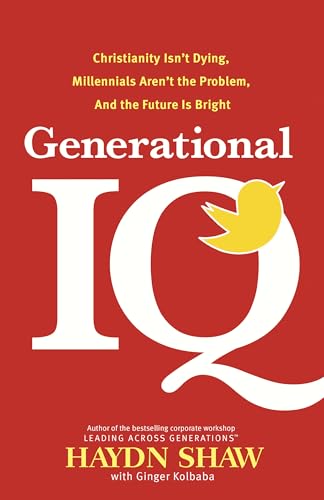
Inhaltsangabe
Why is my daughter drifting from God? Why can’t I explain my life choices to my parents? When will my son get a real job?
Within the last several decades, the world has shifted dramatically. The cracks of this fundamental shift appear everywhere: in our economy, in our cultural debates, in our political landscape, and, most important, in our churches. The problem is we tend to overreact to these changes, fearing that Christianity is dying. We need better Generational IQ, so we can respond to the changes but not be terrified by them. We need a wise generational coach. Haydn Shaw is that generational expert, showing us the roots of this generational shift and how it affects every one of us. Each generation, whether it’s the aging Boomers or the young Millennials, approaches God with a different set of questions and needs based on the times in which they grew up. Haydn walks you through these generational differences and paints a vision of hope for the future.
Die Inhaltsangabe kann sich auf eine andere Ausgabe dieses Titels beziehen.
Von der hinteren Coverseite
Is Christianity really going to be dead in three generations?
Why is my twentysomething still in the basement?
Is it even possible for young people to save sex for marriage when they don’t marry until age twenty-eight?
How do I pass on my faith to my children when they don’t respond to the things I find most meaningful?
What can I do now that my child is walking away from the faith?
Why won’t the younger generations come to our church?
How can our church keep all the generations engaged?
All of these problems share one thing in common: they are rooted in generational differences. Yet we often don’t know enough about the problems to know how big of a deal these differences are or what to do about them. We need intelligence to help us sort fact from terrifying fiction.
That’s where Generational IQ comes in. If we don’t have generational intelligence, we overreact to the small things, ignore the big things, and do the wrong things, making our relationships worse. People of faith tend to overreact to generational differences even more than others do. The reason is that it’s personal. The people we worry about are our children, our friends, and our churches. Or our faith itself. The questions above keep Christians up at night because they hit us in the heart. The more we read about them in the news or online, the more frightened we get. It’s like we’re watching one of those scary movies where the girl heads into the dark basement, and we know the bad guy is there, because the ominous music tells us he is there. We end up yelling at the screen, “No! Don’t go down there! Run away! What’s wrong with you?” Many of us are doing the same to those closest to us, and frankly, it isn’t helping.
Generational IQ brings the best of generational research close to home, to help you find a way to dispel generational tensions in your family and church community. Generational problems aren’t going away anytime soon. We may be tempted to wonder,Why can’t we go back to the way things were? Like the young woman going into the dark basement, wecan’t go back.
But we can turn on the lights.
Haydn Shaw is a leading expert on helping the four generations work better together. He has worked with more than fifteen hundred businesses, nonprofits, and governmental organizations. He is a business consultant for FranklinCovey, specializing in leadership, trust, and personal productivity methodologies, as well as a speaker and consultant with religious organizations. Haydn was hailed as a “leadership guru” by theWashington Post and an “expert on cultural differences at the office” by TIME. The father of four Millennials, Haydn lives with his wife, Laurie, in a multigenerational household in Illinois.
Aus dem Klappentext
Is Christianity really going to be dead in three generations?
Why is my twentysomething still in the basement?
Is it even possible for young people to save sex for marriage when they don t marry until age twenty-eight?
How do I pass on my faith to my children when they don t respond to the things I find most meaningful?
What can I do now that my child is walking away from the faith?
Why won t the younger generations come to our church?
How can our church keep all the generations engaged?
All of these problems share one thing in common: they are rooted in generational differences. Yet we often don t know enough about the problems to know how big of a deal these differences are or what to do about them. We need intelligence to help us sort fact from terrifying fiction.
That s where Generational IQ comes in. If we don t have generational intelligence, we overreact to the small things, ignore the big things, and do the wrong things, making our relationships worse. People of faith tend to overreact to generational differences even more than others do. The reason is that it s personal. The people we worry about are our children, our friends, and our churches. Or our faith itself. The questions above keep Christians up at night because they hit us in the heart. The more we read about them in the news or online, the more frightened we get. It s like we re watching one of those scary movies where the girl heads into the dark basement, and we know the bad guy is there, because the ominous music tells us he is there. We end up yelling at the screen, No! Don t go down there! Run away! What s wrong with you? Many of us are doing the same to those closest to us, and frankly, it isn t helping.
Generational IQ brings the best of generational research close to home, to help you find a way to dispel generational tensions in your family and church community. Generational problems aren t going away anytime soon. We may be tempted to wonder,Why can t we go back to the way things were? Like the young woman going into the dark basement, wecan t go back.
But we can turn on the lights.
Haydn Shaw is a leading expert on helping the four generations work better together. He has worked with more than fifteen hundred businesses, nonprofits, and governmental organizations. He is a business consultant for FranklinCovey, specializing in leadership, trust, and personal productivity methodologies, as well as a speaker and consultant with religious organizations. Haydn was hailed as a leadership guru by theWashington Post and an expert on cultural differences at the office by TIME. The father of four Millennials, Haydn lives with his wife, Laurie, in a multigenerational household in Illinois.
Auszug. © Genehmigter Nachdruck. Alle Rechte vorbehalten.
Generational IQ
Christianity Isn't Dying, Millennials Aren't the Problem, and the Future is Bright
By HAYDN SHAW, Ginger Kolbaba, Jonathan SchindlerTyndale House Publishers, Inc.
Copyright © 2015 Haydn Shaw
All rights reserved.
ISBN: 978-1-4143-6472-8All rights reserved.
Contents
CHAPTER 1 Turning On the Lights, 1,
CHAPTER 2 Generational Intelligence, 9,
PART 1: HOW WHEN YOU WERE BORN AFFECTS YOUR RELATIONSHIP WITH GOD,
CHAPTER 3 Traditionalists (Born before 1945), 25,
CHAPTER 4 Baby Boomers (Born 1946–1964), 43,
CHAPTER 5 Generation X (Born 1965–1980), 63,
CHAPTER 6 Millennials (Born 1981–2001), 81,
PART 2: FRIENDS AND FAMILY,
CHAPTER 7 What Do I Say to Friends Who Claim, "I'm Spiritual but Not Religious"?, 103,
CHAPTER 8 When Will My Twentysomething Move out of the Basement?, 121,
CHAPTER 9 How Do I Reach My Twentysomething Who Is Drifting from God?, 139,
CHAPTER 10 What Do I Do When My Kid Is Putting Off Marriage but Not Sex?, 155,
PART 3: CHURCH,
CHAPTER 11 Will Christianity Really Disappear in Three Generations?, 175,
CHAPTER 12 Why Won't Younger People Come to My Church?, 197,
CHAPTER 13 What Am I Supposed to Do Now That It Doesn't Feel like My Church Anymore?, 217,
PART 4: WHY WE NEED EACH OTHER,
CHAPTER 14 The Ultimate Generational Intelligence, 237,
Acknowledgments, 251,
Discussion Guide, 253,
Notes, 259,
Sticking Points sample chapter, 277,
CHAPTER 1
Turning On the Lights
* * *
"Haydn, I can't see out of my right eye."
My wife, Laurie, and I were traveling home from my company's holiday party, and we were still an hour away.
"What do you mean you can't see?" I asked, fighting the temptation to take my eyes off the road and stare at her.
"It wasn't so noticeable at the party," she said, "but now that we're on the interstate, it seems like I'm peering through thick steam."
"So it didn't happen just now — it was bothering you at the party?" I confirmed, relieved that my forty-nine-year-old wife probably hadn't had a stroke. "Why don't you look it up on your phone and see what's going on?"
"Haydn," she said patiently, "I can't see."
I pulled over to the shoulder, put on the hazards, and spent the next seven or eight minutes scrambling over the Internet on my phone so we could decide whether we needed to race to the nearest emergency room. Cancer stared at me from every website.
If you've ever looked up medical symptoms on the Internet, you know how the possibilities are a mix of the horrifying and the ordinary. I read the list to Laurie:
> Stroke
> Cancer
> Brain tumor
> Eye tumor
> Macular degeneration (which had taken her mother's eyesight at sixty-two)
> Retinal detachment
> Ocular migraine
> Allergies
I thought this was an ominous list, but to my surprise, she said, "I wonder if it's allergies."
"To what?"
"To this sweater. I just bought it today for the party, and I've never worn angora before."
She decided to go home, remove the sweater, and take some Benadryl to see if that helped. Ten minutes after doing this, she couldn't see any better, so we went to the emergency room. Often there's a long wait, but since she suddenly couldn't see out of one eye, they were worried about stroke and took her straight to a CAT scan.
By the time she got back from the CAT scan, her vision was almost completely clear.
Within an hour, the emergency room doctors concluded from a clear CAT scan and dissipated symptoms that it was allergies and sent us home.
I'm happy to report that Laurie has had no other problems, because that was her first and only experience wearing an angora blend. With the emergency room cost added in, we joke that the angora sweater was the most expensive she'll ever wear. But we were happy to pay for the doctors and the test because we had no way of knowing which of the possible Internet diagnoses was right. We didn't have the information, the training, or the know-how to interpret all the frightening reports we found to tell us about Laurie's problem.
A Frightening Diagnosis
Many of us are in a similar situation with our families, friends, and churches. We see the United States and Canada becoming less Christian, and many of us long for the good old days. We hear that in three generations Christianity will all but disappear unless something radically changes. We hear that 88 percent of young people have sex before they marry and that the statistics for Christian young people aren't much different. We see hundreds of news reports that for the first time, people who claim no religious affiliation, the "Nones," make up as much as 23 percent of our population. Even more frightening, we hear that the Millennial generation is the biggest part of the "Nones"; they are leaving church and aren't coming back.
Like my wife and me with her vision loss, we recognize that there are problems. We may even panic about the problems, and then when we see books or news stories about them or do our own investigations on the Internet, we panic even more. We ask ourselves and our friends questions like these (if we bring them up at all):
> Is Christianity really going to be dead in three generations?
> Why is my twentysomething still living in the basement?
> Is it even possible for young people to save sex for marriage when they don't marry until age twenty-eight?
> How do I pass on my faith to my children when they don't respond to the things I find most meaningful about it?
> What can I do now that my child is walking away from the faith?
> What do I say to people who claim they're spiritual but not religious?
> Why won't the younger generations come to our church?
> How does our church keep both the youngest and the oldest generations happy?
> How do I help my church figure out what to do with retirees like me who have real skills and want to do more than fold bulletins?
All of these problems share one thing in common: they are rooted in generational differences. Yet we often don't know enough about the problem to know how big of a deal it is or what to do about it. We don't know whether, as with my wife's allergic reaction, the solution is as simple as returning a sweater or whether we will struggle with it for the rest of our lives. We need intelligence to help us sort fact from terrifying fiction.
That's where Generational IQ comes in.
Generational Intelligence
I've been providing generational intelligence reports to individuals, businesses, the government, churches, and other organizations for twenty years, helping them make sense of the generations: Traditionalists (born before 1945), Baby Boomers (born 1946–1964), Generation Xers (born 1965–1980), and Millennials (born 1981–2001). I've pored over countless studies and interviewed people from each generation, but I've learned the most from interacting with thousands of people in classes and speeches each year. That research allows me to advise my clients (and friends) which generational challenges are important and which ones are no big deal.
But it's not only when I speak at churches that the questions I listed above come up. When I speak in the marketplace, people of faith come to me after the presentations with their worries. They realize after being introduced to generational research that it can help us understand and answer all of them, yet...
„Über diesen Titel“ kann sich auf eine andere Ausgabe dieses Titels beziehen.
Suchergebnisse für Generational IQ: Christianity Isn't Dying, Millennials...

Beispielbild für diese ISBN
Generational IQ
Verlag:
Tyndale House Publishers, 2015
ISBN 10: 1414364725
ISBN 13: 9781414364728
Gebraucht
Hardcover
Anbieter: World of Books (was SecondSale), Montgomery, IL, USA
Verkäuferbewertung 5 von 5 Sternen

Hardback. Zustand: Good. Why is my daughter drifting from God? Why can't I explain my life choices to my parents? When will my son get a real job?Within the last several decades, the world has shifted dramatically. The cracks of this fundamental shift appear everywhere: in our economy, in our cultural debates, in our political landscape, and, most important, in our churches. The problem is we tend to overreact to these changes, fearing that Christianity is dying. We need better Generational IQ, so we can respond to the changes but not be terrified by them. We need a wise generational coach. Haydn Shaw is that generational expert, showing us the roots of this generational shift and how it affects every one of us. Each generation, whether it's the aging Boomers or the young Millennials, approaches God with a different set of questions and needs based on the times in which they grew up. Haydn walks you through these generational differences and paints a vision of hope for the future. Artikel-Nr. 00064178775
Gebraucht kaufen
EUR 4,49
Versand gratis
Versand innerhalb von USA
Versand innerhalb von USA
Anzahl: 3 verfügbar
Beispielbild für diese ISBN
Generational IQ: Christianity Isn't Dying, Millennials Aren't the Problem, and the Future Is Bright
Verlag:
Tyndale Momentum (edition First Edition), 2015
ISBN 10: 1414364725
ISBN 13: 9781414364728
Gebraucht
Hardcover
Erstausgabe
Anbieter: BooksRun, Philadelphia, PA, USA
Verkäuferbewertung 5 von 5 Sternen
Hardcover. Zustand: Very Good. First Edition. With dust jacket. It's a well-cared-for item that has seen limited use. The item may show minor signs of wear. All the text is legible, with all pages included. It may have slight markings and/or highlighting. Artikel-Nr. 1414364725-11-18-29
Gebraucht kaufen
EUR 5,70
Versand gratis
Versand innerhalb von USA
Versand innerhalb von USA
Anzahl: 1 verfügbar
Beispielbild für diese ISBN
Generational IQ: Christianity Isn't Dying, Millennials Aren't the Problem, and the Future Is Bright
Anbieter: ThriftBooks-Dallas, Dallas, TX, USA
Verkäuferbewertung 5 von 5 Sternen
Hardcover. Zustand: As New. No Jacket. Pages are clean and are not marred by notes or folds of any kind. ~ ThriftBooks: Read More, Spend Less. Artikel-Nr. G1414364725I2N00
Gebraucht kaufen
EUR 5,96
Versand gratis
Versand innerhalb von USA
Versand innerhalb von USA
Anzahl: 1 verfügbar
Beispielbild für diese ISBN
Generational IQ: Christianity Isn't Dying, Millennials Aren't the Problem, and the Future Is Bright
Anbieter: ThriftBooks-Atlanta, AUSTELL, GA, USA
Verkäuferbewertung 5 von 5 Sternen
Hardcover. Zustand: Very Good. No Jacket. Missing dust jacket; May have limited writing in cover pages. Pages are unmarked. ~ ThriftBooks: Read More, Spend Less. Artikel-Nr. G1414364725I4N01
Gebraucht kaufen
EUR 5,96
Versand gratis
Versand innerhalb von USA
Versand innerhalb von USA
Anzahl: 1 verfügbar
Beispielbild für diese ISBN
Generational IQ: Christianity Isn't Dying, Millennials Aren't the Problem, and the Future Is Bright
Anbieter: ThriftBooks-Atlanta, AUSTELL, GA, USA
Verkäuferbewertung 5 von 5 Sternen
Hardcover. Zustand: Very Good. No Jacket. May have limited writing in cover pages. Pages are unmarked. ~ ThriftBooks: Read More, Spend Less. Artikel-Nr. G1414364725I4N00
Gebraucht kaufen
EUR 5,96
Versand gratis
Versand innerhalb von USA
Versand innerhalb von USA
Anzahl: 1 verfügbar
Beispielbild für diese ISBN
Generational IQ : Discover Why Christianity Isn't Dying, Millennials Aren't the Problem, and the Future Is Bright
Verlag:
Tyndale House Publishers, 2015
ISBN 10: 1414364725
ISBN 13: 9781414364728
Gebraucht
Hardcover
Anbieter: Better World Books, Mishawaka, IN, USA
Verkäuferbewertung 5 von 5 Sternen
Zustand: Very Good. Pages intact with possible writing/highlighting. Binding strong with minor wear. Dust jackets/supplements may not be included. Stock photo provided. Product includes identifying sticker. Better World Books: Buy Books. Do Good. Artikel-Nr. 16346729-6
Gebraucht kaufen
EUR 6,56
Versand gratis
Versand innerhalb von USA
Versand innerhalb von USA
Anzahl: 3 verfügbar
Beispielbild für diese ISBN
Generational IQ : Discover Why Christianity Isn't Dying, Millennials Aren't the Problem, and the Future Is Bright
Verlag:
Tyndale House Publishers, 2015
ISBN 10: 1414364725
ISBN 13: 9781414364728
Gebraucht
Hardcover
Anbieter: Better World Books, Mishawaka, IN, USA
Verkäuferbewertung 5 von 5 Sternen
Zustand: Good. Pages intact with minimal writing/highlighting. The binding may be loose and creased. Dust jackets/supplements are not included. Stock photo provided. Product includes identifying sticker. Better World Books: Buy Books. Do Good. Artikel-Nr. 17976485-6
Gebraucht kaufen
EUR 6,56
Versand gratis
Versand innerhalb von USA
Versand innerhalb von USA
Anzahl: 1 verfügbar
Beispielbild für diese ISBN
Generational IQ: Discover Why Christianity Isn't Dying, Millennials Aren't the Problem, and the Future Is Bright
Anbieter: Revaluation Books, Exeter, Vereinigtes Königreich
Verkäuferbewertung 5 von 5 Sternen
Hardcover. Zustand: Brand New. 250 pages. 7.00x5.00x1.00 inches. In Stock. Artikel-Nr. 1414364725
Neu kaufen
EUR 34,03
EUR 11,80 Versand
Versand von Vereinigtes Königreich nach USA
Versand von Vereinigtes Königreich nach USA
Anzahl: 1 verfügbar