
Verwandte Artikel zu Open Target: Where America Is Vulnerable to Attack
Inhaltsangabe
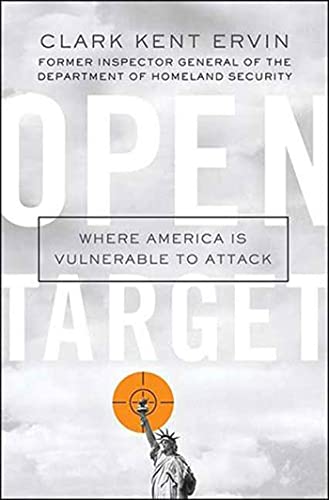
Based on his first-hand experiences and observations of how the Department of Homeland Security is failing to make America safe, Ervin shows the real threats we face--from nuclear attack to homegrown terrorism. Pushed out by the White House for refusing to sugarcoat its failures, Ervin candidly discusses the circumstances of his departure. He takes the reader inside the decision-making councils of this newest department of the U.S. government, and shows how his team's prescriptions for urgent change were ignored--leaving the US vulnerable to another terrorist attack.
Die Inhaltsangabe kann sich auf eine andere Ausgabe dieses Titels beziehen.
Über die Autorin bzw. den Autor
Clark Kent Ervin
Auszug. © Genehmigter Nachdruck. Alle Rechte vorbehalten.
Open Target
Where America Is Vulnerable to AttackBy Clark Kent ErvinPalgrave MacMillan
Copyright © 2007 Clark Kent ErvinAll right reserved.
ISBN: 9781403978943
Chapter One
HOMELAND (IN)SECURITY
I'm a stickler for timeliness. To me, being late is almost a sin-not just any sin, but an unforgivable one. I'm the kind of person who showed up at the airport two hours before flight time years before terrorists forced everyone else to. So, there was no way I was going to be late for my first meeting with Tom Ridge.
The White House is at most a ten-minute walk from the State Department. In no time, I was waiting patiently, if a little anxiously, in the cozy, dimly lit, elegantly appointed West Wing reception area with at least a half-hour to spare. As I waited, I went over my mental script again. I had it all thought out, and my mind was made up. I wanted Ridge to like me, but I didn't want him to like me too much. I would do my best to do well in the interview, but I didn't want to do too well. I was perfectly happy at the State Department, and I would be perfectly happy to stay there.
Being as good as you can be is always a challenge. Being almost as good as you can be, but not an iota better, would be even harder. My mental calibrations were so intricate and distracting that Ridge's assistant had to repeat herself and speak louder when she finally came out of what appeared to be nowhere to tell me that the Governor was ready to see me.
Ushering me into his tiny office, Ridge greeted me graciously and motioned for me to sit down. I settled in for what was scheduled to be only a fifteen-minute "chat."
Tom Ridge is an extraordinarily likable man. It's easy to see why he had such a successful career in electoral politics: He is friendly, engaging, and sincere, and, he pulls off the rare feat of being an imposing presence, while at the same time being utterly unpretentious and easily approachable. He's a huge man, 6'6", and built like a football player, but his manner is so warm and welcoming that he creates a sense of intimacy with those he meets that has the immediate effect of bringing him down to eye level.
I found myself getting so comfortable with Ridge that I forgot that I was supposed to go only so far in selling myself and no further. I heard myself explaining why I would make not just a good Department of Homeland Security Inspector General, but the perfect one: I knew the job inside and out. I already had experience in visa matters, a key part of the border control aspect of homeland security. I was well versed in international affairs, and homeland security had a global dimension to it. I'd shown myself to be thorough, aggressive, and independent, and those were just the qualities the Homeland Security Department, more than any other agency in government, needed in an Inspector General. I could tell by Ridge's intense focus on me and his positive body language that I was racking up points on his mental scoreboard. The fifteen-minute chat stretched into an hour-long heart-to-heart session. By the end of it, we were remarking upon, and bonding over, the similarities between us. We both came from modest backgrounds. We had both gone to Harvard on scholarship. We had both lost our fathers to relatively early deaths. We were both trying to carve time out of our busy schedules to visit our aging mothers. As I walked out of the White House and into the dimming light of a chilly late fall Washington afternoon, it was clear to me that Tom Ridge and I had clicked. I was fairly certain that it would be only a matter of time before Presidential Personnel called back to offer me the job.
I would bask in the glow of that meeting for quite some time. It would take me a while to realize that I'd made a big mistake. Perhaps my time at Colin Powell's State Department had spoiled me: I'd thought that the Department of Homeland Security would be different from the run-of-the-mill agency where a "good enough for government work" mentality is pervasive. I assumed that the very best and brightest the country had to offer would be recruited to run and staff the agency charged with the task of preventing another terror attack on the homeland. I believed that the Secretary and his management team would move Heaven and Earth to close the gaps in America's defenses that my team and I would surely find the minute we set out to look for them. The very last thing I expected was to be made persona non grata for being impertinent enough to do my job.
If the story stopped here, this would be merely a history book, interesting perhaps to political junkies and students of government; but the story doesn't stop here. The gaps in America's defenses that my team and I uncovered during my time at the Department of Homeland Security largely remain, and, since then, still more gaps have been found.
Somewhere in the world today-perhaps right here in America, under our very noses, hiding in plain sight-terrorists are plotting another attack on the homeland. To succeed, they have to find out where we remain vulnerable, and then they need to figure out how to exploit those vulnerabilities to inflict the maximum possible degree of death, injury, and economic damage. So, the urgent question is, What is the state of homeland security today? In general terms, where are the gaps in security that terrorists can exploit right now to attack the homeland once again?
AMERICA'S OPEN DOORS
People in power in Washington, D.C., are bad at keeping secrets. The nation's capital is awash in a downpour of leaks. Many secrets are so poorly kept that they are secrets in name only. Probably the worst-kept secret is that our nation's borders are easy to slip through.
Until terror struck the homeland, this was mostly a political, social, and economic issue, and one of only secondary importance. After September 11, it became a national security issue, and one of first-order importance. Our approach to border control mirrors our approach to every other aspect of homeland security since the attacks: We've taken a half-step in the right direction, but we haven't done everything we can do. We haven't moved with the sense of warp-speed urgency that defending the nation requires; it's as if we think that terrorists are decent, honorable, reasonable, and empathetic. It's as if we think that they wouldn't dare attack until we get around to putting up as much in the way of defenses as we possibly can. In short, we're continuing to take what remains an essentially pre-9/11 approach, and moving at a pre-9/11 pace, in a radically different, post-9/11 world.
For example, in one key aspect of border security, DHS has made some progress. For the first time in our history, we're moving toward keeping track of who is entering our country-at least through legal channels. Thanks to the biometrics-based automated immigration system known as U.S. VISIT, port of entry inspectors can confirm the identity of some entrants, and a more extensive check against terrorist and criminal watch lists can be run.
However, millions of people come to the United States each year by land, and most of those who do so come by way of Mexico and Canada. Most of those countries' citizens aren't subjected to the scrutiny of U.S. VISIT. Moreover, the exit feature is still only in a nascent stage. Until that feature is fully operational, we can't be sure whether terrorists who have managed to legally enter the country undetected by the U.S. VISIT system remain here or...
„Über diesen Titel“ kann sich auf eine andere Ausgabe dieses Titels beziehen.
Suchergebnisse für Open Target: Where America Is Vulnerable to Attack

Beispielbild für diese ISBN
Open Target: Where America Is Vulnerable to Attack
Anbieter: World of Books (was SecondSale), Montgomery, IL, USA
Verkäuferbewertung 5 von 5 Sternen

Zustand: Good. Item in good condition. Textbooks may not include supplemental items i.e. CDs, access codes etc. Artikel-Nr. 00063282698
Gebraucht kaufen
EUR 3,22
Versand gratis
Versand innerhalb von USA
Versand innerhalb von USA
Anzahl: 1 verfügbar
Beispielbild für diese ISBN
Open Target: Where America Is Vulnerable to Attack
Anbieter: Books From California, Simi Valley, CA, USA
Verkäuferbewertung 4 von 5 Sternen

Paperback. Zustand: Very Good. Artikel-Nr. mon0003090343
Gebraucht kaufen
EUR 6,70
EUR 4,45 Versand
Versand innerhalb von USA
Versand innerhalb von USA
Anzahl: 1 verfügbar
Beispielbild für diese ISBN
Open Target
Anbieter: Majestic Books, Hounslow, Vereinigtes Königreich
Verkäuferbewertung 4 von 5 Sternen
Zustand: New. pp. 272. Artikel-Nr. 6808666
Neu kaufen
EUR 21,40
EUR 7,68 Versand
Versand von Vereinigtes Königreich nach USA
Versand von Vereinigtes Königreich nach USA
Anzahl: 1 verfügbar