
Verwandte Artikel zu After Fidel: Raul Castro and the Future of Cuba's...
Inhaltsangabe
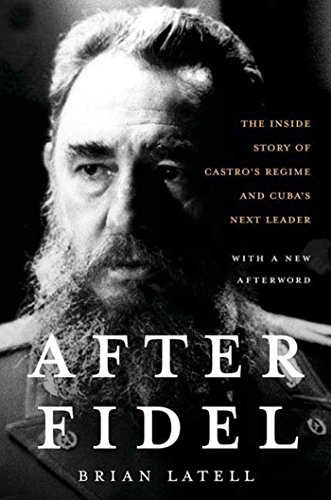
This is a compelling behind-the-scenes account of the extraordinary Castro brothers and the impending dynastic succession of Fidel's younger brother Raul. Brian Latell, the CIA analyst who has followed Castro since the sixties, gives an unprecedented view into Fidel and Raul's remarkable relationship, revealing how they have collaborated in policy making, divided responsibilities, and resolved disagreements for more than forty years--a challenge to the notion that Fidel always acts alone. Latell has had more access to the brothers than anyone else in this country, and his briefs to the CIA informed much of U.S. policy. Based on his knowledge of Raul Castro, Latell makes projections on what kind of leader Raul would be and how the shift in power might influence U.S.-Cuban relations.
Die Inhaltsangabe kann sich auf eine andere Ausgabe dieses Titels beziehen.
Über die Autorin bzw. den Autor
Brian Latell
Auszug. © Genehmigter Nachdruck. Alle Rechte vorbehalten.
After Fidel
The Inside Story of Castro's Regime and Cuba's Next Leader
By Brian LatellPalgrave Macmillan
Copyright © 2005 Brian Latell
All rights reserved.
ISBN: 978-1-4039-7507-2All rights reserved.
Contents
Title Page,
Copyright Notice,
Dedication,
Epigraphs,
Acknowledgments,
PROLOGUE,
INTRODUCTION: More Radical Than Me,
CHAPTER ONE: A Peasant from Biran,
CHAPTER TWO: The Victim of Exploitation,
CHAPTER THREE: We Will All Be Heroes,
CHAPTER FOUR: My True Destiny,
CHAPTER FIVE: So We Can Seize Power,
CHAPTER SIX: He Is Our Father,
CHAPTER SEVEN: My Job Is To Talk,
CHAPTER EIGHT: I Detest Solitude,
CHAPTER NINE: The Moral and Political Duty,
CHAPTER TEN: The Corpse of Imperialism,
CHAPTER ELEVEN: My Brother Twice Over,
CHAPTER TWELVE: More Than Enough Cannons,
Afterword,
Notes,
Index,
Additional Praise for After Fidel,
Copyright,
CHAPTER 1
A Peasant from Biran
Pacing with restless energy at his home in Mayaguez, a verdant university town on Puerto Rico's southwestern coast, Fidel Pino Martinez reminisced with me about the Castro clan. Bougainvillea trees flashed their iridescent magenta blooms that mild winter morning, the last day of February 1986. I had taken a year-long sabbatical from the CIA to do research on Cuba and Mexico at Stanford University. I sought out people who had known the Castro brothers, wanting to learn more about their dynamic relationship.
Pino was seventy-eight, retired from a construction business he had operated with his son. Tall and taciturn, he spoke of Cuba only when coaxed, but he was not an angry or bitter exile. He was content living in Puerto Rico, the nearby island that the Cuban poet and patriot Jose Marti had memorably paired with Cuba as "two wings of the same bird." Its green hills and sugar cane fields, and especially its vibrant, garrulous people, reminded Pino of the homeland he had forever left behind a quarter of a century earlier. All of his family—his wife, siblings and their spouses and every one of the twenty-eight children they had among them—also chose exile. Many of them retained vivid memories of the Castros because the two families had been so closely linked in Oriente and Havana across the span of three generations.
Fidel Pino's youngest brother, Raul Pino Martinez—after whom Raul Castro was named—served during the late 1940s and 1950s in Santiago as attorney for the Castro brothers' parents, first for their father Angel, and later for his widow Lina Ruz and some of the Castro siblings. Raul Pino Martinez's son, also named Raul, has generously shared with me copies of intimate documents and correspondence related to the Castro family that were originally in the possession of his father and are now preserved in the Pino family collection.
In Mayaguez, Fidel Pino had vivid memories of the Castros. His knowledge of the immigrant patriarch Angel, his sons, and Biran, the remote community where the brothers grew up on a sprawling plantation, was fortified by the trick of fate that connected him to Fidel Castro. Both men were named after Pino's father, Fidel Pino Santos. The elder Pino, born in 1884, would be a lifelong friend of Angel Castro. The two had started out dirt poor in the early years of the twentieth century in the municipalities surrounding the Bay of Nipe on Cuba's northeastern coast.
Mayari, where Biran is one of fifteen barrios, or districts, and the neighboring municipalities of Banes and Antilla were at the cusp of spectacular economic and demographic expansion, as workers from all over Cuba sought opportunities in the booming local economy. American sugar and fruit interests were building large mills while clearing vast tracts for sugar cane plantations. Bananas were grown for a while, and later, valuable nickel deposits would be developed. A few towns in the area, notably Banes, became comfortable expatriate centers where American workers and managers enjoyed nearly all the amenities of home.
During the first three decades of the century, Mayari alone burgeoned from about twenty-one thousand to nearly one hundred thousand people. For industrious, shrewd, strong, and eager young men like Angel Castro and Fidel Pino Santos, fortunes could be made. There was enough cheap land so that they could assemble large tracts of their own and then profitably sell cane to the American mills close by.
With each man helping the other, the emerging potentates would become two of the richest entrepreneurs in eastern Cuba. They collaborated on many deals, Angel frequently borrowing money from the wealthier and politically more influential Pino Santos. In Mayaguez, the latter's son, Fidel Pino, told me of a huge diamond—four or five carats, he thought—that Angel had once given to his father as collateral on a loan. The diamond resided for a long time in a small vault in the Pino family home in Havana.
* * *
Outsiders, certainly the few who came from the cities to visit Biran would not easily forget the frontier settlement the Castro compound dominated. One found it barbaric "beyond belief," like "something out of Dostoevski." It was rough and isolated when Fidel and Raul were young. Outlaws roamed the hills, and it was wise to always have firearms close at hand and to know how to use them swiftly.
As many as a thousand people, nearly all of them somehow indentured to the Castros, were drawn to this rustic melting pot. They came from all over the island, from Haiti and Spain, and probably other countries as well, seeking work and little plots of their own where they could throw together a simple hut, maybe grow some sugar cane, and stake out a claim. Sexual mores were casual, unencumbered. Documented marriages were a luxury few bothered with, just as government authority of any kind rarely intruded.
Disputes were generally settled on the spot, often with sudden lunges and slashes of the ubiquitous machete. Eye-for-an-eye forms of justice and retribution were meted out. To be weak was not just disgraceful on the Cuban frontier, but dangerous. None of Angel's children has ever reported witnessing maimings or other bloody confrontations at Biran. But there can be little doubt that they occurred, most predictably when the rum flowed and the game cocks fought.
Children at Biran did not remain innocent very long. Fidel and Raul's sangfroid in later years—when ordering or presiding over executions and engaging in many forms of lethal violence—was ingrained at an early age. Most of their Cuban contemporaries, raised in more refined settings, would never be able to understand this. The brothers may even have learned to rationalize murder by observing their father Angel, who was rumored to have coldly killed men himself.
The busiest time was during the sugar harvesting season, the zafra, when Biran throbbed with frenetic labor as the merciless heat of the late spring and summer descended. Brigades of macheteros, cane cutters, sweating in long-sleeved garments and rhythmically swinging their machetes, sliced their way through the fields. First the leaves had to be stripped, then the stalks cut close to the ground, donde canta el sapo—where the toad sings—so that the best juices nearest the roots could be captured. The most skillful macheteros fairly danced through the cane rows, gracefully arching their backs, smoothly reaching high and low. There was a constant crisp metallic echo as the men...
„Über diesen Titel“ kann sich auf eine andere Ausgabe dieses Titels beziehen.
Suchergebnisse für After Fidel: Raul Castro and the Future of Cuba's...

Beispielbild für diese ISBN
After Fidel: Raul Castro and the Future of Cuba's Revolution
Anbieter: World of Books (was SecondSale), Montgomery, IL, USA
Verkäuferbewertung 5 von 5 Sternen

Paperback. Zustand: Good. This is a compelling behind-the-scenes account of the extraordinary Castro brothers and the impending dynastic succession of Fidel's younger brother Raul. Brian Latell, the CIA analyst who has followed Castro since the sixties, gives an unprecedented view into Fidel and Raul's remarkable relationship, revealing how they have collaborated in policy making, divided responsibilities, and resolved disagreements for more than forty years--a challenge to the notion that Fidel always acts alone. Latell has had more access to the brothers than anyone else in this country, and his briefs to the CIA informed much of U.S. policy. Based on his knowledge of Raul Castro, Latell makes projections on what kind of leader Raul would be and how the shift in power might influence U.S.-Cuban relations. Artikel-Nr. 00060003636
Gebraucht kaufen
EUR 5,09
Versand gratis
Versand innerhalb von USA
Versand innerhalb von USA
Anzahl: 2 verfügbar
Beispielbild für diese ISBN
After Fidel: The Inside Story of Castro's Regime and Cuba's Next Leader
Verlag:
St. Martin's Griffin (edition Second Edition, Revised), 2007
ISBN 10: 1403975078
ISBN 13: 9781403975072
Gebraucht
Paperback
Anbieter: BooksRun, Philadelphia, PA, USA
Verkäuferbewertung 5 von 5 Sternen
Paperback. Zustand: Very Good. Second Edition, Revised. It's a well-cared-for item that has seen limited use. The item may show minor signs of wear. All the text is legible, with all pages included. It may have slight markings and/or highlighting. Artikel-Nr. 1403975078-11-22
Gebraucht kaufen
EUR 5,15
Versand gratis
Versand innerhalb von USA
Versand innerhalb von USA
Anzahl: 1 verfügbar
Foto des Verkäufers
After Fidel: The Inside Story of Castro's Regime and Cuba's Next Leader
Anbieter: Redux Books, Grand Rapids, MI, USA
Verkäuferbewertung 5 von 5 Sternen
Paperback. Zustand: Good. Paperback. Moderate highlighting throughout. Covers show light edge wear.; 100% Satisfaction Guaranteed! Ships same or next business day! Artikel-Nr. 142203240007
Gebraucht kaufen
EUR 6,18
Versand gratis
Versand innerhalb von USA
Versand innerhalb von USA
Anzahl: 1 verfügbar
Beispielbild für diese ISBN
After Fidel: The Inside Story of Castro's Regime and Cuba's Next Leader
Anbieter: Wonder Book, Frederick, MD, USA
Verkäuferbewertung 5 von 5 Sternen
Zustand: Good. Good condition. With remainder mark. A copy that has been read but remains intact. May contain markings such as bookplates, stamps, limited notes and highlighting, or a few light stains. Artikel-Nr. N03A-04511
Gebraucht kaufen
EUR 6,43
Versand gratis
Versand innerhalb von USA
Versand innerhalb von USA
Anzahl: 2 verfügbar
Beispielbild für diese ISBN
After Fidel: The Inside Story of Castro's Regime and Cuba's Next Leader
Anbieter: ThriftBooks-Phoenix, Phoenix, AZ, USA
Verkäuferbewertung 5 von 5 Sternen
Paperback. Zustand: Good. No Jacket. Pages can have notes/highlighting. Spine may show signs of wear. ~ ThriftBooks: Read More, Spend Less. Artikel-Nr. G1403975078I3N00
Gebraucht kaufen
EUR 6,64
Versand gratis
Versand innerhalb von USA
Versand innerhalb von USA
Anzahl: 1 verfügbar
Beispielbild für diese ISBN
After Fidel: The Inside Story of Castro's Regime and Cuba's Next Leader
Anbieter: ThriftBooks-Dallas, Dallas, TX, USA
Verkäuferbewertung 5 von 5 Sternen
Paperback. Zustand: Good. No Jacket. Former library book; Pages can have notes/highlighting. Spine may show signs of wear. ~ ThriftBooks: Read More, Spend Less. Artikel-Nr. G1403975078I3N10
Gebraucht kaufen
EUR 6,64
Versand gratis
Versand innerhalb von USA
Versand innerhalb von USA
Anzahl: 1 verfügbar
Beispielbild für diese ISBN
After Fidel: The Inside Story of Castro's Regime and Cuba's Next Leader
Anbieter: ThriftBooks-Dallas, Dallas, TX, USA
Verkäuferbewertung 5 von 5 Sternen
Paperback. Zustand: Good. No Jacket. Pages can have notes/highlighting. Spine may show signs of wear. ~ ThriftBooks: Read More, Spend Less. Artikel-Nr. G1403975078I3N00
Gebraucht kaufen
EUR 6,64
Versand gratis
Versand innerhalb von USA
Versand innerhalb von USA
Anzahl: 1 verfügbar
Beispielbild für diese ISBN
After Fidel: The Inside Story of Castro's Regime and Cuba's Next Leader
Anbieter: ThriftBooks-Dallas, Dallas, TX, USA
Verkäuferbewertung 5 von 5 Sternen
Paperback. Zustand: Very Good. No Jacket. May have limited writing in cover pages. Pages are unmarked. ~ ThriftBooks: Read More, Spend Less. Artikel-Nr. G1403975078I4N00
Gebraucht kaufen
EUR 6,64
Versand gratis
Versand innerhalb von USA
Versand innerhalb von USA
Anzahl: 1 verfügbar
Beispielbild für diese ISBN
After Fidel: The Inside Story of Castro's Regime and Cuba's Next Leader
Anbieter: ThriftBooks-Atlanta, AUSTELL, GA, USA
Verkäuferbewertung 5 von 5 Sternen
Paperback. Zustand: Very Good. No Jacket. May have limited writing in cover pages. Pages are unmarked. ~ ThriftBooks: Read More, Spend Less. Artikel-Nr. G1403975078I4N00
Gebraucht kaufen
EUR 6,64
Versand gratis
Versand innerhalb von USA
Versand innerhalb von USA
Anzahl: 1 verfügbar
Beispielbild für diese ISBN
After Fidel : The Inside Story of Castro's Regime and Cuba's Next Leader
Anbieter: Better World Books, Mishawaka, IN, USA
Verkäuferbewertung 5 von 5 Sternen
Zustand: Good. Pages intact with minimal writing/highlighting. The binding may be loose and creased. Dust jackets/supplements are not included. Stock photo provided. Product includes identifying sticker. Better World Books: Buy Books. Do Good. Artikel-Nr. 5322894-6
Gebraucht kaufen
EUR 7,22
Versand gratis
Versand innerhalb von USA
Versand innerhalb von USA
Anzahl: 1 verfügbar