
Verwandte Artikel zu Declining By Degrees: Higher Education at Risk
Inhaltsangabe
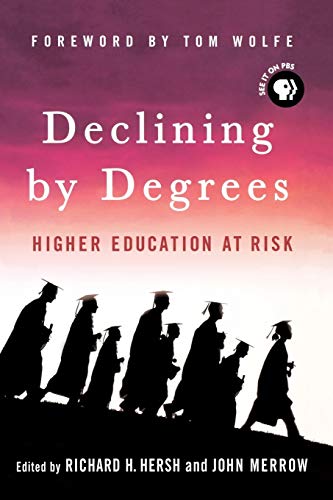
Two decades ago A Nation at Risk sounded a national alarm on K-12 education. Now, an equally urgent alarm is being sounded for higher education in America. In Declining by Degrees, leading authors and educators such as Tom Wolfe, Jim Fallows, and Jay Mathews provide us with a valuable understanding of the serious issues facing colleges today, such as budget cuts, grade inflation, questionable recruitment strategies, and a major focus on Big Time Sports. Tied to the PBS documentary of the same name, Declining by Degrees creates a national discussion about the future of higher education and what we can do about it.
Die Inhaltsangabe kann sich auf eine andere Ausgabe dieses Titels beziehen.
Über die Autorin bzw. den Autor
Richard H. Hersh is a Senior Fellow at the Council for Aid to Education (RAND). He is the former president of Trinity College and Hobart and William Smith Colleges.
John Merrow is the Peabody Award winning president of Learning Matters, Inc. He is Host and Executive Producer of The Merrow Report on PBS and NPR. He is an education correspondent for the MacNeil/Lehrer NewsHour on PBS.
Auszug. © Genehmigter Nachdruck. Alle Rechte vorbehalten.
Declining by Degrees
Higher Education at Risk
By Richard H. Hersh, John MerrowPalgrave Macmillan
Copyright © 2005 Richard H. Hersh and John Merrow
All rights reserved.
ISBN: 978-1-4039-7316-0All rights reserved.
Contents
Title Page,
Copyright Notice,
Acknowledgments,
Foreword,
Dedication,
Introduction Richard H. Hersh and John Merrow,
1. The Media: Degrees of Coverage Gene I. Maeroff,
2. Ready or Not? Where the Public Stands on Higher Education Reform Deborah Wadsworth,
3. College Admissions: A Substitute for Quality? James Fallows,
4. Caveat Lector: Unexamined Assumptions about Quality in Higher Education Jay Mathews,
5. Liberal Education: Slip-Sliding Away? Carol G. Schneider,
6. Six Challenges to the American University Vartan Gregorian,
7. Beyond Markets and Individuals: A Focus on Educational Goals Howard Gardner,
8. This Little Student Went to Market David L. Kirp,
9. How Undergraduate Education Became College Lite — and a Personal Apology Murray Sperber,
10. America's Modern Peculiar Institution Frank Deford,
11. Worlds Apart: Disconnects Between Students and Their Colleges Arthur Levine,
12. Leaving the Newcomers Behind Roberto Suro and Richard Fry,
13. Talking the Talk: Rhetoric and Reality for Students of Color Heather D. Wathington,
14. It is Only a Port of Call: Reflections on the State of Higher Education Julie Johnson Kidd15. The Curriculum and College Life: Confronting Unfulfilled Promises Leon Botstein,
Afterword: What Difference Does a College Make? Richard H. Hersh,
Afterword John Merrow,
Notes,
About the Contributors,
Index,
Additional Praise for Declining by Degrees,
Copyright,
CHAPTER 1
The Media: Degrees of Coverage
Gene I. Maeroff
Professors who study news coverage are fond of content analysis. One approach calls for measuring articles by column inches. Or, in the case of broadcast journalism, counting the number of minutes devoted to a particular topic. This is a crude form of analysis, but it bears some connection to the real world. A comparison of the coverage of higher education and K–12 education, for example, would almost certainly conclude that the space and time that the media devote to colleges and universities pales by comparison with that lavished on elementary and secondary schools. This is so for five reasons.
1. More Americans have an active link to K–12 schools than to higher education and, presumably, have more interest in K–12.
2. Taxpayers plow much more money into elementary and secondary schools, and have soaring property tax bills to show for it.
3. The news media perceive the issues in K–12 as more compelling — and therefore more worthy of coverage.
4. The media fail to see higher education as a landscape rich in story ideas and instead tend to focus on a few predictable subjects, giving far less attention to issues of teaching and learning.
5. This is the way it has always been, and the status quo counts for a great deal in journalism.
These truths add up to a situation in which higher education, surely among society's most valued public goods, escapes scrutiny by the media, one of the few forces with the authority to question the quality of a college or university education. Given higher education's social and economic importance to individuals and to the nation, one hopes that journalism will begin to take its responsibility as an agent for accountability more seriously. Yet the reasons why this has not happened are abundantly clear.
When it comes to the size of the enterprise, it is not surprising that journalists deem precollegiate education worthy of more coverage than higher education. After all, the number of students (53.8 million vs. 15.9 million), institutions (100,000 vs. 3,500), and teachers (3.5 million vs. 1.9 million) in elementary and secondary classrooms dwarfs colleges and universities. Such factors help determine news coverage — the size of the potential audience in terms of those affected and those interested in a subject. News organizations simply do not think that colleges and universities warrant the degree of coverage given to elementary and secondary schools.
As for expenditures, the best advice comes from the film character Jerry Maguire: Follow the dollars. If you ran along the money trail, you would see that precollegiate education is a monstrous $500 billion-a-year enterprise. That is the major part of state and local government expenditures. In most locales, the largest portion of property tax supports K–12 education.
How do schools spend this money? Do they adhere to high standards? What do the taxpayers get for their investment? The pursuit of answers to such questions drives the coverage of elementary and secondary education. Journalists quickly conjure up a plethora of possible articles fraught with the tension and conflict so attractive to the media: Why don't students score higher on tests? Why don't teachers do a better job? Why are members of school boards always squabbling? Why aren't reading, math, and almost every other subject taught better?
Journalists could ask similar questions about higher education, but they usually do not. They act as if it were an article of faith that America's higher education is the best in the world — almost beyond criticism — while considering precollegiate education seriously flawed and, therefore, ripe for scrutiny. The image of a supposedly high-quality system of higher education, operating with the precision of a fine engine, seems to awe journalists. Like most Americans, journalists do not see past the ivy.
Higher education's weaknesses and shortcomings remain largely out of sight to reporters, many of whom are quick to seize on almost any foible at the elementary and secondary level. In other words, higher education is Teflon-coated, remarkably immune to criticism. It is easier to assume that when students do not succeed at colleges and universities, it is because high schools have not prepared them properly, not due to any deficiency on the part of institutions of higher education. Charles B. Reed of California State University and Edward B. Rust of the Business Higher Education Forum think that institutions of higher education can make themselves more accountable by defining their goals and providing evidence that they have met them. Surely such steps would lead to more transparency in judging quality.
The implementation of the federal government's No Child Left Behind Act, however flawed it may be, forced journalists who cover elementary and secondary schools to delve into achievement as never before. Higher education has no analog to that law, though the renewal of the Higher Education Act could contain language that may compel colleges and universities to divulge a great deal more information than they do now about various performance indicators.
Journalists have shied away from using their power to examine how well institutions of higher education discharge the responsibility of educating their students, particularly undergraduates. Instead, similar stories, repeated over and over, dominate the coverage. Not counting college athletics, which is in a class by itself, the big two are tuition and admissions.
The news media convey the impression that nearly every college costs a potentate's fortune and that most institutions are so selective that only super-students need apply. "Reporters...
„Über diesen Titel“ kann sich auf eine andere Ausgabe dieses Titels beziehen.
Suchergebnisse für Declining By Degrees: Higher Education at Risk

Beispielbild für diese ISBN
Declining by Degrees: Higher Education at Risk
Anbieter: World of Books (was SecondSale), Montgomery, IL, USA
Verkäuferbewertung 5 von 5 Sternen

Zustand: Good. Item in good condition. Textbooks may not include supplemental items i.e. CDs, access codes etc. Artikel-Nr. 00107520237
Gebraucht kaufen
EUR 3,80
Versand gratis
Versand innerhalb von USA
Versand innerhalb von USA
Anzahl: 1 verfügbar
Beispielbild für diese ISBN
Declining by Degrees: Higher Education at Risk
Anbieter: World of Books (was SecondSale), Montgomery, IL, USA
Verkäuferbewertung 5 von 5 Sternen
Zustand: Very Good. Item in very good condition! Textbooks may not include supplemental items i.e. CDs, access codes etc. Artikel-Nr. 00107132606
Gebraucht kaufen
EUR 3,80
Versand gratis
Versand innerhalb von USA
Versand innerhalb von USA
Anzahl: 1 verfügbar
Beispielbild für diese ISBN
Declining by Degrees: Higher Education at Risk
Verlag:
St. Martin's Griffin (edition Edition Unstated), 2006
ISBN 10: 1403973164
ISBN 13: 9781403973160
Gebraucht
Paperback
Anbieter: BooksRun, Philadelphia, PA, USA
Verkäuferbewertung 5 von 5 Sternen
Paperback. Zustand: Very Good. Edition Unstated. It's a well-cared-for item that has seen limited use. The item may show minor signs of wear. All the text is legible, with all pages included. It may have slight markings and/or highlighting. Artikel-Nr. 1403973164-11-18
Gebraucht kaufen
EUR 5,23
Versand gratis
Versand innerhalb von USA
Versand innerhalb von USA
Anzahl: 1 verfügbar
Beispielbild für diese ISBN
Declining by Degrees: Higher Education at Risk
Verlag:
St. Martin's Griffin (edition Edition Unstated), 2006
ISBN 10: 1403973164
ISBN 13: 9781403973160
Gebraucht
Paperback
Anbieter: BooksRun, Philadelphia, PA, USA
Verkäuferbewertung 5 von 5 Sternen
Paperback. Zustand: Very Good. Edition Unstated. It's a well-cared-for item that has seen limited use. The item may show minor signs of wear. All the text is legible, with all pages included. It may have slight markings and/or highlighting. Artikel-Nr. 1403973164-11-1
Gebraucht kaufen
EUR 5,45
Versand gratis
Versand innerhalb von USA
Versand innerhalb von USA
Anzahl: 1 verfügbar
Beispielbild für diese ISBN
Declining by Degrees: Higher Education at Risk
Anbieter: ThriftBooks-Dallas, Dallas, TX, USA
Verkäuferbewertung 5 von 5 Sternen
Paperback. Zustand: Very Good. No Jacket. May have limited writing in cover pages. Pages are unmarked. ~ ThriftBooks: Read More, Spend Less. Artikel-Nr. G1403973164I4N00
Gebraucht kaufen
EUR 5,94
Versand gratis
Versand innerhalb von USA
Versand innerhalb von USA
Anzahl: 1 verfügbar
Beispielbild für diese ISBN
Declining by Degrees : Higher Education at Risk
Verlag:
St. Martin's Press, 2006
ISBN 10: 1403973164
ISBN 13: 9781403973160
Gebraucht
Softcover
Erstausgabe
Anbieter: Better World Books, Mishawaka, IN, USA
Verkäuferbewertung 5 von 5 Sternen
Zustand: Good. 1st Edition. Pages intact with minimal writing/highlighting. The binding may be loose and creased. Dust jackets/supplements are not included. Stock photo provided. Product includes identifying sticker. Better World Books: Buy Books. Do Good. Artikel-Nr. 4837473-6
Gebraucht kaufen
EUR 8,31
Versand gratis
Versand innerhalb von USA
Versand innerhalb von USA
Anzahl: 1 verfügbar
Beispielbild für diese ISBN
Declining by Degrees : Higher Education at Risk
Verlag:
St. Martin's Press, 2006
ISBN 10: 1403973164
ISBN 13: 9781403973160
Gebraucht
Softcover
Erstausgabe
Anbieter: Better World Books, Mishawaka, IN, USA
Verkäuferbewertung 5 von 5 Sternen
Zustand: Good. 1st Edition. Former library copy. Pages intact with minimal writing/highlighting. The binding may be loose and creased. Dust jackets/supplements are not included. Includes library markings. Stock photo provided. Product includes identifying sticker. Better World Books: Buy Books. Do Good. Artikel-Nr. 14540944-20
Gebraucht kaufen
EUR 8,31
Versand gratis
Versand innerhalb von USA
Versand innerhalb von USA
Anzahl: 1 verfügbar
Beispielbild für diese ISBN
Declining By Degrees
Anbieter: Magers and Quinn Booksellers, Minneapolis, MN, USA
Verkäuferbewertung 5 von 5 Sternen
Paperback. Zustand: Very Good. May have light to moderate shelf wear and/or a remainder mark. Complete. Clean pages. Artikel-Nr. 1211332
Gebraucht kaufen
EUR 5,94
EUR 3,55 Versand
Versand innerhalb von USA
Versand innerhalb von USA
Anzahl: 1 verfügbar
Beispielbild für diese ISBN
Declining by Degrees: Higher Education at Risk
Anbieter: Ria Christie Collections, Uxbridge, Vereinigtes Königreich
Verkäuferbewertung 5 von 5 Sternen
Zustand: New. In English. Artikel-Nr. ria9781403973160_new
Neu kaufen
EUR 23,65
EUR 13,25 Versand
Versand von Vereinigtes Königreich nach USA
Versand von Vereinigtes Königreich nach USA
Anzahl: Mehr als 20 verfügbar
Beispielbild für diese ISBN
Declining by Degrees: Higher Education at Risk
Anbieter: Revaluation Books, Exeter, Vereinigtes Königreich
Verkäuferbewertung 5 von 5 Sternen
Paperback. Zustand: Brand New. reprint edition. 244 pages. 9.25x6.00x0.75 inches. In Stock. Artikel-Nr. x-1403973164
Neu kaufen
EUR 26,11
EUR 11,73 Versand
Versand von Vereinigtes Königreich nach USA
Versand von Vereinigtes Königreich nach USA
Anzahl: 2 verfügbar