
Verwandte Artikel zu On My Honor: Real Life Lessons from America's First...
Inhaltsangabe
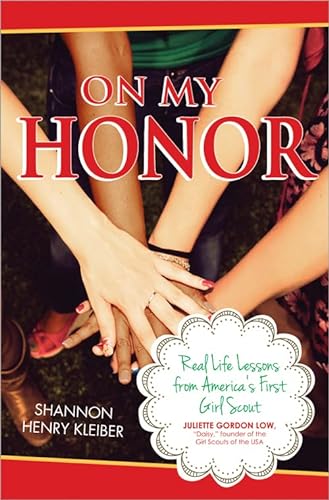
In 1911, Juliette "Daisy" Gordon Low was widowed and completely unsure of what to do with her life when a chance meeting changed her course forever. Determined and inspired by a belief that young girls and women should be taught to rely not on their husbands and fathers but on themselves, Daisy founded the Girl Scouts of the USA the next year.
One hundred years later, Daisy's life lessons still motivate and encourage thousands of young girls and women across the country through the Girl Scout organization. Shannon Henry Kleiber gives Daisy's classic, timeless advice a modern focus that is sure to inspire women of all generations. learn from Daisy's words of wisdom and strive to:
- Know Yourself and Be Yourself
- Love Living Things
- Give to Others
- Be a Sister
- Challenge Yourself
"Have you ever stopped to think that your most constant companion throughout life will be yourself? You will always have this body, this mind, and this spirit that you call 'I,'" — How Girls Can Help Their Country (1916)
Die Inhaltsangabe kann sich auf eine andere Ausgabe dieses Titels beziehen.
Auszug. © Genehmigter Nachdruck. Alle Rechte vorbehalten.
Introduction
Sitting in a close circle, the girls in the group buzz about being invited to the dance, a fight with a friend, schoolwork due the next day. It could be a scene from any high school, middle school, or even elementary school in the United States today. But I like to imagine it might just as easily be something like a moment at one of the first meetings of the Girl Scouts of the USA. The group, then called Girl Guides, started meeting one hundred years ago, with its leaders encouraging girls to become leaders of the future.
It was then that Juliette Gordon Low, affectionately known to everyone as Daisy, founded the Girl Scouts as a group to strengthen girls’ characters through skill-building and learning individual responsibility. The Girl Scouts of today, like those of a century ago, thrive on friendships formed within the group and take what they have learned into adulthood. The story of Daisy is that of every American woman: that of finding herself. But it is also the tale of the woman who has influenced millions, who gave girls a voice even before they had a vote, or before they were likely to compete in a professional sport, run a company, or hold a patent.
Politicians, first ladies, journalists, and actresses are just a handful among the more than fifty million women who were once Girl Scouts. Girl Scouts are currently running our country: about half of the women now in Congress were once Girl Scouts. There are Girl Scouts in all fifty states, and of course, even famous former Girl Scouts, including Lucille Ball, Dorothy Hamill, and Katie Couric. Something every woman has in common as she is trying to find her place in the world is that she was, once, a girl. What happened or didn’t happen to her then doesn’t force any absolute outcomes, but it shapes in little and big ways the person she becomes. Daisy’s character and how she formed the Girl Scouts continues to influence generations. To me, Daisy was a feminist, an environmentalist, and a self-help author (through her contributions in guidebooks), before anyone used those terms. She was forward-thinking not only in her early promotion of women’s leadership, but also in the value she placed on service to others, and inclusivity for girls of diverse religions, races, and economic classes. As fellow Girl Scout leaders and former Girl Scouts know, what she founded defies any sort of simple categorization. Yet we still feel the power in the work she did all those years ago.
From my first days as a Girl Scout troop leader, I was struck by how relevant Daisy’s advice still is for us today. So many of the things I want for my kids—spending more time outdoors, knowing where their food comes from, finding work they love, being a good friend—were all encouraged by Daisy and have become part of what Girl Scouts talk about and strive toward, together. I’ve also realized this is a particularly crucial moment to understand these lessons, as we are in many ways becoming overdependent on technology, less aware of the natural world around us, and most importantly, less connected to each other. In these times of cyber-bullying and social networking, we need to remember to make time to truly connect, and this is especially true of Girl Scout age girls, five- to seventeen-year-olds. We need to talk face to face with young girls, take walks together, and eat meals with each other. Developing real relationships is one of the true tenets of Girl Scouting, and one that guards against children falling through the cracks and feeling alone. When this understanding of human connection starts at an early age, it becomes part of a girl’s internal fabric and helps her navigate the years ahead. I believe and have seen in my own troop that The Girl Scout uses her own intuition and knowledge to solve problems, developing a personal life compass. But at the same time, when a difficulty or roadblock comes up, she is less likely to feel alone, and will instead to look to her friends, including her sisters, to help her through the tough times. As Girl Scouts celebrates in 2012 its founding one hundred years ago by Daisy, the simple but profound encouragement of women seems more germane to our time than ever. It is what we need now, not just for the 3.2 million active members of Girl Scouts, but for our entire society.
Every intertwined aspect of Girl Scouting works to develop “courage, confidence, and character in young women.” It happens not by lecturing the girls, but by guiding them to learn and accomplish things for themselves, to become, as many Girl Scouts call themselves, “Greenbloods.” Juliette Gordon Low was much more than the namesake founder of the organization. Her personality, her way of looking at the world, and her irrepressible joie de vivre can be seen and felt in generation after generation of Girl Scouts.
This is more than just being a good girl who sells cookies. In fact, if there’s a misconception about being a Girl Scout, it’s that she’s annoyingly perfect. Actually, the true Girl Scout is flawed like all of us, but trying and succeeding in our confusing, thorny, miraculous, real world. Being a Girl Scout is about being whoever you are, learning to do new things, and excelling, not so much in one subject, but in your own life. The soul of Girl Scouts is the same as its founder. Daisy was not the typical good girl with the ideal life. She got into trouble and was very outspoken. Her personal trials included becoming nearly deaf and marrying badly. But she moved beyond those difficulties to become an unusual and powerful role model for millions of girls.
Like many former Girl Scouts and mothers of Girl Scouts, until recently I knew Juliette Gordon Low’s name and just a bit about her, but little else. A few years ago, with a group of neighborhood parents, I stood on the corner in front of a big brown Victorian on a Madison, Wisconsin, fall morning. I waved good-bye to the school bus taking our kindergartners, including my older daughter Eve, away to their world. My mind swam with the need to find my youngest daughter Julia’s green froggy boots and just one set of crayons.
My new neighbor, Dana, broke my household reverie. “Would Eve like to join the Girl Scouts?”
We’d moved in the week before, a month late for kindergarten and not knowing anyone in town. After spending most of my life in Washington, DC, then two years in Denver, Colorado, we’d moved to this Midwest college town, to a neighborhood where we could walk to parks, coffee shops, and the zoo, and where my husband would practice cardiology. It sounded like a good life, and it was, but it would take time to build it, to make it our home. My job had shifted from full-time writer to part-time writer to manager of getting our lives back on track. Dana’s question was an invitation to a community. Like many places in the country, Girl Scouts is a really big deal here. Girl Scouts. Yes. Thank you.
At the end of that school year, the college students running Eve’s Girl Scout Daisy troop (the name for the youngest Girl Scouts) told us they were moving on, and that the leadership would need to be taken over by parents, or the troop would disband. Melissa and Sherry, two of the other moms, and I decided we’d take on the troop. How hard would it be with three of us? We are all moms of all girls. Melissa and Sherry each have three girls and I have two. The way girls talk and move and laugh and live is a part of our homes and every moment of our consciousness. Melissa is a champion of the underserved and the underdog, running her own nonprofit law firm in Madison. Sherry is a historian and former curator at the Circus World Museum in Baraboo, Wisconsin, which is where the Ringling Bros. Circus was founded. They...
„Über diesen Titel“ kann sich auf eine andere Ausgabe dieses Titels beziehen.
Suchergebnisse für On My Honor: Real Life Lessons from America's First...

Beispielbild für diese ISBN
On My Honor: Real Life Lessons from America's First Girl Scout
Anbieter: World of Books (was SecondSale), Montgomery, IL, USA
Verkäuferbewertung 5 von 5 Sternen

Paperback. Zustand: Very Good. In 1911, Juliette Daisy Gordon Low was widowed and completely unsure of what to do with her life when a chance meeting changed her course forever. Determined and inspired by a belief that young girls and women should be taught to rely not on their husbands and fathers but on themselves, Daisy founded the Girl Scouts of the USA the next year. One hundred years later, Daisy's life lessons still motivate and encourage thousands of young girls and women across the country through the Girl Scout organization. Shannon Henry Kleiber gives Daisy's classic, timeless advice a modern focus that is sure to inspire women of all generations. learn from Daisy's words of wisdom and strive to: -Know Yourself and Be Yourself -Love Living Things -Give to Others -Be a Sister -Challenge Yourself Have you ever stopped to think that your most constant companion throughout life will be yourself? You will always have this body, this mind, and this spirit that you call 'I, ' -- How Girls Can Help Their Country (1916). Artikel-Nr. 00101476422
Gebraucht kaufen
EUR 4,66
Versand gratis
Versand innerhalb von USA
Versand innerhalb von USA
Anzahl: 1 verfügbar
Beispielbild für diese ISBN
On My Honor: Real Life Lessons from America's First Girl Scout
Anbieter: BooksRun, Philadelphia, PA, USA
Verkäuferbewertung 5 von 5 Sternen
Paperback. Zustand: Very Good. It's a well-cared-for item that has seen limited use. The item may show minor signs of wear. All the text is legible, with all pages included. It may have slight markings and/or highlighting. Artikel-Nr. 1402267932-11-1
Gebraucht kaufen
EUR 4,67
Versand gratis
Versand innerhalb von USA
Versand innerhalb von USA
Anzahl: 1 verfügbar
Beispielbild für diese ISBN
On My Honor : Real Life Lessons from America's First Girl Scout
Verlag:
Sourcebooks, Incorporated, 2012
ISBN 10: 1402267932
ISBN 13: 9781402267932
Gebraucht
Softcover
Anbieter: Better World Books, Mishawaka, IN, USA
Verkäuferbewertung 5 von 5 Sternen
Zustand: Good. Pages intact with minimal writing/highlighting. The binding may be loose and creased. Dust jackets/supplements are not included. Stock photo provided. Product includes identifying sticker. Better World Books: Buy Books. Do Good. Artikel-Nr. 1300033-6
Gebraucht kaufen
EUR 6,18
Versand gratis
Versand innerhalb von USA
Versand innerhalb von USA
Anzahl: 1 verfügbar
Beispielbild für diese ISBN
On My Honor: Real Life Lessons from America's First Girl Scout
Anbieter: ThriftBooks-Dallas, Dallas, TX, USA
Verkäuferbewertung 5 von 5 Sternen
Paperback. Zustand: Good. No Jacket. Pages can have notes/highlighting. Spine may show signs of wear. ~ ThriftBooks: Read More, Spend Less. Artikel-Nr. G1402267932I3N00
Gebraucht kaufen
EUR 6,48
Versand gratis
Versand innerhalb von USA
Versand innerhalb von USA
Anzahl: 1 verfügbar
Beispielbild für diese ISBN
On My Honor: Real Life Lessons from America's First Girl Scout
Anbieter: ThriftBooks-Atlanta, AUSTELL, GA, USA
Verkäuferbewertung 5 von 5 Sternen
Paperback. Zustand: Fair. No Jacket. Readable copy. Pages may have considerable notes/highlighting. ~ ThriftBooks: Read More, Spend Less. Artikel-Nr. G1402267932I5N00
Gebraucht kaufen
EUR 6,48
Versand gratis
Versand innerhalb von USA
Versand innerhalb von USA
Anzahl: 1 verfügbar