
Verwandte Artikel zu Decision Making for Complex Socio-Technical Systems:...
Decision Making for Complex Socio-Technical Systems: Robustness from Lessons Learned in Long-Term Radioactive Waste Governance (Environment & Policy, 42, Band 42) - Hardcover
Buch 2 von 58: Environment & Policy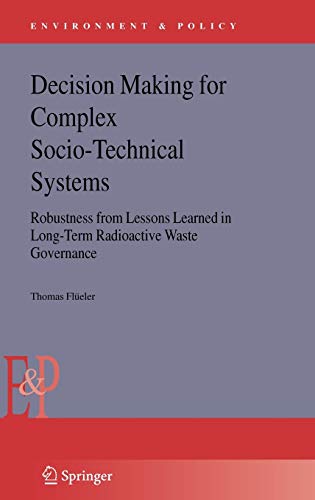
Inhaltsangabe
Waste management can be considered as a mirror of society. In its (our) fluctuating definition, besides conserving a supply of valuable materials and resources, it acts as a fascinating expression for our throw-away mentality. Waste is inevitable, but it nevertheless provides an opportunity, a need and an incentive for society to pursue a more careful management of it. If this is successfully carried out, society may well find it possible to manage itself in an overall more careful and universal way. The management, or governance, of radioactive waste particularly is determined by a complex constellation of individuals, social aggregates, and institutions. A wealth of interconnected parts forms a complex and volatile system that is highly technical and explosively political in nature. The problems inherent in this system must be managed so as to reach a safe, acceptable, responsible, feasible, and sustainable “solution”. It is a system with an objective long-term dimension, with a hazard potential of, in part, hundreds of thousands of years; and it has a long-term institutional dimension insofar as its implementation must last for decades. The very notion of risk extends from the long life of radionuclides, over the perception of dread to the decisional risk of whether, when and how to implement an agreed upon “solution”.
Die Inhaltsangabe kann sich auf eine andere Ausgabe dieses Titels beziehen.
Von der hinteren Coverseite
The long-term governance of radioactive waste continues to be a major complex and contentious socio-technical issue worldwide. Traditionally, it has been considered as mainly a challenge to scientists and engineers to develop technical "solutions" to specific problems. But increasingly these narrow solutions have been enlarged by wider societal considerations such as ethics, public involvement, control and retrievability – needs that have in the meanwhile been recognised by the nuclear community, at least in a general way. In this book, we analyse motives for a broad discourse as well as suggest prerequisites to launch it. The author attempts to give a novel, empirically based and technically sound treatment of fundamental issues in long-term management and governance. Written to be accessible to a wide selection of the interested public, the study proposes a combination of technical design issues, analysis methods and institutional backup in a dynamic procedure, and with involvement at all levels of political, commercial and social life.
„Über diesen Titel“ kann sich auf eine andere Ausgabe dieses Titels beziehen.
Suchergebnisse für Decision Making for Complex Socio-Technical Systems:...

Beispielbild für diese ISBN
Decision Making For Complex Socio-technical Systems
Anbieter: Romtrade Corp., STERLING HEIGHTS, MI, USA
Verkäuferbewertung 5 von 5 Sternen

Zustand: New. This is a Brand-new US Edition. This Item may be shipped from US or any other country as we have multiple locations worldwide. Artikel-Nr. ABBB-154854
Beispielbild für diese ISBN
Decision Making for Complex Socio-Technical Systems: Robustness from Lessons Learned in Long-Term Radioactive Waste Governance (Environment & Policy, 42)
Anbieter: Ria Christie Collections, Uxbridge, Vereinigtes Königreich
Verkäuferbewertung 5 von 5 Sternen
Zustand: New. In English. Artikel-Nr. ria9781402034800_new
Neu kaufen
EUR 182,44
EUR 13,17 Versand
Versand von Vereinigtes Königreich nach USA
Versand von Vereinigtes Königreich nach USA
Anzahl: Mehr als 20 verfügbar
Foto des Verkäufers
Decision Making for Complex Socio-Technical Systems : Robustness from Lessons Learned in Long-Term Radioactive Waste Governance
Anbieter: AHA-BUCH GmbH, Einbeck, Deutschland
Verkäuferbewertung 5 von 5 Sternen
Buch. Zustand: Neu. Druck auf Anfrage Neuware - Printed after ordering - Waste management can be considered as a mirror of society. In its (our) fluctuating definition, besides conserving a supply of valuable materials and resources, it acts as a fascinating expression for our throw-away mentality. Waste is inevitable, but it nevertheless provides an opportunity, a need and an incentive for society to pursue a more careful management of it. If this is successfully carried out, society may well find it possible to manage itself in an overall more careful and universal way. The management, or governance, of radioactive waste particularly is determined by a complex constellation of individuals, social aggregates, and institutions. A wealth of interconnected parts forms a complex and volatile system that is highly technical and explosively political in nature. The problems inherent in this system must be managed so as to reach a safe, acceptable, responsible, feasible, and sustainable 'solution'. It is a system with an objective long-term dimension, with a hazard potential of, in part, hundreds of thousands of years; and it has a long-term institutional dimension insofar as its implementation must last for decades. The very notion of risk extends from the long life of radionuclides, over the perception of dread to the decisional risk of whether, when and how to implement an agreed upon 'solution'. Artikel-Nr. 9781402034800
Neu kaufen
EUR 174,36
EUR 35,00 Versand
Versand von Deutschland nach USA
Versand von Deutschland nach USA
Anzahl: 1 verfügbar
Foto des Verkäufers
Decision Making for Complex Socio-Technical Systems: Robustness from Lessons Learned in Long-Term Radioactive Waste Governance (Environment & Policy, 42, Band 42)
Anbieter: Studibuch, Stuttgart, Deutschland
Verkäuferbewertung 5 von 5 Sternen
hardcover. Zustand: Gut. 384 Seiten; 9781402034800.3 Gewicht in Gramm: 1. Artikel-Nr. 1440858
Gebraucht kaufen
EUR 147,51
EUR 62,30 Versand
Versand von Deutschland nach USA
Versand von Deutschland nach USA
Anzahl: 1 verfügbar
Beispielbild für diese ISBN
Decision Making for Complex Socio-Technical Systems
Anbieter: Majestic Books, Hounslow, Vereinigtes Königreich
Verkäuferbewertung 4 von 5 Sternen

Zustand: Used. pp. 392 52:B&W 6.14 x 9.21in or 234 x 156mm (Royal 8vo) Case Laminate on White w/Gloss Lam. Artikel-Nr. 5857733
Gebraucht kaufen
EUR 211,55
EUR 7,58 Versand
Versand von Vereinigtes Königreich nach USA
Versand von Vereinigtes Königreich nach USA
Anzahl: 1 verfügbar
Beispielbild für diese ISBN
Decision Making for Complex Socio-Technical Systems
Anbieter: Biblios, Frankfurt am main, HESSE, Deutschland
Verkäuferbewertung 4 von 5 Sternen
Zustand: Used. pp. 392. Artikel-Nr. 183071504
Gebraucht kaufen
EUR 209,95
EUR 9,95 Versand
Versand von Deutschland nach USA
Versand von Deutschland nach USA
Anzahl: 1 verfügbar
Beispielbild für diese ISBN
Decision Making for Complex Socio-Technical Systems: Robustness from Lessons Learned in Long-Term Radioactive Waste Governance (Environment & Policy, 42, Band 42) Thomas Flüeler
Anbieter: BUCHSERVICE / ANTIQUARIAT Lars Lutzer, Wahlstedt, Deutschland
Verkäuferbewertung 5 von 5 Sternen
Zustand: gut. 2005. Decision Making for Complex Socio-Technical Systems: Robustness from Lessons Learned in Long-Term Radioactive Waste Governance (Environment & Policy, 42, Band 42) In englischer Sprache. pages. Artikel-Nr. BN676870
Gebraucht kaufen
EUR 479,90
EUR 39,95 Versand
Versand von Deutschland nach USA
Versand von Deutschland nach USA
Anzahl: 1 verfügbar