
Verwandte Artikel zu Problems of Fracture Mechanics and Fatigue: A Solution...
Inhaltsangabe
On Fracture Mechanics A major objective of engineering design is the determination of the geometry and dimensions of machine or structural elements and the selection of material in such a way that the elements perform their operating function in an efficient, safe and economic manner. For this reason the results of stress analysis are coupled with an appropriate failure criterion. Traditional failure criteria based on maximum stress, strain or energy density cannot adequately explain many structural failures that occurred at stress levels considerably lower than the ultimate strength of the material. On the other hand, experiments performed by Griffith in 1921 on glass fibers led to the conclusion that the strength of real materials is much smaller, typically by two orders of magnitude, than the theoretical strength. The discipline of fracture mechanics has been created in an effort to explain these phenomena. It is based on the realistic assumption that all materials contain crack-like defects from which failure initiates. Defects can exist in a material due to its composition, as second-phase particles, debonds in composites, etc. , they can be introduced into a structure during fabrication, as welds, or can be created during the service life of a component like fatigue, environment-assisted or creep cracks. Fracture mechanics studies the loading-bearing capacity of structures in the presence of initial defects. A dominant crack is usually assumed to exist.
Die Inhaltsangabe kann sich auf eine andere Ausgabe dieses Titels beziehen.
Suchergebnisse für Problems of Fracture Mechanics and Fatigue: A Solution...

Foto des Verkäufers
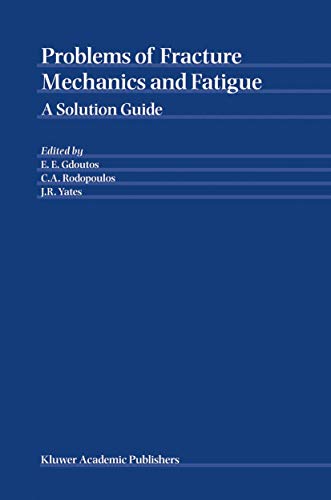
Problems of Fracture Mechanics and Fatigue: A Solution Guide
Verlag:
Kluwer Academic Publishers, 2003
ISBN 10: 1402017596
ISBN 13: 9781402017599
Gebraucht
Hardcover
Anbieter: Antiquariat Bernhardt, Kassel, Deutschland
Verkäuferbewertung 5 von 5 Sternen

Zustand: Sehr gut. Mit Abbildungen, XXIV, 618 S. Zust: Gutes Exemplar. Schneller Versand und persönlicher Service - jedes Buch händisch geprüft und beschrieben - aus unserem Familienbetrieb seit über 25 Jahren. Eine Rechnung mit ausgewiesener Mehrwertsteuer liegt jeder unserer Lieferungen bei. Wir versenden mit der deutschen Post. Sprache: Englisch Gewicht in Gramm: 1140 gebundene Ausgabe gebundene Ausgabe. Artikel-Nr. 488949
Gebraucht kaufen
EUR 108,06
EUR 49,90 Versand
Versand von Deutschland nach USA
Versand von Deutschland nach USA
Anzahl: 1 verfügbar
Beispielbild für diese ISBN
Problems of Fracture Mechanics and Fatigue: A Solution Guide
Anbieter: Ria Christie Collections, Uxbridge, Vereinigtes Königreich
Verkäuferbewertung 5 von 5 Sternen
Zustand: New. In English. Artikel-Nr. ria9781402017599_new
Neu kaufen
EUR 184,50
EUR 17,63 Versand
Versand von Vereinigtes Königreich nach USA
Versand von Vereinigtes Königreich nach USA
Anzahl: Mehr als 20 verfügbar
Foto des Verkäufers
Problems of Fracture Mechanics and Fatigue : A Solution Guide
Anbieter: AHA-BUCH GmbH, Einbeck, Deutschland
Verkäuferbewertung 5 von 5 Sternen
Buch. Zustand: Neu. Druck auf Anfrage Neuware - Printed after ordering - On Fracture Mechanics A major objective of engineering design is the determination of the geometry and dimensions of machine or structural elements and the selection of material in such a way that the elements perform their operating function in an efficient, safe and economic manner. For this reason the results of stress analysis are coupled with an appropriate failure criterion. Traditional failure criteria based on maximum stress, strain or energy density cannot adequately explain many structural failures that occurred at stress levels considerably lower than the ultimate strength of the material. On the other hand, experiments performed by Griffith in 1921 on glass fibers led to the conclusion that the strength of real materials is much smaller, typically by two orders of magnitude, than the theoretical strength. The discipline of fracture mechanics has been created in an effort to explain these phenomena. It is based on the realistic assumption that all materials contain crack-like defects from which failure initiates. Defects can exist in a material due to its composition, as second-phase particles, debonds in composites, etc. , they can be introduced into a structure during fabrication, as welds, or can be created during the service life of a component like fatigue, environment-assisted or creep cracks. Fracture mechanics studies the loading-bearing capacity of structures in the presence of initial defects. A dominant crack is usually assumed to exist. Artikel-Nr. 9781402017599
Neu kaufen
EUR 183,45
EUR 42,53 Versand
Versand von Deutschland nach USA
Versand von Deutschland nach USA
Anzahl: 1 verfügbar
Beispielbild für diese ISBN
Problems of Fracture Mechanics and Fatigue: A Solution Guide Gdoutos, E. E., C. A. Rodopoulos and J. R. Yates
Verlag:
Kluwer Academic Publishers, 2003
ISBN 10: 1402017596
ISBN 13: 9781402017599
Gebraucht
Hardcover
Anbieter: BUCHSERVICE / ANTIQUARIAT Lars Lutzer, Wahlstedt, Deutschland
Verkäuferbewertung 5 von 5 Sternen
Zustand: gut. 2003. Problems of Fracture Mechanics and Fatigue: A Solution Guide In englischer Sprache. pages. Artikel-Nr. BN472037
Gebraucht kaufen
EUR 359,90
EUR 39,95 Versand
Versand von Deutschland nach USA
Versand von Deutschland nach USA
Anzahl: 1 verfügbar