
Verwandte Artikel zu Analyzing Rational Crime ― Models and Methods...
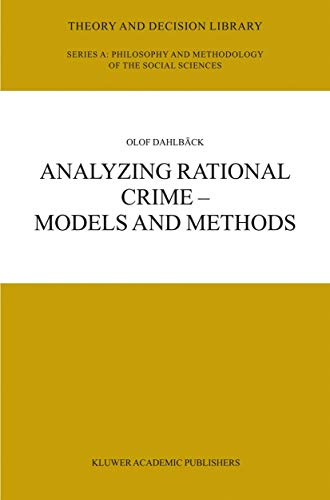
Analyzing Rational Crime ― Models and Methods (Theory and Decision Library A:, 36, Band 36) - Hardcover
Inhaltsangabe
Olof Dahlbäck's book breaks new ground for the analysis of crime from a rationality perspective by presenting models and methods that go far beyond those with which researchers have hitherto been equipped. The book examines single crimes, individual criminality, and societal crime, and it discusses thoroughly the general decision theoretical presuppositions necessary for analyzing these various types of crime. An expected utility maximization model for a single discrete choice regarding the commission of a crime is the foundation of most of the analyses presented. A version of this model is developed that permits interpersonal comparisons, and this basic model is used when deriving more complex models of crime as well as when analyzing the potential for such derivations. The rigorous, powerful methods suggested provide considerable opportunities for improving research and for seeing old problems in a new light.
Die Inhaltsangabe kann sich auf eine andere Ausgabe dieses Titels beziehen.
Suchergebnisse für Analyzing Rational Crime ― Models and Methods...

Beispielbild für diese ISBN
Analyzing Rational Crime ? Models and Methods (Theory and Decision Library A:, 36)
Anbieter: Ria Christie Collections, Uxbridge, Vereinigtes Königreich
Verkäuferbewertung 5 von 5 Sternen

Zustand: New. In English. Artikel-Nr. ria9781402016578_new
Neu kaufen
EUR 116,52
EUR 13,18 Versand
Versand von Vereinigtes Königreich nach USA
Versand von Vereinigtes Königreich nach USA
Anzahl: Mehr als 20 verfügbar
Beispielbild für diese ISBN
Analyzing Rational Crime
Anbieter: Kennys Bookstore, Olney, MD, USA
Verkäuferbewertung 5 von 5 Sternen
Zustand: New. Examines single crimes, individual criminality, and societal crime. This book discusses the general decision theoretical presuppositions necessary for analyzing these various types of crime. An expected utility maximization model for a single discrete choice regarding the commission of a crime is the foundation of most of the analyses presented. Series: Theory and Decision Library A:. Num Pages: 218 pages, biography. BIC Classification: JKV; JMM. Category: (P) Professional & Vocational. Dimension: 297 x 210 x 14. Weight in Grams: 504. . 2003. Hardback. . . . . Books ship from the US and Ireland. Artikel-Nr. V9781402016578
Neu kaufen
EUR 167,47
EUR 9,10 Versand
Versand innerhalb von USA
Versand innerhalb von USA
Anzahl: 15 verfügbar
Foto des Verkäufers
Analyzing Rational Crime - Models and Methods
Anbieter: AHA-BUCH GmbH, Einbeck, Deutschland
Verkäuferbewertung 5 von 5 Sternen
Buch. Zustand: Neu. Druck auf Anfrage Neuware - Printed after ordering - Olof Dahlbäck's book breaks new ground for the analysis of crime from a rationality perspective by presenting models and methods that go far beyond those with which researchers have hitherto been equipped. The book examines single crimes, individual criminality, and societal crime, and it discusses thoroughly the general decision theoretical presuppositions necessary for analyzing these various types of crime. An expected utility maximization model for a single discrete choice regarding the commission of a crime is the foundation of most of the analyses presented. A version of this model is developed that permits interpersonal comparisons, and this basic model is used when deriving more complex models of crime as well as when analyzing the potential for such derivations. The rigorous, powerful methods suggested provide considerable opportunities for improving research and for seeing old problems in a new light. Artikel-Nr. 9781402016578
Neu kaufen
EUR 151,73
EUR 30,50 Versand
Versand von Deutschland nach USA
Versand von Deutschland nach USA
Anzahl: 1 verfügbar