
Verwandte Artikel zu Economy―Energy―Environment Simulation:...
Economy―Energy―Environment Simulation: Beyond the Kyoto Protocol (Economy & Environment, 20, Band 20) - Hardcover
Inhaltsangabe
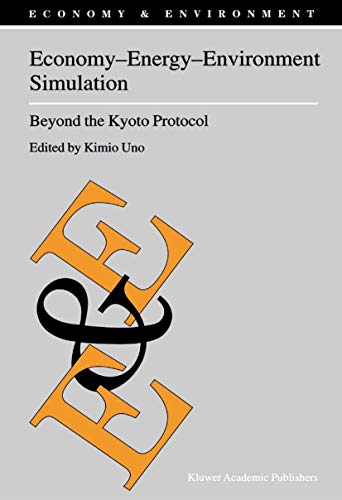
In the policy arena, as well as in the academic world, a new challenge is having to deal with the global community. We are increasingly aware that the world is linked through economy–energy–environment interactions. We are increasingly aware, at the same time, that the emergence of the global community does not imply an integrated harmonious world; rather, it is a community where co- tries/regions of different interests and values face each other directly. Global governance has to be achieved through actions of national governments under different motives and constraints. We need to have an analytical tool that is capable of producing a global picture, yet with detailed country resolution. If the world is a better place now compared to 100 years ago in terms of p- capita income, this is due to the industrialization that continued throughout the 20th century. We entered the 21st century knowing that the human aspiration that translates into ever-increasing production may not be tenable in the long run. Sustainability of the global community is at stake. In contrast to inc- mental decision making through the market mechanism that should lead to some optimal state under some assumptions such as perfect knowledge, smooth movement of resources, no externalities, and so forth, we need to have an a- lytical tool to provide us with details of the future state of the world.
Die Inhaltsangabe kann sich auf eine andere Ausgabe dieses Titels beziehen.
Suchergebnisse für Economy―Energy―Environment Simulation:...

Beispielbild für diese ISBN
ECONOMY - ENERGY - ENVIRONMENT SIMULATION: BEYOND THE KYOTO PROTOCOL.
Verlag:
Kluwer,, Dordrecht,, 2002
ISBN 10: 1402004508
ISBN 13: 9781402004506
Gebraucht
Hardcover
Erstausgabe
Anbieter: Burwood Books, Wickham Market, Vereinigtes Königreich
Verkäuferbewertung 5 von 5 Sternen

Hardback. Zustand: Fine. First Edition. Hardback. 8vo. pp ix, 339. Original publishers printed laminated boards. tables. ISBN: 1402004508 Fine. Artikel-Nr. A72598
Gebraucht kaufen
EUR 72,07
EUR 26,24 Versand
Versand von Vereinigtes Königreich nach USA
Versand von Vereinigtes Königreich nach USA
Anzahl: 1 verfügbar
Beispielbild für diese ISBN
Economy - Energy - Environment Simulation: Beyond the Kyoto Protocol
Verlag:
Kluwer Academic Publishers, 2002
ISBN 10: 1402004508
ISBN 13: 9781402004506
Gebraucht
Hardcover
Anbieter: Fireside Bookshop, Stroud, GLOS, Vereinigtes Königreich
Verkäuferbewertung 5 von 5 Sternen
Cloth/Laminated Boards. Zustand: Like New. Type: Book 339pp.The volume is based on a policy simulation model linking sixty countries and regions at a detailed industrial level, covering 99.5 per cent of the world's economic activities. Country models are linked by trade matrices that explicitly describe annual trade flow among world regions. Energy demand and supply is explained in response to changing prices reflecting emission trading and other market-oriented policy instruments. The impact on global environment is gauged through CO2 emission. Simulation results to 2010 with an explicit description of economy-energy-environment feedback under different scenarios serve as an open platform for policy debate. Comparisons with results from other research works are provided, together with methodological comparisons. An annotated bibliography is also included. Artikel-Nr. 014785
Gebraucht kaufen
EUR 84,08
EUR 29,15 Versand
Versand von Vereinigtes Königreich nach USA
Versand von Vereinigtes Königreich nach USA
Anzahl: 1 verfügbar
Beispielbild für diese ISBN
Economy?Energy?Environment Simulation: Beyond the Kyoto Protocol (Economy & Environment, 20)
Anbieter: Ria Christie Collections, Uxbridge, Vereinigtes Königreich
Verkäuferbewertung 5 von 5 Sternen
Zustand: New. In English. Artikel-Nr. ria9781402004506_new
Neu kaufen
EUR 165,57
EUR 13,17 Versand
Versand von Vereinigtes Königreich nach USA
Versand von Vereinigtes Königreich nach USA
Anzahl: Mehr als 20 verfügbar
Foto des Verkäufers
Economy-Energy-Environment Simulation
Anbieter: moluna, Greven, Deutschland
Verkäuferbewertung 5 von 5 Sternen
Gebunden. Zustand: New. Artikel-Nr. 4091857
Neu kaufen
EUR 136,16
EUR 48,99 Versand
Versand von Deutschland nach USA
Versand von Deutschland nach USA
Anzahl: Mehr als 20 verfügbar
Foto des Verkäufers
Economy-Energy-Environment Simulation : Beyond the Kyoto Protocol
Anbieter: AHA-BUCH GmbH, Einbeck, Deutschland
Verkäuferbewertung 5 von 5 Sternen
Buch. Zustand: Neu. Druck auf Anfrage Neuware - Printed after ordering - In the policy arena, as well as in the academic world, a new challenge is having to deal with the global community. We are increasingly aware that the world is linked through economy-energy-environment interactions. We are increasingly aware, at the same time, that the emergence of the global community does not imply an integrated harmonious world; rather, it is a community where co- tries/regions of different interests and values face each other directly. Global governance has to be achieved through actions of national governments under different motives and constraints. We need to have an analytical tool that is capable of producing a global picture, yet with detailed country resolution. If the world is a better place now compared to 100 years ago in terms of p- capita income, this is due to the industrialization that continued throughout the 20th century. We entered the 21st century knowing that the human aspiration that translates into ever-increasing production may not be tenable in the long run. Sustainability of the global community is at stake. In contrast to inc- mental decision making through the market mechanism that should lead to some optimal state under some assumptions such as perfect knowledge, smooth movement of resources, no externalities, and so forth, we need to have an a- lytical tool to provide us with details of the future state of the world. Artikel-Nr. 9781402004506
Neu kaufen
EUR 230,74
EUR 30,50 Versand
Versand von Deutschland nach USA
Versand von Deutschland nach USA
Anzahl: 1 verfügbar
Beispielbild für diese ISBN
Economy, Energy, Environment Simulation
Anbieter: Kennys Bookstore, Olney, MD, USA
Verkäuferbewertung 5 von 5 Sternen
Zustand: New. Based on a policy simulation model linking sixty countries and regions at an industrial level. Country models are linked by trade matrices that describe annual trade flow among world regions. Energy demand and supply is explained in response to prices reflecting emission trading and other market-oriented policy instruments. Editor(s): Uno, Kimio. Series: Economy and Environment. Num Pages: 351 pages, 27 black & white illustrations, biography. BIC Classification: KCN. Category: (P) Professional & Vocational; (UP) Postgraduate, Research & Scholarly; (UU) Undergraduate. Dimension: 235 x 155 x 20. Weight in Grams: 675. . 2002. annotated ed. Hardback. . . . . Books ship from the US and Ireland. Artikel-Nr. V9781402004506
Neu kaufen
EUR 255,17
EUR 9,14 Versand
Versand innerhalb von USA
Versand innerhalb von USA
Anzahl: 15 verfügbar