
Verwandte Artikel zu Red Azalea: A Memoir
Inhaltsangabe
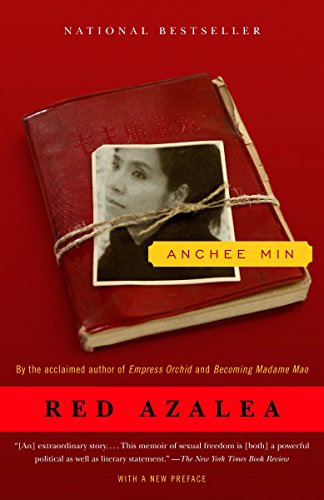
A revelatory and disturbing portrait of China, this is Anchee Min’s celebrated memoir of growing up in the last years of Mao’s China. As a child, Min was asked to publicly humiliate a teacher; at seventeen, she was sent to work at a labor collective. Forbidden to speak, dress, read, write, or love as she pleased, she found a lifeline in a secret love affair with another woman. Miraculously selected for the film version of one of Madame Mao’s political operas, Min’s life changed overnight. Then Chairman Mao suddenly died, taking with him an entire world. This national bestseller and New York Times Notable Book is exceptional for its candor, its poignancy, its courage, and for its prose which Newsweek calls "as delicate and evocative as a traditional Chinese brush painting."
Die Inhaltsangabe kann sich auf eine andere Ausgabe dieses Titels beziehen.
Über die Autorin bzw. den Autor
Anchee Min was born in Shanghai in 1957. At seventeen she was sent to a labor collective, where a talent scout for Madame Mao's Shanghai Film Studio recruited her to work as a movie actress. She came to the United States in 1984 with the help of actress Joan Chen. Her memoir, Red Azalea, won the Carl Sandburg Literary Award in 1993 and was named a New York Times Notable Book in 1994. Other works from Min include Becoming Madame Mao, Empress Orchid, Katherine, and Wild Ginger
Auszug. © Genehmigter Nachdruck. Alle Rechte vorbehalten.
Part OneI was raised on the teachings of Mao and on the operas of Madam Mao, Comrade Jiang Ching. I became a leader of the Little Red Guards in elementary school. This was during the Great Proletarian Cultural Revolution when red was my color. My parents lived like--as the neighbors described them--a pair of chopsticks: always in harmony My father was an instructor of industrial technique drawing at Shanghai Textile Institute, although his true love was astronomy. My mother was a teacher at a Shanghai middle school. She taught whatever the Party asked, one semester in Chinese and the next in Russian. My parents both believed in Mao and the Communist Party, just like everybody else in the neighborhood. They had four children, each one a year apart. I was born in 1957. We lived in the city, on South Luxuriant Road in a small two-story townhouse occupied by two families. The house was left by my grandfather, who had died of tuberculosis right before I was born.I was an adult since the age of five. That was nothing unusual. The kids I played with all carried their family's little ones on their backs, tied with a piece of cloth. The little ones played with their own snot while we played hide-and-seek. I was put in charge of managing the family because my parents were in their working units all day, just like everyone else's parents.I called my sisters and brother my children because I had to pick each one of them up from kindergarten and nursery school while I myself was only a kindergartner. I was six when my sister Blooming was five, my second sister Coral was four and my brother Space Conqueror was three. My parents made careful choices in the names they gave us, They were considered eccentric because the neighbors named their children Guard of Red, Big Leap, Long March, Red Star, Liberation, Revolution, New China, Road of Russia, Resist U.S., Patriotic Forerunner, Matchless Red Soldier, etc. My parents had their own ideas. First they called me Lin-Shuan--Rising Sun at a Mountain. They dropped it because Mao was considered the only sun. After further contemplation, they named me Anchee--Jade of Peace. Also, it sounded like the Chinese pronunciation of the English word "angel." They registered me with it. Blooming and Coral were named after the sound of chee (jade). There were two reasons why my parents named my brother Space Conqueror: one was that my father loved astronomy; the second was to respond to Mao's call that China would soon build its own spaceship.As I understood it, my parents were doing work that was saving the world. Every evening I would pick up the children and fight with the kids on the block all the way home. It was like eating a regular meal that I got a purple cheek or a bloody nose. It did not bother me too much. Although I was scared of crossing at traffic lights and dark alleys, I learned to not show my fear, because I had to be a model for the children, to show them what bravery meant. After I arranged for the children to play by themselves in the living room, I went to set up the stove to cook dinner. It always took me a long time to light the stove, because I did not understand that wood and coals needed air to burn. I stuffed the stove as I sang songs of Mao quotations. One time, when I tried many times and the stove would not light, I lost my patience. I went out to play, thinking that the stove was not burning. Then a kid came and told me that there was smoke coming out of our house window. This happened three times.I tried to put the children to sleep while the sky was still bright. The children's little feet kicked the cotton blankets and made new holes over the old. The blankets soon became rags. When the room quieted down, I would lean on the windowsill staring at the entrance to the lane, waiting for my parents to appear. I watched the sky turn deep blue, Venus rising, and I would fall asleep by the window.In 1967, when I was ten years old, we moved. It was because our downstairs neighbor accused us of having a bigger space than they had. They said, How can a family of six occupy four rooms while a family of eleven has only one? The revolution is about fairness. They came up with chamber pots and poured shit on our blankets. There were no police. The police station was called a revisionist mechanism and had been shut down by the revolutionaries. The Red Guards had begun looting houses. No one answered our call for help. The neighbors just watched.The downstairs neighbor kept bothering us. We cleaned the shit night after night, swallowed insults in meek submission. The downstairs family became uncontrollable. They threatened to harm us children when our parents were not at home. They said their second daughter had a history of mental illness. Therefore, they could not be responsible for what she was going to do. The second daughter came up and showed me an ax that she had just sharpened. She said she could chop my head in two like chopping a watermelon. She asked me if I would like her to do it. I said, You wait here and I'll tell you whether I would like it or not later. I grabbed my sisters and brother and we ran and squeezed ourselves in a closet all day.One day when my mother stepped into the door after work, the second daughter jumped on her. I saw them wrestle into the stairwell. Mother was pushed, crushed on the floor, and was slashed with the scissors. I was in shock. I stood right next to my mother and saw blood pouring down her face and wrists. I wanted to scream but I had no voice. The second daughter went downstairs and cut her own wrists with the scissors. She then rushed to a curious crowd outside the door, bloody hands raised high in the air. She shouted, Look at me. I am a worker who was attacked by a bourgeois intellectual. Comrades, this is a political murder. Her family members came out. They shouted, A debt of blood must be paid by blood.My father said we must move. We must escape. He wrote little notes describing our house and what he would like in exchange. He stuck the notes on the tree trunks by the streets. The next day a truck arrived by our door loaded full with furniture. Five men got out of the truck and said they came to exchange their house with ours. My father said we hadn't looked around for our choice yet. The men said, Our house is a perfect one for you and it's ready for you to move in. My father said we didn't know what it looked like. The men said, Go and take a look at it now, you will like it. My father asked how many rooms. They said three, very nice, Shanghai standard. My mother said, Do you know that our downstairs neighbor's second daughter is mentally ill? The men said it would not be a problem. They said that they had just beaten the second daughter, and she confessed that she was normal and that her family just wanted to have more rooms. She had promised to cause no trouble in the future. The men said they were a father and sons, all workers at a Shanghai steel factory. The sons needed rooms to get married. They wanted the rooms in a hurry. My father said, Please let us think about it. The men said, We'll wait outside your door while you make up your mind. My father said, You can't do that. The men said, No problem. My parents decided to take a look at the men's house on Shanxi Road.I was asked to guard the house while my parents were gone. I was doing my homework when I saw the men start to unload their furniture. After that they began to move our furniture. I went up to them and said, My parents aren't back yet. The men said they would like to help us while they still had the truck. There's nowhere you can borrow such a truck by the time you think you're ready to move, they said. Are you going to move all this stuff with your bare little hands?When my parents got back, most of our furniture was packed on their truck. My mother said, This is not what I want, you can't force us to move. The men said, We're workers, we don't play mind games. You advertised,...
„Über diesen Titel“ kann sich auf eine andere Ausgabe dieses Titels beziehen.
Suchergebnisse für Red Azalea: A Memoir

Beispielbild für diese ISBN
Red Azalea: A Memoir
Anbieter: World of Books (was SecondSale), Montgomery, IL, USA
Verkäuferbewertung 5 von 5 Sternen

Paperback. Zustand: Good. A revelatory and disturbing portrait of China, this is Anchee Min's celebrated memoir of growing up in the last years of Mao's China. As a child, Min was asked to publicly humiliate a teacher; at seventeen, she was sent to work at a labor collective. Forbidden to speak, dress, read, write, or love as she pleased, she found a lifeline in a secret love affair with another woman. Miraculously selected for the film version of one of Madame Mao's political operas, Min's life changed overnight. Then Chairman Mao suddenly died, taking with him an entire world. This national bestseller and New York Times Notable Book is exceptional for its candor, its poignancy, its courage, and for its prose which Newsweek calls "as delicate and evocative as a traditional Chinese brush painting.". Artikel-Nr. 00097051331
Gebraucht kaufen
EUR 3,88
Versand gratis
Versand innerhalb von USA
Versand innerhalb von USA
Anzahl: 20 verfügbar
Beispielbild für diese ISBN
Red Azalea: A Memoir
Anbieter: World of Books (was SecondSale), Montgomery, IL, USA
Verkäuferbewertung 5 von 5 Sternen
Paperback. Zustand: Very Good. A revelatory and disturbing portrait of China, this is Anchee Min's celebrated memoir of growing up in the last years of Mao's China. As a child, Min was asked to publicly humiliate a teacher; at seventeen, she was sent to work at a labor collective. Forbidden to speak, dress, read, write, or love as she pleased, she found a lifeline in a secret love affair with another woman. Miraculously selected for the film version of one of Madame Mao's political operas, Min's life changed overnight. Then Chairman Mao suddenly died, taking with him an entire world. This national bestseller and New York Times Notable Book is exceptional for its candor, its poignancy, its courage, and for its prose which Newsweek calls "as delicate and evocative as a traditional Chinese brush painting.". Artikel-Nr. 00102932833
Gebraucht kaufen
EUR 3,88
Versand gratis
Versand innerhalb von USA
Versand innerhalb von USA
Anzahl: 3 verfügbar
Beispielbild für diese ISBN
Red Azalea: A Memoir
Anbieter: World of Books (was SecondSale), Montgomery, IL, USA
Verkäuferbewertung 5 von 5 Sternen
Paperback. Zustand: Fair. A revelatory and disturbing portrait of China, this is Anchee Min's celebrated memoir of growing up in the last years of Mao's China. As a child, Min was asked to publicly humiliate a teacher; at seventeen, she was sent to work at a labor collective. Forbidden to speak, dress, read, write, or love as she pleased, she found a lifeline in a secret love affair with another woman. Miraculously selected for the film version of one of Madame Mao's political operas, Min's life changed overnight. Then Chairman Mao suddenly died, taking with him an entire world. This national bestseller and New York Times Notable Book is exceptional for its candor, its poignancy, its courage, and for its prose which Newsweek calls "as delicate and evocative as a traditional Chinese brush painting.". Artikel-Nr. 00068684288
Gebraucht kaufen
EUR 3,88
Versand gratis
Versand innerhalb von USA
Versand innerhalb von USA
Anzahl: 3 verfügbar
Beispielbild für diese ISBN
Red Azalea: A Memoir
Verlag:
Anchor (edition Reprint), 2006
ISBN 10: 1400096987
ISBN 13: 9781400096985
Gebraucht
Paperback
Anbieter: BooksRun, Philadelphia, PA, USA
Verkäuferbewertung 5 von 5 Sternen
Paperback. Zustand: Fair. Reprint. The item might be beaten up but readable. May contain markings or highlighting, as well as stains, bent corners, or any other major defect, but the text is not obscured in any way. Artikel-Nr. 1400096987-7-1
Gebraucht kaufen
EUR 4,49
Versand gratis
Versand innerhalb von USA
Versand innerhalb von USA
Anzahl: 1 verfügbar
Beispielbild für diese ISBN
Red Azalea : A Memoir
Verlag:
Knopf Doubleday Publishing Group, 2006
ISBN 10: 1400096987
ISBN 13: 9781400096985
Gebraucht
Softcover
Anbieter: Better World Books, Mishawaka, IN, USA
Verkäuferbewertung 5 von 5 Sternen
Zustand: Very Good. azalea Edition. Pages intact with possible writing/highlighting. Binding strong with minor wear. Dust jackets/supplements may not be included. Stock photo provided. Product includes identifying sticker. Better World Books: Buy Books. Do Good. Artikel-Nr. 4589079-6
Gebraucht kaufen
EUR 6,21
Versand gratis
Versand innerhalb von USA
Versand innerhalb von USA
Anzahl: 1 verfügbar
Beispielbild für diese ISBN
Red Azalea : A Memoir
Verlag:
Knopf Doubleday Publishing Group, 2006
ISBN 10: 1400096987
ISBN 13: 9781400096985
Gebraucht
Softcover
Anbieter: Better World Books: West, Reno, NV, USA
Verkäuferbewertung 5 von 5 Sternen
Zustand: Very Good. azalea Edition. Pages intact with possible writing/highlighting. Binding strong with minor wear. Dust jackets/supplements may not be included. Stock photo provided. Product includes identifying sticker. Better World Books: Buy Books. Do Good. Artikel-Nr. 4589079-6
Gebraucht kaufen
EUR 6,21
Versand gratis
Versand innerhalb von USA
Versand innerhalb von USA
Anzahl: 1 verfügbar
Beispielbild für diese ISBN
Red Azalea : A Memoir
Verlag:
Knopf Doubleday Publishing Group, 2006
ISBN 10: 1400096987
ISBN 13: 9781400096985
Gebraucht
Softcover
Anbieter: Better World Books, Mishawaka, IN, USA
Verkäuferbewertung 5 von 5 Sternen
Zustand: Good. azalea Edition. Pages intact with minimal writing/highlighting. The binding may be loose and creased. Dust jackets/supplements are not included. Stock photo provided. Product includes identifying sticker. Better World Books: Buy Books. Do Good. Artikel-Nr. 3974718-20
Gebraucht kaufen
EUR 6,21
Versand gratis
Versand innerhalb von USA
Versand innerhalb von USA
Anzahl: 3 verfügbar
Beispielbild für diese ISBN
Red Azalea: A Memoir
Anbieter: ThriftBooks-Atlanta, AUSTELL, GA, USA
Verkäuferbewertung 5 von 5 Sternen
Paperback. Zustand: Good. No Jacket. Pages can have notes/highlighting. Spine may show signs of wear. ~ ThriftBooks: Read More, Spend Less. Artikel-Nr. G1400096987I3N00
Gebraucht kaufen
EUR 6,34
Versand gratis
Versand innerhalb von USA
Versand innerhalb von USA
Anzahl: 1 verfügbar
Beispielbild für diese ISBN
Red Azalea: A Memoir
Anbieter: ThriftBooks-Atlanta, AUSTELL, GA, USA
Verkäuferbewertung 5 von 5 Sternen
Paperback. Zustand: Very Good. No Jacket. May have limited writing in cover pages. Pages are unmarked. ~ ThriftBooks: Read More, Spend Less. Artikel-Nr. G1400096987I4N00
Gebraucht kaufen
EUR 6,34
Versand gratis
Versand innerhalb von USA
Versand innerhalb von USA
Anzahl: 1 verfügbar
Beispielbild für diese ISBN
Red Azalea: A Memoir
Anbieter: ThriftBooks-Phoenix, Phoenix, AZ, USA
Verkäuferbewertung 5 von 5 Sternen
Paperback. Zustand: Very Good. No Jacket. May have limited writing in cover pages. Pages are unmarked. ~ ThriftBooks: Read More, Spend Less. Artikel-Nr. G1400096987I4N00
Gebraucht kaufen
EUR 6,34
Versand gratis
Versand innerhalb von USA
Versand innerhalb von USA
Anzahl: 1 verfügbar