
Verwandte Artikel zu Insectopedia: Ausgezeichnet: The Orion Book Award,...
Inhaltsangabe
A New York Times Notable Book
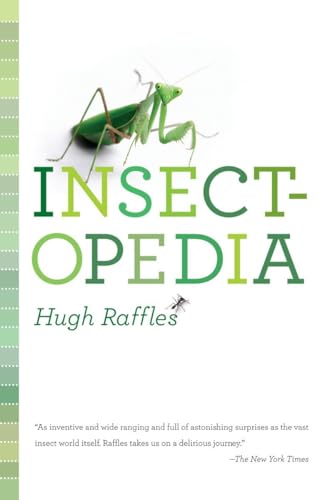
A stunningly original exploration of the ties that bind us to the beautiful, ancient, astoundingly accomplished, largely unknown, and unfathomably different species with whom we share the world.
For as long as humans have existed, insects have been our constant companions. Yet we hardly know them, not even the ones we’re closest to: those that eat our food, share our beds, and live in our homes. Organizing his book alphabetically, Hugh Raffles weaves together brief vignettes, meditations, and extended essays, taking the reader on a mesmerizing exploration of history and science, anthropology and travel, economics, philosophy, and popular culture. Insectopedia shows us how insects have triggered our obsessions, stirred our passions, and beguiled our imaginations.
Die Inhaltsangabe kann sich auf eine andere Ausgabe dieses Titels beziehen.
Über die Autorin bzw. den Autor
Hugh Raffles teaches anthropology at The New School. He is the author of In Amazonia: A Natural History, which received the Victor Turner Prize in Ethnographic Writing. His essays have appeared in Best American Essays, Granta, and Orion. Insectopedia is the recipient of a Special Award for Extending Ethnographic Understanding from the Society for Humanistic Anthropology. In 2009, he received a Whiting Writers’ Award. He lives in New York City.
Visit the author's website at: www.insectopedia.org.
Auszug. © Genehmigter Nachdruck. Alle Rechte vorbehalten.
Air
1.
On August 10, 1926, a Stinson Detroiter SM-1 six-seater monoplane took off from the rudimentary airstrip at Tallulah, Louisiana. The Detroiter was the first airplane built with an electric starter motor, wheel brakes, and a heated cabin, but it was not a good climber, so the pilot leveled off quickly, circled the airstrip and surrounding landscape, held open the specially fitted sticky trap beneath the plane's wing for the designated ten minutes, and soon returned to land. As he touched down, P. A. Glick and his colleagues at the Division of Cotton Insect Investigations of the U.S. Bureau of Entomology and Plant Quarantine ran out to meet him.
It was a historic flight: the first attempt to collect insects by airplane. Glick and his associates, as well as researchers at the Department of Agriculture and at regional organizations such as the New York State Museum, were trying to discover the migration secrets of gypsy moths, cotton bollworm moths, and other insects that were munching their way through the nation's natural resources. They wanted to predict infestations, to know what might happen next. How could they contain these insect enemies if they didn't know where, when, and how they traveled?
2.
Before Tallulah, high-altitude entomology had barely got off the ground. Researchers sent up balloons and kites fitted with hanging nets, climbed up pylons, and pestered lighthouse keepers and mountaineers. But armed now with the new airplane technology, Glick went down to Tlahualilo in Durango, Mexico. There, 3,000 feet above the valley plain, his pilots trapped the pink bollworm moth, a feared invader of the U.S. cotton crop. Face-to-face with the unanticipated scale of his task, Glick wrote tersely that "the pink bollworm moths are carried in the upper air currents for considerable distances."
There were only a few flies and wasps in that first trap at Tallulah. But over the next five years, the researchers flew more than 1,300 sorties from the Louisiana airstrip and captured tens of thousands more insects at altitudes ranging from 20 to 15,000 feet. They generated a long series of charts and tables, cataloguing individual insects of 700 named species according to the height at which they were collected, time of day, wind speed and direction, temperature, barometric pressure, humidity, dew point, and many other physical variables. They already knew something about long-distance dispersal. They had heard about the butterflies, gnats, water striders, leaf bugs, booklice, and katydids sighted hundreds of miles out on the open ocean; about the aphids that Captain William Parry had encountered on ice floes during his polar expedition of 1828; and about those other aphids that, in 1925, made the 800-mile journey across the frigid, windswept Barents Sea between the Kola Peninsula, in Russia, and Spitsbergen, off Norway, in just twenty-four hours. Still, they were taken aback by the enormous quantities of animals they were discovering in the air above Louisiana and unashamedly astonished by the heights at which they found them. All of a sudden, it seemed, the heavens had opened.
Unmoored, they turned to the ocean, began talking about the "aeroplankton" drifting in the vastness of the open skies. They told each other about tiny insects, some of them wingless, all with large surface-area-to-weight ratios, plucked from their earthly tethers by a sharp gust of wind, picked up on air currents and thrust high into the convection streams without volition or capacity for resistance, some terrible accident, carried great distances across oceans and continents, then dropped with the same fateful arbitrariness in a downdraft on some distant mountaintop or valley plain. They estimated that at any given time on any given day throughout the year, the air column rising from 50 to 14,000 feet above one square mile of Louisiana countryside contained an average of 25 million insects and perhaps as many as 36 million. They found ladybugs at 6,000 feet during the daytime, striped cucumber beetles at 3,000 feet during the night. They collected three scorpion flies at 5,000 feet, thirty-one fruit flies between 200 and 3,000, a fungus gnat at 7,000 and another at 10,000. They trapped an anthrax- transmitting horsefly at 200 feet and another at 1,000. They caught wingless worker ants as high as 4,000 feet and sixteen species of parasitic ichneumon wasps at altitudes up to 5,000 feet. At 15,000 feet, "probably the highest elevation at which any specimen has ever been taken above the surface of the earth," they trapped a ballooning spider, a feat that reminded Glick of spiders thought to have circumnavigated the globe on the trade winds and led him to write that "the young of most spiders are more or less addicted to this mode of transportation," an image of excited little animals packing their luggage that opened a small rupture in the consensus around the passivity of all this airborne movement and led to Glick's subsequent observation that ballooning spiders not only climb up to an exposed site (a twig or a flower, for instance), stand on tiptoe, raise their abdomen, test the atmosphere, throw out silk filaments, and launch themselves into the blue, all free legs spread-eagled, but that they also use their bodies and their silk to control their descent and the location of their landing. Thirty-six million little animals flying unseen above one square mile of countryside? The heavens opened. The air column was "a vault of insect-laden air" from which fell " a continuous rain."
3.
From the mid-1920s through the 1930s, high-altitude researchers in France, England, and the United States were making the same discoveries and coming to the same conclusions. Broadly speaking, they decided, there were two kinds of insect travel. The tiny insects of the aerial plankton occupied the air above 3,000 feet, where they moved involuntarily, unable to resist the fast-moving higher-level currents. Stronger-flying, larger insects kept relatively close to the ground, below the 3,000-feet boundary, harnessing the calmer, low-altitude winds and migrating according to their own routes and schedules. These lower- level migrations could be spectacular. Some, such as those of the monarch butterflies and the Old Testament locusts, were already familiar. Others could take an entomologist by surprise. All were somehow mysterious. In 1900, James William Tutt witnessed millions of noctuid Silver Y moths flying with other insects in a steady east-west line alongside migrating birds. A few years later, William Beebe from the New York Zoological Society-the same William Beebe who pioneered deep-sea exploration in his steel bathysphere-found himself caught in a dense mass of purplish-brown butterflies on the Portachuelo Pass in northern Venezuela. Despite his confusion, Beebe managed to calculate that at least 186,000 insects had swept by him in the first ninety minutes. An hour later, with the torrent now "going full strength," he composed himself enough to pull out his high-power binoculars:
I began about twenty-five feet overhead and then refocussed slowly upward until the limit of vision of the small insects was reached. This, judged by horizontal tests of objects of similar size would be about a half mile zenithwards, and at every fractional turn of the screw, more and more smaller-appearing butterflies fluttered into clarity.
Throughout the entire extent of verticality there was no lessening of denseness of flying insects. . . . For many days this particular phase of migration continued, millions upon millions coming from some unknown source, travelling due south to an equally mysterious destination.
Beebe also reported a different phenomenon: a steady stream of insects of many species-cockchafers, chrysomelid beetles, vespid wasps, bees, moths, butterflies, and "hosts upon hosts of minute winged insect...
„Über diesen Titel“ kann sich auf eine andere Ausgabe dieses Titels beziehen.
Suchergebnisse für Insectopedia: Ausgezeichnet: The Orion Book Award,...

Beispielbild für diese ISBN
Insectopedia
Anbieter: World of Books (was SecondSale), Montgomery, IL, USA
Verkäuferbewertung 5 von 5 Sternen

Paperback. Zustand: Very Good. A New York Times Notable Book A stunningly original exploration of the ties that bind us to the beautiful, ancient, astoundingly accomplished, largely unknown, and unfathomably different species with whom we share the world. For as long as humans have existed, insects have been our constant companions. Yet we hardly know them, not even the ones we're closest to: those that eat our food, share our beds, and live in our homes. Organizing his book alphabetically, Hugh Raffles weaves together brief vignettes, meditations, and extended essays, taking the reader on a mesmerizing exploration of history and science, anthropology and travel, economics, philosophy, and popular culture. Insectopedia shows us how insects have triggered our obsessions, stirred our passions, and beguiled our imaginations. Artikel-Nr. CIN1400096960VG
Gebraucht kaufen
EUR 3,83
Versand gratis
Versand innerhalb von USA
Versand innerhalb von USA
Anzahl: 1 verfügbar
Beispielbild für diese ISBN
Insectopedia
Anbieter: World of Books (was SecondSale), Montgomery, IL, USA
Verkäuferbewertung 5 von 5 Sternen
Paperback. Zustand: Good. A New York Times Notable Book A stunningly original exploration of the ties that bind us to the beautiful, ancient, astoundingly accomplished, largely unknown, and unfathomably different species with whom we share the world. For as long as humans have existed, insects have been our constant companions. Yet we hardly know them, not even the ones we're closest to: those that eat our food, share our beds, and live in our homes. Organizing his book alphabetically, Hugh Raffles weaves together brief vignettes, meditations, and extended essays, taking the reader on a mesmerizing exploration of history and science, anthropology and travel, economics, philosophy, and popular culture. Insectopedia shows us how insects have triggered our obsessions, stirred our passions, and beguiled our imaginations. Artikel-Nr. 00107582455
Gebraucht kaufen
EUR 3,83
Versand gratis
Versand innerhalb von USA
Versand innerhalb von USA
Anzahl: 3 verfügbar
Beispielbild für diese ISBN
Insectopedia
Verlag:
Knopf Doubleday Publishing Group, 2011
ISBN 10: 1400096960
ISBN 13: 9781400096961
Gebraucht
Softcover
Anbieter: Wonder Book, Frederick, MD, USA
Verkäuferbewertung 5 von 5 Sternen
Zustand: Very Good. Very Good condition. A copy that may have a few cosmetic defects. May also contain light spine creasing or a few markings such as an owner's name, short gifter's inscription or light stamp. Artikel-Nr. F12D-02414
Gebraucht kaufen
EUR 6,42
Versand gratis
Versand innerhalb von USA
Versand innerhalb von USA
Anzahl: 1 verfügbar
Beispielbild für diese ISBN
Insectopedia
Verlag:
Knopf Doubleday Publishing Group, 2011
ISBN 10: 1400096960
ISBN 13: 9781400096961
Gebraucht
Softcover
Anbieter: Better World Books, Mishawaka, IN, USA
Verkäuferbewertung 5 von 5 Sternen
Zustand: Good. Pages intact with minimal writing/highlighting. The binding may be loose and creased. Dust jackets/supplements are not included. Stock photo provided. Product includes identifying sticker. Better World Books: Buy Books. Do Good. Artikel-Nr. 7644709-6
Gebraucht kaufen
EUR 6,56
Versand gratis
Versand innerhalb von USA
Versand innerhalb von USA
Anzahl: 1 verfügbar
Beispielbild für diese ISBN
Insectopedia
Verlag:
Knopf Doubleday Publishing Group, 2011
ISBN 10: 1400096960
ISBN 13: 9781400096961
Gebraucht
Softcover
Anbieter: Better World Books, Mishawaka, IN, USA
Verkäuferbewertung 5 von 5 Sternen
Zustand: Good. Former library copy. Pages intact with minimal writing/highlighting. The binding may be loose and creased. Dust jackets/supplements are not included. Includes library markings. Stock photo provided. Product includes identifying sticker. Better World Books: Buy Books. Do Good. Artikel-Nr. 9768981-6
Gebraucht kaufen
EUR 6,56
Versand gratis
Versand innerhalb von USA
Versand innerhalb von USA
Anzahl: 1 verfügbar
Beispielbild für diese ISBN
Insectopedia
Verlag:
Knopf Doubleday Publishing Group, 2011
ISBN 10: 1400096960
ISBN 13: 9781400096961
Gebraucht
Softcover
Anbieter: Better World Books, Mishawaka, IN, USA
Verkäuferbewertung 5 von 5 Sternen
Zustand: Very Good. Former library copy. Pages intact with possible writing/highlighting. Binding strong with minor wear. Dust jackets/supplements may not be included. Includes library markings. Stock photo provided. Product includes identifying sticker. Better World Books: Buy Books. Do Good. Artikel-Nr. 12511910-6
Gebraucht kaufen
EUR 6,56
Versand gratis
Versand innerhalb von USA
Versand innerhalb von USA
Anzahl: 1 verfügbar
Beispielbild für diese ISBN
Insectopedia
Verlag:
Knopf Doubleday Publishing Group, 2011
ISBN 10: 1400096960
ISBN 13: 9781400096961
Gebraucht
Softcover
Anbieter: Better World Books, Mishawaka, IN, USA
Verkäuferbewertung 5 von 5 Sternen
Zustand: Very Good. Pages intact with possible writing/highlighting. Binding strong with minor wear. Dust jackets/supplements may not be included. Stock photo provided. Product includes identifying sticker. Better World Books: Buy Books. Do Good. Artikel-Nr. 11290266-6
Gebraucht kaufen
EUR 6,56
Versand gratis
Versand innerhalb von USA
Versand innerhalb von USA
Anzahl: 1 verfügbar
Beispielbild für diese ISBN
Insectopedia
Anbieter: ThriftBooks-Atlanta, AUSTELL, GA, USA
Verkäuferbewertung 5 von 5 Sternen
Paperback. Zustand: Good. No Jacket. Pages can have notes/highlighting. Spine may show signs of wear. ~ ThriftBooks: Read More, Spend Less. Artikel-Nr. G1400096960I3N00
Gebraucht kaufen
EUR 7,35
Versand gratis
Versand innerhalb von USA
Versand innerhalb von USA
Anzahl: 1 verfügbar
Beispielbild für diese ISBN
Insectopedia
Verlag:
Knopf Doubleday Publishing Group, 2011
ISBN 10: 1400096960
ISBN 13: 9781400096961
Gebraucht
Paperback
Anbieter: WorldofBooks, Goring-By-Sea, WS, Vereinigtes Königreich
Verkäuferbewertung 5 von 5 Sternen
Paperback. Zustand: Very Good. The book has been read, but is in excellent condition. Pages are intact and not marred by notes or highlighting. The spine remains undamaged. Artikel-Nr. GOR007420669
Gebraucht kaufen
EUR 16,53
EUR 6,61 Versand
Versand von Vereinigtes Königreich nach USA
Versand von Vereinigtes Königreich nach USA
Anzahl: 1 verfügbar
Beispielbild für diese ISBN
Insectopedia (Vintage)
Anbieter: Kennys Bookstore, Olney, MD, USA
Verkäuferbewertung 5 von 5 Sternen
Zustand: New. 2011. Illustrated. Paperback. . . . . . Books ship from the US and Ireland. Artikel-Nr. V9781400096961
Neu kaufen
EUR 27,89
EUR 9,36 Versand
Versand innerhalb von USA
Versand innerhalb von USA
Anzahl: 1 verfügbar