
Verwandte Artikel zu Everything Happens for a Reason: Finding the True Meaning...
Inhaltsangabe
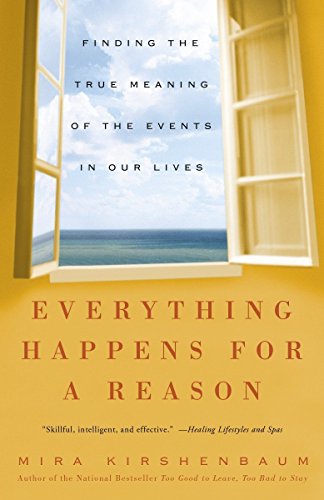
Can it really be true that everything happens for a reason? As amazing as it sounds, it is. There is significance in every event of our lives, from the most joyful and empowering to the inexplicable or seemingly unjust. In Everything Happens for a Reason, psychotherapist Mira Kirshenbaum encourages us to discover the meaning in what has happened to us, seeing these experiences as gifts, lessons, or opportunities. Building on more than twenty-five years of clinical research, Kirshenbaum helps us decode the confusing or unfortunate moments in our lives and find solace and strength.
Die Inhaltsangabe kann sich auf eine andere Ausgabe dieses Titels beziehen.
Über die Autorin bzw. den Autor
Mira Kirshenbaum is a psychotherapist and researcher and the clinical director of the Chestnut Hill Institute in Boston, where she has practiced for twenty-five years. She is the author of six previous books, including the influential Too Good to Leave, Too Bad to Stay and Parent/Teen Breakthrough.
Von der hinteren Coverseite
Can it really be true that everything happens for a reason? As amazing as it sounds, it is. There is significance in every event of our lives, from the most joyful and empowering to the inexplicable or seemingly unjust. In "Everything Happens for a Reason, psychotherapist Mira Kirshenbaum encourages us to discover the meaning in what has happened to us, seeing these experiences as gifts, lessons, or opportunities. Building on more than twenty-five years of clinical research, Kirshenbaum helps us decode the confusing or unfortunate moments in our lives and find solace and strength.
Auszug. © Genehmigter Nachdruck. Alle Rechte vorbehalten.
Is it really true that everything happens for a reason? After all, that's an amazing thing to say—that no matter what happens to you, not only does something valuable come out of it but it's just what you need.
Amazing as it sounds, it is true. It's taken me a long time, but I now see that even in the worst disaster—and I've had my share—there are wonderful gifts, hidden opportunities, or life-enhancing lessons. And we couldn't have gotten them any other way. If someone as hardheaded as I am can come to understand this, anyone can.
Of course, sometimes it's easy for us to believe that everything happens for a reason. We see it in little ways, like when our plans for an evening out fall through at the last minute, and we discover that everything we really want is at home that night anyway.
And sometimes we see it in not-so-little ways. A woman I know wrenched her back and had to spend a month in bed. She felt this was the last thing she needed in her life, particularly since it happened at a time when she had to make some important decisions. And then it hit her—this was exactly what she needed. Her old habit had been to rush impetuously into a new decision without thinking it through. Now it was as if life were saying, "If you won't give yourself time to think, I will."
We very much want to believe that the things that happen to us have great meaning. It's the way we feel life should be. Yes, some days we feel our life's a soap opera. But we want—we need—to have the sense that there's a purpose and value to it all. And we're right.
I want to reassure you: When you discover the true meaning of the events in your life, everything changes.
You feel stronger because your sense that everything has meaning gives you great confidence.
You feel wiser because you see how everything connects.
You're more in touch with who you are because you know that you're living the life you were meant to lead.
And you're happier because you're able to put your loss behind you and have a sense of a future filled with good things.
Until you get to this place, nothing is going to feel right. Let's say you're outdoors and you suddenly feel a drop of moisture fall on your head. You're not going to be able to think of anything else until you figure out why that happened. Is water dripping from some air conditioner up high? Is it starting to rain? Is a flying monkey peeing on your head? You have to know why that drop of moisture fell on your head because you can't feel safe going forward until you do.
We need to know why much more when what fell on our heads is a catastrophe. If you can't make sense of the catastrophe, it's as if your life is mere dice on a crap table—if nothing has any meaning, everything's random, anything can happen.
It's painful to live not knowing why you got so sick that time or why you lost the love of your life—much more painful than people suspect. One woman I know was flying home for Thanksgiving when she was in college. As the plane was flying along twenty thousand feet in the air, she developed a terrible earache. But that's not what made her cry. In the dark of a nighttime flight she was sobbing because there was pain like this in the world, seemingly without any rhyme or reason.
One guy described this feeling differently: "When I think about the bad stuff that's happened in my life, I feel I'm just a goddamn fool of the cosmos. It's humiliating! On a sidewalk crowded with people, I'm the one who's stepped in the dog poop. No one else is as stupid or unlucky as I am. The problem is: How can I go forward, how can I trust the future if I feel I am this stupid unlucky guy?"
Knowing that there's a reason for what happens also saves us from being filled with blame. Blame is a very human attempt to make sense of some catastrophe, but most of the time we hate the way it feels. And yet when something bad happens to us, it's almost a reflex to think, It's because everyone hates me, because I'm a loser, because I'm doomed. And so the blame begins.
We blame other people, and then we end up with the sense that the world is full of bad people. We blame ourselves, and then instead of feeling healthy, strong, and whole we see ourselves as sick, weak, and broken. And we blame life itself. What could be more demoralizing than feeling condemned to having bad things always happen to us and not being able to do anything about it?
Blame is like a boomerang that loops around and bonks us on the noggin. Try this yourself: If you see someone struggling with sadness, anxiety, and negativity, listen to his story. You'll soon see he's living in a world where all he sees are things to blame because he lives without positive meanings for what's happened to him. The only cure is to restore the sense that there is a good reason for everything that happens.
Explain That, Why Don't You?
Years ago, if you'd said to me, "Everything happens for a reason," I'd have said that was a lot of bull. Things happened in my life that were so painful it's no wonder I'd had trouble finding their meaning, and I gave up looking. I now know that was a big mistake.
Lots of things happen to us that challenge our sense that everything happens for a reason. It can be anything. You get seriously ill at the worst possible moment. You think you've found the love of your life but something goes haywire between you and now the two of you are over. You've had one of those really painful childhoods. You screw up and lose a lot of money. Someone you love dies.
Yeah, we think, maybe there's a meaning for some things that happen, but not for this.
And even if we still have a shred of faith left that there is meaning in these events, we don't know how to find it. After all, the events in our lives don't come to us with labels attached telling us what they mean. We can spend years searching in vain. We ask friends, but they haven't gone through what we have. We ask someone who has gone through something similar, but that person is probably struggling to find meaning, too.
At some point we might be tempted to give up the search. That's what happened to me. It took one of my patients to wake me up and give me the hope that we can discover the meaning of the events in our lives. Everything important I've learned about how to do my job I've learned from my patients. Scott* was one of my best "teachers."
The Message in the Bottle
We all have dreams of what we'd like to do with our lives. When Scott first came to see me many years ago he was dreaming about going back to school and becoming a landscape designer. But he was afraid to give up his well-paying job. As you can imagine, addressing underlying issues of anxiety, low self-esteem, and identity played an important role in our work together. Soon, though, our work was all about helping him get what he needed to make his dream come true. He ultimately completed a two-year program at an excellent school and eventually opened his own little landscape-design business. He felt fulfilled.
Several years later Scott came back to work with me. Sadly, he had non-Hodgkin's lymphoma, and he thought he was dying. (Scott's cancer eventually went into remission. He's still okay.) He said he wanted to discover why this terrible disease had happened to him just when his life was starting to work out. "Isn't this really a theological question?" I asked Scott. Truthfully, I didn't want to deal with a question like this. My attitude at that time was that you could never find an answer. And anyway, the most important thing is to make the best use of the time you have remaining. Why ask why?
But Scott, bless him, held onto his need. He was about to teach me an important lesson about how...
„Über diesen Titel“ kann sich auf eine andere Ausgabe dieses Titels beziehen.
Suchergebnisse für Everything Happens for a Reason: Finding the True Meaning...

Beispielbild für diese ISBN
Everything Happens for a Reason: Finding the True Meaning of the Events in Our Lives
Anbieter: World of Books (was SecondSale), Montgomery, IL, USA
Verkäuferbewertung 5 von 5 Sternen

Paperback. Zustand: Good. Can it really be true that everything happens for a reason? As amazing as it sounds, it is. There is significance in every event of our lives, from the most joyful and empowering to the inexplicable or seemingly unjust. In Everything Happens for a Reason, psychotherapist Mira Kirshenbaum encourages us to discover the meaning in what has happened to us, seeing these experiences as gifts, lessons, or opportunities. Building on more than twenty-five years of clinical research, Kirshenbaum helps us decode the confusing or unfortunate moments in our lives and find solace and strength. Artikel-Nr. 00088809063
Gebraucht kaufen
EUR 4,05
Versand gratis
Versand innerhalb von USA
Versand innerhalb von USA
Anzahl: 10 verfügbar
Beispielbild für diese ISBN
Everything Happens for a Reason: Finding the True Meaning of the Events in Our Lives
Verlag:
Harmony/Rodale/Convergent, 2004
ISBN 10: 1400083214
ISBN 13: 9781400083213
Gebraucht
Softcover
Anbieter: World of Books (was SecondSale), Montgomery, IL, USA
Verkäuferbewertung 5 von 5 Sternen
Zustand: Acceptable. Item in acceptable condition! Textbooks may not include supplemental items i.e. CDs, access codes etc. Artikel-Nr. 00096626078
Gebraucht kaufen
EUR 4,05
Versand gratis
Versand innerhalb von USA
Versand innerhalb von USA
Anzahl: 4 verfügbar
Beispielbild für diese ISBN
Everything Happens for a Reason: Finding the True Meaning of the Events in Our Lives
Anbieter: World of Books (was SecondSale), Montgomery, IL, USA
Verkäuferbewertung 5 von 5 Sternen
Paperback. Zustand: Very Good. Can it really be true that everything happens for a reason? As amazing as it sounds, it is. There is significance in every event of our lives, from the most joyful and empowering to the inexplicable or seemingly unjust. In Everything Happens for a Reason, psychotherapist Mira Kirshenbaum encourages us to discover the meaning in what has happened to us, seeing these experiences as gifts, lessons, or opportunities. Building on more than twenty-five years of clinical research, Kirshenbaum helps us decode the confusing or unfortunate moments in our lives and find solace and strength. Artikel-Nr. 00104339016
Gebraucht kaufen
EUR 4,05
Versand gratis
Versand innerhalb von USA
Versand innerhalb von USA
Anzahl: 4 verfügbar
Beispielbild für diese ISBN
Everything Happens for a Reason: Finding the True Meaning of the Events in Our Lives
Verlag:
Harmony/Rodale/Convergent (edition Reprint), 2004
ISBN 10: 1400083214
ISBN 13: 9781400083213
Gebraucht
Paperback
Anbieter: BooksRun, Philadelphia, PA, USA
Verkäuferbewertung 5 von 5 Sternen
Paperback. Zustand: Very Good. Reprint. It's a well-cared-for item that has seen limited use. The item may show minor signs of wear. All the text is legible, with all pages included. It may have slight markings and/or highlighting. Artikel-Nr. 1400083214-11-1
Gebraucht kaufen
EUR 4,16
Versand gratis
Versand innerhalb von USA
Versand innerhalb von USA
Anzahl: 1 verfügbar
Foto des Verkäufers
Everything Happens for a Reason: Finding the True Meaning of the Events in Our Lives
Verlag:
Harmony/Rodale/Convergent, 2004
ISBN 10: 1400083214
ISBN 13: 9781400083213
Gebraucht
Softcover
Anbieter: Dream Books Co., Denver, CO, USA
Verkäuferbewertung 5 von 5 Sternen
Zustand: acceptable. This copy has clearly been enjoyedâ"expect noticeable shelf wear and some minor creases to the cover. Binding is strong, and all pages are legible. May contain previous library markings or stamps. Artikel-Nr. DBV.1400083214.A
Gebraucht kaufen
EUR 5,07
Versand gratis
Versand innerhalb von USA
Versand innerhalb von USA
Anzahl: 1 verfügbar
Foto des Verkäufers
Everything Happens for a Reason: Finding the True Meaning of the Events in Our Lives
Verlag:
Harmony/Rodale/Convergent, 2004
ISBN 10: 1400083214
ISBN 13: 9781400083213
Gebraucht
Softcover
Anbieter: Dream Books Co., Denver, CO, USA
Verkäuferbewertung 5 von 5 Sternen
Zustand: good. Gently used with minimal wear on the corners and cover. A few pages may contain light highlighting or writing, but the text remains fully legible. Dust jacket may be missing, and supplemental materials like CDs or codes may not be included. May be ex-library with library markings. Ships promptly! Artikel-Nr. DBV.1400083214.G
Gebraucht kaufen
EUR 5,61
Versand gratis
Versand innerhalb von USA
Versand innerhalb von USA
Anzahl: 2 verfügbar
Beispielbild für diese ISBN
Everything Happens for a Reason: Finding the True Meaning of the Events in Our Lives
Anbieter: ThriftBooks-Dallas, Dallas, TX, USA
Verkäuferbewertung 5 von 5 Sternen
Paperback. Zustand: Very Good. No Jacket. May have limited writing in cover pages. Pages are unmarked. ~ ThriftBooks: Read More, Spend Less. Artikel-Nr. G1400083214I4N00
Gebraucht kaufen
EUR 5,96
Versand gratis
Versand innerhalb von USA
Versand innerhalb von USA
Anzahl: 1 verfügbar
Beispielbild für diese ISBN
Everything Happens for a Reason: Finding the True Meaning of the Events in Our Lives
Anbieter: ThriftBooks-Reno, Reno, NV, USA
Verkäuferbewertung 5 von 5 Sternen
Paperback. Zustand: Very Good. No Jacket. May have limited writing in cover pages. Pages are unmarked. ~ ThriftBooks: Read More, Spend Less. Artikel-Nr. G1400083214I4N00
Gebraucht kaufen
EUR 5,96
Versand gratis
Versand innerhalb von USA
Versand innerhalb von USA
Anzahl: 1 verfügbar
Beispielbild für diese ISBN
Everything Happens for a Reason: Finding the True Meaning of the Events in Our Lives
Anbieter: ThriftBooks-Atlanta, AUSTELL, GA, USA
Verkäuferbewertung 5 von 5 Sternen
Paperback. Zustand: Very Good. No Jacket. May have limited writing in cover pages. Pages are unmarked. ~ ThriftBooks: Read More, Spend Less. Artikel-Nr. G1400083214I4N00
Gebraucht kaufen
EUR 5,96
Versand gratis
Versand innerhalb von USA
Versand innerhalb von USA
Anzahl: 1 verfügbar
Beispielbild für diese ISBN
Everything Happens for a Reason : Finding the True Meaning of the Events in Our Lives
Verlag:
Potter/Ten Speed/Harmony/Rodale, 2005
ISBN 10: 1400083214
ISBN 13: 9781400083213
Gebraucht
Softcover
Anbieter: Better World Books: West, Reno, NV, USA
Verkäuferbewertung 5 von 5 Sternen
Zustand: Good. Pages intact with minimal writing/highlighting. The binding may be loose and creased. Dust jackets/supplements are not included. Stock photo provided. Product includes identifying sticker. Better World Books: Buy Books. Do Good. Artikel-Nr. 1295508-6
Gebraucht kaufen
EUR 6,18
Versand gratis
Versand innerhalb von USA
Versand innerhalb von USA
Anzahl: 1 verfügbar