
Verwandte Artikel zu The Quantum and the Lotus: A Journey to the Frontiers...
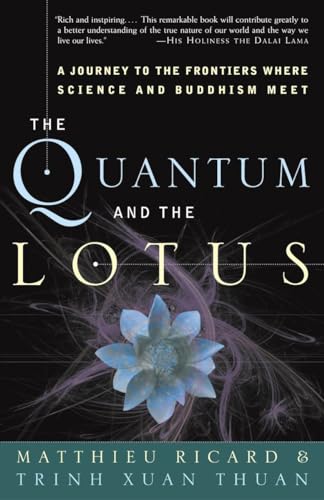
Inhaltsangabe
Matthieu Ricard trained as a molecular biologist, working in the lab of a Nobel prize—winning scientist, but when he read some Buddhist philosophy, he became drawn to Buddhism. Eventually he left his life in science to study with Tibetan teachers, and he is now a Buddhist monk and translator for the Dalai Lama, living in the Shechen monastery near Kathmandu in Nepal. Trinh Thuan was born into a Buddhist family in Vietnam but became intrigued by the explosion of discoveries in astronomy during the 1960s. He made his way to the prestigious California Institute of Technology to study with some of the biggest names in the field and is now an acclaimed astrophysicist and specialist on how the galaxies formed.
When Matthieu Ricard and Trinh Thuan met at an academic conference in the summer of 1997, they began discussing the many remarkable connections between the teachings of Buddhism and the findings of recent science. That conversation grew into an astonishing correspondence exploring a series of fascinating questions. Did the universe have a beginning? Or is our universe one in a series of infinite universes with no end and no beginning? Is the concept of a beginning of time fundamentally flawed? Might our perception of time in fact be an illusion, a phenomenon created in our brains that has no ultimate reality? Is the stunning fine-tuning of the universe, which has produced just the right conditions for life to evolve, a sign that a “principle of creation” is at work in our world? If such a principle of creation undergirds the workings of the universe, what does that tell us about whether or not there is a divine Creator? How does the radical interpretation of reality offered by quantum physics conform to and yet differ from the Buddhist conception of reality? What is consciousness and how did it evolve? Can consciousness exist apart from a brain generating it?
The stimulating journey of discovery the authors traveled in their discussions is re-created beautifully in The Quantum and the Lotus, written in the style of a lively dialogue between friends. Both the fundamental teachings of Buddhism and the discoveries of contemporary science are introduced with great clarity, and the reader will be profoundly impressed by the many correspondences between the two streams of thought and revelation. Through the course of their dialogue, the authors reach a remarkable meeting of minds, ultimately offering a vital new understanding of the many ways in which science and Buddhism confirm and complement each other and of the ways in which, as Matthieu Ricard writes, “knowledge of our spirits and knowledge of the world are mutually enlightening and empowering.”
“The Quantum and the Lotus is a mind-expanding, eye-opening exploration of the exciting parallels between cutting-edge thinking in physics and Buddhism–a scintillating conversation any thinking person would delight in overhearing.” —Daniel Goleman, author of Emotional Intelligence
“The Quantum and the Lotus is the rich and inspiring result of a deeply interesting dialogue between Western science and Buddhist philosophy. This remarkable book will contribute greatly to a better understanding of the true nature of our world and the way we live our lives.” —His Holiness the Dalai Lama
Die Inhaltsangabe kann sich auf eine andere Ausgabe dieses Titels beziehen.
Über die Autorin bzw. den Autor
Mattieu Ricard is a Buddhist monk residing at the Shechen monastery near Kathmandu in Nepal. He is coauthor of the critically acclaimed The Monk and the Philosopher and is the official French translator of His Holiness the Dalai Lama.
Trinh Xuan Thuan is a professor of astronomy at the University of Virginia and the author of the critically acclaimed The Secret Melody and several other popular science books.
Von der hinteren Coverseite
Matthieu Ricard trained as a molecular biologist, working in the lab of a Nobel prize--winning scientist, but when he read some Buddhist philosophy, he became drawn to Buddhism. Eventually he left his life in science to study with Tibetan teachers, and he is now a Buddhist monk and translator for the Dalai Lama, living in the Shechen monastery near Kathmandu in Nepal. Trinh Thuan was born into a Buddhist family in Vietnam but became intrigued by the explosion of discoveries in astronomy during the 1960s. He made his way to the prestigious California Institute of Technology to study with some of the biggest names in the field and is now an acclaimed astrophysicist and specialist on how the galaxies formed.
When Matthieu Ricard and Trinh Thuan met at an academic conference in the summer of 1997, they began discussing the many remarkable connections between the teachings of Buddhism and the findings of recent science. That conversation grew into an astonishing correspondence exploring a series of fascinating questions. Did the universe have a beginning? Or is our universe one in a series of infinite universes with no end and no beginning? Is the concept of a beginning of time fundamentally flawed? Might our perception of time in fact be an illusion, a phenomenon created in our brains that has no ultimate reality? Is the stunning fine-tuning of the universe, which has produced just the right conditions for life to evolve, a sign that a "principle of creation" is at work in our world? If such a principle of creation undergirds the workings of the universe, what does that tell us about whether or not there is a divine Creator? How does the radical interpretation of reality offered byquantum physics conform to and yet differ from the Buddhist conception of reality? What is consciousness and how did it evolve? Can consciousness exist apart from a brain generating it?
The stimulating journey of discovery the authors traveled in their discussions is re-created beautifully in "The Quantum and the Lotus, written in the style of a lively dialogue between friends. Both the fundamental teachings of Buddhism and the discoveries of contemporary science are introduced with great clarity, and the reader will be profoundly impressed by the many correspondences between the two streams of thought and revelation. Through the course of their dialogue, the authors reach a remarkable meeting of minds, ultimately offering a vital new understanding of the many ways in which science and Buddhism confirm and complement each other and of the ways in which, as Matthieu Ricard writes, "knowledge of our spirits and knowledge of the world are mutually enlightening and empowering."
""The Quantum and the Lotus is a mind-expanding, eye-opening exploration of the exciting parallels between cutting-edge thinking in physics and Buddhism-a scintillating conversation any thinking person would delight in overhearing." --Daniel Goleman, author of "Emotional Intelligence
""The Quantum and the Lotus is the rich and inspiring result of a deeply interesting dialogue between Western science and Buddhist philosophy. This remarkable book will contribute greatly to a better understanding of the true nature of our world and the way we live our lives." --His Holiness the Dalai Lama
Auszug. © Genehmigter Nachdruck. Alle Rechte vorbehalten.
At the crossroads
Are there any grounds for a dialogue between science and Buddhism? To find out, we must first clarify the pursuits of each, and then explore whether Buddhism (and spirituality in general) can complement science in important ways, particularly concerning ethics, personal transformation, knowledge of ourselves, and genuine spiritual insight. Buddhism has always been interested in questions that are also basic to modern physics. Might science therefore also help Buddhism in its exploration of reality?
MATTHIEU: You've made an impressive journey from Vietnam to your life as an astrophysicist in the United States. What drew you into a life in science?
THUAN: The 1960s were a golden age for astrophysics, with many great discoveries being made, such as the detection of the cosmic background radiation, which is the residual heat from the Big Bang; the discovery of pulsars, which are stars made entirely of neutrons; and the identification of quasars, which are celestial objects in far distant space, near the edge of the universe, that emit an extraordinary amount of energy. When I arrived in the United States, satellite exploration of the solar system had gotten into full swing. I can still remember the wonder of watching the first images of the surface of Mars transmitted by the space probe Mariner on a screen in our classroom. Those pictures of a dry, sterile desert told humanity that there was no intelligent life on Mars.
The canals that nineteenth-century astronomers thought they'd seen turned out to be nothing but optical illusions created by sandstorms. In the midst of such intellectual ferment, I just had to become an astrophysicist. Ever since, I've continued to marvel at the wonders of the universe, observing it through state-of-the-art telescopes, all the while thinking about its nature, origin, evolution, and destiny.
What did you find unfulfilling about your scientific career? Leaving a biology lab in Paris for a Tibetan monastery in Nepal is an unusual move, to say the least.
MATTHIEU: It was a natural progression, a step in an increasingly thrilling exploration of the meaning of life. All I did was leap from one stone to the next, go from one valley into another, into ever more beautiful realms. I followed where my passions led, while trying not to waste a single moment of this priceless human existence. I was lucky enough to live for thirty years alongside some remarkable Buddhist masters. This was a simple, direct experience, but also so profound that I always find it difficult to describe. You can recognize human and spiritual perfection when you see it, but the usual words that come to mind-wisdom, knowledge, goodness, nobility, simplicity, rigor, integrity-just aren't enough.
I think what everyone should be doing, before it's too late, is committing themselves to what they really want to do with their lives. Scientific research was interesting, of course, but I felt as though I was just adding a tiny dot of color to a pointillist canvas without knowing what the final composition would be like. So was it worth giving up all the unique opportunities of a human existence for that? In Buddhism, on the other hand, the point of departure, the goal to be reached, the means to that end, and the obstacles in the way are all perfectly clear. All you have to do is to look into your own mind and see that it is so often dominated by egoism, and that egoism derives from a deep ignorance of the true nature of ourselves and of the world. This state of affairs inevitably makes us and others suffer. Our most urgent task is to put a stop to this. The means to this end is to develop love and compassion, and to eradicate ignorance by following the path of enlightenment. As the days and years go by a tangible change takes place that creates a rare joy, exempt from hope or fear, which has constantly nourished my enthusiasm.
T: So why this conversation with a scientist?
M: One of Buddhist philosophy's main tasks is to study the nature of reality, and science offers many compelling insights into the nature of our world.
T: My work constantly raises questions about reality, matter, time, and space. Whenever I come up against such concepts, I can't help wondering how Buddhism deals with them, and how the scientific view of reality corresponds to the idea of reality in Buddhism. Do these two points of view coincide, are they opposed, or do they simply have nothing in common? I haven't studied Buddhist texts, so I don't have the knowledge necessary to answer such questions.
M: Is there a solid reality behind appearances? What is the origin of the world of phenomena, the world that we see as "real" all around us? What is the relationship between the animate and the inanimate, between the subject and the object? Do time, space, and the laws of nature really exist? Buddhist philosophers have been studying these questions for the last 2,500 years. Buddhist literature abounds with logical treatises, theories of perception, analyses of different levels of the world of phenomena, and psychological treatises exploring aspects of consciousness and the ultimate nature of our minds.
T: Are you saying that Buddhism is a science of the mind? Is it a science in the same sense as a natural science-that is to say, based on observation, with mathematics as its language?
M: The authenticity of a science doesn't necessarily depend on physical measurements and complex equations. A hypothesis can be checked by inner experience in a rigorous way. The Buddhist method begins with analysis and then often uses "thought experiments," which are hypothetical experiments conducted in the mind, but which lead to irrefutable conclusions, even though the experiments cannot be physically carried out. This technique is widely used in science.
T: That's right. Thought experiments are extremely useful in physics in particular. Einstein and other great physicists have used them not only to demonstrate physical principles, but also to point out paradoxes in some physical situations. For example, when studying the nature of time and space, Einstein imagined himself astride a particle of light. When thinking about gravity, he saw himself in an elevator falling through a vacuum.
I understand that the questions explored by modern physics echo the investigations of Buddhism in unexpected ways. But why is Buddhism interested in modern science, and in particular in physics and astrophysics?
M: Of course, modern science isn't Buddhism's main preoccupation. But there is interest in the findings of science because Buddhism has long been asking similar questions. Can separate, indivisible particles be the "building blocks" of the world? Do they really exist, or are they just concepts that help us understand reality? Are the laws of physics immutable, and do they have an intrinsic existence, like Platonic ideals? While not exaggerating superficial similarities, a study of both the differences and points of agreement between science and Buddhism may help us to deepen our understanding of the world.
Buddhist research is, above all, based on insights perceived through direct life experience, and is not bound by rigid dogma. It is ready to accept any vision of reality that is perceived as authentic. One of its main goals is precisely to bridge the gap between the way things really are and the way they seem to be. The Buddha often put his disciples on their guard against the dangers of blind faith. He said, "Investigate the validity of my teachings as you would examine the purity of gold, rubbing it against a stone, hammering it, melting it. Do not accept my words simply out of respect for me. Accept them when you see that they are true."
But the simple accumulation of knowledge is not enough. My teacher Khyentse Rinpoche said,...
„Über diesen Titel“ kann sich auf eine andere Ausgabe dieses Titels beziehen.
Suchergebnisse für The Quantum and the Lotus: A Journey to the Frontiers...

Beispielbild für diese ISBN
The Quantum and the Lotus: A J
Anbieter: World of Books (was SecondSale), Montgomery, IL, USA
Verkäuferbewertung 5 von 5 Sternen

Zustand: Good. Item in good condition. Textbooks may not include supplemental items i.e. CDs, access codes etc. Artikel-Nr. 00107502055
Gebraucht kaufen
EUR 4,53
Versand gratis
Versand innerhalb von USA
Versand innerhalb von USA
Anzahl: 7 verfügbar
Beispielbild für diese ISBN
The Quantum and the Lotus: A Journey to the Frontiers Where Science and Buddhism Meet
Verlag:
Crown (edition 42945th), 2004
ISBN 10: 1400080797
ISBN 13: 9781400080793
Gebraucht
Paperback
Anbieter: BooksRun, Philadelphia, PA, USA
Verkäuferbewertung 5 von 5 Sternen
Paperback. Zustand: Very Good. 42945th. It's a well-cared-for item that has seen limited use. The item may show minor signs of wear. All the text is legible, with all pages included. It may have slight markings and/or highlighting. Artikel-Nr. 1400080797-8-1
Gebraucht kaufen
EUR 4,74
Versand gratis
Versand innerhalb von USA
Versand innerhalb von USA
Anzahl: 1 verfügbar
Beispielbild für diese ISBN
The Quantum and the Lotus: A Journey to the Frontiers Where Science and Buddhism Meet
Verlag:
Crown (edition 42945th), 2004
ISBN 10: 1400080797
ISBN 13: 9781400080793
Gebraucht
Paperback
Anbieter: BooksRun, Philadelphia, PA, USA
Verkäuferbewertung 5 von 5 Sternen
Paperback. Zustand: Fair. 42945th. The item might be beaten up but readable. May contain markings or highlighting, as well as stains, bent corners, or any other major defect, but the text is not obscured in any way. Artikel-Nr. 1400080797-7-1
Gebraucht kaufen
EUR 4,81
Versand gratis
Versand innerhalb von USA
Versand innerhalb von USA
Anzahl: 1 verfügbar
Beispielbild für diese ISBN
The Quantum and the Lotus: A Journey to the Frontiers Where Science and Buddhism Meet
Verlag:
Crown (edition 42945th), 2004
ISBN 10: 1400080797
ISBN 13: 9781400080793
Gebraucht
Paperback
Anbieter: BooksRun, Philadelphia, PA, USA
Verkäuferbewertung 5 von 5 Sternen
Paperback. Zustand: Very Good. 42945th. It's a well-cared-for item that has seen limited use. The item may show minor signs of wear. All the text is legible, with all pages included. It may have slight markings and/or highlighting. Artikel-Nr. 1400080797-11-1
Gebraucht kaufen
EUR 4,88
Versand gratis
Versand innerhalb von USA
Versand innerhalb von USA
Anzahl: 1 verfügbar
Beispielbild für diese ISBN
The Quantum and the Lotus: A Journey to the Frontiers Where Science and Buddhism Meet
Verlag:
Crown Publishing Group (NY), 2004
ISBN 10: 1400080797
ISBN 13: 9781400080793
Gebraucht
Paperback
Anbieter: ThriftBooks-Reno, Reno, NV, USA
Verkäuferbewertung 5 von 5 Sternen
Paperback. Zustand: Good. No Jacket. Former library book; Pages can have notes/highlighting. Spine may show signs of wear. ~ ThriftBooks: Read More, Spend Less. Artikel-Nr. G1400080797I3N10
Gebraucht kaufen
EUR 6,19
Versand gratis
Versand innerhalb von USA
Versand innerhalb von USA
Anzahl: 1 verfügbar
Beispielbild für diese ISBN
The Quantum and the Lotus: A Journey to the Frontiers Where Science and Buddhism Meet
Verlag:
Crown Publishing Group (NY), 2004
ISBN 10: 1400080797
ISBN 13: 9781400080793
Gebraucht
Paperback
Anbieter: ThriftBooks-Reno, Reno, NV, USA
Verkäuferbewertung 5 von 5 Sternen
Paperback. Zustand: Good. No Jacket. Pages can have notes/highlighting. Spine may show signs of wear. ~ ThriftBooks: Read More, Spend Less. Artikel-Nr. G1400080797I3N00
Gebraucht kaufen
EUR 6,19
Versand gratis
Versand innerhalb von USA
Versand innerhalb von USA
Anzahl: 6 verfügbar
Beispielbild für diese ISBN
The Quantum and the Lotus: A Journey to the Frontiers Where Science and Buddhism Meet
Verlag:
Crown Publishing Group (NY), 2004
ISBN 10: 1400080797
ISBN 13: 9781400080793
Gebraucht
Paperback
Anbieter: ThriftBooks-Phoenix, Phoenix, AZ, USA
Verkäuferbewertung 5 von 5 Sternen
Paperback. Zustand: Very Good. No Jacket. May have limited writing in cover pages. Pages are unmarked. ~ ThriftBooks: Read More, Spend Less. Artikel-Nr. G1400080797I4N00
Gebraucht kaufen
EUR 6,19
Versand gratis
Versand innerhalb von USA
Versand innerhalb von USA
Anzahl: 1 verfügbar
Beispielbild für diese ISBN
The Quantum and the Lotus: A Journey to the Frontiers Where Science and Buddhism Meet
Verlag:
Crown Publishing Group (NY), 2004
ISBN 10: 1400080797
ISBN 13: 9781400080793
Gebraucht
Paperback
Anbieter: ThriftBooks-Reno, Reno, NV, USA
Verkäuferbewertung 5 von 5 Sternen
Paperback. Zustand: Very Good. No Jacket. Former library book; May have limited writing in cover pages. Pages are unmarked. ~ ThriftBooks: Read More, Spend Less. Artikel-Nr. G1400080797I4N10
Gebraucht kaufen
EUR 6,19
Versand gratis
Versand innerhalb von USA
Versand innerhalb von USA
Anzahl: 1 verfügbar
Beispielbild für diese ISBN
The Quantum and the Lotus: A Journey to the Frontiers Where Science and Buddhism Meet
Verlag:
Crown Publishing Group (NY), 2004
ISBN 10: 1400080797
ISBN 13: 9781400080793
Gebraucht
Paperback
Anbieter: ThriftBooks-Phoenix, Phoenix, AZ, USA
Verkäuferbewertung 5 von 5 Sternen
Paperback. Zustand: Good. No Jacket. Pages can have notes/highlighting. Spine may show signs of wear. ~ ThriftBooks: Read More, Spend Less. Artikel-Nr. G1400080797I3N00
Gebraucht kaufen
EUR 6,19
Versand gratis
Versand innerhalb von USA
Versand innerhalb von USA
Anzahl: 6 verfügbar
Beispielbild für diese ISBN
The Quantum and the Lotus: A Journey to the Frontiers Where Science and Buddhism Meet
Verlag:
Crown Publishing Group (NY), 2004
ISBN 10: 1400080797
ISBN 13: 9781400080793
Gebraucht
Paperback
Anbieter: ThriftBooks-Dallas, Dallas, TX, USA
Verkäuferbewertung 5 von 5 Sternen
Paperback. Zustand: Good. No Jacket. Pages can have notes/highlighting. Spine may show signs of wear. ~ ThriftBooks: Read More, Spend Less. Artikel-Nr. G1400080797I3N00
Gebraucht kaufen
EUR 6,22
Versand gratis
Versand innerhalb von USA
Versand innerhalb von USA
Anzahl: 6 verfügbar