Inhaltsangabe
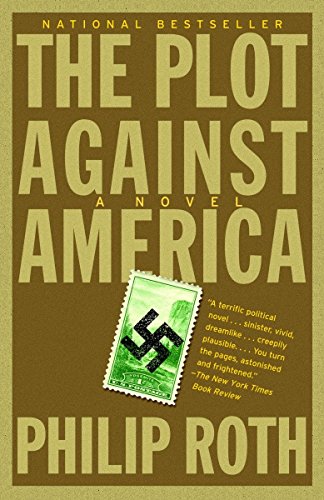
NATIONAL BESTSELLER • The chilling bestselling alternate history novel of what happens to one family when America elects a charismatic, isolationist president whose government embraces a folksy anti-Semitism—from the Pulitzer Prize–winning author of American Pastoral.
“A terrific political novel.... Sinister, vivid, dreamlike...You turn the pages, astonished and frightened.” —The New York Times Book Review
In an extraordinary feat of narrative invention, Philip Roth imagines an alternate history where Franklin D. Roosevelt loses the 1940 presidential election to heroic aviator and rabid isolationist Charles A. Lindbergh. Shortly thereafter, Lindbergh negotiates a cordial "understanding" with Adolf Hitler, while the new government embarks on a program of folksy anti-Semitism.
Die Inhaltsangabe kann sich auf eine andere Ausgabe dieses Titels beziehen.
Über die Autorin bzw. den Autor
PHILIP ROTH won the Pulitzer Prize for American Pastoral. In 1998 he received the National Medal of Arts at the White House and in 2002 the highest award of the American Academy of Arts and Letters, the Gold Medal in Fiction. He twice won the National Book Award and the National Book Critics Circle Award. He won the PEN/Faulkner Award three times. In 2005 The Plot Against America received the Society of American Historians’ Prize for “the outstanding historical novel on an American theme for 2003–2004.” Roth received PEN’s two most prestigious awards: in 2006 the PEN/Nabokov Award and in 2007 the PEN/Bellow Award for achievement in American fiction. In 2011 he received the National Humanities Medal at the White House, and was later named the fourth recipient of the Man Booker International Prize. He died in 2018.
Von der hinteren Coverseite
In an extraordinary feat of narrative invention, Philip Roth imagines an alternate history where Franklin D. Roosevelt loses the 1940 presidential election to heroic aviator and rabid isolationist Charles A. Lindbergh. Shortly thereafter, Lindbergh negotiates a cordial "understanding" with Adolf Hitler, while the new government embarks on a program of folksy anti-Semitism.
Auszug. © Genehmigter Nachdruck. Alle Rechte vorbehalten.
June 1940–October 1940
Vote for Lindbergh or Vote for War
FEAR PRESIDES over these memories, a perpetual fear. Of course no childhood is without its terrors, yet I wonder if I would have been a less frightened boy if Lindbergh hadn't been president or if I hadn't been the offspring of Jews.
When the first shock came in June of 1940--the nomination for the presidency of Charles A. Lindbergh, America's international aviation hero, by the Republican Convention at Philadelphia--my father was thirty-nine, an insurance agent with a grade school education, earning a little under fifty dollars a week, enough for the basic bills to be paid on time but for little more. My mother--who'd wanted to go to teachers' college but couldn't because of the expense, who'd lived at home working as an office secretary after finishing high school, who'd kept us from feeling poor during the worst of the Depression by budgeting the earnings my father turned over to her each Friday as efficiently as she ran the household--was thirty-six. My brother, Sandy, a seventh-grader with a prodigy's talent for drawing, was twelve, and I, a third-grader a term ahead of himself--and an embryonic stamp collector inspired like millions of kids by the country's foremost philatelist, President Roosevelt--was seven.
We lived in the second-floor flat of a small two-and-a-half-family house on a tree-lined street of frame wooden houses with red-brick stoops, each stoop topped with a gable roof and fronted by a tiny yard boxed in with a low-cut hedge. The Weequahic neighborhood had been built on farm lots at the undeveloped southwest edge of Newark just after World War One, some half dozen of the streets named, imperially, for victorious naval commanders in the Spanish-American War and the local movie house called, after FDR's fifth cousin--and the country's twenty-sixth president--the Roosevelt. Our street, Summit Avenue, sat at the crest of the neighborhood hill, an elevation as high as any in a port city that rarely rises a hundred feet above the level of the tidal salt marsh to the city's north and east and the deep bay due east of the airport that bends around the oil tanks of the Bayonne peninsula and merges there with New York Bay to flow past the Statue of Liberty and into the Atlantic. Looking west from our bedroom's rear window we could sometimes see inland as far as the dark treeline of the Watchungs, a low-lying mountain range fringed by great estates and affluent, sparsely populated suburbs, the extreme edge of the known world--and about eight miles from our house. A block to the south was the working-class town of Hillside, whose population was predominantly Gentile. The boundary with Hillside marked the beginning of Union County, another New Jersey entirely.
We were a happy family in 1940. My parents were outgoing, hospitable people, their friends culled from among my father's associates at the office and from the women who along with my mother had helped to organize the Parent-Teacher Association at newly built Chancellor Avenue School, where my brother and I were pupils. All were Jews. The neighborhood men either were in business for themselves--the owners of the local candy store, grocery store, jewelry store, dress shop, furniture shop, service station, and delicatessen, or the proprietors of tiny industrial job shops over by the Newark-Irvington line, or self-employed plumbers, electricians, housepainters, and boilermen--or were foot-soldier salesmen like my father, out every day in the city streets and in people's houses, peddling their wares on commission. The Jewish doctors and lawyers and the successful merchants who owned big stores downtown lived in one-family houses on streets branching off the eastern slope of the Chancellor Avenue hill, closer to grassy, wooded Weequahic Park, a landscaped three hundred acres whose boating lake, golf course, and harness-racing track separated the Weequahic section from the industrial plants and shipping terminals lining Route 27 and the Pennsylvania Railroad viaduct east of that and the burgeoning airport east of that and the very edge of America east of that--the depots and docks of Newark Bay, where they unloaded cargo from around the world.
At the western end of the neighborhood, the parkless end where we lived, there resided an occasional schoolteacher or pharmacist but otherwise few professionals were among our immediate neighbors and certainly none of the prosperous entrepreneurial or manufacturing families. The men worked fifty, sixty, even seventy or more hours a week; the women worked all the time, with little assistance from labor-saving devices, washing laundry, ironing shirts, mending socks, turning collars, sewing on buttons, mothproofing woolens, polishing furniture, sweeping and washing floors, washing windows, cleaning sinks, tubs, toilets, and stoves, vacuuming rugs, nursing the sick, shopping for food, cooking meals, feeding relatives, tidying closets and drawers, overseeing paint jobs and household repairs, arranging for religious observances, paying bills and keeping the family's books while simultaneously attending to their children's health, clothing, cleanliness, schooling, nutrition, conduct, birthdays, discipline, and morale. A few women labored alongside their husbands in the family-owned stores on the nearby shopping streets, assisted after school and on Saturdays by their older children, who delivered orders and tended stock and did the cleaning up.
It was work that identified and distinguished our neighbors for me far more than religion. Nobody in the neighborhood had a beard or dressed in the antiquated Old World style or wore a skullcap either outdoors or in the houses I routinely floated through with my boyhood friends. The adults were no longer observant in the outward, recognizable ways, if they were seriously observant at all, and aside from older shopkeepers like the tailor and the kosher butcher--and the ailing or decrepit grandparents living of necessity with their adult offspring--hardly anyone in the vicinity spoke with an accent. By 1940 Jewish parents and their children at the southwestern corner of New Jersey's largest city talked to one another in an American English that sounded more like the language spoken in Altoona or Binghamton than like the dialects famously spoken across the Hudson by our Jewish counterparts in the five boroughs. Hebrew lettering was stenciled on the butcher shop window and engraved on the lintels of the small neighborhood synagogues, but nowhere else (other than at the cemetery) did one's eye chance to land on the alphabet of the prayer book rather than on the familiar letters of the native tongue employed all the time by practically everyone for every conceivable purpose, high or low. At the newsstand out front of the corner candy store, ten times more customers bought the Racing Form than the Yiddish daily, the Forvertz.
Israel didn't yet exist, six million European Jews hadn't yet ceased to exist, and the local relevance of distant Palestine (under British mandate since the 1918 dissolution by the victorious Allies of the last far-flung provinces of the defunct Ottoman Empire) was a mystery to me. When a stranger who did wear a beard and who never once was seen hatless appeared every few months after dark to ask in broken English for a contribution toward the establishment of a Jewish national homeland in Palestine, I, who wasn't an ignorant child, didn't quite know what he was doing on our landing. My parents would give me or Sandy a couple of coins to drop into his collection box, largess, I always thought, dispensed out of kindness so as not to hurt the feelings of a poor old man who, from one year to the...
„Über diesen Titel“ kann sich auf eine andere Ausgabe dieses Titels beziehen.
Weitere beliebte Ausgaben desselben Titels

Suchergebnisse für The Plot Against America: Philip Roth (Vintage International...

Foto des Verkäufers
The Plot Against America
Anbieter: Dream Books Co., Denver, CO, USA
Verkäuferbewertung 5 von 5 Sternen

Zustand: acceptable. This copy has clearly been enjoyedâ"expect noticeable shelf wear and some minor creases to the cover. Binding is strong, and all pages are legible. May contain previous library markings or stamps. Artikel-Nr. DBV.1400079497.A
Beispielbild für diese ISBN
The Plot Against America
Anbieter: ThriftBooks-Phoenix, Phoenix, AZ, USA
Verkäuferbewertung 5 von 5 Sternen
Paperback. Zustand: Good. No Jacket. Former library book; Pages can have notes/highlighting. Spine may show signs of wear. ~ ThriftBooks: Read More, Spend Less. Artikel-Nr. G1400079497I3N10
Beispielbild für diese ISBN
The Plot Against America
Anbieter: ThriftBooks-Atlanta, AUSTELL, GA, USA
Verkäuferbewertung 5 von 5 Sternen
Paperback. Zustand: Good. No Jacket. Pages can have notes/highlighting. Spine may show signs of wear. ~ ThriftBooks: Read More, Spend Less. Artikel-Nr. G1400079497I3N00
Beispielbild für diese ISBN
The Plot Against America
Anbieter: ThriftBooks-Reno, Reno, NV, USA
Verkäuferbewertung 5 von 5 Sternen
Paperback. Zustand: Good. No Jacket. Former library book; Pages can have notes/highlighting. Spine may show signs of wear. ~ ThriftBooks: Read More, Spend Less. Artikel-Nr. G1400079497I3N10
Beispielbild für diese ISBN
The Plot Against America
Anbieter: ThriftBooks-Atlanta, AUSTELL, GA, USA
Verkäuferbewertung 5 von 5 Sternen
Paperback. Zustand: Good. No Jacket. Former library book; Pages can have notes/highlighting. Spine may show signs of wear. ~ ThriftBooks: Read More, Spend Less. Artikel-Nr. G1400079497I3N10
Beispielbild für diese ISBN
The Plot Against America
Anbieter: ThriftBooks-Dallas, Dallas, TX, USA
Verkäuferbewertung 5 von 5 Sternen
Paperback. Zustand: Good. No Jacket. Pages can have notes/highlighting. Spine may show signs of wear. ~ ThriftBooks: Read More, Spend Less. Artikel-Nr. G1400079497I3N00
Beispielbild für diese ISBN
The Plot Against America
Anbieter: ThriftBooks-Phoenix, Phoenix, AZ, USA
Verkäuferbewertung 5 von 5 Sternen
Paperback. Zustand: Good. No Jacket. Pages can have notes/highlighting. Spine may show signs of wear. ~ ThriftBooks: Read More, Spend Less. Artikel-Nr. G1400079497I3N00
Beispielbild für diese ISBN
The Plot Against America
Anbieter: ThriftBooks-Reno, Reno, NV, USA
Verkäuferbewertung 5 von 5 Sternen
Paperback. Zustand: Good. No Jacket. Pages can have notes/highlighting. Spine may show signs of wear. ~ ThriftBooks: Read More, Spend Less. Artikel-Nr. G1400079497I3N00
Beispielbild für diese ISBN
The Plot Against America
Anbieter: ThriftBooks-Dallas, Dallas, TX, USA
Verkäuferbewertung 5 von 5 Sternen
Paperback. Zustand: Good. No Jacket. Former library book; Pages can have notes/highlighting. Spine may show signs of wear. ~ ThriftBooks: Read More, Spend Less. Artikel-Nr. G1400079497I3N10
Beispielbild für diese ISBN
The Plot Against America
Verlag:
Knopf Doubleday Publishing Group, 2005
ISBN 10: 1400079497
ISBN 13: 9781400079490
Gebraucht
Softcover
Anbieter: Better World Books: West, Reno, NV, USA
Verkäuferbewertung 5 von 5 Sternen
Zustand: Good. america Edition. Former library book; may include library markings. Used book that is in clean, average condition without any missing pages. Artikel-Nr. GRP61964089